
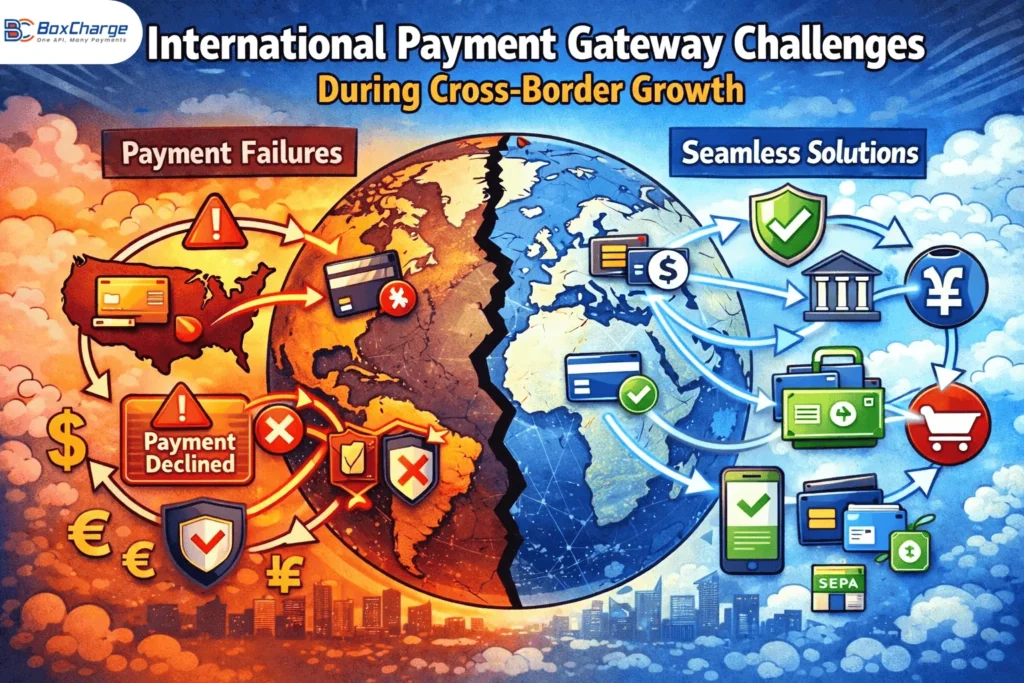
International expansion is often framed as a marketing or logistics challenge. In reality, payments are the first system to break when a business scales across borders.
A gateway that performs flawlessly in one country can quietly fail in another — not because of volume, but because payments are local by nature. Consumer behavior, banking infrastructure, regulations, and fraud patterns vary sharply by region.
For global merchants — especially those operating in high-risk or regulated industries — this disconnect results in:
- Lower authorization rates
- Higher chargebacks
- Failed recurring payments
- Customer churn disguised as “market weakness.”
This article explains why international payment gateways fail during cross-border growth, using real-world examples from Germany, the USA, the UK, Gulf countries, and Japan, and how specialized payment gateway solution providers, such as BoxChrge, solve these failures at scale.
The Core Problem: Global Ambition, Local Payments Reality
Most international gateways are built on a centralized card-processing model. They assume that:
- Cards are the dominant payment method everywhere
- Fraud rules can be standardized
- Currency conversion solves localization
- Compliance is a one-time setup
That assumption breaks the moment a business expands.
Cross-border payment success depends on local trust signals, local payment preferences, and region-specific risk logic — not just global card access.
Germany: Where Card-First Gateways Lose Trust
Germany is one of Europe’s largest e-commerce markets, yet it consistently underperforms for merchants using card-centric gateways.
Where Gateways Break
German consumers prefer bank-based payments over card-based payments due to cultural trust in domestic banking systems and stringent consumer protection regulations.
Gateways that prioritize Visa and Mastercard experience:
- High checkout abandonment
- Lower conversion rates compared to neighboring EU countries
- Increased soft declines from issuing banks
Payment Methods That Actually Convert
- SOFORT (Klarna)
- Giropay
- SEPA Direct Debit
Real Experience
One of our clients was expanding a European subscription platform into Germany, and saw that conversion rates were nearly 35% lower than in France and the Netherlands — despite identical pricing and marketing.
After enabling local bank-based payment methods and localized checkout flows through a regional payment partner, German conversions increased by over 28% within two billing cycles.
Key takeaway: In Germany, trust beats convenience. If payments don’t look local, users don’t complete checkout.
United States: High Volume, High Decline, High Chargeback Risk
The U.S. appears card-friendly, but it is one of the most complex payment environments globally.
Where Gateways Break
- Strict AVS and CVV enforcement
- Aggressive issuer-side fraud detection
- High chargeback sensitivity for cross-border transactions
Many international gateways either over-filter transactions (causing false declines) or under-filter them (triggering monitoring programs).
What Works in the U.S. Market
- Advanced fraud scoring instead of static rules
- Smart transaction routing by issuer and region
- Digital wallets (PayPal, Apple Pay) for trust reinforcement
Real Experience
A cross-border digital services provider processing U.S. transactions experienced an 18% false decline rate for legitimate customers outside North America.
By implementing region-aware fraud logic and adaptive routing via a specialized gateway:
- False declines dropped by over 60%
- Net approved volume increased without increasing fraud exposure
Key takeaway: In the U.S., success depends on risk intelligence, not just payment access.
United Kingdom: Open Banking Is No Longer Optional
The UK has rapidly evolved beyond card-only payments.
Where Gateways Break
Gateways that fail to support Open Banking and wallet-first experiences struggle with:
- Subscription churn
- Mobile checkout drop-offs
- Failed recurring payments under SCA rules
Payment Methods That Perform
- Open Banking payments
- Apple Pay and Google Pay
- Bank-linked recurring billing
Real Experience
A UK-based SaaS platform saw recurring payment failures spike after regulatory changes tightened SCA enforcement.
After integrating Open Banking flows and local retry logic, the business reduced involuntary churn by 14% within one quarter.
Key takeaway: In the UK, modern payments mean bank-first, mobile-first, and regulation-aware.
Gulf Countries (GCC): Wallet-Driven, Trust-Sensitive Markets
Markets like Saudi Arabia, UAE, and Qatar are digitally advanced but behave very differently from Western economies.
Where Gateways Break
- Overreliance on international card schemes
- No support for regional wallets
- Limited local currency settlement
Customers hesitate when payment methods feel “foreign,” even if the brand is trusted.
What Converts in the GCC
- Local wallets (e.g., STC Pay)
- Mobile-optimized checkout
- Transparent pricing in local currencies (SAR, AED)
Real Experience
An e-commerce merchant targeting Saudi Arabia experienced over 30% checkout abandonment when only cards were offered.
After enabling regional wallets and local currency display through a specialized payment gateway:
- Conversions increased by 27%
- Support requests related to payment failures dropped significantly
Key takeaway: In the GCC, local familiarity drives conversion more than global branding.
Japan: One of the Most Misunderstood Payment Markets
Japan is frequently misclassified as a card-dominant market. It is not.
Where Gateways Break
Western gateways often fail because they don’t support Japan’s unique hybrid system of offline and digital payments.
Preferred Payment Methods
- Konbini (convenience store payments)
- PayPay and local wallets
- Carrier billing
- Bank transfers
Real Experience
A digital entertainment company launching in Japan initially saw conversion rates less than half of expectations.
After integrating Konbini and local wallet payments:
- User acquisition costs stabilized
- Local payment adoption increased steadily
- Revenue normalized within three months
Key takeaway: In Japan, payment flexibility matters more than speed.
Common Reasons International Payment Gateways Fail
Across all regions, failing gateways share the same weaknesses:
- No local payment methods
- Static fraud rules across regions
- Card-only checkout assumptions
- Poor multi-currency handling
- Lack of regulatory adaptability
- No specialization for high-risk verticals
These weaknesses compound as transaction volume increases.
What a True Cross-Border Payment Gateway Must Deliver
A scalable international payment gateway solution must operate on a “glocal” model — global infrastructure with local execution.
Core Capabilities Required
- Region-specific payment methods
- Localized checkout experiences
- Multi-currency pricing and settlement
- Dynamic, region-aware fraud management
- Chargeback mitigation for high-risk industries
- Dedicated merchant support teams
This is especially critical for merchants in high-risk categories, where tolerance for error is low and regulatory scrutiny is high.
How BoxCharge Solves Cross-Border Payment Failures
BoxCharge is built specifically for international and high-risk payment processing, not as a generic gateway reseller.
What Makes BoxCharge Different
- Deep regional acquiring relationships
- Local payment method enablement by the market
- Adaptive risk models per geography
- High-risk underwriting expertise
- Conversion-focused checkout optimization
Case Study: Global Subscription Business
After switching to BoxChrge:
- Local payment methods were enabled across the EU and the UK
- Failed recurring payments were recovered using smart retries
- Monthly recurring revenue increased by 22%
- Customer churn dropped by 15%
Key Features High-Growth Merchants Should Demand
| Capability | Why It Matters |
| Local payment methods | Drives trust and conversion |
| Multi-currency pricing | Reduces friction at checkout |
| Dynamic fraud controls | Prevents false declines |
| Chargeback management | Protects merchant accounts |
| High-risk specialization | Ensures account longevity |
Final Takeaway
International growth does not fail because of demand — it fails because payments don’t adapt.
Gateways designed for domestic processing often struggle to support the complexity of cross-border transactions, particularly in regulated or high-risk industries.
Merchants that succeed globally treat payments as a strategic infrastructure decision, not a backend utility.
Request a Cross-Border Risk Audit with BoxChrge
If your business is expanding internationally and experiencing:
- Declining authorization rates
- High chargebacks
- Regional conversion gaps
- Payment-related churn
BoxCharge can help.
👉 Request a Cross-Border Risk Audit for your specific region and discover how localized payment strategies can unlock sustainable global growth.
Disclaimer:
Data based on BoxCharge internal processing trends and regional banking reports from Q4 2025.