
Many online businesses believe that once they enable multi-currency processing, they are “global-ready.” Prices show in local currency, customers feel comfortable at checkout, and everything appears optimized for international sales.
But in reality, multi-currency processing is not the same as global payments.
For e-commerce brands, SaaS platforms, subscription businesses, and high-risk merchants, relying on currency conversion alone often leads to payment failures, unstable revenue, and declining approval rates. This is why global businesses increasingly shift toward payment diversification strategies and alternative payment methods—not as a trend, but as a stability layer.
This guide explains why multi-currency processing falls short, why payment methods fail, and what businesses must do to achieve true payment stability in e-commerce.
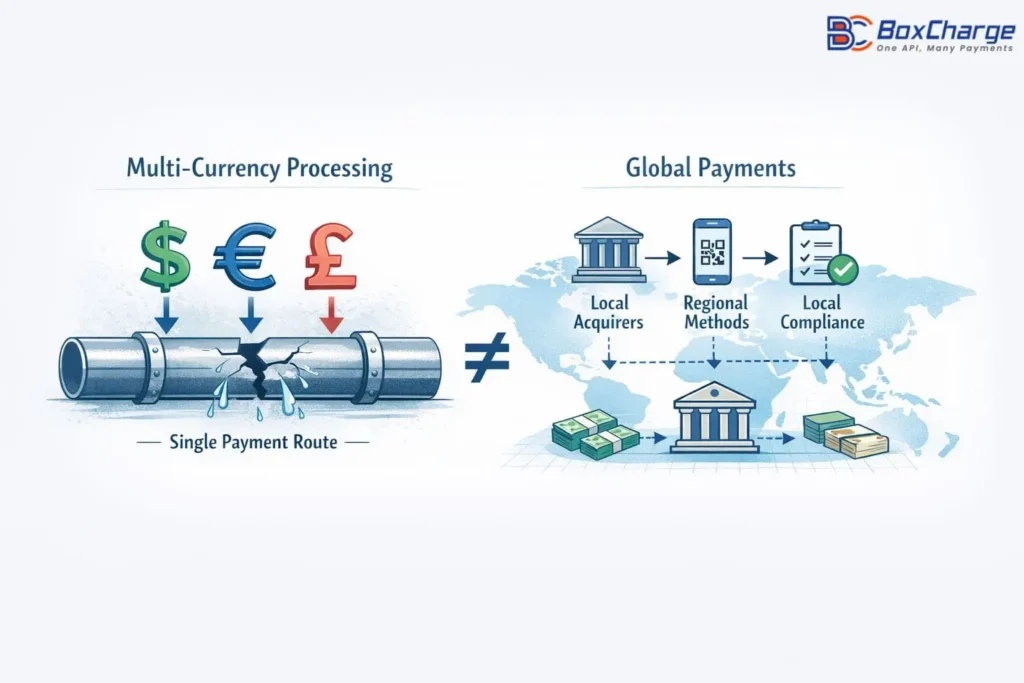
What Multi-Currency Processing Actually Does (and Doesn’t Do)
Multi-currency processing allows customers to pay in their local currency while the merchant settles in a base currency. It improves transparency and reduces confusion at checkout.
However, it does not solve deeper payment infrastructure problems, such as:
- Cross-border acquiring limitations
- Issuer bank risk rules
- Regional payment preferences
- Compliance mismatches
- Network-level declines
This is why businesses still experience high decline rates even when they support dozens of currencies.
Currency ≠ infrastructure.
Why Payment Methods Fail Even with Multi-Currency Enabled
If customers can pay in local currency, why do transactions still fail?
Because most failures happen after currency selection.
Here are the real reasons why payment methods fail:
1. Transactions Are Still Processed Cross-Border
Even when a customer pays in their local currency, the transaction may be routed through a foreign acquiring bank. Issuer banks detect this mismatch and decline the payment.
2. Card Networks Apply Regional Risk Filters
Visa and Mastercard apply different risk thresholds depending on geography. High-risk verticals, digital goods, and subscriptions are especially affected.
3. Local Payment Preferences Are Ignored
In many markets, cards are not the primary payment method. When businesses rely only on cards, they miss large segments of buyers.
4. Single-Processor Dependency
One gateway, one acquirer, one failure point. When routing fails, revenue stops.
This is why multi-currency alone cannot reduce payment failures at scale.
Payment Stability in E-commerce Requires More Than Currency Options
Payment stability, which ecommerce businesses depend on, comes from resilience—not presentation.
A stable payment system must handle:
- Regional outages
- Issuer policy changes
- Network disruptions
- Compliance shifts
- Fraud spikes
Multi-currency setups lack redundancy. When something breaks, there is no fallback.
This is where alternative payment methods importance becomes clear.
Alternative Payment Methods Are a Stability Layer, Not an Add-On
Alternative payment methods (APMs) are no longer optional for global businesses. They are a core part of a payment diversification strategy.
Examples include:
- Local bank transfers
- Digital wallets
- Real-time payment rails
- Region-specific methods
APMs reduce dependence on card networks and dramatically improve authorization rates in many regions.
More importantly, they keep revenue flowing when cards fail.
Payment Diversification Strategy: The Real Difference Maker
A payment diversification strategy spreads transaction risk across:
- Multiple payment methods
- Multiple acquirers
- Multiple regions
- Multiple rails
This approach helps businesses:
- Reduce payment failures
- Increase approval rates
- Improve payment stability, ecommerce-wide
- Scale internationally without constant disruptions
Global businesses don’t ask, “How many currencies do we support?”
They ask, “How many ways can customers successfully pay?”
Why Global Payments Are an Infrastructure Problem, Not a UX Problem
Multi-currency processing focuses on the user interface.
Global payments focus on backend execution.
True global payment infrastructure includes:
- Local acquiring in key markets
- Region-specific compliance handling
- Intelligent routing logic
- Alternative payment method coverage
- Redundant processors
Without this, businesses face hidden decline risks—even with a polished checkout experience.
A Realistic Scenario (What Actually Happens)
Consider a subscription-based ecommerce business selling digital services across Europe and Asia.
They support EUR, GBP, and USD. Prices look local. Customers convert well.
But behind the scenes:
- Payments route through a single foreign acquirer
- Issuer banks flag recurring charges
- Card retries fail
- Churn increases
The business assumes the issue is fraud or customer behavior.
In reality, the problem is a lack of global payment infrastructure.
How Businesses Can Reduce Payment Failures Globally
To reduce payment failures, global businesses should:
- Go beyond multi-currency processing
- Add alternative payment methods based on region
- Implement local acquiring where possible
- Diversify payment providers
- Monitor approval rates by geography
This layered approach improves long-term payment stability, especially for high-risk industries.
Multi-Currency vs Global Payments (Quick Snapshot)
- Multi-currency = currency conversion
- Global payments = local infrastructure
- Multi-currency improves UX
- Global payments improve approvals
- Multi-currency is cosmetic
- Global payments are operational
Understanding this distinction prevents costly scaling mistakes.
Why High-Risk and Subscription Businesses Feel This First
High-risk merchants, adult businesses, streaming platforms, gaming sites, and subscription-based services face stricter issuer scrutiny.
For these businesses:
- Declines happen faster
- Acquirers impose limits sooner
- Single-provider setups fail earlier
This makes payment diversification strategy and alternative payment methods essential—not optional.
Where boxcharge Fits In
Boxcharge works with global and high-risk merchants to design resilient international payment infrastructure, not just currency support.
By combining:
- Global payment gateway solutions
- Multiple acquiring relationships
- Alternative payment methods
- Subscription-ready routing
Businesses gain stability, scalability, and higher lifetime value.
Frequently Asked Questions
1: Are alternative payment methods safer than card payments?
Alternative payment methods are not universally safer, but they reduce reliance on card networks and issuer approvals, improving overall payment stability.
2: Do alternative payment methods reduce payment failures?
Yes. In many regions, alternative payment methods significantly reduce payment failures by aligning with local payment behavior.
3: Is multi-currency processing enough for global ecommerce?
No. Multi-currency processing does not address acquiring, routing, or compliance issues that cause international payment declines.
4: Why do payment methods fail even when customers pay in local currency?
Because transactions are often processed cross-border, triggering issuer bank risk checks despite local currency pricing.
5: Are alternative payment methods required for global businesses?
For scalable global operations, alternative payment methods are essential to maintain payment stability and approval rates.
Final Thought: Currency Is Just the Surface
Multi-currency processing helps customers understand prices.
It does not guarantee successful payments.
For businesses serious about global expansion, payment stability ecommerce-wide comes from infrastructure, diversification, and adaptability—not currency symbols.
If your business is experiencing unexplained declines, failed subscriptions, or regional inconsistencies, the issue isn’t currency.
It’s how your payments are built.