
Why More Online Businesses Are Finally Moving Away From PayPal
At first, PayPal feels easy.
The setup is quick, customers already trust the name, and most businesses can start accepting payments almost immediately. For many startups, it looks like the safest option.
But for high-risk merchants, things usually change once the business starts growing.
A sudden payout hold.
A random account review.
Recurring payments failing without warning.
Funds are getting locked right when ad costs, supplier payments, or payroll are due.
That is the part most businesses do not think about in the beginning.
And honestly, this is exactly why more merchants are now actively searching for reliable PayPal alternatives for high-risk merchants that can actually support long-term growth instead of slowing it down.
For businesses operating in gaming, IPTV, forex, ecommerce, subscription services, digital products, adult platforms, and other high-risk industries, unstable payment processing can become a serious business problem very quickly.
Because when payments stop working smoothly, revenue usually follows.
The Problem High-Risk Merchants Keep Running Into
Most mainstream processors are built for low-risk ecommerce businesses.
The moment a business starts processing larger transaction volumes, recurring subscriptions, or international payments, risk systems become more aggressive.
That is when merchants begin seeing:
- frozen payouts
- rolling reserves
- recurring billing interruptions
- delayed withdrawals
- sudden account limitations
- payment holds
- checkout failures
And the worst part?
These problems usually appear when the business is growing, not when it is small.
One subscription business owner shared that after scaling ad campaigns aggressively, recurring payments suddenly started failing more often during renewal cycles. Customers became frustrated, cancellations increased, and support tickets exploded almost overnight.
The products were not the problem.
The payment infrastructure was.
This situation is becoming more common for businesses relying on processors that are not designed for high-risk payment processing environments.
Why Payment Stability Matters More Than Low Fees
A lot of businesses choose payment processors based on transaction fees alone.
That works until the processor becomes unstable.
For high-risk businesses, payment reliability is usually far more important than saving a small percentage per transaction.
Because every failed payment affects:
- customer trust
- subscription renewals
- advertising ROI
- recurring revenue
- checkout conversions
- long-term retention
Customers rarely care which processor caused the issue.
If the payment fails, they blame the business.
One ecommerce merchant reportedly lost a large number of recurring subscribers after customers experienced repeated payment interruptions during checkout. Even loyal customers eventually stopped retrying payments.
That is why more online businesses are prioritizing stable merchant account solutions instead of simply looking for the cheapest processor available.
What High-Risk Businesses Actually Need
High-risk merchants need more than basic payment acceptance.
They need infrastructure that can handle:
- recurring billing
- international customers
- larger transaction volumes
- cross-border payments
- high approval stability
- subscription-based revenue models
And most importantly, they need processors that will not panic the moment transaction volume increases.
Reliable international payment processing has become essential for businesses trying to scale globally without constantly worrying about payout delays or account reviews.
That is why many businesses are now moving toward providers specializing in:
- high-risk merchant accounts
- global payment gateway solutions
- cross-border payment processing
- online payment processing
Instead of relying entirely on mainstream platforms.
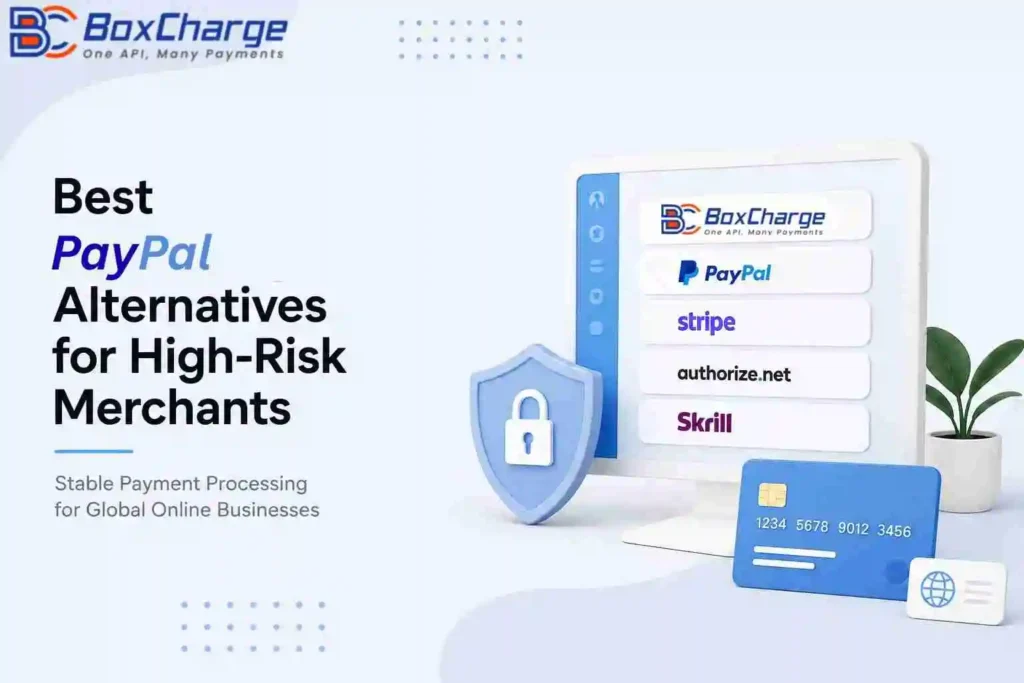
Best PayPal Alternatives for High-Risk Merchants
1. BoxCharge
For businesses dealing with recurring billing, international transactions, or payment instability, BoxCharge is becoming one of the stronger alternatives to PayPal.
Instead of treating high-risk businesses like a temporary risk, the platform is built specifically around supporting industries that traditional processors often struggle with.
That includes:
- gaming
- IPTV
- forex
- subscription businesses
- adult platforms
- ecommerce
- digital services
One thing merchants usually care about most is consistency.
They want payments to keep working during growth periods, marketing campaigns, and high-volume sales cycles.
That is where reliable high-risk payment gateway solutions become valuable.
BoxCharge focuses on:
- recurring billing support
- scalable payment infrastructure
- international payment acceptance
- cross-border transactions
- secure checkout performance
- stable processing support
For businesses tired of constantly monitoring account warnings and payout risks, operational stability matters a lot.
2. Stripe
Stripe is still widely used because integrations are simple and the developer tools are strong.
But many high-risk businesses eventually experience:
- payout monitoring
- reserve requirements
- account reviews
- approval delays
- recurring billing restrictions
Some moderate-risk businesses do fine with Stripe for a while.
But once transaction volume increases or the industry becomes more heavily monitored, payment stability can become unpredictable.
That is why many merchants eventually begin looking for more specialized high-risk payment processing solutions.
3. Authorize.Net
Authorize.Net has been around for years and remains popular with many online businesses.
The gateway itself is stable, but high-risk merchants still often need stronger merchant account support behind it.
Businesses handling subscriptions or international transactions usually require:
- recurring billing flexibility
- higher approval stability
- scalable payment infrastructure
- cross-border transaction support
Without that, even good gateway technology can still lead to operational payment issues.
4. Skrill
Skrill is often used by forex and gaming businesses needing global payment options.
It works well for certain international transactions, but approval flexibility and long-term processing stability can vary depending on the business model.
For merchants handling subscriptions or high-volume recurring payments, reliable recurring billing solutions are still critical.
5. Specialized High-Risk Merchant Account Providers
A lot of businesses eventually realize that generic processors simply are not designed for high-risk industries.
Specialized providers usually offer:
- stronger underwriting flexibility
- recurring billing support
- international transaction scalability
- higher-risk industry support
- better long-term processing stability
That becomes extremely important once businesses start scaling globally.
Why More Businesses Are Leaving Mainstream Processors
The payments industry has changed dramatically over the last few years.
Automated fraud systems, AI-driven monitoring, and stricter compliance reviews are making life harder for businesses considered high-risk.
Unfortunately, many mainstream processors now prioritize risk reduction more than merchant growth.
That leads to:
- sudden payout reviews
- account freezes
- recurring billing failures
- payment instability
- delayed approvals
- reserve increases
And for businesses running ads aggressively or scaling internationally, those problems become expensive very quickly.
This is exactly why more merchants are now searching for:
- PayPal alternatives for high-risk merchants
- reliable online payment processing
- stable global payment gateways
- scalable merchant account solutions
Recurring Billing Problems Hurt More Than Most Merchants Expect
Subscription businesses live and die by recurring revenue.
If recurring payments start failing consistently, customer churn rises fast.
Many businesses do not realize how damaging unstable recurring billing can become until monthly retention numbers start dropping.
Reliable recurring billing solutions help businesses improve:
- subscription retention
- recurring revenue
- customer lifetime value
- checkout consistency
And honestly, for most subscription-based businesses, payment stability is usually worth far more than slightly cheaper processing fees.
Final Thoughts
PayPal may still work for many low-risk businesses.
But for high-risk merchants dealing with international customers, recurring billing, or larger transaction volumes, payment stability matters far more than convenience.
Frozen payouts, failed renewals, checkout interruptions, and sudden account limitations can slow growth fast — even when the business itself is performing well.
That is why more online businesses are moving toward reliable PayPal alternatives for high-risk merchants designed specifically for long-term scalability and stable processing support.
For businesses handling subscriptions, global customers, or high-volume transactions, reliable high-risk payment processing is no longer optional.
It is part of keeping the business running smoothly.