
We recently watched a client lose a $50,000 Forex lead because a one-time password was sent to a phone number the user hadn’t used in months.
The trade never happened.
The user didn’t come back.
And the merchant was left explaining friction that shouldn’t exist in 2026.
That moment summed up a bigger problem we see every day at BoxCharge. Passwords, OTPs, and legacy security tools are no longer just outdated — they’re actively costing high-risk businesses revenue.
For merchants operating in high-risk categories, security today isn’t about adding more steps. It’s about removing the wrong ones.
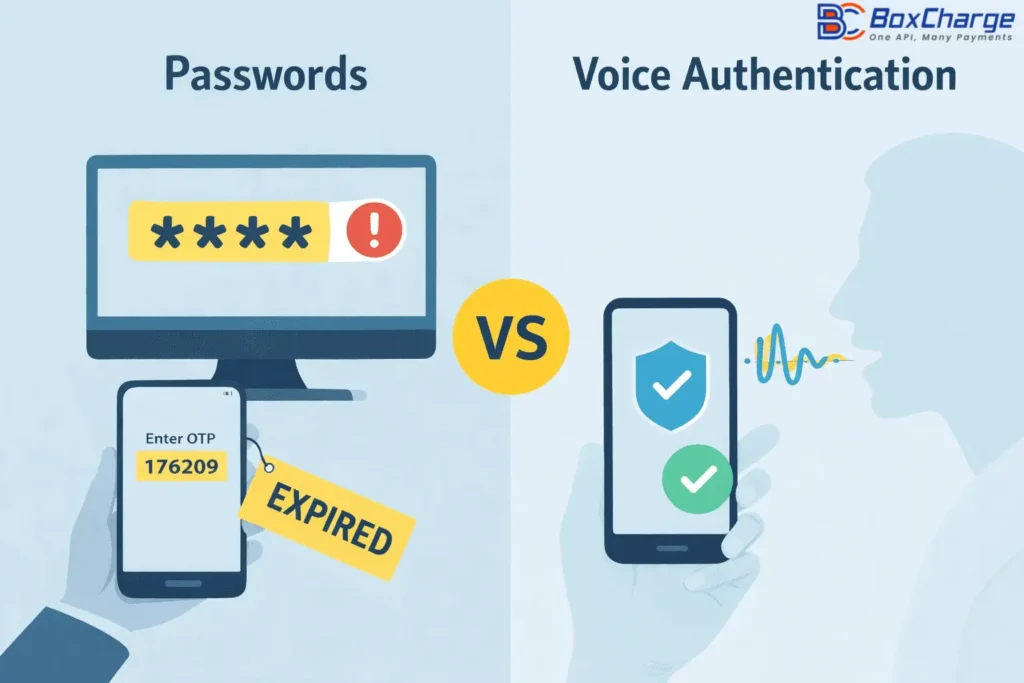
Why Passwords Are Breaking High-Risk Payments
Passwords fail in predictable, expensive ways. They get reused, phished, guessed, or leaked. OTPs expire at the wrong time. Devices change. SIM cards get swapped.
For standard e-commerce, this creates friction.
For high-risk payment processing, it creates risk.
If you’re running payments through an international payment gateway, you’re already dealing with:
- Cross-border fraud that looks legitimate
- Account takeover attempts that bypass basic checks
- Rising chargebacks that trigger bank reviews
- Sudden freezes or de-risking decisions
In industries like forex payment processing, casino merchant accounts, gaming platforms, adult merchant accounts, and online dating merchant accounts, one weak authentication layer can disrupt your entire operation.
Passwords don’t scale in environments like this. And neither do OTPs.
Why Voice Authentication Makes Sense in 2026
Voice authentication works because it doesn’t rely on memory or devices that change. It verifies identity using behavioral and biometric signals that are extremely difficult to fake.
Modern systems don’t just analyze what someone says. They look at:
- Speech rhythm and cadence
- Tone and stress patterns
- Timing and behavioral consistency
- Device and session context
From our perspective as a high-risk payment gateway, this matters because fraud rarely announces itself. It behaves almost like a real user, until you look closer.
Voice adds that missing layer without forcing your customers to jump through hoops.
Where Voice Is Already Improving High-Risk Payments
By 2026, voice authentication isn’t experimental. We’re already seeing it applied across critical payment touchpoints:
- Secure login for online merchant accounts
- High-value transaction approvals
- Payment method and payout changes
- Identity verification during customer support interactions
If you accept payment online at scale, voice reduces dependence on passwords and SMS codes — two of the most abused attack surfaces in digital payments.
For High Risk Business Processing, this is becoming less of a “nice to have” and more of an expectation.
Voice + AI: Better Fraud Control Without Killing Conversions
Voice authentication becomes far more effective when it’s combined with AI-driven fraud tools.
Instead of hard approvals or instant declines, modern systems evaluate voice alongside:
- Transaction history
- Location behavior
- Device fingerprints
- Payment velocity
A returning trader using a forex merchant account with a familiar voice and behavior can pass instantly. The same transaction, with subtle inconsistencies, triggers additional verification.
This is how high-risk payment gateways protect revenue without sacrificing conversion rates — something every serious merchant cares about.
Voice Security in the Era of Agentic Commerce
In 2026, not all payments are initiated by humans.
AI-powered buying agents now handle renewals, subscriptions, digital services, and even trading actions. This shift — often called Agentic Commerce — introduces a new challenge: how do you secure automated spending without slowing everything down?
Voice authentication plays a critical role here.
Instead of manually approving every action, users can bind their voice identity to an authorized buying agent. When that agent attempts an unusual or high-value transaction, voice verification becomes the human checkpoint.
For gaming merchant accounts, forex platforms, and subscription-based high-risk businesses, this balance between automation and control is no longer optional.
The Real-World Friction We Still Have to Solve
Voice authentication isn’t magic — and we don’t treat it that way.
One of the biggest challenges in 2026 is biometric compliance. Regulations like GDPR and CCPA place strict limits on how voice data can be collected, stored, and processed.
In global payment processing, this means:
- Region-specific consent flows
- Limited biometric retention policies
- Encrypted voiceprints instead of raw recordings
We’ve learned that voice works best when it’s implemented with compliance baked in — not bolted on later.
How High-Risk Industries Use Voice Authentication Today
- Gaming & Casino Platforms: Voice verification helps reduce shared accounts, bonus abuse, and unauthorized withdrawals, strengthening casino merchant account stability
- Forex & Trading Platforms: High-value trades benefit from voice confirmation, reducing disputes in fast-moving forex payment processing environments.
- Adult & Dating Platforms: Voice adds discreet protection without disrupting user experience — critical for adult merchant accounts and online dating merchant accounts.
- Subscription-Based High-Risk Businesses: Voice improves control over billing changes and account access without increasing friction.
Is Voice Authentication Enough on Its Own?
No — and it shouldn’t be.
Voice works best as part of a layered approach that includes:
- AI-driven fraud monitoring
- Transaction velocity controls
- Device intelligence
- Smart routing through international payment gateways
For high-risk merchant account setups, the goal isn’t maximum security at all costs. It’s balanced protection that keeps payments moving.
What You Should Be Thinking About Right Now
Voice authentication isn’t a future concept. It’s already influencing how banks and processors assess risk.
If you’re operating in a high-risk category, ask yourself:
- Does your current payment gateway support voice-based verification?
- How is biometric data handled across regions?
- Are your fraud tools ready for AI-driven commerce?
Merchants who adapt early tend to face fewer disruptions, smoother reviews, and stronger long-term processing relationships.
FAQs For Voice Authentication For Payment Gateways
1. What is voice authentication in payment gateways?
Voice authentication is a biometric security method that verifies a user’s identity using unique voice patterns instead of passwords or SMS codes. In payment gateways, it helps secure logins and high-value transactions with less friction.
2. Why are passwords no longer secure for online payments?
Passwords are often reused, phished, or leaked. In high-risk online payments, this makes them unreliable and increases fraud, chargebacks, and account takeovers.
3. How does voice authentication reduce payment fraud?
Voice authentication detects behavioral and biometric signals that are hard to fake. When combined with AI fraud tools, it helps stop suspicious transactions while allowing real customers to pay smoothly.
4. Is voice authentication safe for high-risk merchants?
Yes. When implemented correctly, voice authentication improves security for high-risk merchants by reducing account abuse and unauthorized access without adding checkout friction.
5. Is voice authentication GDPR and CCPA compliant?
Voice authentication can be GDPR and CCPA compliant when encrypted voiceprints, user consent, and limited data retention are used. Compliance depends on how the payment gateway manages biometric data.
6. Which industries benefit most from voice authentication?
Voice authentication is especially useful for forex trading, gaming, casino platforms, adult businesses, online dating platforms, and other high-risk industries.
7. Can voice authentication work with international payment gateways?
Yes. Voice authentication works well with international payment gateways and helps reduce cross-border fraud when paired with region-specific compliance controls.
8. Does voice authentication replace all fraud prevention tools?
No. Voice authentication works best alongside AI fraud detection, device fingerprinting, and transaction monitoring as part of a layered security approach.
9. How does voice authentication protect AI buying agents?
Voice authentication allows users to confirm high-risk or unusual actions made by AI buying agents, helping secure automated payments in Agentic Commerce environments.
10. Should high-risk merchants adopt voice authentication in 2026?
Yes. In 2026, banks and payment processors increasingly expect advanced fraud controls. Voice authentication helps high-risk merchants reduce risk, protect revenue, and maintain account stability.
Final Thought
The end of the password doesn’t mean weaker security. It means smarter security.
For high-risk businesses navigating global compliance, fraud pressure, and increasingly automated commerce, voice authentication is becoming a practical layer — not a novelty.
If you’re still relying on SMS codes to approve five-figure trades, subscriptions, or withdrawals, we should probably talk. At BoxCharge, we work with high-risk merchants who need modern fraud layers — including voice authentication, AI-driven risk scoring, and region-compliant biometric handling — without adding friction to how customers pay.