
As explained in our pillar guide, “Why International High-Risk Payment Processing Is Harder Than Ever as We Approach 2026”, global payments have become more fragmented, regulated, and risk-sensitive than ever before. For high-risk merchants operating across borders, this shift doesn’t just affect approvals—it directly impacts how and when money is settled.
One of the most common outcomes of this new environment is the rolling reserve.
For many merchants, the first time they hear the term rolling reserve is not during onboarding, but when payouts suddenly look smaller than expected. Money feels delayed. Support tickets follow. Confusion sets in.
In 2026, rolling reserves remain one of the most misunderstood elements of high-risk payment processing, and for businesses relying on high-risk merchant accounts, they can quietly become a serious cash-flow constraint. Understanding how rolling reserves work—and how to plan around them—is no longer optional.
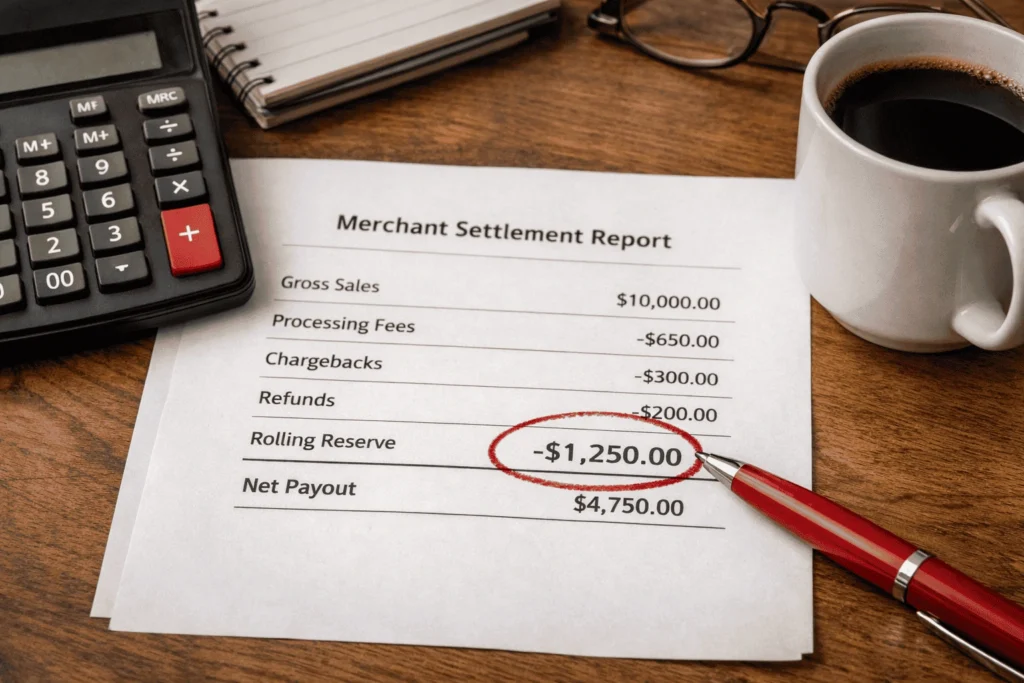
What Is a Rolling Reserve in High Risk Payment Processing, Really?
A rolling reserve is a portion of processed revenue that a payment provider or acquiring bank temporarily holds to cover potential future risks.
Unlike a flat reserve, where funds are locked for a fixed period, rolling reserves move continuously. A percentage of daily or weekly transactions is withheld and released after a defined timeframe—often 90, 120, or even 180 days.
From the bank’s perspective, it’s a risk buffer.
From the merchant’s perspective, it’s delayed access to cash.
Rolling reserves are common in high-risk payment gateways because they protect processors against chargebacks, refunds, fraud disputes, and regulatory reversals that may surface long after a transaction is completed.
Why High-Risk Merchants Face Rolling Reserves More Often
Rolling reserves are rarely applied to low-risk businesses. They are most common in industries where volatility is expected rather than exceptional.
This includes:
- Forex merchant accounts and forex payment processing
- Gaming merchant accounts
- Casino and iGaming platforms
- Adult merchant accounts
- Online dating merchant accounts
- Subscription-based digital services
- Cross-border eCommerce
These sectors often involve higher transaction values, recurring billing models, delayed service delivery, or international customers—all factors that extend dispute timelines. As a result, banks assume potential exposure lasts well beyond the settlement date.
The Cash-Flow Impact Most Merchants
The biggest issue with rolling reserves isn’t the percentage—it’s predictability.
A 10% reserve may seem manageable on paper. But when combined with:
- Settlement delays
- Currency conversion timelines
- Chargeback deductions
- Refund cycles
Cash flow can tighten faster than expected.
Many merchants continue to accept credit card payments at healthy volumes yet struggle to access enough working capital to scale marketing, payroll, or infrastructure. This is especially common for businesses using an international payment gateway, where multi-currency settlements introduce additional delays.
Many merchants only realize the true impact of rolling reserves after their first full settlement cycle—when revenue dashboards look strong, but accessible cash tells a very different story.
Why a Clean History Doesn’t Always Reduce Reserves
A common frustration among merchants is maintaining low chargebacks and strong compliance, yet still facing rolling reserves.
In 2026, reserve requirements are often driven less by individual performance and more by:
- Industry-level risk exposure
- Portfolio concentration at the acquiring bank
- Regional regulatory pressure
- Card-network dispute thresholds
- Historical performance of similar merchants
Even well-managed businesses may still face reserve requirements simply because of where and how they operate.
Rolling Reserves vs. Held Funds
Rolling reserves are often confused with sudden fund holds, but they are not the same.
- Rolling reserves are pre-agreed, structured, and predictable
- Fund holds are reactive and triggered by risk alerts, volume spikes, or compliance reviews
Merchants who don’t understand this distinction often assume something has gone wrong—when in reality, the reserve was part of the original risk structure. The problem is rarely transparency; it’s education.
How Global Payments Make Reserves More Complex
For businesses focused on global payment processing, rolling reserves can compound across regions.
Different acquiring banks may:
- Apply different reserve percentages
- Release funds on different schedules
- Settle in different currencies
This fragmentation makes forecasting difficult, particularly for merchants operating multiple online merchant accounts across jurisdictions. Without clear reporting, reserves can quietly erode liquidity even as revenue grows.
Can Rolling Reserves Be Reduced?
Sometimes, but they are rarely eliminated.
In 2026, reserve reductions typically depend on:
- Consistent processing history
- Improved dispute ratios
- Stable transaction patterns
- Diversified payment methods
- Reduced reliance on cards alone
Merchants who integrate Alternative Payment Methods, such as local bank transfers or region-specific payment rails, often reduce overall exposure and dependence on high-reserve card processing.
Planning for Reserves Instead of Fighting Them
The biggest mistake merchants make is treating rolling reserves as a temporary inconvenience rather than a structural reality.
Experienced high-risk businesses plan around reserves by:
- Adjusting pricing models
- Maintaining operating buffers
- Staggering expansion timelines
- Structuring multiple processing channels
- Avoiding reliance on a single gateway
This approach turns reserves from a surprise into a known variable.
The Role of High-Risk Payment Specialists
Not all providers structure reserves the same way.
Platforms focused on High-Risk Business Processing understand that long-term stability matters as much as approval rates. They work with acquiring partners that price risk realistically rather than defensively.
Providers like Boxcharge help merchants structure payment flows that balance approval rates, reserve levels, and sustainability—particularly for businesses operating across borders or within regulated verticals.
Final Thoughts
Rolling reserves aren’t a penalty. They’re a signal.
They reflect how banks and payment providers evaluate risk in an increasingly complex global environment. For high-growth, high-complexity businesses, the goal isn’t to eliminate reserves—it’s to manage them intelligently.
In 2026, the merchants who succeed are not those with the fewest restrictions, but those who understand how money actually moves through their payment stack.
Working with providers that specialize in high-risk payment processing can help merchants gain clearer visibility into reserve structures and design payment flows that support long-term stability. Platforms such as BoxCharge, which focus on complex and international payment environments, are increasingly used by businesses looking to balance growth, compliance, and cash-flow predictability.
Frequently Asked Questions
1: What is a rolling reserve in high-risk payment processing?
A rolling reserve is a percentage of processed funds temporarily held by a payment provider to cover future chargebacks, refunds, or disputes, commonly applied to high-risk merchant accounts.
2: Why are rolling reserves common for international high-risk merchants?
International transactions involve greater regulatory, fraud, and dispute risks, leading banks to apply rolling reserves to protect against delayed liabilities.
3: Can rolling reserves be reduced over time?
In some cases, yes. Strong processing history, lower dispute ratios, and diversified payment methods may help reduce reserve requirements.