
Online gaming operators often separate “bonus abuse” from “fraud.”
Banks and card networks rarely do.
From a compliance and risk modeling perspective, both create measurable financial exposure — and exposure is what acquiring institutions price and regulate.
In 2026, AI-driven underwriting and transaction monitoring systems evaluate merchants based on behavioral data, dispute ratios, authentication signals, and regulatory compliance — not marketing intent.
This article breaks down how banks actually evaluate gaming transactions, where operators get blindsided, and how to protect your high-risk infrastructure.
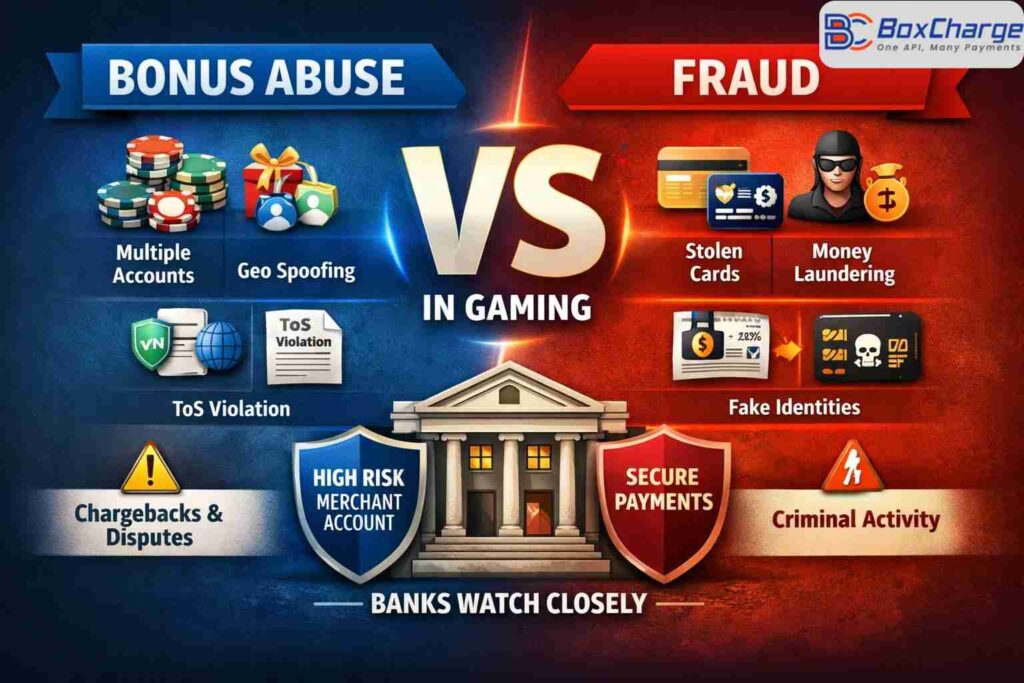
The Banking Lens: It’s About Risk Ratios, Not Morality
Banks evaluate merchants using quantifiable thresholds.
For example:
- Visa’s monitoring programs typically flag merchants when dispute ratios exceed ~0.9% monthly or 100 disputes, depending on program tier.
- Mastercard’s Excessive Chargeback Program (ECP) monitors merchants crossing similar dispute thresholds.
- Ratios above 1.8% often trigger severe monitoring and possible termination.
It doesn’t matter whether disputes come from:
- Stolen cards
- Player regret
- Bonus exploitation
- Subscription confusion
To the acquirer, all of it increases chargeback exposure.
That’s why strong chargeback management for high-risk merchants is not optional in gaming — it’s a survival infrastructure.
Bonus Abuse vs Fraud: The Technical Difference
Bonus Abuse
- Exploits promotional structures
- Often violates Terms of Service
- May involve multi-accounting or arbitrage
- Usually uses legitimate payment credentials
Fraud
- Uses stolen credentials or synthetic identities
- May involve money laundering
- Triggers AML reporting obligations
- Is criminal in nature
However, the banking system evaluates both through:
- Authorization signals
- Authentication strength
- Dispute ratios
- Behavioral risk scoring
If bonus abuse leads to disputes, the financial impact mirrors fraud.
The Friendly Fraud Transition (The Grey Zone Operators Miss)
This is where many gaming businesses underestimate risk.
A player may:
- Legitimately deposit.
- Exploit a bonus.
- Lose funds.
- File a chargeback claiming “unauthorized transaction.”
At this point:
- What started as bonus abuse becomes classified as fraud.
- The issuing bank processes it as unauthorized card use.
- The acquirer treats it as fraud exposure.
- Your dispute ratio increases.
This is why what looks like a “marketing problem” becomes a payment compliance problem.
And why gaming operators require professional high-risk merchant account services rather than standard e-commerce processing.
How Banks Technically Evaluate Gaming Transactions
Modern acquiring banks use layered risk tools:
1. 3D Secure 2.0 (3DS2)
3DS2 adds biometric or app-based authentication.
For banks, successful 3DS2 authentication proves:
- The cardholder was present.
- Liability may shift away from the merchant.
In bonus abuse cases, strong authentication helps prove the user was legitimate — even if they were strategically exploiting bonuses.
2. Network Tokens
Network tokenization replaces raw card numbers with tokenized credentials issued by Visa or Mastercard.
Benefits:
- Reduced fraud exposure
- Lower account updater declines
- Stronger transaction trust signals
3. Behavioral & Device Fingerprinting
Advanced systems track:
- IP consistency
- Device ID reuse
- Velocity patterns
- Geo-risk anomalies
These systems help differentiate:
- Multi-account bonus exploitation
- Coordinated fraud rings
Operators using secure payment processing for high-risk industries typically integrate these tools into their gateway stack.
Refined Comparison: Bonus Abuse vs Fraud (Banking Framework)
| Factor | Bonus Abuse | Fraud |
| Criminal Intent | Usually absent | Present |
| Stolen Card Use | Rare | Common |
| Dispute Risk | High | Very High |
| AML Reporting | Rare | Required (SAR filing) |
| Legal Recourse | ToS enforcement only | Criminal prosecution possible |
| Bank Classification | Risk event | Fraud event |
| Monitoring Impact | Ratio-driven review | Investigation-triggered review |
Notice the critical overlap: Dispute Risk.
Both create exposure.
What Triggers Reviews in 2026
Banks now use AI-enhanced underwriting models. Triggers include:
- Dispute-to-transaction ratio exceeding 0.9%
- Sudden 40–60% volume growth month-over-month
- Geographic risk concentration
- Refund ratios exceeding industry norms
- Authentication bypass rates
- Inconsistent transaction descriptors
High-risk merchant account approval does not eliminate monitoring.
Approval is conditional on ongoing risk performance.
Without robust high-risk business payment solutions, merchants risk sudden reserve increases or processing pauses.
Why Gaming Requires Specialized Infrastructure
Gaming merchants operate in a multi-risk environment:
- Regulatory licensing complexity
- AML obligations
- Cross-border player activity
- Elevated dispute ratios
- Marketing-driven transaction spikes
This is why gaming businesses rely on:
- Experienced high-risk merchant processing providers
- Global international payment processing services
- Structured reserve management strategies
Traditional banks often lack sector expertise.
The International Risk Layer
Most gaming operators serve international players.
That introduces:
- Currency conversion risk
- Cross-border interchange rules
- Jurisdictional AML differences
- Regional card blocking
Professional international merchant account providers structure accounts based on licensing geography and risk exposure.
In some cases, offshore high-risk merchant accounts align more effectively with regulatory strategy — but only when compliance frameworks are strong.
Scalable global merchant payment services ensure operators can manage multiple acquirers and regions without destabilizing risk ratios.
An advanced international e-commerce payment gateway enables:
- Smart transaction routine
- Multi-acquirer redundancy
- Local BIN optimization
- Fraud scoring alignment
These tools reduce decline rates and risk flags simultaneously.
The Shutdown Myth
Many gaming operators search for a high-risk merchant account without shutdowns.
But no acquirer guarantees permanence.
Banks maintain termination rights under:
- Card network compliance rules
- AML suspicion
- Excessive dispute ratios
- Regulatory pressure
The real objective isn’t avoiding shutdowns.
It’s reducing shutdown probability through:
- Stable dispute ratios
- Transparent operations
- Predictable transaction behavior
- Continuous compliance audits
That’s the difference between reactive processing and professional payment solutions for high-risk businesses.
How to Reduce Bonus-Driven Disputes
- Use 3DS2 on first deposits
- Implement strict bonus wagering transparency
- Restrict high-risk geographies
- Monitor device duplication
- Maintain real-time fraud scoring
- Respond to disputes within representment windows
Advanced high-risk merchant account services include dispute analytics dashboards that detect early spikes in ratios.
Prevention protects approval stability.
What Banks Actually Want From Gaming Merchants
Banks look for:
- Predictable volume growth
- Controlled chargeback ratios
- Authentication strength (3DS2 usage rates)
- Low refund volatility
- Transparent business model
- Clear KYC procedures
They don’t expect zero risk.
They expect managed risk.
Merchants demonstrating mature infrastructure are seen as sustainable partners — even in high-risk verticals.
The Strategic Takeaway
Bonus abuse and fraud are legally different.
But in acquiring risk models, they converge as disputes increase.
For gaming operators in 2026:
- Marketing tactics affect payment stability.
- Authentication strength affects liability.
- Infrastructure determines approval longevity.
A compliant high-risk merchant account, backed by experienced high-risk merchant processing providers, strong international payment processing services, and adaptive fraud systems, transforms gaming from a volatile vertical into a manageable one.
The difference between instability and scalable growth isn’t whether abuse exists.
It’s whether your payment architecture is built to absorb it.