
A few years ago, most online businesses could survive with a basic card payment setup. As long as Visa and Mastercard transactions worked, merchants rarely thought much about payment infrastructure.
That is no longer the case.
In 2026, high-risk businesses are dealing with stricter processors, delayed settlements, rising chargebacks, rolling reserves, lower approval rates, and constant compliance reviews. At the same time, customer payment behavior has changed faster than many merchants expected.
People want faster checkout experiences. Some prefer digital wallets. Others trust local bank payment systems more than cards. International customers often abandon purchases completely when familiar payment options are missing.
This shift is exactly why Alternative Payment Methods (APMs) are becoming a major part of modern high-risk payment processing.
For businesses operating in IPTV, gaming, forex, travel, nutraceuticals, subscription billing, and digital services, depending only on traditional online credit card processing is starting to create unnecessary risk. Merchants using diversified alternative payment solutions are seeing stronger approval rates, smoother international payment processing, and fewer failed payments during checkout.
More importantly, they are building payment stability while scaling globally.
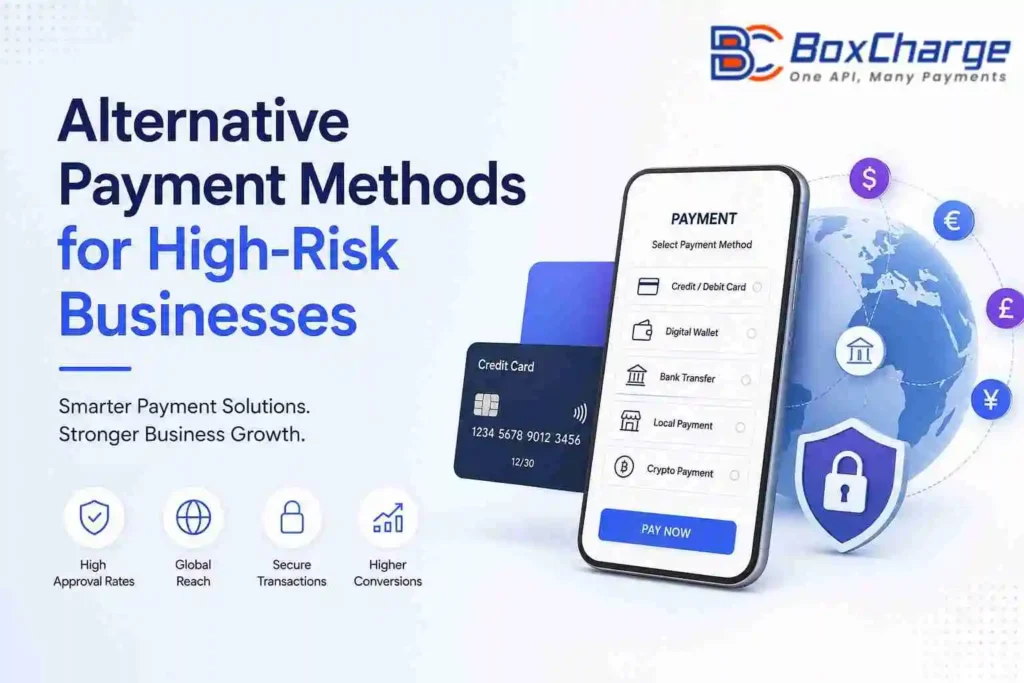
What Are Alternative Payment Methods (APMs)?
Alternative Payment Methods (APMs) are any payment options outside standard debit and credit card processing.
This includes:
- digital wallets
- direct bank transfers
- mobile payment apps
- localized payment systems
- cryptocurrency payment gateways
- buy now pay later solutions
- real-time payment systems
Consumer behavior around payments has changed dramatically over the last few years.
In many international markets, customers no longer want to manually enter card details every time they make a purchase. Mobile-first payments and fast digital checkout experiences are becoming normal across ecommerce payment processing.
For high-risk merchants, this matters more than most people realize.
Businesses relying only on traditional credit card payment processing often experience:
- lower international conversion rates
- more failed transactions
- higher cart abandonment
- increased payment friction
A lot of merchants spend heavily on advertising without realizing the real problem is happening during checkout.
Traffic is expensive. Losing customers because payment options are limited becomes a costly mistake very quickly.
Why High-Risk Merchants Are Facing More Payment Problems
Most mainstream processors are designed for stable, low-risk ecommerce businesses.
High-risk industries operate differently.
Businesses handling:
- recurring billing
- international traffic
- digital products
- subscription payments
- higher transaction volumes
naturally trigger stricter fraud monitoring and compliance reviews.
The frustrating part is that problems usually appear after the business starts growing.
Everything feels stable at first. Payment processes normally. Payouts arrive on time.
Then, the transaction volume increases.
Suddenly, merchants start dealing with:
- frozen payouts
- delayed settlements
- reserve requirements
- lower authorization rates
- account monitoring
- underwriting reviews
Many businesses do not realize how fragile their payment setup is until their processor starts slowing growth down.
For subscription businesses, especially, payment disruptions create serious operational pressure. Advertising campaigns become difficult to manage when payouts are delayed. Customer retention suffers when recurring payments fail unexpectedly.
This is one reason more businesses are actively exploring alternative payment methods for ecommerce instead of relying completely on traditional processors or a single high-risk payment processor.
Why Alternative Payment Solutions Matter More in 2026
Customer expectations have changed.
People want payment flexibility now.
A checkout page offering only card payments creates friction, especially for international customers who already prefer localized payment methods.
For example:
- European customers often prefer direct bank-based payments
- Mobile wallet usage continues to grow across Asia and the Middle East
- Some international buyers avoid traditional card payments because of fraud concerns or regional banking restrictions
Businesses using diversified online payment methods are usually seeing:
- higher checkout completion rates
- lower cart abandonment
- better mobile conversion rates
- stronger international transaction approvals
Even small improvements in payment acceptance can create major revenue differences at scale.
And for high-risk merchants, those gains matter because approval rates are already under more pressure compared to standard ecommerce businesses.
Digital Wallets Are Becoming Essential for Online Payment Processing
Digital wallets are no longer an optional feature added at the end of checkout optimization.
They are becoming one of the most important parts of modern ecommerce payment processing.
Customers prefer:
- faster checkout experiences
- fewer manual payment steps
- secure one-click transactions
- mobile-friendly payment systems
For businesses, digital wallets reduce friction during checkout and simplify repeat purchases.
For high-risk merchants, they also create another advantage: less dependence on direct card authorizations.
That matters because card approval rates can fluctuate heavily depending on the processor, region, transaction history, and fraud scoring systems.
A lot of international businesses are already prioritizing wallet integrations simply because customers convert faster when checkout feels familiar.
Local Payment Methods Improve International Conversion Rates
One mistake businesses still make is assuming customers everywhere pay the same way.
They do not.
Payment behavior changes significantly depending on region, banking systems, and local customer habits.
Localized alternative payment solutions help businesses create more trusted checkout experiences for international users.
This improves:
- customer confidence
- recurring payment continuity
- checkout completion rates
- overall international performance
For subscription-based businesses, payment consistency directly affects recurring revenue.
A failed recurring transaction is not always a lost customer immediately, but repeated failures usually damage retention over time.
Businesses scaling internationally need payment systems designed around how customers actually pay in different markets using flexible cross-border payment solutions.
Failed Transactions Quietly Cost Businesses Revenue
Most businesses focus heavily on marketing and traffic generation.
Far fewer focus enough on payment acceptance performance.
But failed transactions quietly reduce revenue every single day.
International card payments commonly fail because of:
- issuer declines
- fraud prevention filters
- currency mismatches
- regional banking restrictions
- authentication issues
For high-risk businesses, these problems become even more aggressive because processors already classify their transactions as higher risk.
Adding diversified cross-border payment solutions and modern digital payment methods helps businesses recover transactions that would otherwise fail.
Sometimes, the difference between scaling successfully and struggling financially comes down to payment approval rates that merchants barely monitor.
Chargebacks Continue to Hurt High-Risk Merchant Accounts
Chargebacks remain one of the biggest problems in high-risk merchant account management.
Processors monitor dispute ratios closely because excessive chargebacks increase financial exposure.
Once chargeback levels rise, merchants often face:
- settlement delays
- reserve increases
- stricter compliance reviews
- payment restrictions
The frustrating reality is that many disputes are avoidable.
Customers forget recurring subscriptions. Billing descriptors look unfamiliar. Refund requests take too long to process.
Some alternative payment methods reduce traditional card-related disputes by creating clearer transaction experiences and improving customer trust during checkout.
Businesses combining:
- card processing
- digital wallets
- localized payment systems
- direct bank transfers
usually create more stable payment ecosystems than merchants relying entirely on one payment channel.
Why More Businesses Are Choosing BoxCharge
As payment compliance becomes stricter globally, high-risk businesses need infrastructure designed specifically for their industries.
This is where BoxCharge helps merchants build more stable payment operations.
Businesses working with BoxCharge gain access to:
- alternative payment methods
- international payment processing
- high-risk merchant accounts
- multi-currency payment gateways
- scalable checkout infrastructure
- diversified payment solutions
The platform supports industries including:
- IPTV
- gaming
- forex
- travel
- subscription billing
- digital services
For businesses struggling with payout delays, unstable processors, declining approval rates, or frozen funds, diversified payment infrastructure is becoming less of an upgrade and more of a necessity.
And honestly, most merchants would rather solve those problems before scaling becomes harder.
Frequently Asked Questions
1: What are Alternative Payment Methods (APMs)?
Alternative Payment Methods (APMs) are payment options outside traditional debit and credit card processing, including digital wallets, bank transfers, localized payment systems, crypto payments, and mobile payment apps.
2: Why are APMs important for high-risk businesses?
APMs help high-risk businesses improve approval rates, reduce failed transactions, support international customers, and reduce dependence on a single processor or acquiring bank.
3: Do alternative payment methods improve conversion rates?
Yes. Businesses offering multiple payment options usually experience better checkout completion rates because customers can choose payment methods they already trust.
4: Can alternative payment methods reduce payment processing disruptions?
Diversified payment infrastructure helps businesses maintain transaction flow even when traditional processors apply stricter underwriting rules or risk controls.
Final Thoughts
The payment industry is changing quickly.
Customers expect faster, more flexible checkout experiences, while processors continue tightening restrictions around high-risk industries.
That combination is forcing businesses to rethink how they manage global online payment processing.
Alternative Payment Methods (APMs) are no longer just an extra checkout feature. They are becoming a core part of modern ecommerce payment processing, global payment solutions, and international business growth.
Businesses that diversify payment infrastructure early are usually in a much stronger position to:
- improve approval rates
- reduce payment friction
- support international growth
- create more stable long-term revenue
For high-risk merchants, payment stability is no longer just operational support. It is becoming a competitive advantage.