
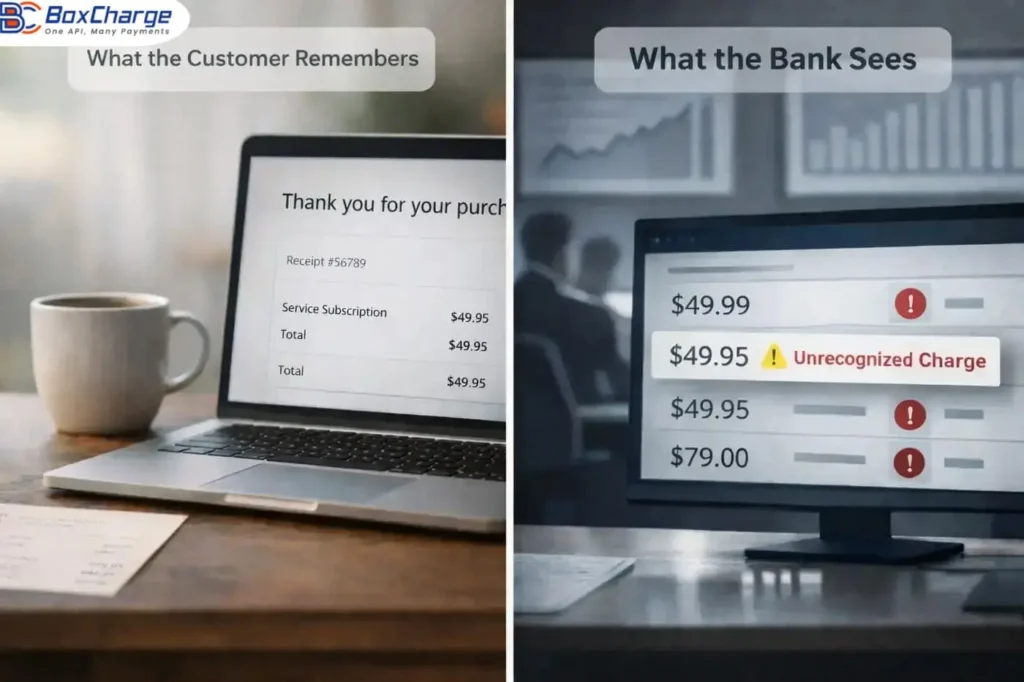
A customer opens their banking app, scans a list of transactions, and pauses.
One charge doesn’t look familiar.
They don’t email support.
Don’t check their inbox.
Just tap “Dispute”.
For adult businesses, that single tap is often more dangerous than high volume, aggressive growth, or even elevated chargeback ratios. Not because the transaction was fraudulent—but because the customer didn’t immediately recognize it.
This is where most adult merchant accounts begin to unravel. Not at onboarding. Not during approval. But quietly, as payment activity scales and clarity breaks down.
This blog explains why “unrecognized charges” are one of the fastest ways adult merchant accounts enter review, how banks and card networks interpret these signals, and how a clarity-first payment structure helps adult businesses stay alive as they grow.
What an Adult Merchant Account Actually Supports
An adult merchant account is a specialized payment processing arrangement designed for businesses operating in high-risk and reputation-sensitive environments. It enables adult platforms to accept credit card payments and alternative payment methods while operating under closer scrutiny from banks and card networks.
Unlike standard merchant accounts, adult merchant accounts are underwritten with the expectation of:
- Subscription or recurring billing models
- Cross-border transaction behavior
- Higher dispute exposure
- Ongoing monitoring after approval
For adult businesses, this account is not simply a way to accept payment online. It is an operational infrastructure. When it’s designed only for approval—and not for long-term monitoring—interruptions become inevitable.
Why “Unrecognized Charges” Matter More Than Most Merchants Realize
Many adult merchants assume disputes are primarily about dissatisfaction or refund timing. In reality, banks treat “unrecognized charge” reason codes very differently.
From an issuer’s perspective, these disputes suggest one of three things:
- The customer didn’t understand what they purchased
- The billing descriptor didn’t clearly reflect the merchant
- The transaction resembled unauthorized activity
Even when the purchase was legitimate, a lack of transaction clarity triggers concern.
What makes this particularly risky is how these disputes appear. Banks don’t just look at totals—they look at patterns.
Important:
Most merchants watch chargeback ratios.
Banks watch how fast disputes arrive and why they’re filed.
A short burst of “unrecognized charge” disputes can escalate an account into review faster than a higher ratio spread evenly over time.
What Banks See vs What Merchants Think Is Happening
To understand why adult merchant accounts get flagged, it helps to compare merchant assumptions with issuer interpretation.
| Metric | What Looks Healthy to Banks | What Raises Risk Flags |
| Billing Descriptor | Clear, recognizable, aligned with site and brand | Generic, vague, or mismatched |
| Dispute Timing | Evenly distributed across the month | Clustered disputes in short windows |
| Growth Pattern | Controlled 10–20% month-over-month scaling | Sudden, unstructured spikes |
| Reason Codes | “Canceled Subscription” | “Unrecognized Charge” |
| Refund Behavior | Proactive and timely | Reactive, post-dispute refunds |
This gap between intent and perception is where many adult payment setups fail.
Who This Payment Structure Is Built For
This approach isn’t designed for every adult business. It works best for operators who treat payments as long-term infrastructure—not a short-term workaround.
It’s most effective for:
- Subscription-based adult platforms
- Businesses processing international card volumes
- Merchants expanding into multiple regions
- Models operating under compliance or reputational pressure
- Teams prioritizing stability over speed
By focusing on how a business operates, not just what it sells, this distinction aligns with how banks evaluate risk.
Why Adult Merchant Accounts Often Fail After Approval
Approvals don’t fail—risk models evolve.
During onboarding, banks assess projected behavior. Once transactions go live, they assess reality. As volume increases, patterns emerge around geography, refund behavior, and dispute timing.
Several triggers commonly lead to review:
- Rapid volume increases without structure
- Changes in transaction size or frequency
- Increased cross-border traffic
- Shifts in dispute reason codes
Importantly, none of these automatically indicate fraud. But they do indicate change—and unstructured change attracts scrutiny.
Issuers respond to behavioral signals, not merchant intent.
A Common Pattern: Legitimate Sales, Unexpected Review
This scenario appears frequently in subscription-based adult platforms during early growth.
Traffic increases. Conversions improve. Revenue rises.
Disputes remain under network thresholds.
Then settlements slow—or pause entirely.
Not because ratios were breached, but because dispute clustering increased and a growing number of users marked transactions as unrecognized. The issue wasn’t volume. It was clarity.
How BoxCharge Approaches Adult Payment Stability
BoxCharge (international high-risk payment solution provider) doesn’t focus on promises or buzzwords. We focus on predictability.
Aligning Transaction Behavior With Issuer Expectations
Banks don’t expect zero risk. They expect consistency. We help adult merchants structure:
- Transaction pacing
- Geographic exposure
- Payment method distribution
- Refund and dispute workflows
So growth appears intentional, not erratic.
Managing Dispute Velocity—Not Just Ratios
Two merchants can report identical chargeback ratios. One remains alive. One doesn’t.
The difference is how disputes accumulate over time.
By designing payment flows that reduce dispute clustering, boxcharge helps merchants stay within issuer comfort zones—even as volume scales.
Reducing “Unrecognized Charge” Disputes at the Source
Clarity is addressed before disputes occur.
We work with merchants to:
- Optimize billing descriptors so they match brand context
- Align descriptors with domain and customer expectations
- Implement order confirmation and reminder workflows that reinforce recognition
When customers immediately recognize a transaction, dispute reason codes shift away from “unrecognized charge,” reducing issuer concern before escalation.
Payment Infrastructure That Adapts as Risk Evolves
Adult businesses rarely fit into one rigid setup. Mature payment infrastructure is modular.
A stable configuration may include:
- Single or multiple merchant accounts (MIDs)
- International acquiring across regions
- Smart routing by geography
- Alternative payment rails to balance exposure
- Optional crypto settlement where appropriate
This flexibility signals operational maturity to banks and card networks.
Why Generic Processors Struggle With Adult Businesses
Most low-risk processors don’t fail due to a lack of capability. They fail due to a structural mismatch.
Common limitations include:
- Low tolerance for dispute fluctuations
- Static fraud rules
- Forcing global businesses through domestic acquisition rails
- No continuity between the underwriting and monitoring teams
Adult businesses require payment systems built for complexity—not just throughput.
Risk, Compliance, and Long-Term Survivability
In adult online payment processing, eliminating risk isn’t realistic.
Making risk predictable is.
That means:
- Awareness of card network monitoring programs
- Transparent dispute and refund handling
- Regulatory adaptability across regions
- Designing for survivability, not shortcuts
Banks respect merchants who understand this distinction.
Frequently Asked Questions
1: How long does approval usually take?
Typically 5–15 business days, depending on structure and geography.
2: Should adult merchants expect reserves?
In most cases, yes. Structure matters more than the percentage.
3: Can BoxCharge support international traffic?
Yes. Cross-border acquiring is core to our setup.
4: What happens if volume spikes?
Planned growth is manageable. Unplanned spikes trigger reviews.
5: What if the card pressure increases?
Alternative payment rails and routing strategies reduce dependency.
No guarantees—just preparation.
When This Approach Makes Sense—and When It Doesn’t
Best suited for:
- Adult businesses planning to scale
- Teams prioritizing stability over speed
- Long-term operational models
Not ideal for:
- Short-term projects
- Experimental launches
- Merchants chasing instant approval
Selective infrastructure isn’t exclusionary—it’s responsible.
Final Perspective
Most adult merchant accounts don’t fail because the business is flawed.
They fail because the payment foundation wasn’t designed for recognition, clarity, and growth.
Approval is rarely the problem.
Stability is intentional.
Request a Risk Review with BoxCharge
If you’re operating—or planning to operate—an adult business and want to understand whether your payment setup can survive real growth, we’ll start with an honest assessment.
Request a risk review and evaluate your payment readiness—before interruptions happen.