
When global payments fail, most merchants instinctively look at the obvious places. They check their payment gateway, contact their acquiring bank, or question their merchant account provider. Rarely do they look further upstream. Yet in many cases, the true cause of payment disruption sits outside their direct visibility.
That cause is correspondent banking. Correspondent Banks in Global Payment Processing play a critical but often unseen role in how international payments move, settle, or fail.
As outlined in our pillar guide, “Why International High-Risk Payment Processing Is Harder Than Ever as We Approach 2026,” the modern payments ecosystem has become increasingly layered and fragile. One of the least understood — and most influential — layers is the correspondent banking network quietly supporting cross-border transactions.
For businesses that depend on global payment processing, understanding this hidden infrastructure is no longer optional.
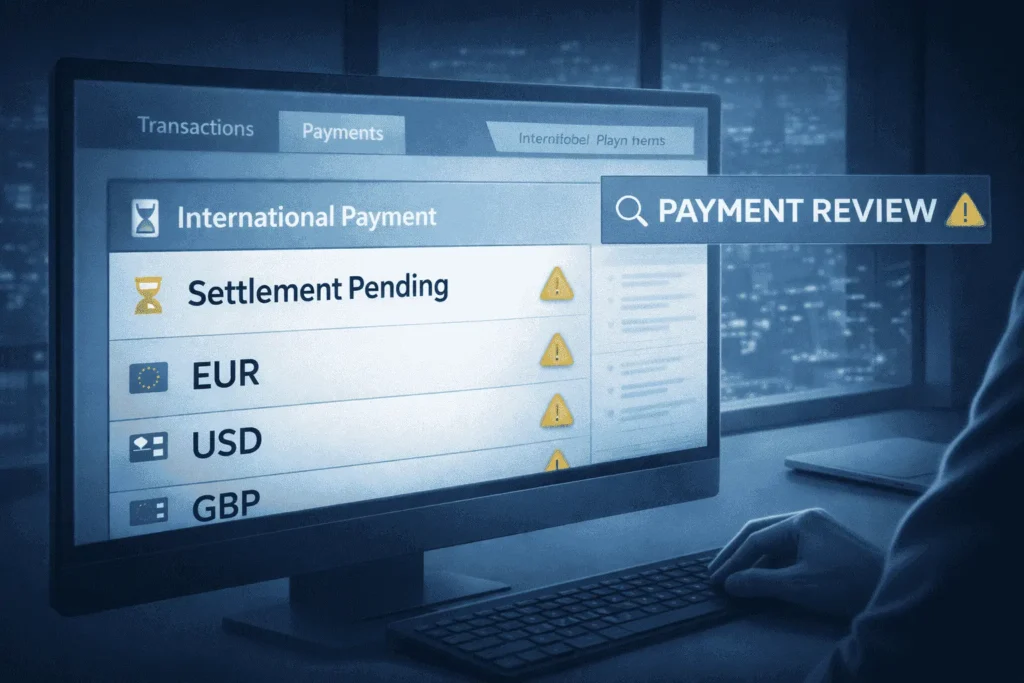
What Correspondent Banks Do in Global Payment Processing
Correspondent banks are financial institutions that provide cross-border services to other banks. They enable foreign currency settlements, international fund transfers, and access to global payment rails. When a business accepts payment online from another country, the funds rarely move in a straight line.
Instead, a typical transaction flows through:
- The customer’s issuing bank
- The card network
- The acquiring bank
- One or more correspondent banks
- Final settlement accounts
Each step introduces its own compliance checks, risk filters, and decision points.
Even a stable credit card merchant account relies on correspondent banking relationships to function internationally. Merchants may never interact with these institutions directly, but their payment outcomes depend on them.
How Correspondent Banks Affect Global Payment Processing
Correspondent banks operate under intense regulatory pressure. They are held accountable not only for their own compliance, but also for the behavior of every institution connected to them. When something goes wrong, the consequences are rarely proportional.
As regulations tighten, correspondent banks have become more conservative. Rather than evaluating merchants individually, many institutions choose to exit entire categories that are considered complex or sensitive.
This has a direct impact on:
- High-risk merchant accounts
- Forex merchant accounts and forex payment processing
- Gaming merchant accounts
- Online dating merchant accounts
- Adult and casino merchant accounts
From a correspondent bank’s perspective, exiting an industry reduces exposure faster than monitoring it closely. When that decision is made upstream, downstream banks often have no choice but to follow.
The Invisible Trigger Behind Payment Shutdowns
From the merchant’s point of view, payment failures often feel sudden.
Transactions process normally. Settlements arrive on time. Then, without meaningful warning, delays appear. Shortly after, the ability to accept credit card payments may be restricted or removed altogether.
In many cases, the acquiring bank is not the decision-maker. The trigger originates with a correspondent bank reassessing its exposure. Once that relationship changes, the acquiring bank must react — even if the merchant’s performance remains strong.
This is especially common in high-risk payment processing, where transaction patterns differ from traditional retail models.
A Real-World Scenario Merchants Rarely See
Consider a gaming platform operating across Europe and Southeast Asia. The business uses a reputable international payment gateway, maintains acceptable chargeback ratios, and complies with local regulations. For months, payments flow without issue.
Then, the transaction volume increases due to seasonal demand. Nothing about the business changes — except scale.
Upstream, a correspondent bank flags the category for review. The acquiring bank is instructed to reduce exposure. Within weeks, settlement delays begin. Shortly after, card processing is limited.
From the merchant’s perspective, the shutdown feels arbitrary. In reality, it was driven by a decision made several layers above them.
Why High-Risk Businesses Feel the Impact First
Correspondent banks do not assess nuance well. They evaluate risk in broad segments.
A forex merchant account may be transparent and compliant, yet forex as a sector involves regulatory sensitivity, cross-border volume, and dispute exposure. For a correspondent bank, exiting the sector entirely is often simpler than monitoring individual merchants.
The same logic applies to:
- Gaming merchant accounts with high transaction frequency
- Casino merchant accounts serving international players
- Adult merchant accounts with subscription billing
- Online dating merchant accounts reliant on recurring payments
These businesses are not failing — they are operating at scale. But scale itself attracts scrutiny.
Credit Cards Aren’t the Problem — Dependency Is
Many merchants assume their credit card payment solution is the weak link. In reality, cards are only one layer of a much larger system.
A business that relies entirely on a single credit card merchant account inherits every upstream dependency tied to that account. When correspondent relationships shift, that dependency becomes a liability.
This is why resilient payment strategies prioritize diversification.
Alternative Payment Methods — including digital wallets, local bank transfers, and region-specific rails — reduce reliance on correspondent networks. They also improve approval rates and customer experience in international markets.
A modern international payment gateway supports this flexibility by routing transactions based on geography, availability, and risk conditions.
Why Diagnosing Global Payment Failures Is So Difficult
One of the most frustrating aspects of correspondent-driven failures is the lack of transparency.
Merchants rarely receive clear explanations. Support teams often reference “policy changes” or “banking decisions” without specifics. By the time communication reaches the merchant, the decision has already been implemented upstream.
As payment ecosystems grow more complex, this opacity has increased. Correspondent banks prioritize protecting their networks over explaining outcomes to downstream participants.
For merchants, this means fewer warnings and faster enforcement.
Designing Payments Around Correspondent Risk
Merchants who remain operational during disruptions don’t try to eliminate correspondent bank risk. They design around it.
That starts with accepting that correspondent banking is a structural vulnerability, not a temporary inconvenience. From there, practical steps include:
- Using a High-Risk Merchant Account built for cross-border activity
- Working with a High-Risk Payment Gateway that supports multiple acquiring paths
- Avoiding reliance on a single bank or region
- Integrating Alternative Payment Methods alongside cards
- Planning settlement flows with redundancy
High-Risk Business Processing specialists understand these dynamics because they operate within them daily.
Providers like Boxcharge focus on building payment infrastructures that account for correspondent bank behavior instead of assuming long-term stability.
Rethinking What Payment Stability Really Means
For many businesses, stability has traditionally meant consistency — the same bank, the same gateway, the same setup year after year.
In global payments, that definition no longer applies.
True stability now comes from adaptability. It’s the ability to continue accepting payment online even when one route fails. It’s having alternatives ready before disruption occurs. It’s understanding that global payment processing is not a fixed pipeline, but a living system.
Merchants who embrace this reality are better positioned to navigate change without panic.
Final Thoughts
Correspondent banks rarely appear in merchant dashboards or onboarding conversations. Yet they play a decisive role in whether global payments succeed or fail.
As international commerce expands and regulatory pressure increases, these unseen relationships will continue to shape the payment landscape.
Merchants who understand this hidden layer — and structure their payment systems accordingly — gain a meaningful advantage.
In global payments, what you don’t see often determines what you can’t control.
If your business operates across borders or in complex industries, reviewing how your payments depend on correspondent banking may be the most important step you take to protect long-term revenue.