
What VAMP Does?
Visa continuously reviews transaction data from acquiring banks.
If a merchant crosses certain risk limits, Visa flags the account and places it into a monitoring program.
Visa does not deal directly with merchants. Instead, it:
- Alerts the acquiring bank
- Requires the bank to take corrective action
That action can include:
- Higher processing fees
- Increased rolling reserves
- Extra compliance checks
- Suspension or termination of the merchant account
For many online businesses, payment processing still feels like a background function. Cards are accepted, transactions settle, and growth continues quietly in the background.
For high-risk businesses, payments work very differently.
As discussed in Why International High-Risk Payment Processing Is Harder Than Ever as we approach 2026, global merchants today face stricter regulations, higher dispute scrutiny, and far less tolerance from card networks. One of the most common systems driving these challenges is Visa Monitoring Programs (VAMP).
Most merchants don’t actively look for information about VAMP. They encounter it only after their credit card merchant account starts facing restrictions, reserves increase, or payments stop altogether.
This article breaks down Visa Monitoring Programs in simple terms and explains why they matter so much for high-risk merchants operating in 2026.
What is the Visa Monitoring Program (VAMP)?
Visa Monitoring Programs are internal risk-control frameworks used by Visa to identify merchants with elevated levels of chargebacks, disputes, or fraud-related activity.
Visa does not manage merchants directly. Instead, it monitors transaction data reported by acquiring banks. When a merchant crosses certain risk thresholds, Visa places the account into a monitoring category and instructs the bank to take corrective action.
That action can include:
- Higher processing fees
- Increased rolling reserves
- Additional compliance requirements
- Termination of the online merchant account
For businesses already classified as high risk, this process can escalate quickly.
Why High-Risk Merchants Are More Exposed to VAMP
High-risk industries face customer behavior that traditional e-commerce businesses rarely deal with.
For example:
- Forex merchant accounts face disputes when traders lose money
- Gaming and casino merchant accounts deal with bonus misuse and subscription confusion
- Adult merchant accounts face privacy-driven chargebacks
- Online dating merchant accounts see refund requests driven by emotional decisions
These industries are legitimate, but dispute frequency is naturally higher. This makes high risk payment processing more vulnerable to Visa monitoring programs, even when merchants follow the rules.
Visa Monitoring Thresholds Explained Simply
Earlier Visa programs focused heavily on chargeback ratios alone. That model is no longer sufficient.
The Modern VAMP Risk Model
Visa now evaluates merchants using a combined risk signal, which includes:
- Confirmed fraud reports
- Disputes and chargebacks
- Total settled transaction volume
In simple terms, Visa looks at how fraud + disputes trend relative to volume, not just a single percentage.
This means:
- A merchant with “acceptable” chargeback ratios can still trigger monitoring
- Rising fraud signals alone can push a merchant into risk review
- Volume and velocity matter as much as ratios
VAMP Risk Stages — 2026
Visa does not publish a universal threshold that applies to every merchant. Risk is evaluated in stages and varies by region, volume, and industry.
| Risk Stage | What Typically Triggers It | What Merchants Experience |
|---|---|---|
| Early Risk Signals | Rising fraud or dispute trends | Quiet monitoring by the acquiring bank |
| Active Monitoring | Sustained elevated risk indicators | Higher fees, reserves, compliance checks |
| High-Risk Monitoring | Severe or persistent risk signals with high volume | High likelihood of account termination |
Chargeback percentages alone no longer tell the full story.
What Merchants Experience After Entering VAMP
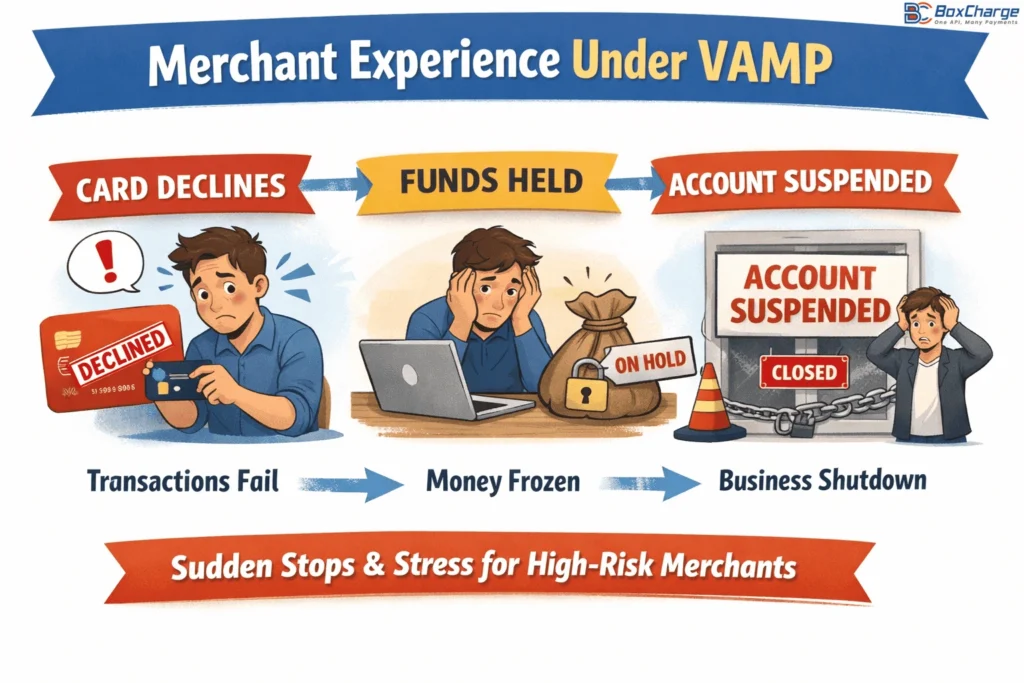
From a merchant’s perspective, VAMP rarely feels gradual.
Common experiences include:
- Sudden card declines
- Funds held for months
- Payment gateway suspension
- Inability to accept payment online
In many real cases, merchants are given little time to react, making recovery costly.
Why Traditional Banks Are a Weak Fit for High-Risk Businesses
Most banks are designed for predictable, low-risk industries.
They prefer:
- Transparent business models
- Publicly available company information
- Low dispute ratios
High-risk merchants rarely meet all of these expectations. As a result, banks may approve accounts initially but withdraw support once risk increases.
This is why relying on standard banks for high-risk payment processing often leads to instability.
The Importance of a High-Risk Payment Gateway
A proper high-risk payment gateway does more than connect cards.
It helps merchants by:
- Working with multiple acquiring banks
- Monitoring dispute trends early
- Supporting international payment gateway setups
- Integrating Alternative Payment Methods
In 2026, this layered structure is essential for global payment processing, especially for high-risk industries.
Why Alternative Payment Methods Reduce Visa Risk
Merchants who rely only on card payments concentrate their risk with Visa and Mastercard.
To reduce exposure, many businesses now combine:
- Credit card payments
- Local bank transfers
- Digital wallets
- Region-specific payment options
This approach lowers chargeback pressure and helps maintain long-term credit card payment solutions without constant disruption.
Industry-Specific Risk Realities
1: Forex & Trading Platforms
Forex payment processing is highly sensitive to market volatility. Even experienced traders may dispute legitimate transactions after losses.
2: Gaming & Casino Platforms
Gaming merchant accounts must manage recurring billing transparency and bonus misuse to control dispute ratios.
3: Adult Content Businesses
Adult merchant accounts face disputes driven by privacy concerns and unclear billing descriptors.
4: Online Dating Platforms
Online dating merchant accounts see higher refund requests unless expectations, pricing, and cancellations are communicated clearly.
Each of these verticals requires a customized High Risk Business Processing strategy.
How BoxCharge Supports High-Risk Merchants
BoxCharge works with businesses that traditional banks avoid.
The focus is on:
- Stable credit card payment solutions
- Risk-aware merchant account structures
- International acquiring relationships
- Support for Alternative Payment Methods
Rather than chasing quick approvals, BoxCharge helps merchants build payment systems designed for long-term stability.
Can Merchants Recover From VAMP?
Yes, but recovery takes time.
It usually involves:
- Moving to alternative acquiring banks
- Improving refund and dispute handling
- Reducing chargeback ratios consistently
- Rebuilding trust with payment partners
Without the right setup, merchants often re-enter monitoring programs repeatedly.
Final Thoughts
Visa Monitoring Programs are not random. They are triggered by measurable risk indicators.
As we move deeper into 2026, high-risk merchants must treat payments as critical infrastructure, not just a checkout feature.
With the right high-risk payment gateway, online merchant account, and global strategy, businesses can continue operating even under strict card network oversight.
If your business operates in a high-risk industry and is facing payment instability, rising chargebacks, or account restrictions, reviewing your payment setup early can prevent long-term disruption.
BoxCharge helps high-risk businesses accept payment online with stability, compliance, and global reach.