
Online payments are no longer just about speed or convenience. For modern digital businesses, especially those operating globally or in regulated sectors, payment stability has become a core operational requirement.
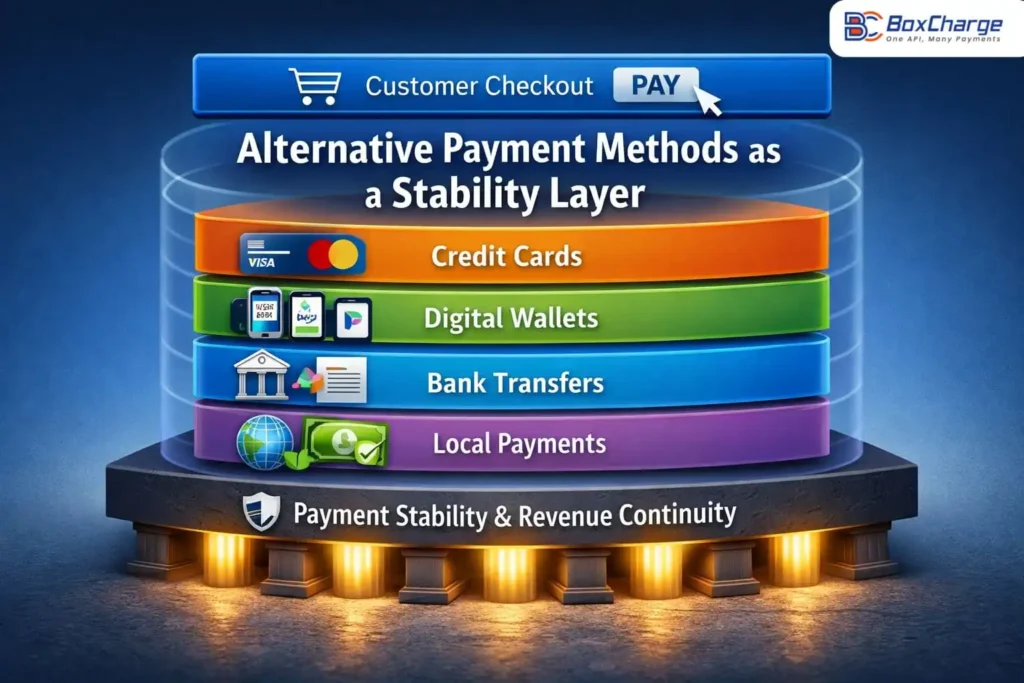
This is where the importance of alternative payment methods becomes clear. They are not a passing trend or optional add-on. They function as a stability layer that protects revenue, reduces payment failures, and ensures business continuity when traditional payment rails fail.
The Growing Importance of Alternative Payment Methods
Card payments still dominate many markets, but relying on a single payment method exposes businesses to unnecessary risk. Declines, compliance blocks, issuer restrictions, and regional limitations can interrupt revenue without warning.
The importance of alternative payment methods lies in their ability to diversify payment acceptance. When cards fail, wallets, bank transfers, local payment methods, or account-to-account solutions keep transactions flowing.
For e-commerce businesses, SaaS platforms, and subscription models, this diversification is no longer optional — it is foundational.
Why Payment Methods Fail More Often Than Businesses Expect
Understanding why payment methods fail is essential to building a resilient payment stack.
Common failure points include:
- Issuer declines due to fraud rules or spending limits
- Card network policy changes
- Cross-border transaction restrictions
- Expired or replaced cards
- Regulatory pressure on specific industries
- Downtime or processing bottlenecks
These failures often occur without any issue on the customer’s side. From their perspective, the checkout simply “doesn’t work.”
This is why businesses that rely only on cards experience higher abandonment and revenue leakage.
Payment Stability in E-commerce Depends on Diversification
Payment stability in e-commerce is not achieved by optimizing a single gateway. It is achieved through a payment diversification strategy.
A diversified setup distributes transaction risk across multiple rails:
- Credit and debit cards
- Digital wallets
- Local bank transfers
- Alternative and real-time payment methods
If one method fails, another succeeds — silently and instantly.
This redundancy is what turns payment infrastructure from a fragile system into a resilient one.
Payment Diversification Strategy: Designing for Continuity
A strong payment diversification strategy is proactive, not reactive.
Instead of waiting for declines to rise or accounts to be reviewed, businesses design their checkout to support multiple payment options from day one.
Key benefits include:
- Higher approval rates
- Lower dependency on card networks
- Reduced operational disruptions
- Better global acceptance
- Improved customer trust
Diversification is not about offering “more choices.” It is about engineering reliability.
How Alternative Payment Methods Reduce Payment Failures
One of the biggest advantages of alternative payment methods is their ability to reduce payment failures caused by card-specific limitations.
For example:
- Bank transfers eliminate card expiration issues
- Push payments reduce fraud disputes
- Local payment methods align with regional preferences
- Wallets bypass issuer-based declines
By spreading transaction volume across multiple rails, businesses dramatically reduce the impact of any single failure point.
This directly improves approval rates and customer experience.
Alternative Payment Methods as a Stability Layer
When viewed strategically, alternative payment methods sit beneath the checkout experience as a stability layer.
They:
- Absorb shocks from card declines
- Provide fallback routes during outages
- Reduce exposure to compliance changes
- Support uninterrupted subscription billing
This is why forward-thinking businesses no longer ask whether they need alternative payment methods — they ask how many and how well integrated they should be.
Global Expansion Makes Payment Diversification Essential
As businesses expand internationally, payment complexity increases.
Different regions prefer different methods. Cards may dominate in one market but underperform in another. Without local payment options, approval rates drop, and customer trust erodes.
A diversified payment stack enables:
- Higher conversion in local markets
- Reduced cross-border decline rates
- Compliance alignment across regions
- Scalable global growth
This is where alternative payment methods move from “nice to have” to mission-critical.
Subscription Models Depend on Payment Stability
Recurring revenue models are especially vulnerable to payment failures.
Expired cards, issuer rejections, or network disruptions can silently cancel subscriptions. Alternative payment methods protect recurring revenue by providing:
- Backup payment routes
- Account-to-account billing options
- Lower involuntary churn
For subscription-based businesses, payment stability is directly tied to lifetime value.
Why Stability Matters More Than Trends
Trends come and go. Infrastructure decisions last.
Businesses that treat alternative payment methods as a trend often adopt them too late — after declines rise, accounts are flagged, or growth stalls.
Those who treat them as a stability layer build resilient systems that scale without disruption.
Frequently Asked Questions
1: Are alternative payment methods safer than cards?
In many cases, yes. Bank-based and push payment methods reduce fraud exposure and chargebacks compared to traditional card transactions.
2: Do alternative payment methods reduce payment declines?
Yes. They bypass many issuer and network-level decline reasons, helping reduce payment failures across regions.
3: Are alternative payment methods required for global businesses?
For global e-commerce and subscription businesses, they are increasingly essential to maintain approval rates and payment stability.
Final Thoughts
The conversation is no longer about trends. It is about resilience.
The importance of alternative payment methods lies in their ability to stabilize revenue, reduce payment failures, and future-proof businesses against an increasingly complex payment landscape.
For e-commerce, subscription platforms, and global merchants, alternative payment methods are not an upgrade — they are a foundation.