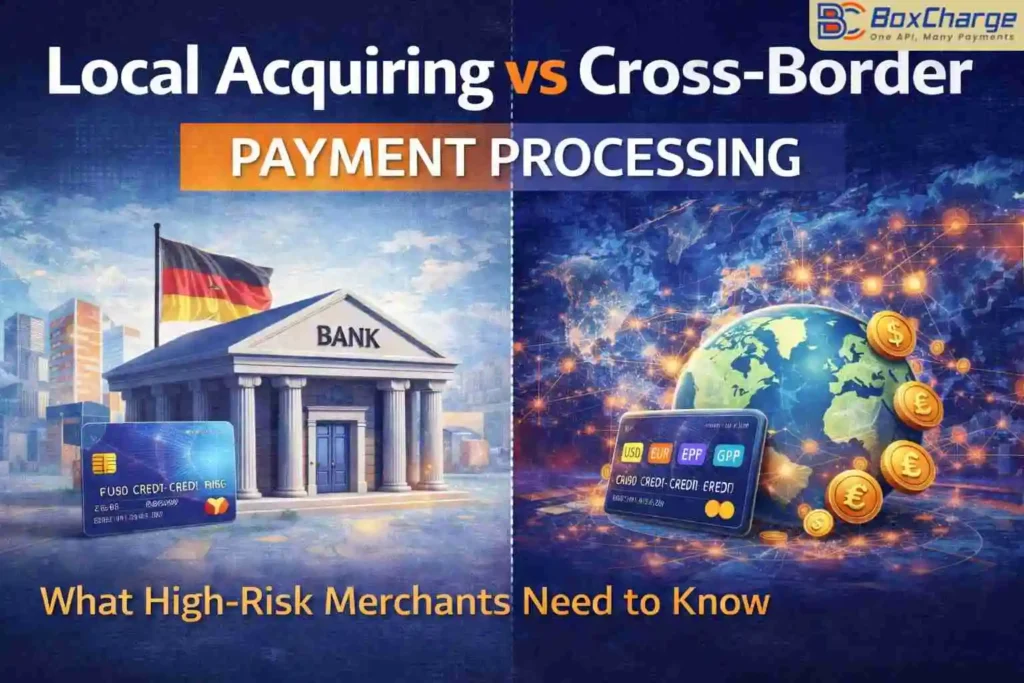
Local Acquiring vs Cross-Border Payment Processing: A Guide for High-Risk Merchants
As global e-commerce continues to expand, businesses must choose the right payment processing infrastructure to accept transactions from customers worldwide. For many companies, especially high-risk merchants, payment processing is not just a technical decision—it is a critical factor that affects revenue, customer experience, and long-term stability. Two common models dominate the payments landscape: local acquiring and cross-border payment processing. Each approach offers different advantages depending on the business model, target market, and risk profile. Understanding the differences between these models helps businesses build a stronger online payment processing system and improve their payment approval rates. What Is Local Acquiring? Local acquiring refers to a payment processing model where the acquiring bank operates in the same country as the customer making the payment. For example, if a customer in Germany makes an online purchase using a German credit card and the acquiring bank is also located in Germany, the transaction is processed domestically. Because the payment remains within the same banking network, it is treated as a local transaction rather than an international one. Local acquiring is widely used in global e-commerce payments because it often improves payment performance. Domestic transactions typically face fewer fraud checks and may have higher acceptance rates. Many large online businesses rely on local acquiring networks as part of their payment gateway solutions to ensure smooth transactions across different markets. Benefits of Local Acquiring Local acquiring offers several benefits for businesses that sell primarily within a specific region. 1: Higher Payment Approval Rates One of the biggest advantages of local acquiring is improved payment approval rates. Banks generally trust domestic transactions more than international ones. When a payment appears local, issuing banks are less likely to block it due to fraud concerns. 2: Lower Transaction Fees Local payments usually avoid the additional fees associated with international transactions. This can reduce processing costs for merchants handling large transaction volumes. 3: Faster Settlement Times Domestic transactions often settle faster than international ones. This allows businesses to maintain stable cash flow and manage operations more efficiently. 4: Better Customer Experience Customers may encounter fewer authentication steps when payments are processed locally. This creates a smoother checkout experience and reduces abandoned transactions. What Is Cross-Border Payment Processing? Cross-border payment processing refers to transactions where the acquiring bank and the customer are located in different countries. For example, if a customer in the United Kingdom purchases a product from an online store that processes payments through an acquiring bank in Singapore, the transaction becomes international. Cross-border payment processing is essential for companies engaged in international payment processing and global payment processing. It allows businesses to accept payments from customers across multiple countries without establishing a local banking relationship in each market. While this model expands global reach, it can also introduce additional challenges. Challenges of Cross-Border Payment Processing Although cross-border payments enable global commerce, they often involve higher complexity. 1: Lower Authorization Rates International transactions are more likely to trigger fraud detection systems. This can result in lower approval rates compared to domestic payments. 2: Higher Processing Costs Cross-border transactions often include additional charges such as foreign exchange fees and international interchange costs. 3: Increased Fraud Monitoring Banks apply stricter security checks to international payments. While this protects customers, it can also lead to legitimate transactions being declined. For businesses handling large volumes of global e-commerce payments, these challenges must be carefully managed. Local Acquiring vs Cross-Border Payment Processing: Key Differences The primary difference between the two models lies in how transactions are routed through banking networks. Local Acquiring Cross-Border Payment Processing Many businesses combine both models to create efficient payment gateway solutions that maximize acceptance rates. Why High-Risk Merchants Face Payment Challenges For high-risk merchants, obtaining a stable payment infrastructure can be significantly more difficult. Many traditional banks avoid industries they classify as high risk. These may include online trading platforms, subscription-based services, digital products, or certain e-commerce categories. As a result, merchants often face multiple obstacles when seeking reliable merchant account solutions. 1: Merchant Account Rejections Banks frequently decline applications from high-risk businesses due to regulatory concerns and chargeback risks. 2: Payment Gateway Terminations Even after approval, merchants may experience sudden account closures if a processor changes its risk policies. 3: Limited Banking Partnerships Some financial institutions restrict access to payment services for industries with higher dispute ratios. Because of these limitations, high-risk merchants often rely on specialized providers offering flexible online payment processing and global payment acceptance. The Role of Cross-Border Processing for High-Risk Merchants For many high-risk businesses, cross-border payment processing becomes an essential part of their payment strategy. International acquiring banks sometimes support industries that local banks avoid. This allows merchants to access merchant account solutions tailored for higher-risk business models. Cross-border processing also enables businesses to reach international customers without needing a local bank in every country. In the context of global payment processing, this flexibility is essential for companies operating across multiple markets. When Local Acquiring Works Best Local acquiring is ideal for businesses with strong domestic customer bases. E-commerce companies selling mainly within a single country benefit from local processing because it improves payment approval rates and reduces costs. Large retailers and subscription platforms often maintain multiple local acquiring partnerships to support regional payment networks. When Cross-Border Payment Processing Is the Better Option Cross-border processing becomes more important when businesses expand internationally. Companies targeting global audiences often require international payment processing to support customers from different countries. This is particularly important for businesses operating in specialized industries or regions where local banks may not provide merchant accounts. For high-risk merchants, global acquiring networks often provide the most reliable payment gateway solutions providers. Combining Both Models for Better Payment Performance Many successful businesses combine local acquiring and cross-border payment processing to create a flexible payment strategy. This hybrid approach allows transactions to be routed through the most suitable acquiring bank based on the customer’s location. Advanced payment gateway solutions often include intelligent routing systems that analyze transaction data and select the best processing
Local Acquiring vs Cross-Border Payment Processing: A Guide for High-Risk Merchants Read Post »