
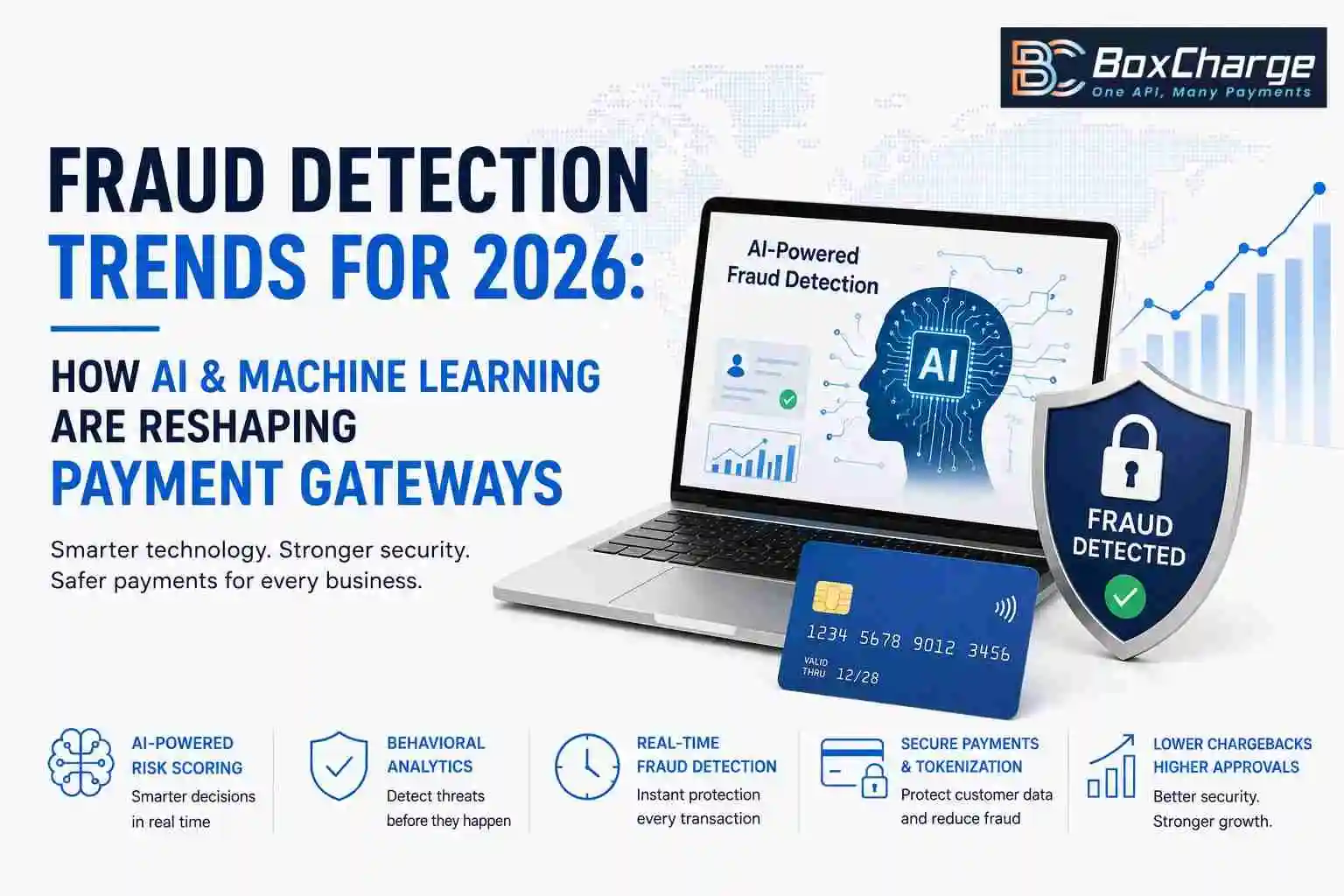
Fraud is no longer a problem that payment gateways can solve with a fixed list of rules. In 2026, fraudsters are using automation, generative AI, synthetic identities, bots, social engineering, and increasingly sophisticated transaction patterns to attack digital commerce. Payment providers are responding by moving toward AI fraud detection, machine learning, behavioral analytics, and real-time risk scoring.
For merchants, particularly those operating in high-risk industries, this shift matters enormously.
A legitimate transaction declined by a fraud system can mean lost revenue. A fraudulent transaction that gets approved can lead to a chargeback, financial loss, or additional scrutiny from an acquiring bank. The challenge is finding the point where fraud prevention protects revenue without damaging payment conversion.
The 2026 Global eCommerce Payments and Fraud Report from the Merchant Risk Council (MRC), based on responses from 1,278 payment and fraud professionals across 37 countries, shows how quickly the landscape is changing. The report says 63% of merchants are exploring or planning to implement agentic AI payments, while 72% already use some form of payment tokenization. It also reports that merchants lost an average of 3.2% of annual e-commerce revenue to payment fraud.
For payment gateways, the message is clear: fraud detection is becoming an intelligent, continuously learning process rather than a one-time transaction check.
Why Traditional Fraud Detection Is No Longer Enough
Traditional fraud systems typically rely heavily on predefined rules.
For example:
Block transactions above a certain amount.
Reject transactions from specific countries.
Flag multiple purchases within a short period.
Require additional authentication for unusual transactions.
Block cards or devices associated with previous fraud.
These controls remain useful. But they have a weakness: fraudsters can adapt to predictable rules.
If a criminal knows that transactions above $1,000 trigger additional verification, they may split purchases into smaller amounts. If a particular geographic location receives additional scrutiny, they may use compromised accounts, proxies, or other techniques to make transactions appear legitimate.
This is where machine learning fraud detection becomes valuable.
Instead of asking only whether a transaction matches a predefined rule, machine-learning models can examine numerous signals simultaneously and identify relationships that are difficult to capture through static rules.
The Bank for International Settlements' Project Hertha demonstrated how transaction analytics and modern AI techniques can help identify complex financial-crime patterns across real-time retail payment systems.
How AI Fraud Detection Works in Payment Gateways
Modern AI payment fraud detection can analyze transaction and behavioral signals in milliseconds.
Depending on the payment infrastructure, these signals may include:
Transaction amount
Customer history
Purchase frequency
Device information
IP and geographic signals
Account age
Billing information
Shipping information
Authentication results
Previous disputes
Transaction velocity
Merchant behavior
Payment-method history
Network-level intelligence
The model can then generate a risk assessment.
A low-risk transaction may proceed with minimal friction.
A transaction showing several unusual signals may receive additional authentication or be declined.
The advantage is context.
A $2,000 transaction isn't automatically fraudulent simply because it is large. If the customer has made similar purchases for two years from the same device and location, the transaction may be legitimate.
Conversely, a $100 transaction could be suspicious if it forms part of a rapid sequence of purchases from a newly created account.
Mastercard describes this shift as moving toward AI systems that combine historical patterns with fresh, real-time information to make more accurate authorization decisions. Its 2026 research reports that 83% of surveyed industry leaders said AI had reduced false positives and customer churn.
2026 Trend #1: Behavioral Fraud Detection Is Becoming More Important
One of the biggest developments in payment fraud prevention is the shift from transaction-level analysis toward behavioral analysis.
A transaction tells you what happened.
Behavior can tell you why it may be happening.
For example, an AI system can recognize that a customer who normally makes one purchase every few weeks suddenly:
Changes their password.
Adds a new payment method.
Changes their shipping address.
Logs in from a new device.
Attempts several high-value transactions.
Individually, none of these events necessarily proves fraud.
Together, however, they may represent account takeover.
Visa's Spring 2026 Biannual Threats Report says payment security is increasingly moving from detecting stolen credentials toward identifying behavioral manipulation and deception. It also notes that AI is accelerating both attacks and defensive capabilities.
This is particularly important as fraudsters become better at making fraudulent activity look normal.
2026 Trend #2: AI Is Fighting AI
Fraudsters aren't waiting for payment companies to upgrade their systems.
They are using AI themselves.
Generative AI can help criminals produce more convincing phishing messages, impersonation attempts, synthetic identities, deepfakes, and automated attacks.
Mastercard's 2026 research identifies synthetic identity fraud, impersonation scams, and cross-border fraud among the threats payment-industry leaders expect to grow rapidly.
Stripe's 2025 State of AI and Fraud report similarly found that 30% of surveyed business leaders said generative AI was making merchant fraud worse, while 47% of businesses were already using AI to detect and prevent fraud.
This creates an ongoing technology race.
Fraudsters automate → payment providers learn → fraudsters adapt → models evolve again.
For a modern payment gateway, static security architecture is increasingly difficult to defend.
2026 Trend #3: Real-Time Risk Scoring Is Becoming Standard
Payment decisions increasingly need to happen while the customer is still at checkout.
Discovering that a transaction was fraudulent several hours after the funds have already moved adds little value.
Real-time risk scoring allows payment systems to evaluate transactions before authorization or settlement decisions are finalized.
The 2026 MRC report identifies real-time payment fraud as a major emerging concern, with 45% of merchants identifying it as the next biggest fraud attack overall.
This is particularly relevant as real-time payments expand.
The same MRC research reports that 43% of merchants now accept real-time payments.
The faster money moves, the smaller the window for intervention becomes.
That makes real-time fraud detection increasingly important for payment processors, gateways, acquiring platforms, and merchants.
2026 Trend #4: Tokenization Is Supporting Both Security and Conversion
Tokenization isn't new, but its importance keeps growing.
Instead of repeatedly exposing sensitive card information, tokenization allows payment systems to use a substitute value representing the underlying payment credentials.
This can improve security while supporting smoother recurring and repeat transactions.
The MRC's 2026 report says 72% of surveyed merchants use one or more forms of payment tokenization.
For merchants operating subscription models, marketplaces, and repeat-purchase businesses, this can be particularly valuable.
A secure tokenized payment flow can reduce unnecessary friction while supporting fraud controls.
2026 Trend #5: The Industry Is Moving Beyond Transaction-Level Fraud
Fraud doesn't always happen inside one transaction.
A criminal network may use:
Multiple customer accounts
Multiple cards
Multiple devices
Multiple merchants
Multiple IP addresses
Multiple payment methods
Looking at each transaction independently can make those connections difficult to see.
Network-level analysis changes the picture.
The BIS Project Hertha research specifically explored how transaction data across payment participants can reveal complex and coordinated financial-crime patterns.
This suggests an important direction for AI payment processing: fraud prevention will increasingly depend on understanding relationships between transactions rather than simply scoring transactions individually.
Why High-Risk Merchants Are Feeling the Pressure
The move toward advanced fraud detection creates a particular challenge for high-risk merchant accounts.
Businesses in industries such as:
iGaming
Forex
Adult
Nutraceuticals
Travel
Digital subscriptions
Online gaming
Certain financial services
already operate under greater payment scrutiny.
They may face higher chargeback exposure, stricter underwriting, additional compliance requirements, and more complicated customer geographies.
Now they also need to demonstrate that their transaction activity can be monitored effectively.
1: The first problem is false positives.
A legitimate customer may suddenly make a larger purchase.
An AI system that interprets the transaction without sufficient context could flag it.
For the merchant, that means a declined payment.
2: The second problem is chargebacks.
A fraudulent transaction that gets approved can create a dispute, processing costs, and potentially additional risk scrutiny.
3: The third problem is account stability.
If fraud rates or disputes increase, a high-risk merchant may face additional monitoring, reserve requirements, or settlement reviews.
This makes AI-powered fraud prevention more than a security feature.
It becomes part of the merchant's broader payment strategy.
The Real Challenge: Prevent Fraud Without Killing Conversion
This is where payment gateways need to become smarter.
A fraud system that blocks everything suspicious may produce impressive fraud numbers while destroying legitimate sales.
Imagine a merchant with 100,000 payment attempts.
If the system blocks 20,000 transactions and 15,000 were actually legitimate, fraud losses may fall—but the merchant has created an enormous revenue problem.
The objective should therefore be:
Maximum fraud reduction + minimum unnecessary declines.
Machine learning can help because it can evaluate transactions in context instead of relying exclusively on rigid thresholds.
Mastercard's research specifically connects AI with reducing false positives and customer churn.
Stripe's research also identifies fraud detection as the most popular AI use case in payments, based on its survey of more than 4,000 payment leaders.
What Should Merchants Look for in an AI-Enabled Payment Gateway?
Merchants evaluating payment gateway solutions in 2026 should look beyond the phrase "AI-powered."
Ask what the technology actually does.
Real-time transaction scoring: Can the system evaluate risk during checkout?
Behavioral analytics: Does it analyze customer behavior rather than transaction value alone?
Adaptive machine learning: Can the model respond to new fraud patterns?
3D Secure: Can transactions requiring stronger authentication be routed through appropriate authentication flows?
Tokenization: Does the platform support secure payment credentials for recurring and repeat transactions?
Chargeback monitoring: Can merchants identify emerging dispute patterns before they become serious?
Device and identity intelligence: Can the system identify unusual device, account, or identity behavior?
Reporting: Can merchants understand why transactions are being flagged or declined?
Human oversight: Can complex cases be reviewed rather than relying entirely on automated decisions?
The best systems combine automation with appropriate human oversight.
AI Does Not Replace Compliance
There is another important point that high-risk merchants sometimes overlook.
AI can identify suspicious activity.
It cannot make an unlawful business model compliant.
Payment providers still need to consider:
KYC/KYB
AML requirements
Sanctions screening
Licensing
Card-network rules
Business-category restrictions
Consumer-protection requirements
Data privacy
Regulatory obligations
AI should strengthen compliance operations, not be used as a shortcut around them.
The BIS (Bank of International Settlements) has highlighted data governance, infrastructure, and human expertise as important challenges as financial institutions adopt AI.
For merchants, this means choosing a provider that treats fraud prevention, compliance, and payment performance as connected disciplines.
What Comes Next: Agentic Commerce and AI-Driven Payments
One of the more interesting developments heading into 2026 and beyond is agentic commerce.
AI agents are increasingly being designed to perform tasks on behalf of users, including finding products, comparing options, and potentially initiating transactions.
The MRC's 2026 report says 63% of merchants are exploring or planning to implement agentic AI payments.
Mastercard has also announced initiatives around machine-to-machine payments, envisioning AI agents conducting transactions programmatically at high speed.
This introduces a new fraud question:
How does a payment gateway distinguish between an authorized AI agent and a malicious automated system?
That will require new approaches to identity, authentication, authorization, transaction context, and behavioral analysis.
In other words, the next generation of payment fraud detection may need to understand not only who is making a payment, but also what agent is acting, on whose behalf, under what authorization, and with what behavior.
How Payment Gateways Can Prepare for the Next Fraud Wave
A modern fraud strategy should combine several layers rather than depend on one AI model.
A strong architecture can include:
Customer authentication → Tokenization → AI risk scoring → Behavioral analysis → Fraud rules → Transaction monitoring → Chargeback intelligence → Human review
Each layer addresses a different part of the risk.
This is especially important for high-risk merchants because a single fraud-control failure can have consequences beyond one transaction.
The goal is to create a system that can learn, adapt, authenticate, and respond without unnecessarily interfering with legitimate customers.
Final Thoughts
The biggest change in fraud detection trends for 2026 isn't simply that payment companies are using more artificial intelligence.
It is that fraud prevention is becoming increasingly real-time, behavioral, adaptive, and interconnected.
Fraudsters are using AI to scale attacks, create convincing identities, automate social engineering, and move money faster. Payment providers are responding with machine learning, network intelligence, behavioral analytics, tokenization, and real-time risk scoring. Mastercard, Visa, the BIS, the ECB/EBA, the Merchant Risk Council, and major payment platforms all point toward the same broad direction: the future of payment security will depend on faster decisions and richer context.
For high-risk merchants, this evolution is especially important.
They need fraud controls that protect acquiring relationships and reduce chargebacks without turning legitimate customers away.
That means the right AI-powered payment gateway should not simply block more transactions.
It should make better decisions.
For businesses evaluating high-risk payment processing, international payment acceptance, and fraud-management infrastructure, BoxCharge can be evaluated based on its specific acquiring capabilities, merchant category support, transaction profile, target markets, and risk-management requirements.
Ultimately, the competitive advantage in 2026 will belong to payment systems that can do three things at the same time:
👉detect fraud faster, approve legitimate customers more intelligently, and adapt before the next fraud pattern becomes yesterday's problem.