IBAN Settlement is becoming an essential part of international payment processing for businesses that operate across borders. Whether you're accepting payments from customers in Europe, managing multiple currencies, or looking for a more reliable way to receive business funds, an IBAN settlement solution can simplify global transactions and improve cash flow. For high-risk merchants, where delayed settlements, banking restrictions, and limited payment options are common, understanding how IBAN settlement works can be the difference between smooth business operations and constant financial disruption.
Traditional banks often hesitate to support businesses operating in industries like forex, travel, digital services, subscription platforms, gaming, or other high-risk sectors. Even after securing a high-risk merchant account, many businesses continue to face delayed settlements, rolling reserves, cross-border payment challenges, and expensive international transfers. This is where IBAN accounts, global payment solutions, and international merchant services become an important part of a scalable payment infrastructure.
If your business relies on international customers, understanding IBAN settlement isn't just about banking—it's about building a payment ecosystem that supports growth.
What Is IBAN Settlement?
An International Bank Account Number (IBAN) is a globally recognized format used to identify bank accounts for international transactions. Introduced to reduce payment errors and standardize cross-border banking, the IBAN allows financial institutions to process international transfers more accurately and efficiently.
IBAN settlement refers to the process of receiving, holding, and transferring business funds through an IBAN-enabled account after payment transactions have been successfully processed.
Think of it as the final stage of the payment journey.
When a customer pays through your website using a credit card or another payment method, the payment is first authorized, processed, and cleared. Once those steps are complete, the settled funds are transferred into your designated business account. If your payment infrastructure includes an IBAN account, those funds can be received and managed more efficiently across international banking networks.
For businesses selling globally, this creates a more streamlined way to handle international settlements while reducing unnecessary payment delays.
Why High-Risk Merchants Struggle With International Settlements
Accepting payments is only half the challenge. Receiving those funds on time is where many high-risk businesses encounter serious problems.
Unlike low-risk industries, high-risk merchants are often subject to stricter underwriting requirements, enhanced compliance reviews, and ongoing monitoring from banks and payment providers. These measures are intended to manage risk but can also create operational hurdles that affect day-to-day business.
Some of the most common settlement challenges include:
Long settlement cycles delay access to revenue.
Rolling reserves that lock away a portion of processed funds.
Limited banking options due to industry classification.
Cross-border payment delays caused by intermediary banks.
High foreign exchange costs when dealing with multiple currencies.
Increased scrutiny for international transactions.
Unexpected account reviews or payout holds.
Imagine running a growing forex brokerage that processes thousands of dollars in client deposits every day. Your customers have paid, your services have been delivered, but your settlements are delayed because additional compliance checks are required. Meanwhile, employee salaries, technology costs, affiliate commissions, and operational expenses still need to be paid.
This isn't an uncommon scenario. Cash flow interruptions can quickly become a growth barrier, even for businesses with healthy sales volumes.
How IBAN Settlement Works
To understand why IBAN settlement matters, it's helpful to look at the payment flow.
A customer makes a purchase using your online checkout. The payment is securely processed through your payment gateway, authorized by the issuing bank, and acquired through your merchant account provider. Once the transaction clears, the settlement process begins.
Instead of routing funds through multiple banking intermediaries before reaching your business account, an IBAN-enabled settlement solution provides standardized banking details that help financial institutions identify the destination account more accurately.
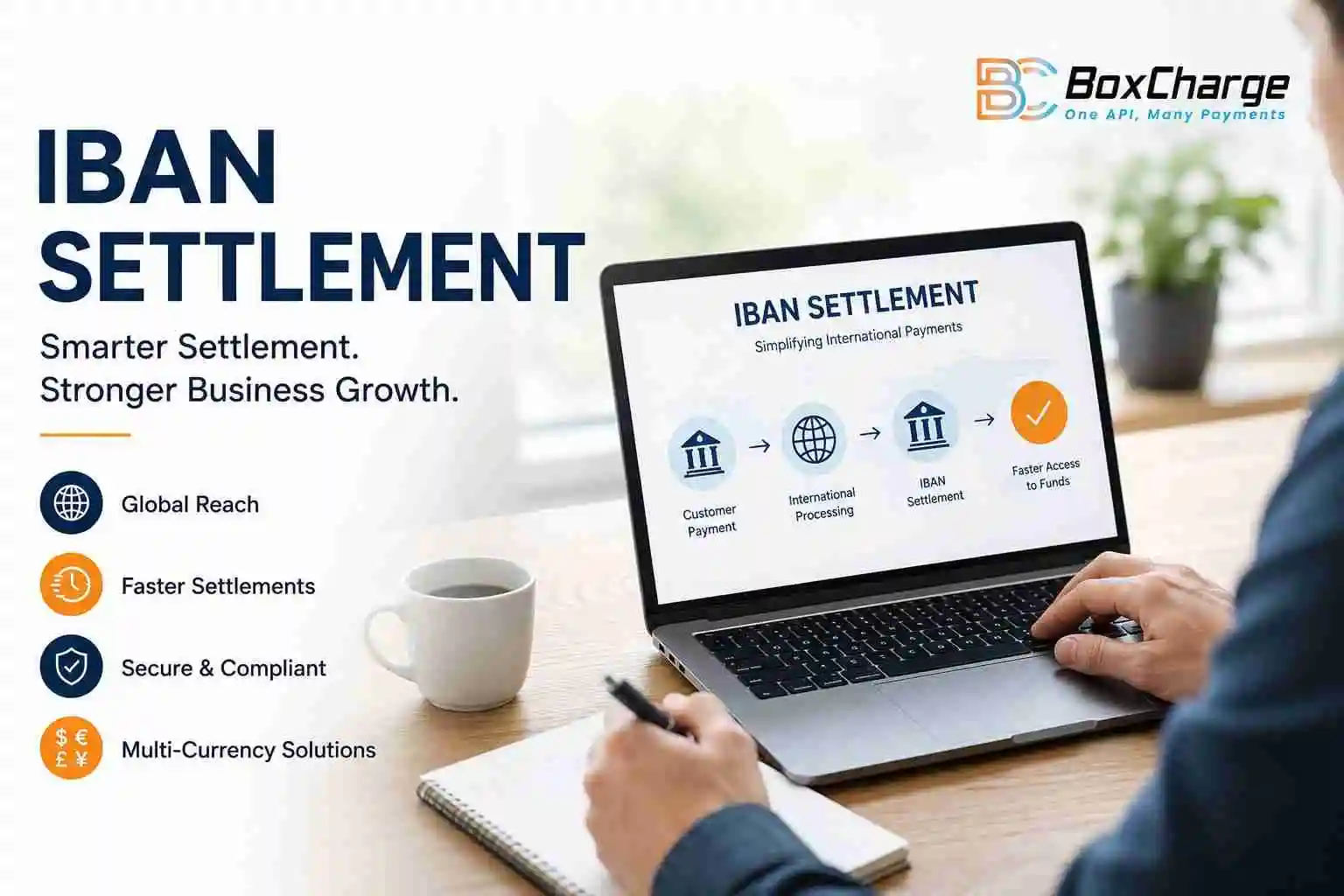
In a typical payment journey:
A customer completes a payment online.
The transaction is authorized.
The acquiring bank captures the funds.
The payment enters the settlement cycle.
The settled amount is transferred to your dedicated IBAN account.
Your business can hold, convert, or transfer the funds internationally.
This standardized approach helps reduce processing errors while improving the efficiency of cross-border payments.
Why IBAN Settlement Is Important for International Businesses
Global commerce has changed dramatically over the last decade.
Today, businesses can sell products and services to customers almost anywhere in the world. However, international banking hasn't always evolved at the same pace.
Without the right settlement infrastructure, businesses often experience unnecessary complexity.
1: Faster Access to Business Funds
Delayed settlements create unnecessary pressure on working capital.
Whether you're paying suppliers, funding marketing campaigns, or processing customer refunds, every extra day can affect business performance.
An optimized IBAN settlement solution helps businesses receive funds more efficiently, reducing delays associated with international transfers.
2: Better Multi-Currency Management
Many online businesses accept payments in USD, EUR, GBP, CAD, AUD, and other currencies.
Managing separate local bank accounts for every market is expensive and operationally inefficient.
IBAN-enabled accounts simplify multi-currency payment processing by allowing businesses to receive international funds through a centralized banking structure, making reconciliation easier and reducing administrative overhead.
3: Improved Cash Flow
Cash flow is one of the biggest concerns for high-risk merchants.
Revenue locked in lengthy settlement cycles cannot be reinvested into business growth.
With faster access to settled funds, businesses can better manage payroll, supplier invoices, inventory purchases, software subscriptions, advertising budgets, and customer support operations.
For growing companies, improved settlement efficiency directly contributes to financial stability.
4: Reduced International Payment Errors
International wire transfers occasionally fail because of incorrect account information or formatting inconsistencies.
The standardized structure of an IBAN reduces these issues by allowing banks to validate account details more effectively before processing international transactions.
Fewer failed payments mean less administrative work and a better experience for both businesses and banking partners.
5: Simplified Global Banking
Businesses expanding internationally often find themselves managing relationships with several banks across multiple jurisdictions.
IBAN settlement simplifies global banking by providing a standardized method of receiving international payments without the operational complexity of maintaining numerous local banking relationships.
IBAN Settlement vs Traditional International Bank Transfers
Many businesses assume that all international bank transfers work the same way, but there are important differences.
Traditional international transfers often pass through several correspondent banks before reaching the beneficiary account. Each intermediary can introduce additional processing time, fees, and compliance checks.
IBAN settlement helps standardize the destination account information, making it easier for participating banks to route payments accurately. While an IBAN does not eliminate intermediary banks in every case, it significantly improves the efficiency and reliability of cross-border transfers, particularly within regions where the IBAN standard is widely adopted.
For businesses handling frequent international transactions, this can lead to fewer payment errors, improved reconciliation, and more predictable settlement timelines.
IBAN Settlement vs SWIFT: What's the Difference?
One of the most common misconceptions is that IBAN and SWIFT are interchangeable. They are not.
An IBAN identifies the specific bank account that should receive the funds. It acts as the destination address for the payment.
A SWIFT/BIC code, on the other hand, identifies the financial institution responsible for handling the transfer. It functions more like identifying the bank itself rather than the individual account.
In many international transactions, both pieces of information work together. The SWIFT network helps route the payment between financial institutions, while the IBAN ensures the funds are credited to the correct account.
For businesses involved in international payment processing, understanding this distinction is important when setting up banking details, reducing payment failures, and ensuring smoother cross-border settlements.
How IBAN Settlement Supports High-Risk Merchant Accounts
For businesses operating in high-risk industries, payment processing doesn't end once a customer completes a transaction. The real challenge often begins after the payment is approved. Delayed settlements, banking restrictions, rolling reserves, and sudden account reviews can disrupt cash flow and make it difficult to run day-to-day operations.
This is why many businesses are adding IBAN settlement to their overall high-risk payment processing strategy.
An IBAN account doesn't replace a high-risk merchant account. Instead, it complements it by providing a more efficient way to receive and manage settled funds. When combined with a reliable payment gateway and international merchant services, an IBAN account helps create a payment infrastructure that's better suited for businesses operating across multiple countries.
For example, an online trading platform receiving payments from clients in Europe, the Middle East, and Asia may struggle to reconcile settlements arriving through different banking channels. A dedicated IBAN account provides a centralized destination for incoming funds, making reconciliation easier and reducing operational complexity.
Similarly, subscription businesses with recurring international payments often benefit from streamlined settlement processes that improve cash flow and reduce the administrative burden on finance teams.
For high-risk merchants, every improvement in settlement efficiency translates into better financial planning and greater confidence when expanding into new markets.
Industries That Benefit the Most from IBAN Settlement
Although businesses across many sectors use IBAN accounts, some industries depend on them more than others because of their international customer base and complex payment flows.
These include:
High-risk businesses
Forex and CFD brokers
Travel agencies and tour operators
SaaS and software companies
E-commerce businesses selling internationally
Digital marketing agencies
Subscription-based businesses
Online education platforms
International B2B service providers
Affiliate marketing companies
Export and import businesses
These industries often receive payments in multiple currencies while paying suppliers, partners, or employees across different countries. Without an efficient settlement solution, managing international cash flow becomes increasingly difficult as the business grows.
Key Features to Look for in an IBAN Settlement Solution
Not every provider offers the same level of service. Choosing the right payment partner is just as important as choosing the right technology.
Here are the features businesses should prioritize when evaluating an IBAN settlement solution.
1: Multi-Currency Support
Global businesses rarely operate in a single currency. Look for a provider that supports major currencies such as EUR, USD, GBP, CAD, and others to reduce unnecessary foreign exchange conversions and simplify international transactions.
2: Faster Settlement Cycles
Settlement speed has a direct impact on cash flow. Providers offering faster settlement cycles can help businesses access working capital sooner, making it easier to manage operational expenses and invest in growth.
3: Compliance and Regulatory Expertise
International payments involve strict regulatory requirements, including Know Your Customer (KYC), Anti-Money Laundering (AML), and sanctions screening. A provider experienced in supporting high-risk industries can help businesses navigate these requirements more efficiently.
4: Integration With Payment Infrastructure
Your IBAN settlement solution should work seamlessly with your existing payment gateway, merchant account, fraud prevention tools, and financial reporting systems. Smooth integration reduces manual work and improves operational efficiency.
5: Transparent Pricing
International banking fees can quickly add up. Look for providers with transparent pricing structures that clearly explain settlement fees, foreign exchange charges, and any additional costs associated with cross-border transfers.
6: Dedicated Account Management
Payment issues can affect revenue, customer satisfaction, and business continuity. Having access to experienced payment specialists who understand international settlements can make resolving issues much faster.
Common Mistakes Businesses Make With IBAN Settlement
Many businesses adopt an IBAN account expecting it to solve every payment challenge. While it can significantly improve international settlements, it's only one part of a broader payment ecosystem.
Some of the most common mistakes include:
1: Assuming an IBAN replaces a Merchant Account
An IBAN account helps businesses receive settled funds, but it does not process customer card payments. You'll still need a merchant account and a secure payment gateway to accept online payments.
2: Ignoring Currency Conversion Costs
Holding funds in multiple currencies without a clear foreign exchange strategy can increase costs. Businesses should understand when to convert funds and how exchange rates affect profitability.
3: Choosing Price Over Reliability
The cheapest provider isn't always the best option. Settlement delays, poor customer support, and limited banking coverage can cost far more than slightly higher service fees.
4: Overlooking Compliance
Businesses operating internationally must ensure they comply with local regulations, tax requirements, and banking rules. Choosing an experienced payment partner can help reduce compliance risks.
Why Businesses Are Moving Toward Global Settlement Solutions
Cross-border commerce continues to grow, and customer expectations have changed. Buyers expect businesses to accept local payment methods, support multiple currencies, and process payments quickly.
To meet these expectations, businesses need a payment infrastructure that goes beyond traditional banking.
Modern global payment solutions combine payment gateways, merchant accounts, fraud prevention, currency management, and IBAN settlement into a single ecosystem. This approach gives businesses greater visibility into payment operations while simplifying international expansion.
Instead of managing multiple banking relationships across different countries, companies can centralize payment operations and focus on growing their business.
How BoxCharge Helps Businesses Simplify International Payments
At BoxCharge, we understand that high-risk businesses face payment challenges that traditional banks and standard payment providers often aren't equipped to handle.
Whether you're launching a new business or expanding into international markets, having the right payment infrastructure is essential for sustainable growth.
Our solutions are designed to help businesses access:
High-Risk Merchant Accounts
International Payment Processing
Global Payment Solutions
Dedicated IBAN Accounts
Multi-Currency Payment Solutions
Secure Payment Gateways
Cross-Border Payment Support
Merchant Services for High-Risk Industries
By combining these services into a scalable payment ecosystem, businesses can reduce settlement delays, improve cash flow, and manage international transactions more efficiently.
Frequently Asked Questions About IBAN Settlement
Q: What is IBAN settlement?
IBAN settlement is the process of transferring settled business funds into an account identified by an International Bank Account Number (IBAN). It simplifies international banking by using standardized account information for cross-border payments.
Q: Is an IBAN the same as a merchant account?
No. A merchant account is used to accept customer card payments, while an IBAN account is used to receive and manage settled funds after payment processing is complete.
Q: Do high-risk businesses need an IBAN account?
Not every business requires one, but companies processing international payments or operating across multiple countries often benefit from having an IBAN account to simplify settlements and improve cash flow.
Q: Can an IBAN account support multiple currencies?
Many providers offer multi-currency capabilities, allowing businesses to receive payments in different currencies while managing funds more efficiently.
Q: Does an IBAN replace SWIFT?
No. An IBAN identifies the destination account, while the SWIFT/BIC code identifies the bank handling the transfer. International payments often require both.
Q: How can IBAN settlement improve international payment processing?
By reducing payment errors, simplifying reconciliation, supporting cross-border transactions, and helping businesses receive funds more efficiently, IBAN settlement strengthens overall payment operations.
Final Thoughts
As international commerce continues to evolve, businesses need a payment infrastructure that supports speed, security, and scalability. IBAN Settlement is no longer just a banking feature—it's a practical solution for businesses that want to improve international payment processing, simplify cross-border payments, and manage global cash flow more effectively.
For high-risk merchants, the benefits are even greater. Faster settlements, improved banking flexibility, better multi-currency management, and streamlined financial operations can help overcome many of the challenges associated with operating in regulated or high-risk industries.
However, an IBAN account is only one part of a successful payment strategy. To build a resilient payment ecosystem, businesses should combine IBAN settlement with a reliable high-risk merchant account, secure payment gateway, robust fraud prevention tools, and experienced international merchant services.
If your business is facing settlement delays, banking limitations, or difficulties expanding into international markets, BoxCharge can help. Our team works with businesses across high-risk industries to deliver tailored global payment solutions, international payment processing, and merchant services that support long-term growth. Contact boxcharge today to discover how the right payment infrastructure can help your business move money faster, operate more efficiently, and expand with confidence.
Looking for a reliable IBAN settlement solution? Contact BoxChrge today to discuss your payment requirements and discover a customized solution that helps your business accept, manage, and settle international payments with confidence.