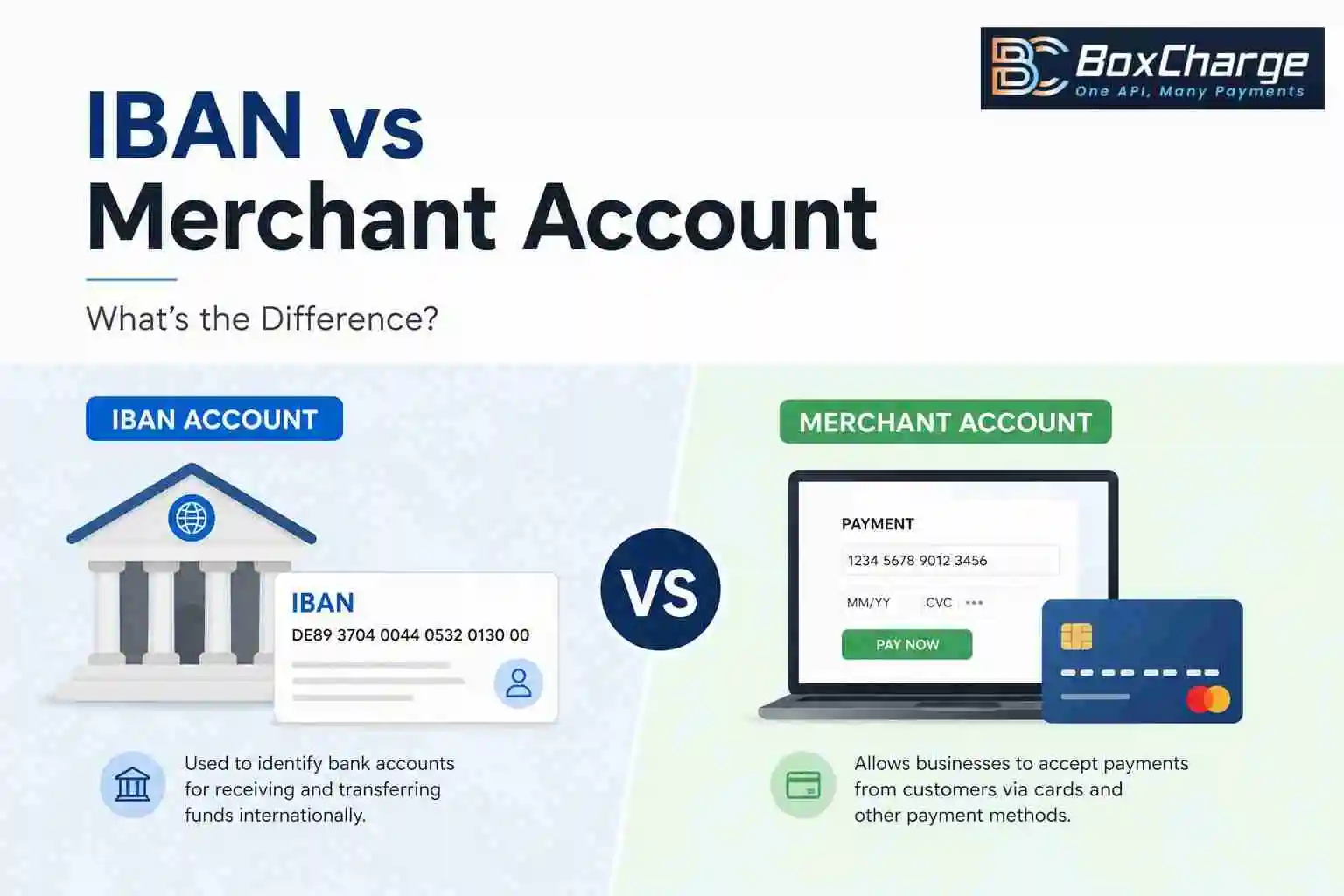
IBAN vs merchant account is a common point of confusion for businesses moving into international payments. Both are important parts of a modern payment infrastructure, but they solve very different problems. An IBAN helps identify and manage a bank account for receiving and sending funds, while a merchant account is designed to let a business accept card payments and other transactions before those funds are settled.
For high-risk merchants, understanding the difference matters even more. A business can have a perfectly functional IBAN account and still be unable to accept card payments. Likewise, having a high-risk merchant account does not automatically solve every international banking or settlement problem.
The simplest way to look at it is this: a merchant account helps you accept payments; an IBAN account helps you receive, hold, and move funds through banking networks.
IBAN vs Merchant Account: The Basic Difference
An IBAN (International Bank Account Number) is an internationally standardized account identifier used to route bank transfers to the correct account. It is commonly associated with cross-border payments, particularly within regions and banking systems that use IBAN standards.
A merchant account, on the other hand, is a type of account or acquiring arrangement used to process payments made by customers through cards and, depending on the provider and setup, other payment methods.
That distinction becomes clearer when you follow the money.
Suppose an online business sells a service for €500.
A customer pays by card. The transaction goes through the payment gateway and acquiring infrastructure, and the merchant's payment arrangement handles authorization, processing, and settlement. The resulting funds can then be paid out to the merchant's designated business bank account or IBAN account.
In that example, the merchant account is part of the payment acceptance process. The IBAN is associated with the banking side of receiving and moving the settled funds.
They are complementary rather than interchangeable.
What Is an IBAN Account?
An IBAN is essentially a standardized way of identifying a bank account for international transfers. It contains information used to identify the country, financial institution, and individual account.
Businesses may use an IBAN account for business to receive customer payments, supplier transfers, marketplace payouts, international settlements, or funds from payment providers, depending on the account and provider's permitted use.
For internationally active companies, an IBAN can make the banking side of cross-border transactions more straightforward.
However, an IBAN is not a substitute for a payment gateway or merchant account.
If a business wants to accept Visa or Mastercard payments directly from customers, simply having an IBAN does not give it card-processing capability. Card acceptance requires the appropriate acquiring and payment-processing infrastructure.
This distinction is particularly important for online businesses that assume opening an international business account automatically means they can start accepting card payments.
It doesn't.
What Is a Merchant Account?
A merchant account is used to support the acceptance and processing of customer payments, particularly card transactions.
When a customer enters card details during checkout, several stages can take place behind the scenes:
The payment is submitted through the checkout or payment gateway.
The transaction is routed to the appropriate payment infrastructure.
The issuing bank or payment network participates in authorization.
The transaction is captured and cleared.
Funds are eventually settled to the merchant according to the agreed settlement arrangement.
The merchant account therefore sits much closer to the payment acceptance side of the transaction.
Businesses looking for a merchant account for online business may also need a payment gateway, fraud controls, transaction monitoring, chargeback management, and an appropriate settlement account. The exact structure depends on the provider, business model, location, transaction profile, and risk classification.
For ordinary businesses, this distinction is useful. For high-risk businesses, it is essential.
Why High-Risk Merchants Often Need Both
High-risk businesses frequently face a more complicated payment environment than conventional merchants.
Industries such as forex, gaming, travel, subscription services, digital goods, nutraceuticals, adult-oriented businesses, and certain financial services can receive greater scrutiny from payment providers because of factors such as chargeback exposure, regulatory complexity, customer disputes, transaction patterns, or cross-border activity.
That can make securing a high-risk merchant account only one part of the problem.
Consider a growing online business that has customers across several markets. It may successfully obtain card-processing capabilities but still encounter:
Longer settlement cycles
Rolling reserves
Payment holds
Additional compliance reviews
Limited banking relationships
Currency-conversion costs
Cross-border transfer delays
Difficulty moving settled funds between jurisdictions
This is where the difference between payment acceptance and settlement becomes very real.
A merchant might process €100,000 in legitimate customer transactions but still experience operational pressure if a portion of the funds remains unavailable during a reserve or settlement period.
The business still has payroll, advertising expenses, technology bills, suppliers, refunds, and other obligations to cover.
That is why high-risk payment processing should not be evaluated solely on whether a provider can approve an account. Settlement structure and banking access matter just as much to day-to-day cash flow.
IBAN vs Merchant Account: A Practical Comparison
Feature | IBAN Account | Merchant Account |
Primary purpose | Banking and fund transfers | Payment acceptance and processing |
Common use | Receiving/sending bank transfers | Accepting card payments |
Card acceptance | Not inherently included | Designed to support card processing |
Cross-border transfers | Yes, where supported | Depends on acquiring setup |
Settlement destination | Can receive settled funds | Handles merchant payment settlement |
Chargeback management | Generally not its primary function | Relevant to card-processing operations |
Fraud/payment monitoring | Depends on banking provider | Common part of payment processing |
Suitable for high-risk businesses | Depends on provider and compliance | Specialized high-risk arrangements may be available |
Replaces the other? | No | No |
The table highlights the central point: IBAN and merchant accounts serve different functions within the payment ecosystem.
Why an IBAN Alone Is Not Enough for Online Payments
One of the most common mistakes businesses make is treating an IBAN as if it were a complete payment solution.
It isn't.
An IBAN may allow a business to receive a bank transfer, but customers shopping online may expect to pay with cards, digital wallets, or alternative payment methods.
Imagine an international software company that publishes its IBAN on an invoice and asks every customer to make a bank transfer. That may work for certain B2B transactions, but it creates friction for consumers who expect a quick checkout.
Bank transfers can require customers to leave the checkout, enter beneficiary details, authenticate the transaction, and wait for funds to arrive.
A payment gateway can provide a much smoother customer-facing experience for supported payment methods.
For this reason, businesses often use both banking and payment-processing infrastructure rather than attempting to make one replace the other.
Why a Merchant Account Alone May Not Solve Settlement Problems
The opposite assumption can be just as problematic.
A merchant may think that securing a high-risk payment gateway or merchant account means every payment-related problem has been solved.
In practice, the quality of the settlement arrangement matters.
High-risk merchants can face stricter underwriting, transaction monitoring, reserves, payout restrictions, and periodic reviews. These measures can affect how quickly processed revenue becomes usable business cash.
For a merchant operating internationally, the next question is often: Where will the settled money go, and how efficiently can the business access it?
That is where an appropriate business banking or IBAN settlement arrangement can become useful.
The goal is not to choose between an IBAN and a merchant account. The goal is to build a payment structure in which the two perform their respective roles effectively.
IBAN Settlement and High-Risk Payment Processing
IBAN settlement is particularly relevant when merchants operate across borders or need a practical destination for settled funds.
For example, a high-risk merchant may accept customer payments through a specialized acquiring arrangement. Once those transactions are processed and settled, the funds may be transferred to a designated account.
An appropriate IBAN-based settlement structure can help organize the banking side of that process, subject to the provider's terms, supported currencies, jurisdiction, compliance requirements, and settlement arrangements.
This can be important for businesses managing multiple currencies.
Without an efficient settlement structure, international merchants may encounter unnecessary foreign exchange conversions, intermediary-bank delays, additional transfer fees, or difficulties reconciling incoming funds.
The issue is not simply whether money eventually arrives. For a growing merchant, when the money arrives, in which currency, and through which account can directly affect financial planning.
What High-Risk Merchants Should Look At
Choosing between an IBAN and a merchant account is actually the wrong question for most international businesses.
The better question is: What does my complete payment infrastructure need to accomplish?
A high-risk merchant should consider several factors.
1. Payment acceptance
Can customers pay using the methods they actually prefer?
For many online businesses, this means considering cards, digital wallets, bank payments, and relevant alternative payment methods.
2. Settlement timing
How long does it typically take for processed funds to become available?
Merchants should understand settlement schedules, reserve requirements, and any circumstances that can result in delayed payouts.
3. Banking compatibility
Can the business receive and manage its settled funds through an appropriate business account?
This becomes particularly important when the merchant operates internationally.
4. Currency support
A business selling in euros, pounds, and US dollars may want to avoid unnecessary conversions and understand how each currency will be settled.
5. Compliance requirements
High-risk payment processing involves additional scrutiny in many cases. Merchants should provide accurate information about their business model, ownership, expected transaction volumes, customer locations, products or services, and transaction flows.
Trying to hide the true nature of a business can create bigger problems later.
6. Chargeback and fraud exposure
A payment solution should be assessed not just on approval but on how it manages the operational realities of disputes, fraud monitoring, refunds, and chargebacks.
Which Is Better: IBAN or Merchant Account?
There is no universal winner because they are not competing products.
If the primary requirement is receiving and sending bank transfers, an appropriate IBAN-enabled business account may be relevant.
If the requirement is accepting card payments online, a merchant account and payment gateway are generally the relevant infrastructure.
If a business operates internationally and needs both card acceptance and efficient settlement, it may need both a merchant account and an IBAN-based settlement solution.
For high-risk merchants, the relationship between these components becomes even more important. A payment provider may approve processing, but the merchant still needs a reliable way to manage settled revenue. Conversely, having a suitable banking account does not solve the challenge of accepting card payments.
The Bottom Line
The IBAN vs merchant account distinction becomes much easier once their roles are separated.
An IBAN identifies a bank account and supports the movement of funds through banking networks. A merchant account supports payment acceptance and processing. One is primarily on the banking and settlement side; the other is on the acquiring and payment-processing side.
For high-risk businesses, this distinction can directly impact cash flow and operational stability. Delayed settlements, rolling reserves, payment holds, limited banking options, currency issues, and enhanced compliance reviews can make payment infrastructure considerably more complicated.
That is why high-risk merchants should assess the entire payment journey rather than choosing a solution based solely on whether an account is available.
At BoxCharge, the focus is on helping businesses understand how high-risk merchant accounts, international payment processing, IBAN settlement, and cross-border payment infrastructure fit together. The right structure depends on the merchant's business model, jurisdictions, risk profile, transaction volume, and compliance requirements.
In short: an IBAN helps move and manage business funds; a merchant account helps you accept customer payments. For many international and high-risk businesses, they work best as complementary parts of the same payment infrastructure.