Payment orchestration vs payment gateway is an important distinction for businesses that are processing payments across multiple markets, currencies, payment methods, or acquiring partners. The two technologies work together, but they solve different problems.
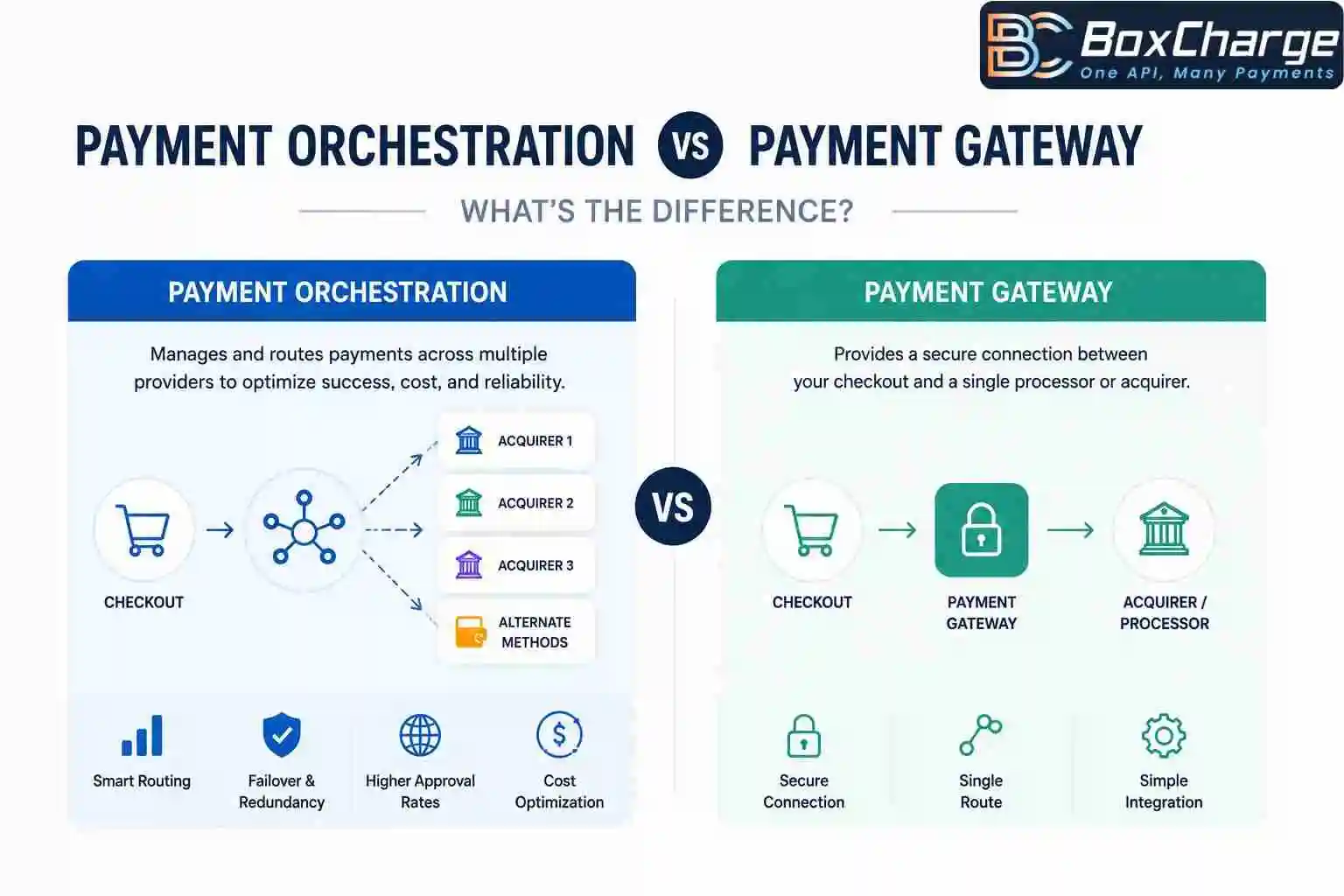
A payment gateway primarily provides the connection that securely carries a payment request from the checkout to a processor or acquiring setup. Payment orchestration operates at a broader level, coordinating multiple gateways, processors, acquirers, payment methods, routing rules, and fallback options through a unified layer.
That difference may not matter much when a business has one market, one payment provider, and a relatively simple payment flow.
It matters considerably more once payments become complicated.
For high-risk merchants, the difference can be even more important. A single acquiring relationship can leave a business exposed to processing interruptions, changing risk decisions, regional limitations, and inconsistent authorization performance. When payment revenue is the lifeline of the business, having more control over how transactions are routed can become a practical necessity rather than a technology upgrade.
What Is a Payment Gateway?
A payment gateway is the technology that securely transfers payment information between the customer's checkout and the relevant payment processor or acquiring infrastructure.
When a customer enters card details and clicks Pay, the gateway helps transmit the transaction for authorization and returns the response to the merchant's system.
In a traditional setup, the payment flow may look something like this:
Customer → Checkout → Payment Gateway → Processor/Acquirer → Card Network → Issuing Bank
The response then travels back through the chain so the merchant knows whether the payment was approved or declined.
A gateway therefore performs an essential job. Without a suitable payment connection, an online business cannot simply accept card transactions from its website.
For a smaller merchant with straightforward requirements, this can be enough.
If the business operates in one country, primarily accepts cards, has one acquiring relationship, and isn't experiencing significant payment-performance problems, adding a sophisticated orchestration layer may create more complexity than value.
What Is Payment Orchestration?
Payment orchestration sits above individual payment providers and gives a merchant one layer through which multiple payment gateways, processors, acquirers, and payment methods can be managed.
Instead of sending every transaction down the same payment path, an orchestration platform can apply configured rules to determine which route should handle a particular transaction.
For example, routing logic may consider:
Customer geography
Card or payment method
Currency
Acquirer availability
Transaction value
Historical approval performance
Processing cost
Provider health
Failover requirements
A simplified architecture looks like this:
Customer → Checkout → Payment Orchestration Layer → Gateway/Processor/Acquirer A, B, or C
This gives the merchant considerably more control over its payment infrastructure. Current industry explanations from Stripe, PayPal/Braintree, and Adyen similarly describe orchestration as a layer that can coordinate multiple providers and apply routing or failover logic.
But there is an important point here: payment orchestration does not magically make every transaction succeed.
The quality of the underlying acquirers, routing rules, merchant setup, risk controls, payment methods, and individual transactions all still matter. Adyen specifically notes that orchestration does not guarantee better authorization rates, lower costs, or improved customer experience.
Payment Gateway vs Payment Orchestration: The Main Difference
The simplest way to understand the difference is this:
A payment gateway provides a payment connection. Payment orchestration manages payment connections.
A gateway is primarily concerned with moving the transaction through a particular processing path.
Orchestration is concerned with deciding which processing path should be used and what should happen if that path doesn't perform as expected.
Feature | Payment Gateway | Payment Orchestration |
Primary role | Connects checkout to payment processing | Coordinates multiple payment providers |
Provider setup | Often one primary route | Multiple gateways, processors or acquirers |
Routing | Generally fixed or provider-defined | Configurable rules-based routing |
Failover | Limited or dependent on provider | Can route eligible transactions to alternatives |
Multi-acquirer support | Limited | Core capability |
Regional optimization | Depends on provider | Can route based on geography and other rules |
Payment-method expansion | Provider dependent | Multiple providers/methods can be managed through one layer |
Reporting | Often provider-specific | Can centralize payment data |
Complexity | Lower | Higher |
Best suited for | Simpler payment setups | Complex or growing payment operations |
The distinction becomes increasingly relevant when a business expands internationally or starts working with multiple payment providers.
Why High-Risk Merchants Feel the Difference More
High-risk merchants often don't have the luxury of treating payment processing as a simple plug-and-play service.
A merchant account can be perfectly functional one month and then become harder to manage after a change in transaction volume, chargeback levels, customer geography, or acquiring-bank risk policy.
That creates a difficult situation.
Imagine an online business processing most of its transactions through one acquiring relationship. One afternoon, that provider experiences an outage or begins declining a larger percentage of transactions from a particular region.
The merchant's checkout is still working.
The website is still online.
Customers are still clicking Pay.
But the revenue isn't coming through.
With a single gateway and processing path, there may be very little the merchant can do immediately.
This problem can be particularly painful for high-risk merchant accounts, where finding another acquiring relationship may take time because underwriting is more involved.
Payment orchestration can provide an additional layer of resilience by connecting multiple acquiring or processing routes and allowing eligible transactions to be redirected according to configured rules.
BoxCharge's own orchestration infrastructure, for example, describes multi-acquirer connectivity, cascading logic, failover, regional optimization, MDR-aware routing, and performance monitoring as components of its payment orchestration solution.
The point isn't that every high-risk merchant needs orchestration.
The point is that single-provider dependency can become a much bigger business risk when payment acceptance is already difficult to replace.
How Payment Orchestration Can Improve Payment Operations
1. Smarter Transaction Routing
Different acquirers can perform differently for different transaction profiles.
A transaction from a particular region may have a better outcome through one acquiring route, while another route may be more appropriate for a different market or payment method.
Orchestration allows businesses to establish routing rules around these differences.
This can help merchants make payment decisions based on actual processing requirements rather than sending every transaction through the same route.
2. Failover When a Provider Has Problems
Payment downtime is expensive.
If a primary provider becomes unavailable, an orchestration layer can potentially redirect eligible transactions to an alternative route.
That doesn't eliminate outages. It simply reduces the risk that one provider's problem automatically becomes the merchant's problem.
3. Better Control Over Multiple Acquirers
As a business grows, it may work with several acquiring partners for geographic, risk, currency, or performance reasons.
Managing those relationships independently can quickly become messy.
Each provider may have different reporting formats, response codes, integrations, settlement arrangements, and operational processes.
An orchestration layer can create a more unified operating model.
4. International Payment Flexibility
Cross-border payments introduce additional variables.
A merchant may need different payment methods, currencies, acquiring relationships, or processing routes depending on the customer's location.
Orchestration can help coordinate these routes without requiring the merchant to build a completely separate checkout architecture for every market.
5. Centralized Payment Visibility
When transactions are spread across multiple providers, reporting can become fragmented.
Finance teams may have to compare separate dashboards, reconcile different transaction identifiers, and piece together information from several sources.
A well-designed orchestration layer can provide a more consistent view of transaction activity, routing, and performance.
That can make it easier to identify where declines are happening and where payment performance needs attention.
Payment Gateway vs Payment Orchestration: Which One Do You Need?
The answer depends on the complexity of your payment operation.
A payment gateway may be enough if:
You operate primarily in one market.
You use one main processor or acquirer.
Your payment volume is relatively manageable.
Your customers mainly use one or two payment methods.
You don't need sophisticated routing.
Your current authorization performance is acceptable.
Provider dependency isn't creating operational problems.
There is no benefit in adding technology simply because it sounds more advanced.
Payment orchestration becomes more attractive if:
You work with multiple acquirers or processors.
You operate across several countries.
You need local payment methods.
Your payment volume is growing quickly.
You experience meaningful differences in approval rates between providers.
You need automatic failover.
You want more control over payment routing.
Your finance team is struggling with fragmented payment reporting.
A single provider represents too much operational risk.
Businesses that have outgrown a single payment provider are often the ones that gain the most from orchestration. Recent industry guidance similarly points to transaction volume, geographic reach, payment-method diversity, and provider dependency as important factors when deciding whether orchestration is justified.
Does Payment Orchestration Replace a Payment Gateway?
No.
This is one of the most common misunderstandings.
Payment orchestration doesn't make payment gateways unnecessary. It typically works with gateways, processors, acquirers, fraud tools, and other payment services.
Think of a gateway as one road into the payment system.
Think of orchestration as the traffic-management layer that can decide which available road should be used.
The exact architecture varies between providers, but the basic concept remains the same: orchestration adds control across multiple payment connections rather than replacing the underlying payment infrastructure.
The Cost Question: Is Orchestration Worth It?
This is where businesses should be realistic.
Payment orchestration can introduce additional technology, integration, configuration, monitoring, and operational requirements. It is not automatically cheaper than using one gateway.
However, looking only at the orchestration fee misses the larger picture.
A merchant should consider the cost of:
Failed transactions
Provider downtime
Poor authorization performance
Duplicate integrations
Manual reconciliation
Limited market coverage
Payment-provider dependency
Slow expansion into new markets
For a small business, those costs may not justify orchestration.
For a high-volume international merchant, they can become much more significant.
Payment Orchestration Is About Control, Not Just More Providers
One of the biggest misconceptions is that payment orchestration simply means connecting five or ten payment providers.
That's only part of it.
The real value comes from how those connections are managed.
A merchant might have multiple gateways but still route every transaction through one provider. In that case, simply having additional integrations doesn't necessarily solve the underlying problem.
The orchestration layer needs appropriate routing rules, monitoring, fallback logic, reporting, and operational oversight.
This is especially important for high-risk merchants.
If an operator has several acquiring relationships but doesn't understand which routes perform best for particular markets, transaction types, or payment methods, the additional connections may create more complexity without producing better outcomes.
Final Thoughts
The payment orchestration vs payment gateway debate isn't really about deciding which technology is better.
It's about deciding how much control your payment operation actually needs.
A payment gateway can be the right choice for a straightforward merchant with a single primary processing route. It provides the essential connection between checkout and payment processing without adding unnecessary infrastructure.
Payment orchestration becomes more compelling when the business has multiple providers, international customers, several payment methods, growing transaction volumes, or concerns about single-provider dependency.
For high-risk merchants, that distinction deserves particular attention. Payment account stability, authorization performance, geographic coverage, and access to alternative processing routes can directly affect revenue and cash flow.
The strongest payment infrastructure is not necessarily the most complicated one. It is the one that matches the merchant's actual needs and gives the business enough flexibility to grow without turning payment processing into a bottleneck.
For businesses evaluating payment orchestration, BoxCharge provides a payment orchestration layer with multi-acquirer connectivity, cascading payment logic, failover, regional optimization, and performance monitoring.
The goal isn't simply to process more payments. It's to build a payment operation that can keep working when the business, its customers, and its markets become more complex.