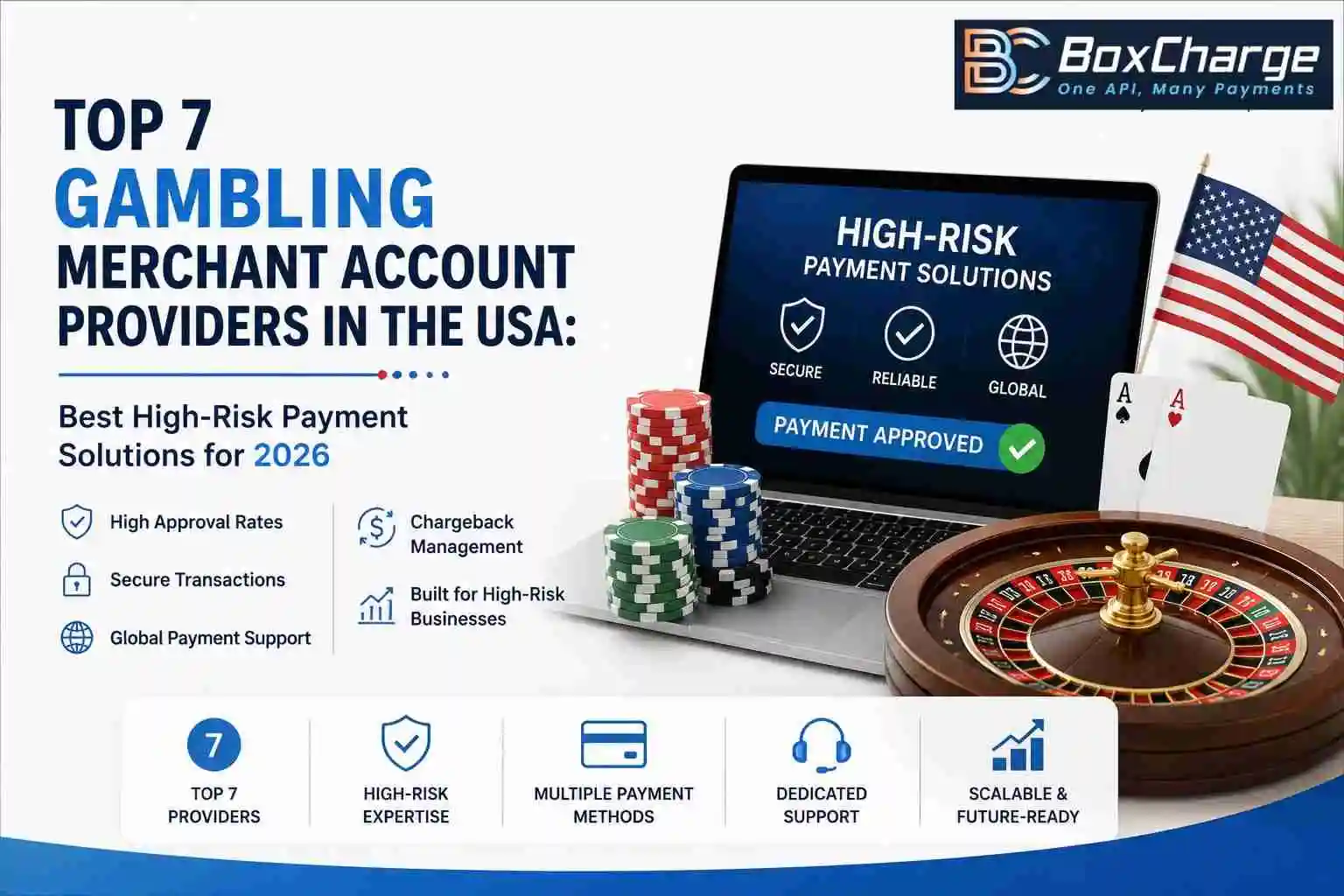
Who are the top 7 gambling merchant account providers in the USA? The U.S. gambling industry is bigger than ever, but accepting payments remains one of the toughest challenges for online casinos, sportsbooks, poker rooms, betting platforms, and iGaming operators. According to the American Gaming Association's State of the States 2026 report, U.S. commercial gaming generated $78.62 billion in revenue during 2025, 9.1% more than the previous year. Thirty-four of 38 commercial gaming jurisdictions also set annual revenue records.
That growth makes payment acceptance increasingly important. A gambling operator can invest heavily in player acquisition, technology, licensing, and marketing, only to lose revenue when deposits fail, transactions are declined, funds are held, or a payment account is suddenly reviewed.
A Gambling merchant account is designed to handle the additional underwriting and payment risks associated with gambling-related transactions. Visa's Merchant Data Standards Manual identifies online gambling transactions under MCC 7995, covering betting, casino gaming, wagers, lottery tickets, and games of chance involving monetary prizes. Visa also identifies MCC 7995 among its high-integrity-risk categories.
For operators searching for iGaming merchant account services, the challenge is therefore not simply finding a payment gateway. The objective is finding a processing structure that fits the business model, licensing position, transaction profile, customer geography, and risk exposure.
Below are seven providers and payment brands worth researching when evaluating the U.S. gambling payments market.
1. BoxCharge
BoxCharge specializes in payment infrastructure for high-risk businesses and offers solutions aimed at gambling and gaming merchants.
Its gambling merchant account solution addresses the payment requirements of businesses such as online casinos, sportsbooks, poker platforms, and other gaming operators. The solution focuses on areas that matter to high-risk merchants, including payment gateway integration, fraud prevention, 3D Secure, chargeback management, international processing, and multi-currency payments.
For gambling operators, this specialization can be important because conventional payment processors may not be structured around the risk profile of gaming businesses.
A dedicated high-risk payment provider can help merchants evaluate acquiring options based on their actual business model instead of attempting to fit a gambling operation into a standard eCommerce processing setup.
Potential fit: Online casinos, sportsbooks, poker platforms, fantasy gaming and other high-risk gaming businesses.
2. PayCly
PayCly is another provider focused on high-risk and international payment processing.
Its gambling merchant account service identifies gambling as a high-risk category and discusses issues such as chargebacks, fraud, regulatory requirements, transaction volume, and international payments.
PayCly also promotes multiple payment methods and currencies for gambling businesses, giving operators the ability to consider card payments alongside alternative payment methods and other payment channels.
This can be particularly relevant for international gambling businesses because players in different markets may have very different payment preferences.
For operators evaluating payment solutions for betting platforms, payment-method diversity can become a competitive consideration. A customer who cannot use their preferred payment method may simply abandon the deposit process.
Potential fit: Gambling, casino, gaming and international high-risk businesses requiring multi-currency and alternative payment capabilities.
3. WebPays
WebPays focuses on high-risk payment processing and identifies gaming, gambling, casino and betting businesses among the sectors it serves.
Its published information highlights payment gateway infrastructure and international payment processing for high-risk merchants. WebPays also discusses gaming merchant accounts and the payment difficulties experienced by businesses operating in high-risk industries.
The problem is familiar to many gambling operators: an account may be approved initially, but processing can become more complicated when transaction volumes increase or a merchant experiences higher chargeback activity.
This is why merchants should look beyond an advertised processing rate. A reliable setup should also be evaluated for settlement terms, reserves, transaction limits, fraud controls, chargeback management, and support.
Potential fit: Gaming, casino, betting and other high-risk online businesses.
4. Amald
Amald provides high-risk payment services and promotes solutions for gambling, casino, betting and iGaming businesses.
Its casino merchant account service addresses online casino payment acceptance, while its FAQ discusses high-risk processing, alternative payment methods and online acquiring.
For an iGaming operator, the attraction of a specialized provider is that payment acceptance can be considered as part of a broader risk-management strategy.
Operators may need card processing, alternative payment methods, multi-currency acceptance, fraud controls and international settlement. Bringing these requirements together can be more practical than building a payment stack around a provider that only supports conventional low-risk businesses.
Potential fit: Online casinos, betting companies, gambling operators and other high-risk merchants.
5. InQuid
InQuid is positioned around high-risk payment processing, international acquiring and payment infrastructure.
Its high-risk payment gateway offering discusses high-risk merchant accounts, international processing, multiple currencies, and payment infrastructure for businesses operating in complex industries.
Gaming and betting businesses can face additional challenges because transactions may involve customers from multiple jurisdictions, different currencies, higher transaction frequency, fraud exposure, and strict acquiring requirements.
Payment routing can also become important as a business grows. When transactions are sent through unsuitable acquiring routes, legitimate customers can experience unnecessary declines.
For this reason, operators should consider not just whether a processor can accept payments, but whether its infrastructure can support the merchant as transaction volumes and customer markets expand.
Potential fit: High-risk businesses, gaming-related operators, international merchants and businesses requiring scalable payment infrastructure.
6. PayPal
PayPal is one of the most recognizable payment brands in the world, but gambling operators should not automatically consider PayPal a gambling merchant account provider.
PayPal's Acceptable Use Policy specifically addresses gambling and gaming activities. Its restricted activities include gambling, gaming, sports betting, casino games, horse and greyhound racing, fantasy sports, lottery tickets, and other activities that facilitate gambling.
That distinction is important.
A major payment brand can be extremely popular with consumers while still being unsuitable for a particular merchant category. Gambling operators should therefore verify eligibility before building their payment strategy around any mainstream wallet or payment platform.
Potential fit: Mainstream businesses that comply with PayPal's applicable policies; gambling eligibility must be confirmed separately.
7. Wise
Wise is another major financial technology platform that frequently appears in searches for international business payments and multi-currency financial services.
However, Wise should not be confused with a specialist gambling merchant account provider.
Its Acceptable Use Policy and product-specific terms determine which activities and services are supported. Gambling and betting businesses should therefore check the current eligibility requirements for their specific activity before considering Wise as part of their payment setup.
This distinction is particularly important for international operators.
A business may need USD, EUR, GBP or other currencies, but having access to multi-currency financial services does not automatically mean that the provider will acquire gambling card transactions.
Potential fit: Eligible international businesses requiring multi-currency financial services; not a default gambling payment-processing recommendation.
Why Gambling Merchants Struggle With Payment Processing
Being classified as high-risk does not automatically mean that a gambling business is illegal or poorly managed.
The classification reflects the financial, operational, regulatory, and fraud exposure associated with the merchant category.
Visa's Merchant Data Standards Manual explicitly requires online gambling transactions to use MCC 7995. The category covers betting, lottery tickets, casino gaming chips, off-track betting, race-track wagers and games of chance involving monetary prizes.
That classification has consequences for underwriting and acquiring.
Chargebacks Are a Major Pain Point
Chargebacks are one of the biggest concerns for high-risk merchants.
The Office of the Comptroller of the Currency's Merchant Processing handbook explains that merchant processing involves a range of risks that acquiring banks need to monitor and manage.
The OCC's merchant-processing guidance specifically discusses monitoring chargeback trends and evaluating merchant-funded chargeback reserves for merchants with significant chargeback exposure.
For gambling businesses, this can become painful very quickly.
A growing sportsbook may process thousands of transactions every day. Even a relatively small percentage of disputed transactions can create significant financial exposure.
That is why chargeback management should be treated as part of the payment strategy rather than something addressed after problems occur.
Rolling Reserves Can Affect Cash Flow
High-risk merchants can also face reserves or other forms of financial protection.
From the acquiring bank's perspective, a reserve can protect against future chargebacks, refunds, and other liabilities. From the merchant's perspective, however, funds being held back can affect cash flow.
This creates a particularly difficult situation for growing gambling businesses.
The operator may have strong revenue growth but still have less immediately available working capital because a portion of processed funds is subject to reserve requirements.
Before signing a merchant-processing agreement, operators should therefore understand:
Rolling reserve percentage
Settlement schedule
Reserve release conditions
Chargeback fees
Refund policies
Transaction limits
Processing volume requirements
Termination clauses
Declined Payments Mean Lost Players
Payment declines are another major pain point.
A customer may discover a sportsbook through an advertisement, register, complete KYC, select a betting market, and then reach the deposit page—only to have the payment declined.
That customer may never return.
For operators spending heavily on customer acquisition, payment conversion is therefore directly connected to marketing ROI.
A well-designed high-risk payment gateway can support tools such as 3D Secure, fraud screening, tokenization, payment-method diversification, and appropriate transaction routing.
Regulation Makes the U.S. Market More Complex
The U.S. gambling market is not governed by one universal framework.
State-level regulation plays a major role, which means operators and their payment providers need to understand the jurisdictions in which gambling activity is permitted.
The scale of the regulated market makes this increasingly important. The American Gaming Association's 2026 State of the States report reports that 34 of 38 commercial gaming jurisdictions set annual revenue records in 2025, while commercial gaming generated $17.86 billion in direct gaming tax revenue.
For payment providers, this means merchant underwriting cannot be separated from the operator's regulatory position.
A payment gateway does not replace a gambling license, and obtaining a merchant account does not make an otherwise non-compliant operation legal.
What Should You Look for in a Gambling Merchant Account?
Choosing the right provider requires more than comparing processing fees.
A gambling merchant should evaluate:
Experience with gambling and iGaming businesses
Support for the exact gambling vertical
Licensing and jurisdiction requirements
KYC and KYB procedures
Fraud prevention tools
3D Secure authentication
Chargeback management
Rolling reserve requirements
Settlement timelines
Multi-currency processing
Alternative payment methods
Gateway and API integration
Transaction limits
Acquiring relationships
Customer support
Scalability
Most importantly, merchants should ask who actually underwrites the account, which acquiring institution processes the transactions, where funds settle, and what happens if transaction volumes increase significantly.
Final Verdict
There is no single best gambling merchant account provider for every U.S. operator.
The right solution depends on the merchant's licensing position, gambling model, target states, customer geography, processing volume, average ticket size, and risk profile.
For businesses specifically researching iGaming merchant account services, BoxCharge, PayCly, WebPays, Amald and InQuid are the most directly relevant names in this comparison because their published materials focus on high-risk or gaming-related payment services.
PayPal and Wise provide an important comparison because they demonstrate why brand recognition alone should not determine a gambling merchant's payment strategy. Their policies and product eligibility need to be checked against the operator's exact business activity.
The broader lesson is simple: the cheapest payment processor is not necessarily the best payment processor for a high-risk gambling business.
An operator needs stable processing, transparent reserves, sensible settlement terms, effective fraud controls, reliable payment acceptance and a provider that understands the risks associated with the gambling industry.
If your sportsbook, casino, poker platform or iGaming business is dealing with rejected applications, declining transactions, frozen funds, excessive reserves or inconsistent settlement, it may be time to evaluate a specialized high-risk payment structure.
BoxCharge provides payment solutions for high-risk businesses and can help merchants evaluate payment infrastructure based on their business model and processing requirements.