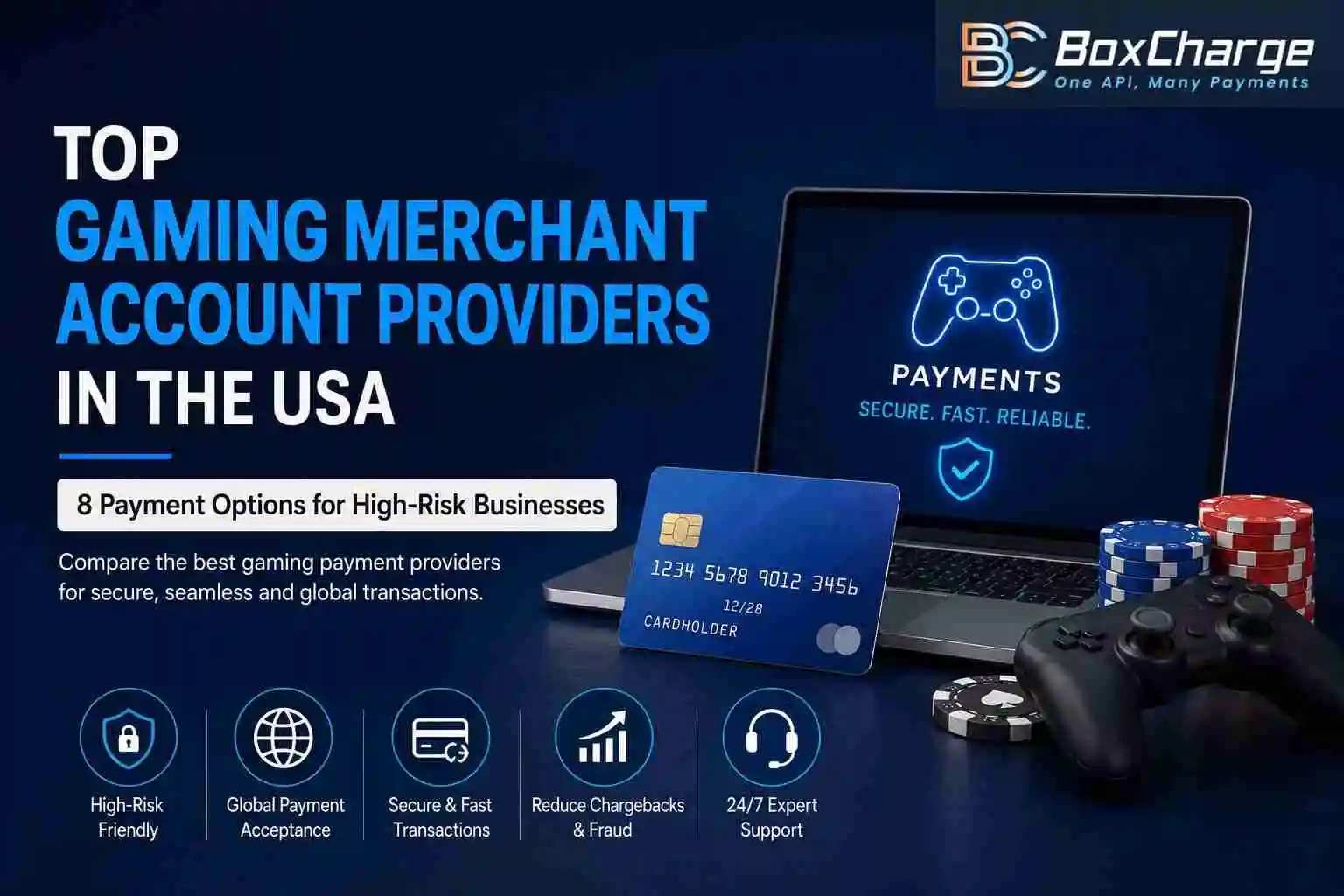
For an online gaming company, choosing a gaming merchant account payment provider in the USA is rarely as simple as opening a standard merchant account and connecting a checkout page. Gaming businesses can deal with international customers, digital goods, recurring purchases, in-game transactions, high transaction volumes, fraud attempts, chargebacks, and rapidly changing customer payment preferences.
That makes finding the right gaming merchant account particularly important.
The challenge becomes even greater when the business operates in a higher-risk segment such as social gaming, fantasy gaming, gaming subscriptions, esports, or platforms that have characteristics associated with betting or prize-based play. Traditional payment providers may impose restrictions, require additional underwriting, or decline certain business models altogether.
Below are eight payment providers and platforms worth researching for gaming businesses in the USA. This is not a ranking or endorsement, and eligibility depends on the merchant's business model, location, MCC, licensing, transaction profile, and underwriting. In particular, gambling and prize-based gaming can have substantially different requirements from ordinary video-game commerce.
What Makes Gaming Payment Processing Different?
A gaming platform may have customers purchasing game credits, downloadable content, subscriptions, virtual items, tournament entries, or other digital products. Some platforms also operate internationally, creating additional currency and payment-method requirements.
For merchants, this poses several payment challenges in the gaming industry.
A processor that works perfectly for a conventional online retailer may not necessarily be appropriate for a gaming platform.
Gaming merchants can encounter:
Higher fraud and account-takeover exposure
Chargeback disputes involving digital purchases
Transactions from multiple countries
Recurring and subscription billing
High transaction velocity
Virtual goods and in-game purchases
Regulatory restrictions on certain gaming models
Payment-provider underwriting challenges
Settlement and reserve requirements
Restrictions around gambling or prize-based gaming
This is why payment processing for online gaming should be evaluated according to the actual business model rather than simply the advertised processing rate.
1. BoxCharge
BoxCharge is a global payment infrastructure provider focused on merchant services, cross-border payment acceptance, payment orchestration, acquiring connectivity, and alternative payment methods. Its platform combines multiple payment capabilities through one integration, including card networks, digital wallets, local APMs, multi-currency processing, routing, tokenization, 3DS authentication, and fraud controls.
For a gaming company selling digital products internationally, this type of infrastructure can be useful when payment operations span multiple processors or countries.
BoxCharge's platform supports payment orchestration, cascading, multi-acquirer connectivity, and regional payment optimization. That can be particularly relevant when merchants are trying to reduce unnecessary declines and create more resilient payment flows.
For businesses evaluating online gaming payment solutions, the key consideration is whether the available acquiring relationships and payment methods match the gaming model, target markets, and compliance requirements.
Best suited to: Gaming and digital businesses looking for international payment infrastructure, multi-acquirer connectivity, and cross-border payment capabilities.
2. WebPays
WebPays is another provider worth researching for merchants looking for specialized payment infrastructure. Its public company profile describes its focus on payment gateway solutions, global processing for casino businesses, gaming and betting payment gateways, merchant accounts, and high-risk payment processing.
This positioning makes WebPays particularly relevant to merchants whose gaming operations fall closer to high-risk categories.
Gaming businesses should still clarify exactly how their model is classified during underwriting. A video-game store, social gaming platform, esports operator, fantasy platform, and gambling business may all receive different treatment from acquiring partners.
For a merchant comparing gaming payment gateway solutions, questions around supported countries, currencies, chargeback procedures, reserves, transaction limits, and prohibited activities should be addressed before integration.
Best suited to: Gaming, betting, casino, and other higher-risk merchants seeking specialized payment processing.
3. PayCly
PayCly has a dedicated gaming merchant account offering and specifically positions its services around high-risk gaming businesses. Its published gaming solution describes support for multiple currencies and payment methods, international payment acceptance, multilingual checkout capabilities, gaming-specific integration, and fraud and chargeback controls.
PayCly also offers a dedicated social gaming merchant account, with multi-currency processing and payment gateway integration for different types of online games.
This is important for merchants because social gaming merchant account requirements can differ from those of conventional e-commerce.
PayCly's published materials also discuss specialized accounts combining high-risk merchant account features with gaming-specific functionality.
Best suited to: Online gaming, social gaming, fantasy gaming, casino, and other high-risk gaming-related business models subject to approval.
4. Amald
Amald positions itself as a payment gateway and merchant services provider offering international payment processing, high-risk merchant accounts, alternative payment methods, dedicated MIDs, and global payment processing.
Gaming is specifically included among the higher-risk industries referenced by Amald, and its high-risk merchant account materials discuss online gaming alongside other higher-risk sectors.
Amald also publishes gaming-specific payment gateway content covering multi-currency processing, alternative payment methods, PCI-DSS-related security, and multiple payment channels.
For gaming businesses expanding internationally, the ability to accept different currencies and payment methods can be important because customers may expect local payment options instead of relying solely on cards.
Best suited to: High-risk gaming businesses seeking international payment acceptance and multiple payment methods.
5. InQuid
InQuid focuses heavily on high-risk payment processing and describes support for online gaming and betting among the business categories it can serve. Its platform highlights multi-currency payment processing, MID cascading, fraud detection, compliance-oriented infrastructure, and global acquiring relationships.
Its broader platform also discusses high-risk merchants dealing with issues such as account termination, reserves, payment declines, and generic risk rules.
That is relevant because one of the biggest frustrations for high-risk merchants is instability.
A gaming operator can spend months building a customer base and payment history only to discover that its processor has changed its risk appetite. When an account is suddenly restricted, the consequences can include failed checkouts, delayed settlements, customer complaints, and lost revenue.
InQuid's acquiring-partner model also emphasizes multiple acquiring connections and smart routing.
Best suited to: High-risk gaming and betting businesses that need acquiring connectivity, routing, and risk-management capabilities.
6. Payoneer
Payoneer is a major global payments company, but merchants should understand that it is not identical to a specialized gaming merchant-account provider.
Its relevance to gaming comes partly from its history in digital commerce. Payoneer's investor materials note that its acquisition of SafeCharge had significant gaming exposure, with gaming accounting for a substantial share of SafeCharge's revenue at the time.
For gaming businesses operating across international markets, Payoneer's broader global commerce infrastructure can therefore be worth investigating where the particular product and merchant activity are eligible.
However, merchants should not assume that a global payments brand automatically accepts every gaming or gambling business.
Best suited to: Eligible digital-commerce and gaming businesses requiring international payment and business-payment capabilities.
7. Stripe
Stripe is widely used by digital businesses and supports payment infrastructure for many types of online commerce. Its documentation also identifies games as a business category.
However, this is where gaming merchants need to pay close attention to the distinction between gaming and gambling.
Stripe's current prohibited-business policy specifically restricts gambling, including internet gambling, casino games, sweepstakes, and games of skill involving monetary or material prizes. It also restricts the sale of in-game currency or game items in certain circumstances.
Therefore, Stripe may be worth evaluating for an eligible conventional digital gaming business, but it should not be treated as a universal solution for gambling, betting, or prize-based gaming.
This distinction is critical when researching payment systems for digital games.
Best suited to: Eligible mainstream digital gaming and software businesses that fit Stripe's current requirements.
8. Authorize.net
Authorize.net remains a well-known payment gateway option for online businesses and provides tools such as recurring billing, digital invoicing, tokenization, and fraud-management filters. Its Advanced Fraud Detection Suite includes controls covering velocity, IP addresses, transaction amounts, regional activity, AVS, CCV, and other indicators.
However, gaming merchants should examine eligibility carefully.
Authorize.net's documentation states that its eCheck services may be cancelled when a business is considered high risk and specifically lists gambling among restricted business types for that service.
At the same time, Authorize.net's partner ecosystem refers to options for high-risk merchants, demonstrating that availability can depend on the specific acquiring relationship and merchant setup.
Best suited to: Eligible gaming and digital-commerce merchants whose business model and acquiring arrangement meet current underwriting requirements.
Top Gaming Merchant Account Provider in the USA Comparison
Provider | Primary Focus | Gaming / High-Risk Relevance | International Payments | Best Fit |
BoxCharge | Global merchant services & payment infrastructure | High-risk gaming, casino, sportsbook and social gaming | Yes | International gaming businesses needing multi-currency and cross-border processing |
WebPays | High-risk payment processing & merchant accounts | Yes | Yes | Gaming, betting and other high-risk online businesses |
PayCly | Gaming & high-risk merchant accounts | Yes | Yes | Online gaming, social gaming, casino and sportsbook businesses |
Amald | High-risk merchant services & payment gateway | Yes | Yes | Gaming businesses seeking international processing and payment flexibility |
InQuid | High-risk payment infrastructure & alternative payments | Yes | Yes | High-risk and crypto-oriented gaming businesses |
Payoneer | Global payments & gaming payouts | Gaming-focused services available | Yes | Game developers, publishers, marketplaces and gaming platforms |
Stripe | General online payment infrastructure | Limited / model dependent | Yes | Eligible mainstream digital gaming businesses |
Payment gateway & merchant-account services | Eligibility varies | Yes | Eligible gaming/e-commerce businesses with appropriate acquiring arrangements |
The Biggest Payment Problems Facing High-Risk Gaming Merchants
The provider itself is only part of the equation.
Many high-risk merchants struggle with the same operational problems: inconsistent approvals, rolling reserves, sudden MID closures, transaction limits, expensive processing, and limited support when something goes wrong.
A gaming company can also experience a sharp increase in fraud when a new game, promotion, or digital product becomes popular. Fraudsters may target stolen cards, compromised accounts, automated purchases, and chargeback abuse.
This makes gaming payments fraud detection essential.
At the same time, gaming merchants need effective gaming payment risk management. The objective is not to block every suspicious transaction. Excessive risk controls can also reject legitimate players and reduce revenue.
The ideal setup balances:
Payment approval + fraud prevention + customer experience + compliance + settlement stability.
What Should Gaming Merchants Look for in a Payment Provider?
Before selecting a provider, ask whether it supports:
Multi-Currency Processing
International gaming platforms should be able to accept relevant currencies without creating unnecessary checkout friction.
Recurring Billing
Businesses offering memberships, passes, subscriptions, or premium gaming services need reliable gaming subscription payments and clear retry and cancellation processes.
In-Game Transactions
If customers purchase digital credits, items, upgrades, or other virtual products, merchants should confirm that the provider's policies specifically permit the transaction type.
Fraud and Chargeback Controls
Strong risk controls are particularly important for in-game payment processing, where transaction volume can be high, and fraud patterns can change rapidly.
Compliance Support
Gaming payment compliance becomes even more important when a business operates across several jurisdictions or approaches gambling, betting, or prize-based activities.
Scalable Acquiring
As transaction volumes grow, merchants should understand what happens when they move from a small operation to a high-volume platform.
Is “Instant Approval” Really Possible for Gaming Merchants?
Searches for online gaming merchant account instant approval are understandable. A merchant wants to launch quickly and start accepting payments immediately.
But legitimate providers still need to conduct appropriate underwriting.
No serious payment provider should guarantee approval without reviewing the business model, ownership, products, transaction expectations, jurisdictions, and compliance position.
Fast onboarding is useful. Guaranteed approval is a warning sign.
High-risk merchants should prioritize a provider that understands their business and can explain the underwriting process clearly.
Choosing the Right Gaming Merchant Account
There is no universal best gaming payment provider.
A casual mobile-game developer selling digital downloads has very different requirements from a subscription gaming platform, social casino, esports operator, fantasy gaming company, or betting platform.
That is why merchants should compare providers based on:
Industry eligibility
Supported gaming model
Target countries
Payment methods
Processing currencies
Fraud controls
Chargeback management
Settlement schedule
Reserves
Transaction limits
Recurring billing capabilities
API and checkout integration
Acquiring relationships
Customer support
For merchants operating in gambling or betting, licensing and jurisdictional requirements should be treated as fundamental—not as an afterthought.
Final Thoughts
The gaming payments market is becoming increasingly sophisticated, but payment acceptance remains one of the areas where gaming businesses can encounter the most friction.
The right gaming merchant account can help create a more dependable payment environment, while the wrong setup can lead to unnecessary declines, reserves, account restrictions, or lost customers.
For businesses comparing payment processing for gaming platforms, the most important decision is not simply which provider has the lowest advertised rate. It is whether the payment infrastructure matches the merchant's risk profile, gaming model, target markets, compliance requirements, and growth plans.
BoxCharge provides gaming merchant account services, cross-border payment connectivity, payment orchestration, alternative payment methods, and acquiring infrastructure for legitimate businesses operating across international markets. Its platform is designed around multi-acquirer connectivity, smart routing, 3DS authentication, tokenization, fraud controls, and global payment acceptance.
For a gaming business evaluating its options, the practical next step is to review the business model, expected transaction volume, customer geography, payment methods, and regulatory position before selecting a gaming payment gateway or merchant account.
The strongest payment setup is ultimately the one that can support the business after launch—not just get it approved before launch.