For an online merchant, checkout conversion can be won or lost in a matter of seconds. A customer may be ready to pay, enter their card details, and then encounter an unexpected authentication screen. If that extra step feels confusing, slow, or unreliable, the customer may simply leave.
This is where 3D Secure (3DS) becomes important.
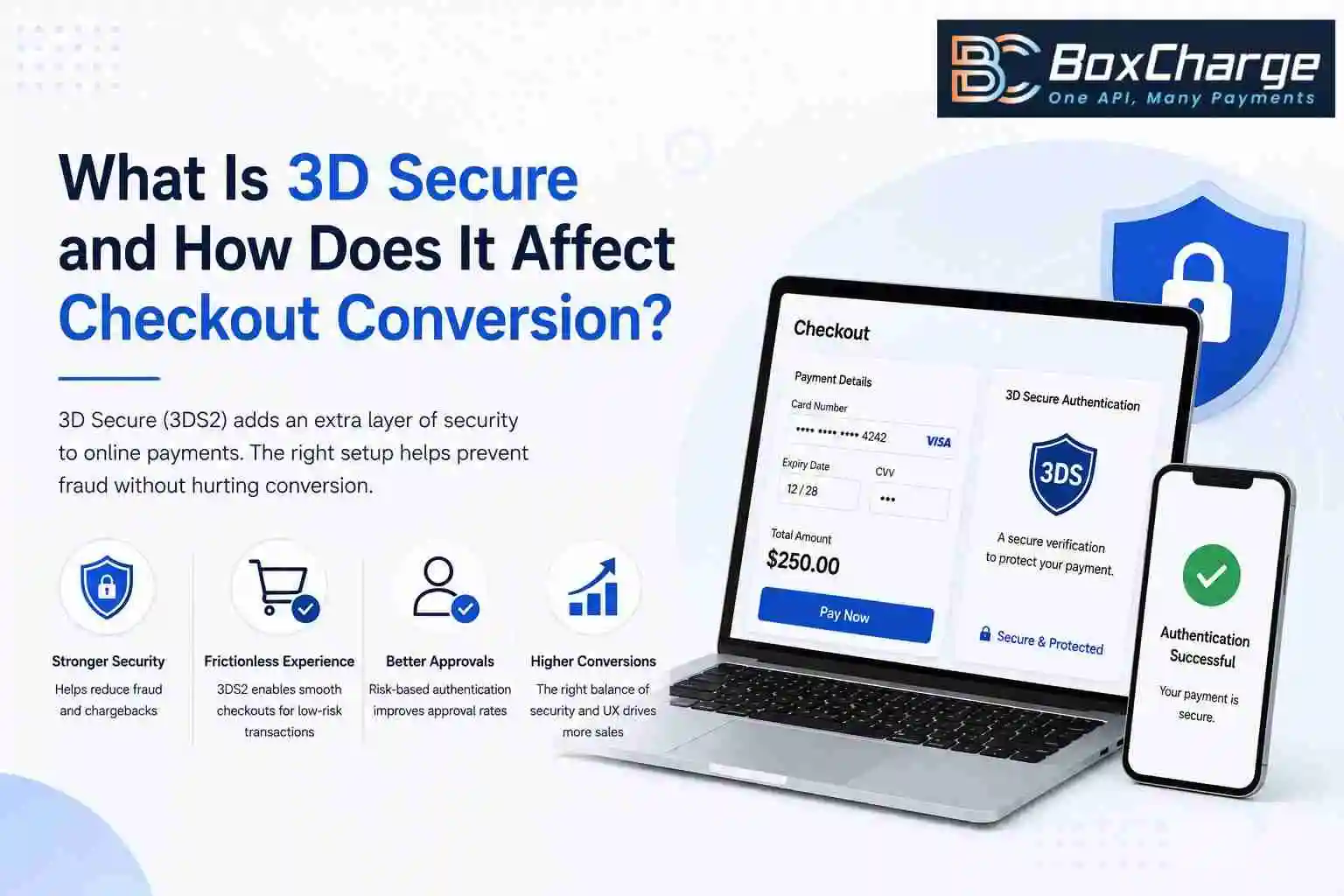
3D Secure is an authentication protocol designed to add another layer of security to card-not-present transactions. EMVCo describes EMV 3DS as a way for merchants and card issuers to exchange transaction, payment, and device information to authenticate customers and help reduce card-not-present fraud.
But there is an important commercial question for merchants:
Does adding more authentication improve security at the expense of conversion?
The answer is not necessarily. Modern 3D Secure 2 (3DS2) was designed to make authentication more intelligent, including a frictionless flow where customers can be authenticated without an additional interactive challenge. When an issuer considers further verification necessary, a challenge flow can be triggered instead.
For high-risk merchants, getting this balance right is particularly important. They already deal with higher fraud exposure, chargebacks, stricter underwriting, and payment-provider scrutiny. Poorly implemented authentication can add another obstacle between a legitimate customer and a successful transaction.
What Is 3D Secure and Why Does It Matter?
3D Secure authentication is an additional security layer used during online card payments.
You may have encountered it when your bank asks you to:
Enter a one-time password
Approve a transaction in a banking app
Confirm your identity using biometrics
Complete another verification step
The exact experience depends on the card issuer, transaction, device, market, and authentication setup.
The newer 3DS2 framework is designed to use more transaction and device information during the risk assessment process. This allows issuers to authenticate some transactions without interrupting the customer's checkout experience.
That distinction matters.
Older approaches to online authentication were often associated with noticeable checkout friction. With modern 3DS2 payment authentication, the objective is to authenticate legitimate customers with as little unnecessary interruption as possible while applying additional verification when risk warrants it.
How Does 3DS2 Work at Checkout?
A simplified 3D Secure payment flow looks like this:
Customer enters payment details → 3DS authentication → issuer risk assessment → frictionless approval or challenge → payment authorization
During the process, information about the transaction, payment method, and device can be exchanged between the merchant environment and the issuer's authentication system.
There are two primary experiences.
Frictionless Authentication
With a frictionless 3DS2 flow, the customer may not have to enter anything additional.
The issuer evaluates the available transaction information and can authenticate the payment without presenting a visible challenge to the cardholder.
This is the ideal scenario from a conversion perspective because the security process can happen without creating another obvious step in the checkout.
However, frictionless eligibility is determined by the issuer on a transaction-by-transaction basis. Merchants cannot simply guarantee that every payment will receive a frictionless experience.
3DS Challenge Flow
If the issuer determines that additional verification is necessary, the customer can be presented with a 3DS challenge.
This could involve a one-time passcode, mobile banking approval, biometric verification, or another authentication method.
EMVCo notes that a challenge may be triggered when a transaction is considered high-risk or when additional authentication is required because of applicable mandates or regulations.
The challenge is therefore not automatically a sign that something has gone wrong.
It is part of the risk-based authentication process.
How 3D Secure Affects Checkout Conversion
The commercial impact of 3DS depends heavily on how authentication is implemented.
Used intelligently, 3DS can help protect merchants while allowing many legitimate transactions to remain frictionless.
Used poorly, it can introduce unnecessary interruptions.
Imagine a customer buying a $200 product online. They reach the payment page, enter their card information, and are suddenly redirected to an unfamiliar authentication screen. The page loads slowly. The customer is unsure whether the request is legitimate. They close the browser.
The payment wasn't declined because the customer lacked funds.
The transaction was lost because payment friction interrupted the purchase.
This is why merchants should not measure 3DS solely by fraud reduction.
They should also monitor:
Authorization rates
Authentication success rates
Challenge rates
Challenge abandonment
Checkout completion
False declines
Chargeback rates
Payment failure rates
A strong payment authentication strategy aims to improve the overall balance between security and conversion.
Why High-Risk Merchants Need a Different 3DS Strategy
For a conventional e-commerce merchant, a payment decline is frustrating.
For a high-risk merchant, it can be much more expensive.
Businesses operating in industries such as forex, iGaming, online gaming, nutraceuticals, subscriptions, adult services, travel, and specialized e-commerce may already face greater scrutiny from acquiring banks and payment providers.
Their payment problems can also compound quickly.
A merchant may have a good product, strong traffic, and legitimate customers, yet still experience:
Higher chargeback exposure
Fraud attempts
Declining authorization rates
Additional underwriting reviews
Processing restrictions
Rolling reserves
Limited acquiring options
Higher payment costs
Now add an authentication system that challenges too many legitimate customers.
The result can be a serious conversion problem.
For high-risk businesses, 3D Secure fraud prevention therefore needs to work alongside authorization optimization rather than operating as a standalone security layer.
3DS Can Help Reduce Fraud Without Blocking Every Customer
One of the biggest misconceptions about 3D Secure payment processing is that every customer must complete an additional verification step.
That isn't how modern 3DS2 is designed to operate.
The frictionless flow allows eligible transactions to be authenticated without requiring further cardholder interaction. A challenge can be introduced when the issuer determines that additional verification is appropriate.
This risk-based approach is commercially valuable.
A returning customer using a familiar device and card may present a very different risk profile from a first-time customer making an unusually large purchase.
The objective is to treat those transactions differently rather than applying exactly the same amount of friction to every customer.
The Connection Between 3DS and Strong Customer Authentication
For merchants operating in markets where Strong Customer Authentication (SCA) requirements apply, 3DS can play an important role in meeting authentication requirements for online card payments.
For example, Stripe's current guidance explains that 3DS2 is a primary method used to authenticate online card payments under applicable SCA requirements, while exemptions may be available for eligible transactions.
This makes authentication more than a fraud-prevention feature.
For merchants serving customers across Europe and other regulated markets, the payment setup needs to account for applicable authentication requirements, exemptions, issuer behavior, and transaction circumstances.
Merchants should therefore avoid treating 3DS as simply a checkbox during gateway implementation.
It is part of the broader payment architecture.
Why Poor 3DS Implementation Can Hurt High-Risk Payment Conversion
The technology itself is rarely the entire problem.
Implementation matters.
Consider a subscription business with a large percentage of returning customers. If every recurring or returning payment triggers unnecessary authentication, the customer experience can become frustrating.
Or consider an international merchant receiving customers from the UK, Europe, Canada, and Australia. Different issuers, cards, devices, and regulatory environments can produce different authentication experiences.
A merchant may then see inconsistent results:
Customer A: payment completes instantly.
Customer B: authentication challenge appears.
Customer C: authentication fails.
Customer D: payment is declined before completion.
Without proper reporting, these transactions can simply appear as "failed payments."
That makes it difficult for the merchant to understand whether the underlying problem is fraud, authentication, issuer behavior, technical integration, or payment routing.
3DS2 and International Payment Processing
For businesses accepting payments internationally, 3DS2 for international payments can be particularly useful because customer authentication expectations differ across markets.
A global merchant may need to support different issuer behaviors and authentication requirements while maintaining a consistent checkout experience.
This is one reason payment infrastructure should be designed around the merchant's actual geographic footprint.
A business expanding from the UK into European markets, for example, should consider how its payment gateway handles authentication, exemptions, local acquiring, and customer experience.
The same principle applies to merchants expanding into North America, Australia, and other international markets.
Global payment processing requires more than simply accepting cards in multiple currencies.
The authentication layer needs to work as part of the wider payment ecosystem.
How Merchants Can Reduce 3DS Checkout Friction
There is no single setting that guarantees maximum conversion.
Instead, merchants should focus on the complete payment experience.
Use Risk-Based Authentication
Where supported and appropriate, merchants should allow the payment ecosystem to distinguish between lower-risk and higher-risk transactions.
This increases the possibility of frictionless authentication for eligible payments while reserving stronger intervention for transactions that actually need it.
Provide a Familiar Checkout
Customers are more likely to complete authentication when the process feels trustworthy and understandable.
Clear messaging can help customers understand that the verification request is coming from their bank or card issuer.
Monitor Authentication Performance
Don't simply monitor whether 3DS is enabled.
Measure its actual effect.
Track challenge rates, successful authentication, abandonment, authorization rates, and payment conversion.
Work With the Right Payment Provider
The gateway, acquirer, 3DS server, fraud engine, and issuer all play a role in the payment journey.
For high-risk merchants, selecting a provider that understands the industry's transaction patterns can be particularly important.
What High-Risk Merchants Should Look for in a Payment Solution
A strong high-risk payment processing solution should provide more than basic card acceptance.
Merchants should evaluate whether their payment setup supports:
3DS2 authentication
Risk-based authentication
Fraud screening
Chargeback management
Tokenization
Multi-currency processing
Recurring payments
Payment retries
Detailed transaction reporting
API integration
International acquiring
Appropriate compliance controls
The exact requirements will vary by industry and business model.
A forex broker, for example, may have very different requirements from a subscription merchant or online gaming business.
The important point is to build the payment strategy around the merchant's actual risk and transaction profile.
3D Secure Is Not a Magic Fix for Chargebacks
It is also important not to overstate what 3DS can accomplish.
3D Secure fraud prevention can add meaningful authentication to card-not-present transactions, but it does not eliminate every type of fraud, dispute, or payment failure.
Merchants still need appropriate fraud monitoring, customer verification, transaction controls, refund processes, and chargeback management.
Likewise, 3DS does not guarantee a successful payment.
A customer can authenticate successfully and still have the transaction declined for another reason.
This is why merchants should look at the entire payment funnel rather than one security technology.
The Best 3DS Strategy Balances Security and Revenue
For most online merchants, the question shouldn't be:
"Should we use 3D Secure?"
A better question is:
"How can we use 3D Secure without creating unnecessary friction for legitimate customers?"
Modern 3DS2 is built around that balance.
EMVCo's current materials emphasize frictionless authentication, risk assessment, challenge flows, and newer authentication approaches designed to improve both security and the customer experience.
For high-risk merchants, that balance becomes even more important.
A business cannot afford to ignore fraud, but it also cannot afford to make legitimate customers repeatedly fight their way through checkout.
The goal is secure payment processing with minimal unnecessary friction.
Final Takeaway: Treat 3DS as Part of Your Payment Strategy
3D Secure is more than an authentication pop-up. It is part of the wider payment infrastructure connecting merchants, payment providers, card networks, and issuing banks.
When properly implemented, 3DS2 can provide stronger authentication while allowing eligible transactions to move through a frictionless experience.
For high-risk merchants, the stakes are even higher. The right setup can help reduce fraud exposure and support compliance without unnecessarily damaging checkout conversion.
That is why businesses should evaluate 3DS alongside authorization rates, payment routing, fraud tools, chargeback controls, international acquiring, and overall payment performance.
Looking to Improve Your High-Risk Payment Infrastructure?
If your business is dealing with high decline rates, excessive payment friction, chargebacks, or limited acquiring options, BoxCharge can help you evaluate payment infrastructure around your business model, markets, and transaction profile.
A stronger setup can bring together 3D Secure authentication, fraud prevention, payment processing, international acceptance, and risk management while keeping the customer experience at the center.
Talk to BoxCharge about building a payment strategy designed to protect transactions without unnecessarily putting legitimate customers through checkout friction.