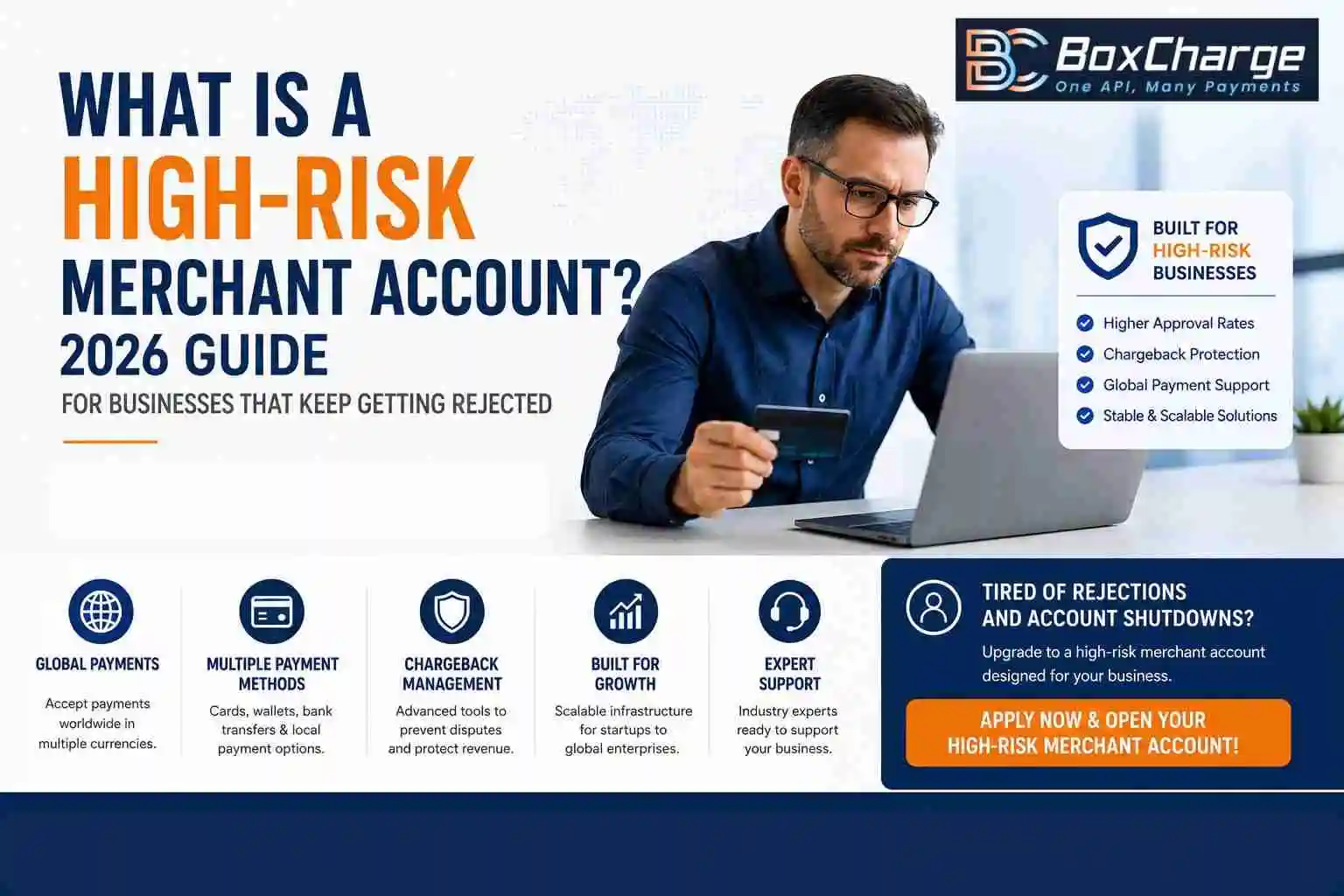
If you’ve ever had your payment account suddenly frozen, your application rejected without explanation, or your transactions declined for no clear reason, you’re not alone.
For many businesses, especially those operating online or globally, getting approved for payment processing isn’t just difficult—it feels almost impossible. That’s where a high-risk merchant account comes in.
This guide breaks down what a high-risk merchant account really is, why businesses are labeled high-risk, and how you can turn constant rejections into a stable, scalable payment system.
What Is a High-Risk Merchant Account?
A high-risk merchant account is a type of payment processing account designed specifically for businesses that traditional banks and payment processors consider risky.
Instead of rejecting these businesses outright, specialized providers offer high-risk merchant payment processing solutions that can handle:
Higher chargeback ratios
Cross-border transactions
Subscription or recurring billing
Industry-specific risks
In simple terms:
👉 If standard payment providers say “no,” a high-risk merchant account is built to say “yes.”
Why Are Businesses Classified as High-Risk?
Most merchants don’t even realize they’re “high-risk” until they get rejected.
Here’s what typically triggers that classification:
1. Industry Type
Certain industries are automatically flagged as high-risk merchants, including:
Subscription-based services
Digital products and SaaS
Forex, gaming, or trading platforms
Global eCommerce businesses
These industries often require a high-risk merchant account provider because of higher dispute rates.
2. High Chargeback Potential
If your business model increases the likelihood of refunds or disputes, processors see liability.
Without proper chargeback management for high-risk, even a small spike can:
Trigger account reviews
Lead to fund holds
Cause permanent shutdowns
3. International Transactions
Operating globally is great for growth—but risky for banks.
Cross-border payments increase:
Fraud exposure
Currency complications
Compliance risks
That’s why businesses need international payment solutions and global merchant payment services instead of local-only setups.
4. New or No Processing History
Startups often struggle with high-risk merchant account approval simply because they lack history.
From a bank’s perspective:
👉 No data = Unknown risk
5. Regulatory & Compliance Concerns
If your business operates in a regulated space or has an unclear legal structure, approval becomes harder.
This is where high-risk merchant processing providers with industry experience make a difference.
The Real Struggles High-Risk Merchants Face
Let’s talk about what actually happens behind the scenes—because this is where most blogs stop, but your business reality starts.
Unpredictable Cash Flow
Imagine processing payments all week…
…and then suddenly your funds are held for 90 days.
That’s the reality of unstable setups. Without secure payment processing for high-risk industries, cash flow becomes unpredictable.
Constant Account Shutdowns
One day, everything works.
Next day: “Your account has been suspended.”
No warning. No clear reason.
Many businesses go through multiple providers because they don’t have access to a high-risk merchant account without shutdowns.
High Decline Rates
Even legitimate customers get declined.
This leads to:
Lost revenue
Frustrated users
Lower conversion rates
Without optimized high-risk merchant credit card processing, your checkout becomes a bottleneck.
Limited Payment Options
Most standard processors restrict:
Alternative payment methods
Multi-currency support
Regional payment options
That’s why modern payment solutions for high-risk businesses focus on flexibility.
Growth Gets Stuck
You want to scale globally—but your payment system can’t handle it.
Without worldwide payment gateway solutions, expansion becomes risky instead of profitable.
How High-Risk Merchant Accounts Actually Work
A high-risk merchant account setup is different from traditional processing.
Here’s how it typically works:
Customer makes a payment
Payment goes through a payment gateway for specialized industries
A high-risk-friendly acquiring bank processes the transaction
Funds are settled into your merchant account
Payouts are released (sometimes with rolling reserves)
What Makes It Different?
Unlike standard setups, high-risk business payment solutions include:
Advanced fraud filters
Chargeback monitoring systems
Multi-layered payment routing
Support for offshore high-risk merchant accounts
This is not just payment processing—it’s risk-managed infrastructure.
Key Features of a High-Risk Merchant Account
If you’re choosing a provider, these features matter:
✔ High Approval Rates
Specialized providers offer fast merchant account approval, even for complex business models.
✔ Multi-Currency Support
Essential for global businesses using international ecommerce payment gateway systems.
✔ Alternative Payment Methods
Beyond cards:
Digital wallets
Bank transfers
Region-specific methods
This improves conversions and reduces dependency on cards.
✔ Chargeback Protection Tools
Built-in chargeback management for high-risk helps maintain account stability.
✔ Scalable Infrastructure
Designed for growth with international online payment solutions and global routing.
High-Risk vs Low-Risk Merchant Accounts
Feature | Low-Risk Account | High-Risk Merchant Account |
Approval Speed | Fast | Moderate but flexible |
Chargeback Tolerance | Low | Higher tolerance |
Global Payments | Limited | Strong support |
Risk Management | Basic | Advanced |
Stability | Can shut down easily | Built for risk |
👉 If your business is scaling or complex, a best high-risk merchant account is often the smarter long-term choice.
How to Get Approved for a High-Risk Merchant Account
Getting approved isn’t random—it’s strategic.
1. Build a Transparent Website
Include:
Clear product descriptions
Refund policies
Terms & conditions
This directly impacts merchant account approval requirements.
2. Control Your Chargebacks
Use tools to keep disputes low. Strong chargeback management for high-risk improves approval chances.
3. Choose the Right Provider
Not all providers understand high-risk businesses.
Look for:
Industry-specific experience
Global capabilities
Flexible underwriting
4. Show Business Stability
Even small data points help:
Transaction history
Customer base
Revenue consistency
5. Use a Multi-Gateway Setup
Relying on one provider is risky.
Modern businesses use global payment gateway solutions with redundancy to avoid failures.
The Rise of Global Payment Infrastructure
In 2026, payment processing is no longer local—it’s global.
Businesses are moving toward:
International payment processing services
Local acquiring in multiple regions
Hybrid models combining cards + alternative methods
Scaling today isn’t just about accepting cards.
It’s about building international payment systems that work everywhere.
Why Traditional Payment Providers Fail High-Risk Businesses
Most mainstream processors are designed for low-risk businesses.
They prioritize:
Low chargebacks
Predictable transactions
Local markets
So when a business doesn’t fit that model, the result is:
Rejections
Account freezes
Sudden shutdowns
This is why high-risk merchant account services exist—to support businesses that don’t fit the “standard” mold.
Turning “High-Risk” Into a Competitive Advantage
Being labeled “high-risk” isn’t a weakness—it’s a signal.
It usually means:
You operate globally
You scale fast
You handle complex transactions
With the right high-risk merchant payment processing, you can:
Accept payments worldwide
Reduce dependency on single providers
Improve conversion rates
Build a resilient payment system
The Future of High-Risk Payment Processing
The industry is evolving fast.
Key trends include:
AI-driven fraud detection
Smarter underwriting models
Growth of offshore merchant accounts
Expansion of international merchant account providers
Businesses that adapt early will gain a major advantage.
Final Thoughts
A high-risk merchant account isn’t just a workaround—it’s a necessity for modern businesses operating beyond traditional limits.
If you’ve faced:
Rejections
Payment failures
Account shutdowns
…it’s not your business that’s broken.
It’s your payment infrastructure.
The goal isn’t just approval—it’s long-term stability, scalability, and control.
Ready to Fix Your Payment Setup?
If your current provider is holding you back, it’s time to upgrade to a system built for your business model.
👉 Get access to high-risk merchant account services, global payment gateway solutions, and secure payment processing for high-risk industries—all designed to help you scale without disruption.
Because in 2026, payments shouldn’t limit your growth—they should power it. apply high-risk merchant account to open a high-risk merchant account now!