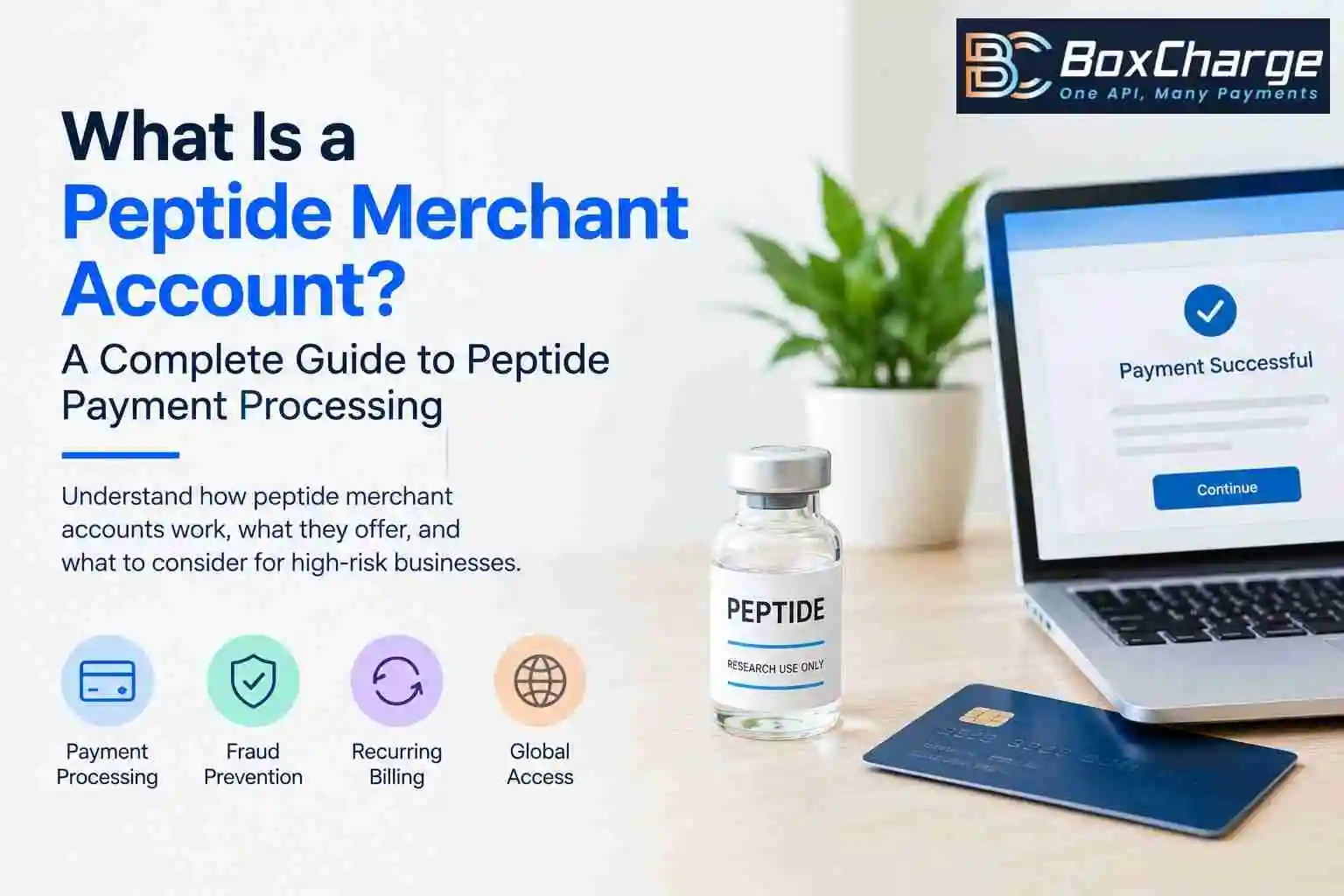
If you operate an online peptide business, accepting payments can be more complicated than simply adding a card checkout to your website. A peptide merchant account is a specialized payment-processing arrangement that allows an eligible peptide business to accept card and other electronic payments while addressing the underwriting, compliance, fraud, chargeback, and settlement considerations associated with the business model.
The important word here is eligible. Not every peptide product or peptide business has the same regulatory or payment profile. Some peptides are used in legitimate research, while others are regulated pharmaceutical products or are marketed with medical claims. Payment providers therefore look beyond the word "peptide" and may evaluate the products, intended use, website claims, customer base, transaction history, and applicable regulatory requirements.
This distinction has become particularly important in 2026. The FDA continues to take action against businesses marketing certain unapproved peptide products as drugs, while also developing regulatory guidance for specific peptide drug products.
For merchants, that creates a payment question as much as a regulatory one: What exactly is a peptide merchant account, and why might a peptide business need specialized payment processing?
What Is a Peptide Merchant Account?
A peptide merchant account is a merchant-processing relationship that enables an eligible peptide business to accept payments through cards and other supported payment methods.
Depending on the business model and acquiring arrangement, the payment infrastructure may support:
Credit and debit card payments
Online checkout
Recurring billing
Subscription payments
Refunds
Chargeback management
Fraud monitoring
3D Secure authentication
Multi-currency transactions
International payment acceptance
Alternative payment methods
It is important not to confuse a merchant account with a business bank account.
A bank account primarily holds and manages business funds. A merchant account sits within the payment-processing ecosystem that allows a business to authorize customer card transactions and ultimately receive settlement.
For a peptide company, the difference becomes important because the acquiring bank and payment processor may conduct additional underwriting before agreeing to process transactions.
Why Do Peptide Businesses Need Specialized Payment Processing?
A standard online retailer may sell a conventional physical product with relatively straightforward fulfillment.
A peptide merchant can have a considerably more complicated profile.
The processor may need to understand:
What products are being sold
Whether products are intended for research or human use
How the products are described
Whether medical or therapeutic claims are made
Where customers are located
Whether products require prescriptions or other authorization
Whether sales are one-time or recurring
Expected transaction volume
Average order value
Refund and cancellation practices
Previous chargeback levels
This is one reason searches for peptide payment processing, peptide merchant account providers, and high-risk peptide merchant accounts have become increasingly relevant to online merchants.
The business may be legitimate, but the payment provider still has to assess financial, regulatory, and network risk.
Are Peptide Businesses Considered High Risk?
There is no universal rule that every peptide company is automatically a high-risk merchant.
The classification depends on the specific business model, products, claims, jurisdictions, and acquiring partner.
For example, a company selling legitimate research materials under appropriate conditions can have a very different profile from a business selling prescription-only products directly to consumers.
Payment providers can also establish their own restricted-business policies. Stripe's current guidance, for example, says it supports many types of peptides but applies limitations based on applicable law, FDA requirements, financial-partner requirements, and card-network rules. It also states that some peptide sales require preapproval, while research-use peptides can be processed only where safeguards exist to prevent non-research use.
That is an important distinction for merchants:
Being legal does not automatically mean being eligible for every payment processor.
Why High-Risk Peptide Merchants Struggle With Payment Accounts
The biggest frustration for many high-risk merchants is not necessarily getting their first transaction approved.
It is maintaining stable payment processing over time.
A merchant may initially be approved and then experience problems when transaction volume increases, its product catalog changes, chargebacks rise, or the payment provider conducts a compliance review.
Common pain points include:
Account rejection
Some traditional processors may not be comfortable underwriting specialized products, particularly where regulatory classification is complicated.
A merchant can spend weeks preparing an application only to discover that the provider does not support its particular business model.
Rolling reserves
Higher-risk merchants may encounter reserve requirements designed to protect the acquiring relationship against future refunds and chargebacks.
For a growing company, having part of its revenue held back can create significant working-capital pressure.
Settlement delays
If funds are held longer than expected, merchants can struggle to pay suppliers, advertising expenses, employees, and other operating costs.
This is especially painful for businesses experiencing rapid growth.
Account termination
A sudden payment-account closure can be even more damaging.
A merchant may have customers, inventory, advertising campaigns, and recurring subscriptions already operating when payment acceptance is interrupted.
Chargebacks
Customers may dispute transactions because they do not recognize the billing descriptor, misunderstand a product, forget a recurring subscription, or claim that the product was not as represented.
For digital and specialized products, the merchant needs strong documentation to defend legitimate transactions.
The Regulatory Side of Peptide Payment Processing
This is where peptide merchants need to be particularly careful.
The word "research" on a product page does not automatically determine how a regulator or payment provider will view the product.
The FDA has taken enforcement action against peptide businesses where website content and product marketing indicated that products labeled "research use only" were actually being marketed for human use.
In March 2026, for example, the FDA issued a warning letter to Gram Peptides concerning products including retatrutide and tirzepatide, determining that the products were unapproved new drugs.
The FDA also issued a June 2026 warning letter involving Wholesale Peptide and stated that certain products identified on its website were unapproved new drugs.
For merchants, the practical lesson is straightforward:
Payment processing should not be treated as a substitute for regulatory compliance.
A merchant account does not make a product legal, approved, or authorized for sale.
What Makes a Peptide Merchant Account Different?
The underlying payment technology may look similar to other e-commerce processing systems, but the underwriting and risk-management requirements can be different.
Area | Standard E-commerce | Peptide Business |
Card payments | Common | Common where eligible |
Recurring billing | Often available | Important for subscription models |
Underwriting | Standard | May require additional review |
Product documentation | Usually straightforward | May require additional information |
Regulatory review | Usually limited | Can be significant |
Fraud controls | Important | Particularly important |
Chargeback monitoring | Important | Often critical |
Multi-currency processing | Provider dependent | Useful for international businesses |
Settlement requirements | Standard | May include reserves or additional conditions |
Website claims | General product information | Claims can materially affect risk classification |
The key point is that a peptide merchant account is not simply a special button that makes high-risk processing available.
The merchant still needs to meet the requirements of its acquiring bank and payment partners.
What Payment Features Should Peptide Businesses Look For?
Once eligibility has been established, merchants should evaluate the actual payment infrastructure.
Recurring Payment Processing
If customers purchase monthly or recurring products, peptide subscription payment processing becomes particularly important.
The payment system should support:
Recurring billing
Failed-payment retries
Customer payment updates
Subscription cancellation
Refunds
Transaction records
Authentication
A failed renewal can result in unnecessary customer churn if the merchant has no effective recovery process.
Fraud Prevention
Online merchants selling specialized products can face stolen-card transactions, account abuse, automated purchases, and friendly-fraud disputes.
A robust payment gateway may incorporate tools such as:
3D Secure
Velocity controls
Address verification
Transaction monitoring
Risk scoring
Geographic controls
Device intelligence
Chargeback alerts
However, aggressive fraud controls can create another problem: legitimate customers being declined.
The objective should be to balance fraud prevention with payment approval and customer experience.
Multi-Currency Processing
For businesses selling internationally, multi-currency acceptance can make checkout easier for customers and simplify cross-border payment operations.
Merchants should check:
Supported currencies
Settlement currencies
Conversion fees
Supported countries
Cross-border processing fees
Local payment methods
What Documents Are Required for a Peptide Merchant Account?
Requirements vary by provider, but merchants should be prepared for detailed underwriting.
Potential documentation can include:
Certificate of incorporation
Government-issued identification
Beneficial-owner information
Business bank statements
Previous processing statements
Website URL
Product information
Terms and conditions
Privacy policy
Refund policy
Shipping and fulfillment information
Subscription terms
Expected monthly processing volume
Average transaction value
Customer locations
Relevant licenses or authorizations, where applicable
Product documentation
The exact requirements depend on the product and business model.
For merchants operating in a regulated area, transparency during underwriting is critical.
Attempting to hide the nature of a business can create much greater problems later if the acquiring partner discovers that the actual activity differs from what was disclosed during onboarding.
What Should You Ask a Peptide Payment Processor?
Before applying for a peptide merchant account, ask the provider:
1. Do you support my exact product category?
Do not rely on a generic statement that the provider supports "high-risk businesses."
Ask whether your particular products are eligible.
2. What documentation will you require?
Understanding requirements before submitting an application can prevent unnecessary delays.
3. Are reserves required?
Ask whether the account includes a rolling reserve, upfront reserve, or other holdback.
4. How quickly are funds settled?
Cash flow can be just as important as the processing rate.
5. What are the chargeback fees?
Understand both the fee and the dispute-management process.
6. Is recurring billing supported?
This is particularly important for subscription-based businesses.
7. Which countries and currencies are supported?
International customers may require more than basic USD card processing.
8. What happens if transaction volume increases?
A payment setup should ideally be able to accommodate legitimate growth without creating unexpected processing restrictions.
Is an Instant-Approval Peptide Merchant Account Realistic?
Searches for peptide merchant account instant approval are understandable.
High-risk merchants often want to begin processing quickly after experiencing rejection from conventional providers.
But legitimate payment providers still need to perform appropriate underwriting.
There is a major difference between:
Fast onboarding
and
Guaranteed approval without reviewing the business.
The second should be treated cautiously.
A legitimate provider needs to understand the merchant's products, business model, ownership, transaction volume, customer markets, and compliance position before establishing a processing relationship.
For specialized merchants, a thorough application can ultimately be better than a rushed approval that later results in an account review or termination.
How Can High-Risk Peptide Merchants Improve Payment Stability?
Merchants cannot control every decision made by an acquiring bank, but they can make their businesses easier to underwrite and monitor.
Be transparent
Clearly describe what the business sells and how customers use the products.
Keep policies visible
Terms, refunds, shipping, cancellations, and subscription conditions should be easy to find.
Monitor chargebacks
Do not wait for chargebacks to become a serious problem before investigating the underlying cause.
Maintain transaction records
Keep appropriate records of orders, customer communication, authentication, fulfillment, and refunds.
Keep compliance documentation organized
If licenses, authorizations, product documentation, or other evidence are relevant to the business, keep them current.
Monitor processing volume
A sudden increase in transaction volume can trigger additional risk review. Communicating significant growth with the payment provider can be preferable to allowing the processing profile to change unexpectedly.
How to Choose the Right Peptide Merchant Account Provider
There is no single best peptide merchant account provider for every business.
The right choice depends on:
Product category
Intended use
Regulatory status
Customer geography
Monthly processing volume
Average transaction value
Subscription model
Chargeback history
Payment methods required
Settlement needs
Fraud exposure
Acquiring-bank requirements
A merchant selling legitimate research materials has different requirements from a pharmacy or a company selling regulated prescription products.
That is why merchants should evaluate payment providers according to the actual business model, rather than simply choosing whichever provider advertises the lowest rate.
Final Thoughts
So, what is a peptide merchant account?
A peptide merchant account is a payment-processing arrangement designed for an eligible peptide business to accept card and other electronic payments while meeting the underwriting and risk requirements of its acquiring partners.
It is particularly relevant because peptide businesses can operate across a complicated intersection of e-commerce, recurring billing, financial risk, product regulation, fraud prevention, and payment compliance.
The peptide market is also receiving significant regulatory attention. In July 2026, the FDA published revised draft product-specific guidance for several peptide products, demonstrating the continuing development of the regulatory framework around peptide drugs.
For high-risk merchants, the payment challenge goes beyond simply finding a gateway. Account rejection, rolling reserves, settlement delays, chargebacks, transaction declines, and unexpected compliance reviews can all affect business cash flow and customer retention.
The strongest approach is therefore to build payment processing around transparency, appropriate product classification, clear customer policies, effective fraud controls, reliable recurring billing, and suitable acquiring relationships.
For legitimate businesses evaluating their options, BoxCharge can be considered as part of a broader review of high-risk and international merchant-account infrastructure. The appropriate solution will depend on the merchant's business model, products, target markets, transaction profile, and underwriting requirements.
Ultimately, the right peptide payment processing solution is not necessarily the one that approves an application the fastest. It is the one that can provide a stable, transparent payment relationship while the merchant continues to operate within applicable rules and grows responsibly.