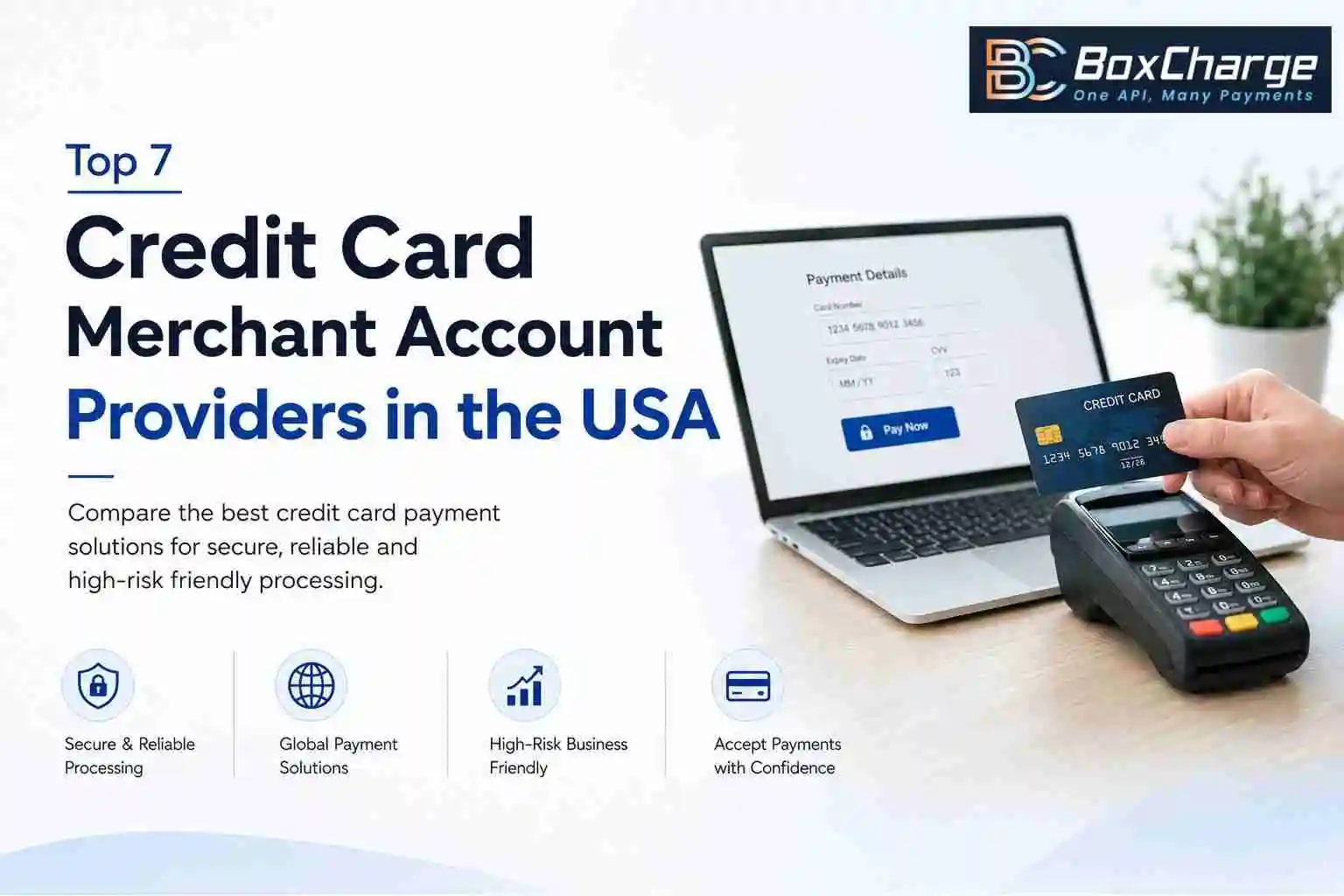
Choosing a Credit Card Merchant Account in the USA is no longer just about finding the lowest processing rate. For online businesses, the real question is whether a provider can help you accept credit card payments consistently, manage risk, protect cash flow, and scale without unexpected processing interruptions.
That becomes even more important for high-risk merchants. Businesses operating in industries such as forex, gaming, subscriptions, digital goods, travel, nutraceuticals, adult products, and other higher-risk categories can face stricter underwriting, higher processing costs, rolling reserves, chargeback pressure, and sudden account reviews. A payment setup that works perfectly for a conventional retailer may not work for a high-risk online business.
This guide reviews seven payment providers worth considering when evaluating credit card payment solutions for the US market: BoxCharge, InQuid, PAYCLY, Amald, Stripe, Payoneer, and Wise. They are not identical products—some focus heavily on merchant acquiring and high-risk processing, while others are broader payment platforms. The right choice depends on your business model, risk profile, transaction volume, target markets, and required payment methods.
What Makes a Good Credit Card Merchant Account Provider?
A merchant account is part of the infrastructure that enables a business to receive card payments. For ecommerce and other card-not-present transactions, the merchant account works alongside a payment gateway or payment processor to authorize, capture, and settle transactions.
The distinction matters. Authorize.Net, for example, explains that online merchants generally need both a merchant account and a gateway account for accepting website payments.
For businesses comparing credit card processing services, several factors deserve attention:
Support for your business category and MCC
Card-not-present transaction capabilities
Chargeback and fraud management
3D Secure authentication
Multi-currency processing
Recurring billing and subscriptions
API and hosted checkout options
Settlement speed and reserve requirements
International acquiring capabilities
Clear underwriting and compliance requirements
For high-risk merchants, these considerations can matter more than a headline processing rate.
1. BoxCharge — Global Credit Card Processing for Complex Businesses
BoxCharge is positioned around global merchant services, cross-border payment processing, payment orchestration, and payment infrastructure for businesses operating across multiple markets. Its platform supports card acceptance alongside digital wallets, bank payment methods, and regional alternative payment methods.
For merchants looking for a Credit Card Payment Solution, BoxCharge combines merchant enablement with gateway connectivity and intelligent routing. Its infrastructure supports 3DS authentication, tokenization, fraud controls, cascading, and multi-acquirer connectivity.
This can be particularly relevant to high-risk merchants because payment problems often go beyond simple card acceptance. A merchant may experience declines with one acquiring route while legitimate transactions could perform better through another. BoxCharge's orchestration model is designed to address that type of payment complexity.
The platform also offers hosted checkout and server-to-server API integration, allowing businesses to choose between a faster implementation and a more customized technical setup.
Best suited for: Global ecommerce, SaaS, subscriptions, travel, marketplaces, fintech and merchants with complex or international processing requirements.
Why consider it: Global merchant enablement, multi-acquirer connectivity, smart routing, cross-border acceptance, 3DS, tokenization and API-based integration.
2. InQuid — High-Risk Credit Card Processing
InQuid has built its offering around high-risk payment processing, merchant accounts, global acquiring and payment infrastructure. Its website specifically highlights industries including forex, casino, IPTV, crypto, digital goods and higher-risk ecommerce.
Its credit card processing infrastructure includes smart acquirer routing, 3DS2 authentication, fraud monitoring, multi-currency processing and chargeback management. InQuid says its routing engine can select acquiring routes based on factors such as card BIN, issuing country, currency, merchant category and approval performance.
For high-risk merchants, this approach can be valuable. A merchant doesn't simply need a gateway that sends transactions from point A to point B. It needs payment infrastructure capable of handling different risk profiles, geographies, currencies and transaction patterns.
InQuid also states that reserve requirements and commercial terms can vary according to the merchant's risk profile and business model.
Best suited for: High-risk ecommerce, digital goods, IPTV, subscriptions, gaming, forex and international businesses.
Why consider it: High-risk underwriting focus, smart routing, 3DS2, multi-currency processing and chargeback-management features.
3. PAYCLY — International Merchant Accounts and Card Processing
PAYCLY is another provider focused strongly on international and high-risk payment processing. Its services include merchant accounts, payment gateways, credit card processing, alternative payment methods and international payment infrastructure.
The provider highlights dedicated merchant IDs, multi-currency processing, alternative payment methods, fraud management and international payment acceptance. Its credit card processing offering is designed to help merchants accept card payments while maintaining control over transaction and settlement information.
For businesses that want to accept payment online, PAYCLY also promotes API integration, checkout integration and ready-to-use plugins.
High-risk merchants should still evaluate the specific underwriting terms offered for their business rather than assuming that every industry receives the same pricing, reserves or approval conditions.
Best suited for: International ecommerce, forex, gaming, casino, high-risk businesses and merchants needing multiple payment methods.
Why consider it: High-risk focus, international processing, dedicated MIDs, multi-currency acceptance and API-based payment infrastructure.
4. Amald — Flexible Payment Infrastructure for High-Risk Merchants
Amald provides payment gateway, credit card processing, eCheck, alternative payment and high-risk merchant account solutions. Its platform includes features such as virtual terminals, multi-MID support, customer vaults, recurring billing and open API integration.
That flexibility can matter for businesses that don't fit neatly into a standard ecommerce processing model.
High-risk merchants frequently need more than a checkout button. They may need recurring billing, multiple MIDs, fraud controls, transaction reporting, and alternative payment methods to maintain stable cash flow.
Amald's published product information also highlights tokenization, anti-fraud tools, multi-currency conversion and recurring or installment payment functionality.
Best suited for: High-risk ecommerce and businesses requiring customized gateway and merchant-account configurations.
Why consider it: Multi-MID support, API integration, recurring payments, fraud tools and flexible payment infrastructure.
5. Stripe — Developer-Friendly Online Card Payments
Stripe is one of the most recognizable names in online payment processing and offers a broad technology stack for accepting payments online and in person. Its platform supports major credit and debit cards, wallets, bank payment methods and buy now, pay later options.
For businesses that need a credit card payment API, Stripe provides APIs, hosted Checkout, embedded payment interfaces and payment links. Its documentation also supports different integration approaches depending on how much control a merchant wants over its checkout experience.
Stripe can be attractive for conventional ecommerce, SaaS and technology businesses because of its developer tooling and broad payment-method coverage.
However, high-risk merchants should carefully review Stripe's current business restrictions and eligibility requirements before building their entire payment operation around the platform. A technically excellent payment stack is not necessarily appropriate for every high-risk business model.
Best suited for: Mainstream ecommerce, SaaS, marketplaces, subscriptions and technology businesses.
Why consider it: Strong API ecosystem, hosted checkout, card acceptance, wallets, recurring payments and developer tools.
6. Payoneer — Global B2B Payment Collection
Payoneer is better understood as a global payment and business-finance platform rather than a traditional dedicated high-risk merchant-account provider.
Its Request a Payment service allows eligible businesses to request money from business clients using methods including credit and debit cards, ACH debit and bank transfers. Payoneer states that its service is designed for business-to-business payments and is not intended to operate as a consumer ecommerce checkout gateway.
That distinction is important.
For consultants, agencies, exporters, freelancers, technology companies and businesses billing international clients, Payoneer can be a useful way to collect payments globally. Its platform supports clients across more than 190 countries and territories, subject to eligibility and availability.
Best suited for: B2B businesses, freelancers, agencies, exporters and international service providers.
Why consider it: Global payment requests, card acceptance for eligible B2B payments, international receiving capabilities and multi-currency support.
7. Wise — International Business Payments and Card Collection
Wise has expanded beyond traditional international transfers and offers business payment functionality in supported markets. Its card-payment terms describe payment gateway services that allow eligible businesses to accept online card-not-present payments through a third-party merchant acquirer.
That makes Wise worth considering for businesses already using its international business infrastructure and looking for ways to connect payment collection with cross-border financial operations.
However, availability and eligibility can depend heavily on the jurisdiction, product and business model. High-risk merchants should therefore confirm whether their exact activity is supported before treating Wise as a replacement for a specialist high-risk merchant account.
Best suited for: International businesses that need cross-border financial infrastructure and eligible online card-payment capabilities.
Why consider it: International business payments, cross-border functionality and card-payment services in supported markets.
Why High-Risk Merchants Need a Different Approach
For a conventional retailer, selecting a payment provider can feel like comparing processing rates and checkout features.
For a high-risk merchant, it is rarely that simple.
A merchant can have a legitimate business, strong sales and genuine customers and still face:
Repeated merchant account application declines
Higher processing rates
Rolling reserves
Longer underwriting reviews
Sudden transaction declines
Higher chargeback exposure
Settlement delays
Restrictions on certain products or markets
Difficulty obtaining recurring billing
Limited access to international acquiring
This is why the cheapest online credit card payment processing option isn't automatically the best option.
A provider should understand the merchant's business model and risk profile before recommending a processing structure.
Security is equally important. The PCI Security Standards Council recommends that merchants consider how payment applications, third-party services and ecommerce connections are secured and maintained.
What Should You Compare Before Choosing a Provider?
Before opening a merchant account, ask prospective providers:
Q: Can you underwrite my industry?
A provider may accept ecommerce businesses but restrict specific products, subscriptions or regulated categories.
Q: What happens if my transaction volume increases?
A processing solution should be able to accommodate growth without creating unexpected account problems.
Q: Are reserves required?
Ask whether a rolling or upfront reserve applies, how it is calculated and when funds are released.
Q: How are chargebacks handled?
Look for 3DS, fraud screening, dispute alerts and evidence-management capabilities where appropriate.
Q: Can I process internationally?
If your customers are in the USA, UK, Europe or Asia, ask about currencies, acquiring coverage and cross-border transaction support.
Q: Can I integrate through an API?
A strong credit card payment API can give ecommerce and SaaS businesses significantly more control over checkout, transaction status, refunds and recurring payments.
Q: Do you support alternative payment methods?
Adding wallets and buy now pay later payment solutions can help merchants serve customers who do not want to enter card details.
The Bottom Line
There is no single best credit card merchant account provider for every business in the USA.
BoxCharge stands out for merchants looking for global merchant services, cross-border processing and payment orchestration. InQuid, PAYCLY and Amald are particularly relevant when high-risk processing and customized payment infrastructure are important considerations. Stripe is compelling for developer-led mainstream businesses, while Payoneer and Wise can be useful for eligible businesses with international payment requirements.
The most important step is matching the provider to your actual business model—not simply choosing the provider with the lowest advertised rate.
For high-risk merchants, reliable payment acceptance can directly influence revenue, customer experience, and cash flow. If your business has already experienced declined applications, frozen funds, excessive chargebacks or unstable processing, it may be time to look beyond conventional payment setups.
BoxCharge helps businesses evaluate merchant account, cross-border payment gateway, and payment orchestration requirements based on their processing profile, markets, and payment needs. If you're looking for a more flexible way to accept card payments and scale internationally, speak with the BoxCharge team about your requirements.