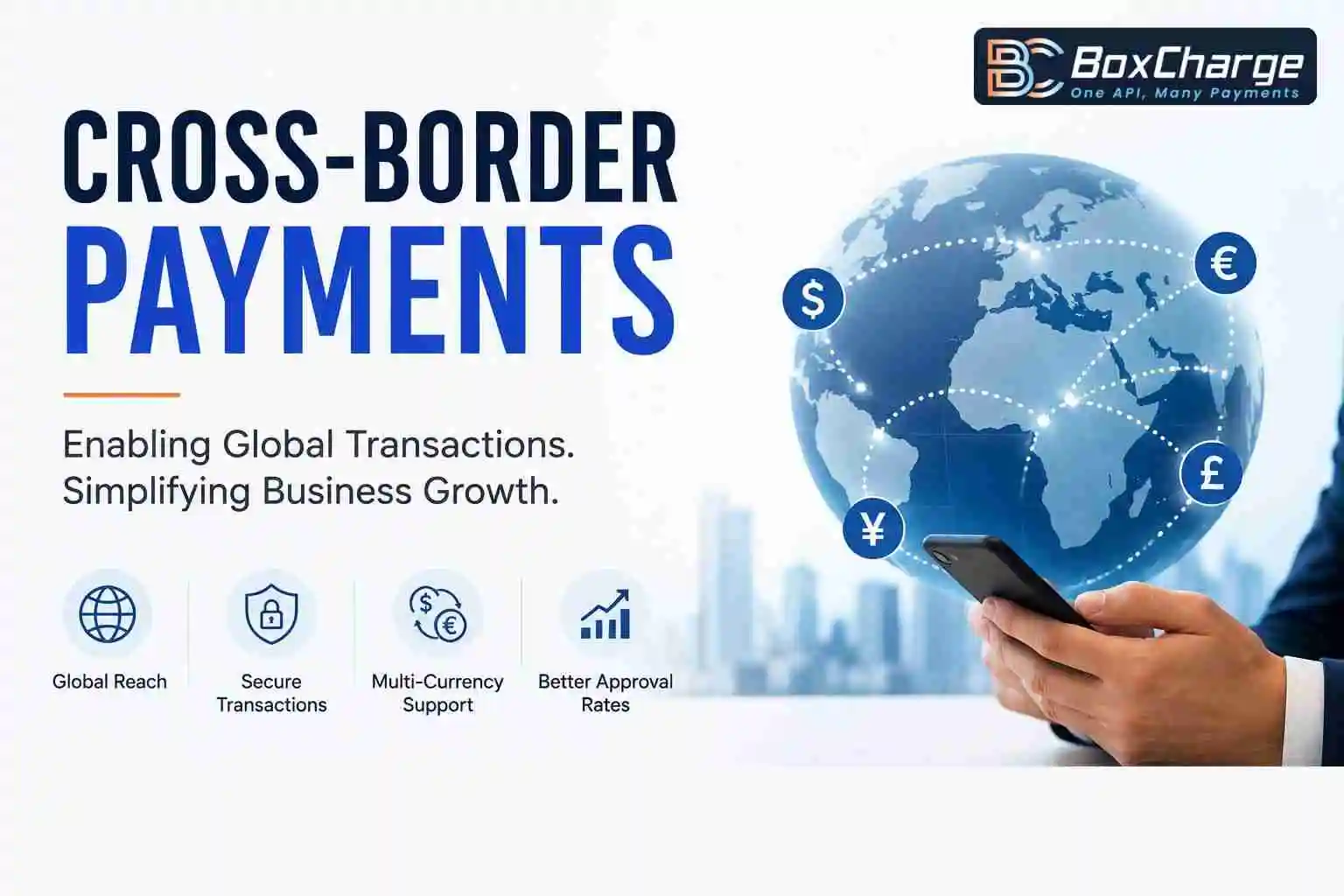
Cross-border payments have become a normal part of doing business online. A customer in Germany can purchase from a UK-based company in euros, a US SaaS business can bill a customer in Canada, and an Australian merchant can accept payments from buyers across Europe within seconds. From the customer's perspective, the transaction should feel as simple as buying from a local business.
Behind the scenes, it is rarely that simple.
International transactions can involve different currencies, issuing banks, acquiring partners, payment methods, fraud controls, regulations, settlement timelines, and foreign exchange costs. For businesses, especially those operating in high-risk sectors, these additional layers can create payment failures, cash-flow pressure, higher processing costs, and frustrated customers.
That is why understanding international payment processing is no longer just a concern for finance teams. It has become an important part of customer experience, conversion optimization, and international growth.
What Are Cross-Border Payments?
A cross-border payment occurs when the payer and the business receiving the funds are located in different countries or jurisdictions.
For an online merchant, this might mean a customer in France paying a US company, or a customer in the UK purchasing a subscription from a business based in Australia. The payment may need to move through different financial institutions and payment networks before the merchant receives the funds.
The process can involve:
Currency conversion and foreign exchange (FX)
Card networks and issuing banks
Acquiring banks
Payment processors
Fraud and compliance screening
Local payment methods
Settlement and reconciliation
Refund and dispute management
The exact process depends on the payment method, countries involved, currencies, merchant setup, and the providers handling the transaction.
This complexity explains why a payment that looks instant to a customer can involve several moving parts in the background.
Visa notes that cross-border transactions can involve multiple intermediaries, time-zone differences, additional screening, FX fluctuations, and other sources of friction.
Why International Payments Are Becoming More Important
Global commerce is becoming increasingly localized. Customers may buy from international businesses, but they still expect the payment experience to feel familiar.
That means merchants entering markets such as the United States, United Kingdom, Germany, France, Canada, Australia, Singapore, and the UAE need to think beyond simply accepting Visa and Mastercard.
Payment preferences vary by market.
Worldpay's 2026 Global Payments Report highlights the growing importance of local payment behavior, describing the trend as "glocalization." It also identifies digital wallets as leading online payment methods across numerous European and Asia-Pacific markets.
For merchants, the lesson is straightforward: global reach does not necessarily mean using the same payment setup everywhere.
A customer is more likely to complete a purchase when the checkout supports familiar currencies and payment methods while providing a clear, secure experience.
Where Businesses Commonly Struggle
The biggest problem with online cross-border payment processing is that there is rarely one single point of failure.
A payment can be declined because of issuer behavior, fraud rules, authentication requirements, currency issues, processor limitations, or an acquiring relationship that does not perform well in a particular market.
This becomes especially frustrating when the customer is legitimate.
Imagine an online business spending heavily on Google Ads to acquire customers in Germany. The campaign performs well, traffic is strong, and shoppers reach checkout. But a portion of those customers repeatedly experience card declines.
From the marketing team's perspective, it looks like a conversion problem.
From the payments team's perspective, it may be an authorization or routing problem.
The business has already paid to acquire the customer. Losing that customer at the payment stage means the advertising investment has effectively produced no revenue.
This is why payment approval rates should be considered alongside conventional marketing metrics such as conversion rate, cost per acquisition, and customer lifetime value.
Why High-Risk Merchants Have a Harder Time
The challenges become more complicated for high-risk merchants.
Businesses in industries such as Forex, online gaming, travel, subscription services, nutraceuticals, digital services, and other higher-risk categories may face stricter underwriting and ongoing monitoring.
A merchant can have a legitimate business model and still be classified as high risk because of factors such as chargeback exposure, transaction volume, business model, customer location, or regulatory complexity.
The practical consequences can be significant.
A high-risk merchant may encounter:
Higher processing fees
Rolling reserves or other reserve requirements
Longer settlement periods
Stricter underwriting
Greater scrutiny of transaction activity
More limited processor options
Difficulties maintaining stable processing as volumes grow
Stripe's current guidance on high-risk merchant accounts notes that higher fees, rolling reserves, longer settlement periods, and stricter terms can be part of high-risk processing arrangements.
For a growing merchant, the issue isn't simply paying more for processing. A reserve or delayed settlement can tie up working capital that is needed for advertising, inventory, payroll, refunds, or expansion.
The Chargeback Problem
Chargebacks are another major concern.
Consider an online subscription business selling internationally. A customer may not recognize the billing descriptor on their bank statement and dispute the transaction. A travel customer may dispute a booking because of a cancellation misunderstanding. A digital service provider may face disputes when customers claim that a service was not delivered as expected.
At scale, these individual disputes can become a serious operational issue.
Current industry guidance increasingly treats chargeback prevention as part of the broader payments strategy rather than as a problem to address only after a dispute occurs. Adyen, for example, notes that chargeback patterns can vary significantly between markets and that excessive controls can themselves affect customer experience and conversions.
For high-risk merchants, the balance is particularly difficult: tighten fraud controls too much and legitimate customers may be rejected; loosen them too far and chargebacks and fraud can increase.
Currency Conversion Can Quietly Increase Costs
Another issue businesses often underestimate is multi-currency payment processing.
A customer may prefer to pay in euros, while the merchant's operating account is denominated in pounds or US dollars. Somewhere in the payment flow, the currency has to be converted.
The cost isn't always obvious.
Merchants need to consider the FX rate being applied, conversion fees, settlement currency, and whether customers are shown a local currency price at checkout.
Poor currency handling can create two problems at once: the merchant pays more to process the transaction, while the customer receives a less transparent checkout experience.
A well-designed international payment strategy should therefore consider both payment acceptance and settlement.
Local Acquiring Can Make a Difference
One of the most important concepts in international payments is local acquiring.
Instead of treating every international transaction as a foreign transaction from one central processing location, merchants can use acquiring relationships that are better suited to specific markets.
This can improve the overall payment experience and may help merchants address regional authorization, currency, and regulatory considerations.
It is particularly useful for businesses with meaningful transaction volumes in several markets.
However, local acquiring isn't automatically the right answer for every business. The economics, eligibility requirements, settlement arrangements, regulatory obligations, and operational complexity all need to be considered.
This is where a broader payment infrastructure strategy becomes important.
The Role of Payment Gateways and Payment Orchestration
A global payment gateway provides the technical connection between the merchant, payment method, and processing ecosystem. But as international businesses grow, relying on one gateway or processor can create unnecessary dependency.
This is where payment orchestration becomes relevant.
A payment orchestration layer can connect multiple payment providers and help merchants manage different processing routes, payment methods, currencies, and markets through a more unified setup.
For example, if one provider performs strongly in the UK but another has better capabilities in Germany, an orchestrated setup can give the merchant greater flexibility instead of forcing every transaction through the same route.
The objective isn't to add technology for its own sake. It is to give businesses more control over how payments are accepted and managed.
Alternative Payment Methods Are Becoming Part of the Equation
Cards remain important, but international merchants increasingly need to think beyond cards.
Alternative payment methods (APMs) can include bank-based payments, digital wallets, buy now, pay later options, and locally preferred payment methods.
The right mix depends on the target market.
Worldpay's 2026 report shows how strongly digital wallets have developed across multiple European and Asia-Pacific markets.
For a merchant entering a new market, this creates a practical question: should the business simply replicate its existing checkout, or should it adapt the payment experience to local customer expectations?
The second approach is often more appropriate for serious international expansion.
Security and Compliance Cannot Be an Afterthought
A successful international payment strategy must also account for fraud prevention, customer authentication, sanctions screening, data security, and applicable regulations.
This is particularly important for high-risk businesses because payment providers and financial institutions may continuously assess transaction activity.
A merchant that suddenly doubles its processing volume, changes its customer geography, or begins processing significantly larger transactions may attract additional scrutiny.
That doesn't necessarily indicate wrongdoing. It is part of how financial institutions manage risk.
For merchants, transparency matters. Accurate business information, consistent transaction patterns, clear billing descriptors, effective dispute management, and appropriate fraud controls can all contribute to a healthier processing relationship.
High-risk merchants should also understand the potential consequences of excessive fraud and chargebacks. Mastercard's MATCH system and Visa's corresponding merchant screening mechanisms can affect a business's ability to establish processing relationships after qualifying account termination events.
What Should Businesses Look for in a Cross-Border Payment Strategy?
There isn't one universal setup that works for every international merchant.
A business evaluating its payment infrastructure should look at several practical areas:
Market coverage: Can the provider support the countries and currencies that matter to the business?
Payment methods: Does the checkout support the methods customers actually use in those markets?
Authorization performance: Are legitimate transactions being approved consistently?
Risk management: Can fraud controls protect the business without creating excessive checkout friction?
Settlement: How quickly and in which currencies can the business receive funds?
Scalability: Can the infrastructure handle higher transaction volumes and additional markets?
Resilience: What happens if a processor experiences an outage or performance issue?
Reporting: Can the business identify which markets, payment methods, and processors are generating problems?
These questions are much more useful than choosing a provider based solely on the headline transaction fee.
Where Cross-Border Payments Are Heading
The next stage of international payments is less about simply moving money between countries and more about making those transactions feel domestic.
The industry is moving toward greater payment choice, faster settlement, digital wallets, connected domestic payment systems, and more intelligent payment infrastructure.
Worldpay's 2026 report points to developments such as digital wallets, payment-system connectivity, and "glocalization" as important themes shaping the payments landscape.
For merchants, this means international expansion will increasingly require local thinking backed by global infrastructure.
A business may have one global brand, but its payment strategy cannot assume that every customer behaves the same way.
Final Thoughts
Cross-border payments are no longer simply a technical function sitting behind an eCommerce checkout. They influence conversion rates, customer experience, cash flow, acquisition economics, and a business's ability to expand into new markets.
For standard-risk merchants, the priority may be improving authorization and offering familiar payment methods. For high-risk merchants, the stakes are often higher because reserves, settlement delays, chargebacks, underwriting restrictions, and limited processing options can directly affect day-to-day operations.
The strongest international payment strategy is therefore not necessarily the one with the most payment methods or the lowest advertised fee. It is the one that fits the merchant's markets, customers, risk profile, currencies, and growth plans.
Businesses that understand those differences can make international payments feel much less complicated—for themselves and, more importantly, for the customer standing at checkout.
Explore BoxCharge's cross-border payment solutions and find the right approach for your international growth.