Faster international settlements are quickly becoming the deciding factor in whether a high-risk business survives its first two years of cross-border selling — not the approval, not the processing fees, but how fast the money you've already earned actually becomes usable cash.
If you run a high-risk business that sells across borders, you already know the drill. A customer in Berlin pays in euros. A customer in Manila pays in pesos. And somewhere between the checkout page and your bank account, that money seems to vanish into a black hole for days — sometimes weeks before it finally lands where you can actually use it.
For low-risk businesses, this is an inconvenience. For high-risk merchants, it's a cash flow crisis waiting to happen.
Slow international settlements aren't just an operational headache. They tie up working capital, delay payroll and supplier payments, and put growth plans on hold while you wait for a processor to release funds it's already collected on your behalf. And because a high-risk merchant account already comes with tighter scrutiny, higher reserves, and stricter rolling holds, the settlement delay problem hits this segment harder than almost anyone else in the payments ecosystem.
This post breaks down why cross-border settlement speed matters so much for high-risk industries, where the real bottlenecks are, and what a faster international settlement process should actually look like — plus what to ask before you sign with any processor.
The High-Risk Merchant Reality: Approved, But Not Really Supported
Getting approved for a high-risk merchant account is only step one. Many high-risk business owners — in industries like nutraceuticals, CBD, travel, subscription services, gaming, forex, and adult content — discover that "approval" doesn't mean smooth operations. It often means:
Longer underwriting timelines before you can even accept a payment
Rolling reserves that lock away a percentage of revenue for months
Higher processing fees than standard merchant accounts
Limited access to multi-currency settlement options
Payouts that take 5, 7, or even 15+ business days to clear internationally
That last point is where a lot of high-risk merchants quietly bleed money. When your international settlement time is slow, you're not just waiting — you're financing your own payment processor's risk buffer with your own revenue.
Why Cross-Border Payment Processing Is Harder for High-Risk Businesses
1. Correspondent banking delays
Most international transfers still rely on a chain of correspondent banks, each one adding a layer of compliance checks, currency conversion, and processing time. For a high-risk merchant account, this chain is often longer because fewer banks are willing to sit in the middle.
2. Manual compliance reviews
High-risk transactions frequently get flagged for manual review under anti-money laundering (AML) and know-your-customer (KYC) protocols. This is necessary for security, but it also means settlement isn't instant — it's queued behind a human decision.
3. Currency conversion bottlenecks
Multi-currency merchant accounts sound convenient, but not every payment gateway for high-risk businesses actually supports real-time FX conversion. Many still batch conversions once a day, or worse, once a week, which delays the entire settlement cycle.
4. Chargeback and fraud buffers
Industries prone to higher chargeback ratios often see extended settlement holds specifically to cover potential disputes. It's a legitimate risk management tool for the processor — but it's your cash flow that absorbs the impact.
The Real Cost of Slow Settlements
Delayed international settlements aren't just annoying — they compound into serious business problems:
Cash flow strain: You've made the sale, but you can't reinvest the revenue, pay suppliers, or cover payroll until funds clear.
Missed growth opportunities: Scaling into new markets requires capital on hand, not capital in transit.
Increased reliance on credit: Some high-risk merchants end up taking on short-term financing just to bridge settlement gaps — an avoidable expense.
Currency risk exposure: The longer funds sit unsettled, the more exposure you have to exchange rate fluctuations, especially in volatile currency pairs.
Operational uncertainty: Unpredictable settlement timing makes it nearly impossible to forecast accurately.
If you're a high-risk merchant processing international transactions regularly, these aren't hypothetical risks. They're the daily reality of running a business on a payment infrastructure that wasn't built with your industry in mind.
What Faster International Settlements Should Actually Look Like
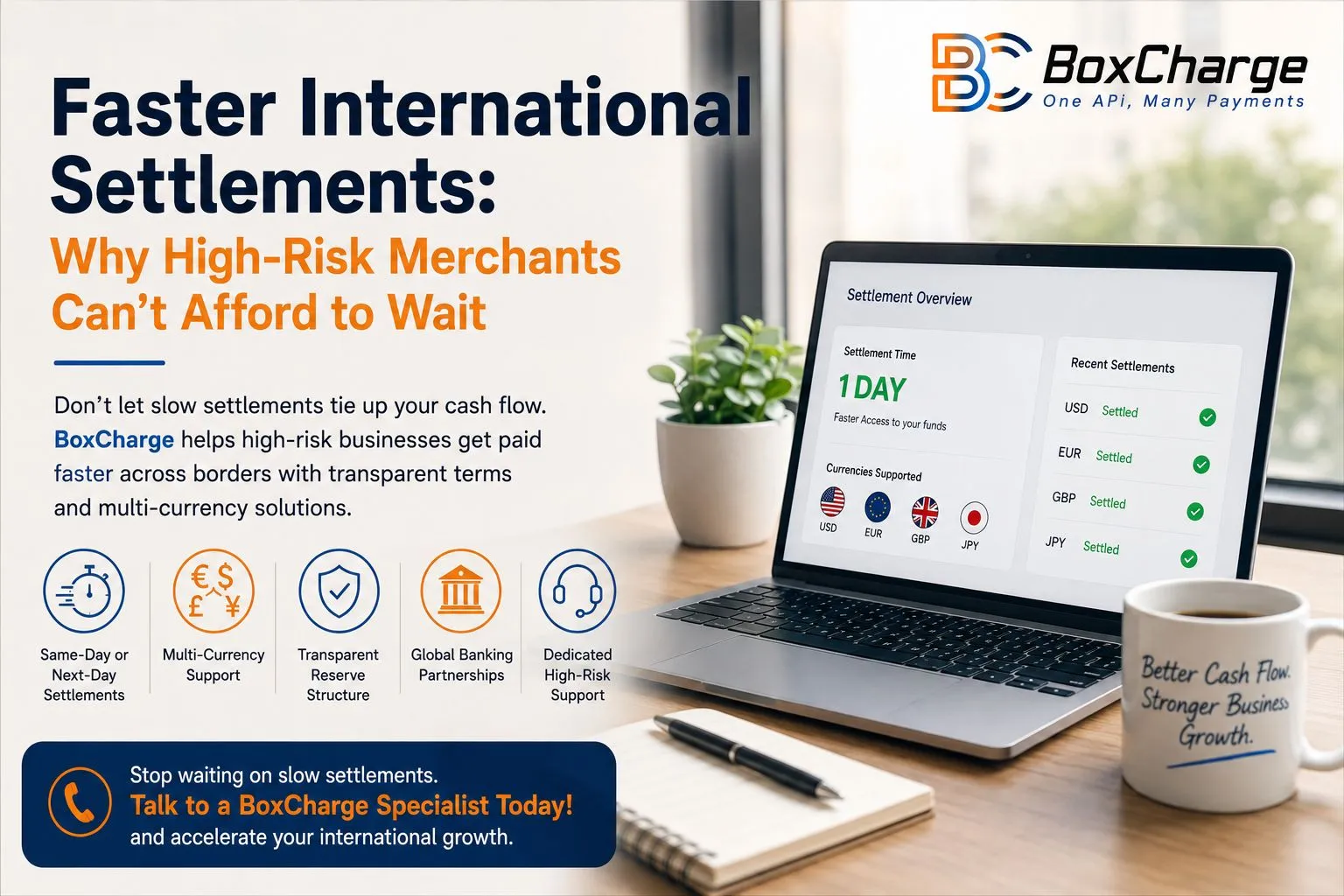
The good news: settlement speed isn't a fixed cost of doing business in a high-risk category. It's a function of the payment processor's infrastructure, banking relationships, and risk framework. A modern high-risk payment gateway built for cross-border commerce should offer:
1: Same-day or next-day settlement options
Rather than defaulting to industry-standard 5-15 day holds, merchants should have access to accelerated settlement tiers based on transaction history and risk profile.
2: Real-time or near-real-time currency conversion
Faster FX processing means funds move through the settlement pipeline without sitting idle in a conversion queue.
3: Transparent reserve structures
Instead of blanket rolling reserves, a merchant-friendly processor should offer risk-based reserves that shrink as your processing history builds trust — not indefinite holds with no clear release schedule.
4: Direct banking partnerships across regions
Fewer intermediary banks in the settlement chain means fewer delays, fewer fees, and fewer points of failure.
5: Dedicated support for high-risk verticals
A processor that understands your industry — whether that's e-commerce, travel, or subscription billing — can structure settlement terms around actual risk data, not blanket assumptions about "high-risk" as a category.
This is exactly the gap BoxCharge was built to close. Rather than treating high-risk merchants as an afterthought bolted onto a standard payment stack, BoxCharge structures its cross-border settlement process around the realities of high-risk industries — faster payout cycles, multi-currency support, and reserve terms that are actually explained rather than buried in fine print.
Choosing the Right High-Risk Merchant Account for International Growth
If you're evaluating payment processors for a high-risk business with international customers, settlement speed should be part of your due diligence checklist — not an afterthought you discover after onboarding. A few questions worth asking any prospective processor:
What is the average international settlement time for accounts in my industry?
Do you support multi-currency settlement, or will everything be converted to a single base currency?
How is the rolling reserve calculated, and when does it get reviewed or reduced?
What banking partners handle the cross-border leg of the transaction?
Is there a dedicated risk or underwriting team familiar with my specific vertical?
A processor that can answer these clearly — with specific numbers and timelines rather than vague reassurances — is one that's built its infrastructure around high-risk merchants, not one that's tolerating them.
FAQs: Faster International Settlements for High-Risk Merchants
Q: How long does international settlement usually take for a high-risk merchant account?
It varies by processor and industry, but many high-risk merchants see settlement windows of 5 to 15 business days, compared to 1-2 days for standard low-risk accounts. The gap comes down to correspondent banking chains, manual compliance review, and reserve policies.
Q: Why do high-risk merchant accounts have slower settlement than regular accounts?
Processors build in longer holds to cover chargeback risk, run manual AML/KYC checks on flagged transactions, and route funds through more correspondent banks — all of which add time to the settlement cycle.
Q: Can high-risk merchants get same-day or next-day international settlements?
Yes, with the right processor. Accelerated settlement tiers exist, but they're typically tied to transaction history, risk profile, and a processor's direct banking relationships rather than being offered universally.
Q: What should I ask a payment processor about settlement speed before signing up?
Ask for average settlement times specific to your industry, how rolling reserves are calculated and reduced, whether multi-currency settlement is supported, and which banking partners handle the cross-border leg of transactions.
Final Thoughts
High-risk merchants already navigate enough friction: tougher approvals, higher fees, and constant scrutiny. Slow international settlements shouldn't be another tax on doing business globally. As cross-border e-commerce continues to grow, the merchants who win will be those that partner with payment processors built to move money quickly, transparently, and reliably — regardless of which "high-risk" category they fall into.
Faster settlement isn't a luxury feature. For high-risk businesses competing internationally, it's the difference between reinvesting revenue today and waiting weeks to access money you've already earned.
Ready to Stop Financing Your Processor's Risk Buffer?
BoxCharge works exclusively with high-risk businesses to structure international payment processing around real cash flow needs — faster settlement tiers, multi-currency support, and reserve terms you can actually understand.
Talk to a BoxCharge specialist about your settlement timeline →