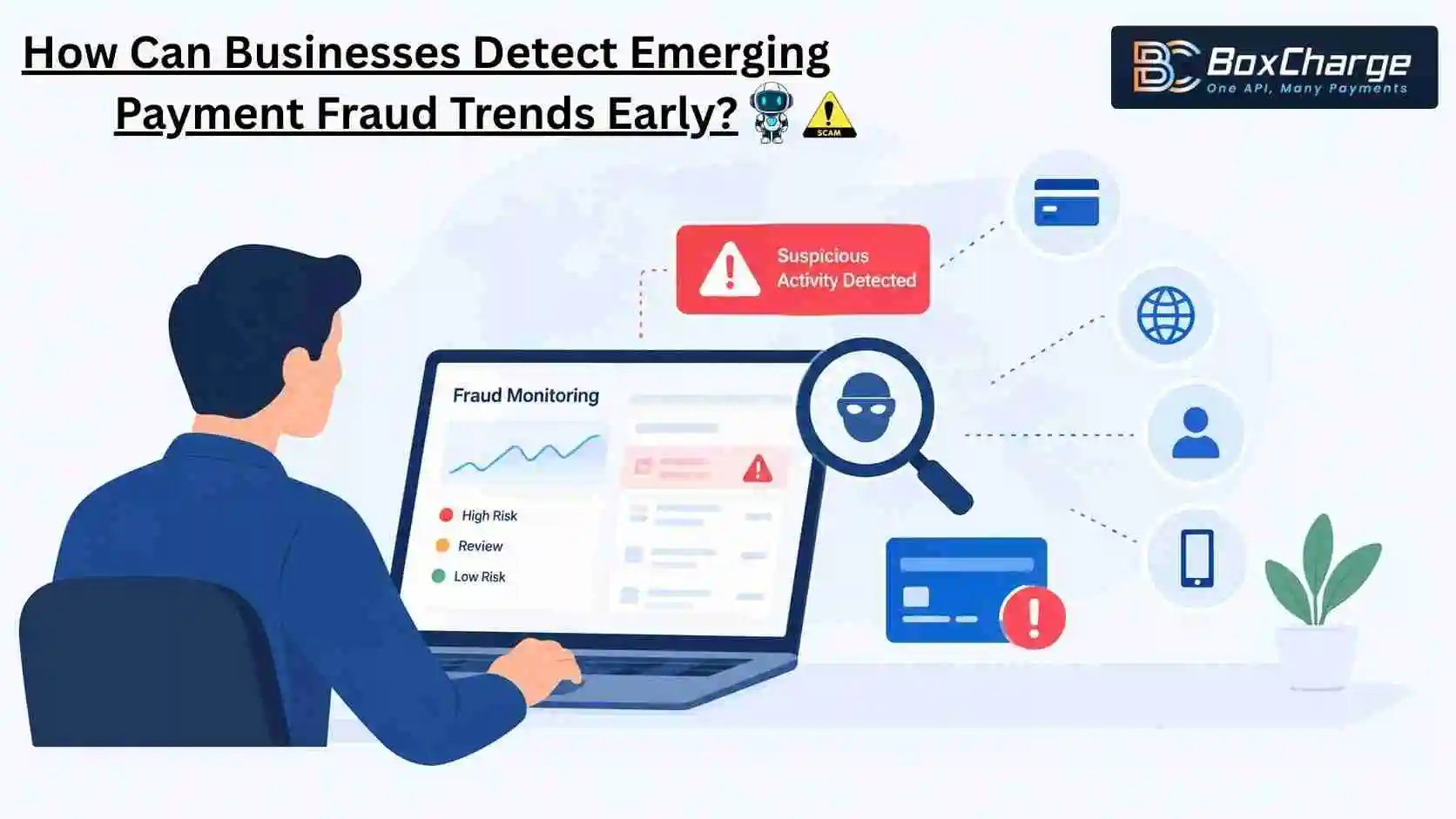
Payment fraud is no longer something businesses can afford to investigate only after a chargeback appears. The more useful question is: how can businesses detect emerging payment fraud trends early enough to act?
Fraudsters are changing tactics quickly, using AI, account takeovers, social engineering, synthetic identities, automated attacks, and coordinated fraud networks. Visa reported that scams were becoming the fastest-growing source of consumer payment harm, while Mastercard has highlighted the increasing use of AI to automate payment fraud.
For merchants, especially those operating in high-risk payment processing, the stakes are even higher. A sudden increase in fraudulent transactions can mean more chargebacks, declining approval rates, additional reviews, higher reserves, delayed settlements, or even disruption to a merchant account.
The good news is that emerging fraud rarely appears completely out of nowhere. Changes in transaction behavior, customer activity, payment methods, geography, device patterns, and chargeback data can provide early warning signals.
Here is how businesses can identify those signals before a small fraud problem becomes a major payment-risk issue.
Why Emerging Payment Fraud Is Harder to Detect
Traditional fraud prevention often focuses on individual transactions.
A transaction comes in, the system checks a set of rules, and the payment is either approved, challenged, or declined.
That approach still has value, but modern fraudsters understand predictable controls.
They can distribute activity across different cards, accounts, devices, and transaction amounts. A single payment may therefore look completely normal while a group of related transactions reveals a much larger problem.
This is one reason fraud detection is moving toward behavioral analytics, real-time transaction monitoring, network analysis, and adaptive risk scoring.
Sift's 2026 research similarly points to the growing importance of connecting identity, payment, device, behavior, and transaction-outcome data instead of assessing every event in isolation.
The objective is not simply to identify yesterday's fraud.
It is to recognize what tomorrow's fraud might look like.
1. Monitor Changes in Transaction Behavior
One of the earliest warning signs of emerging payment fraud is a change in normal customer behavior.
Businesses should establish a baseline for legitimate activity and monitor meaningful deviations.
For example, a customer who normally:
Makes one purchase every month
Uses the same device
Logs in from the same region
Uses the same payment method
Places transactions within a predictable value range
may suddenly:
Log in from a new location
Change account details
Add a new payment method
Make several purchases within minutes
Increase transaction values dramatically
Attempt transactions from multiple devices
None of these signals automatically means fraud.
The problem begins when several unusual signals occur together.
Modern payment fraud detection therefore needs to consider behavioral context rather than simply asking whether a transaction exceeds a predefined amount.
J.P. Morgan's 2026 payments outlook also highlights behavioral signals such as unusual location, transaction amount, and transaction time as useful indicators for identifying abnormal activity.
2. Watch Transaction Velocity Closely
Transaction velocity is another useful early-warning indicator.
A sudden increase in the number of transactions associated with a particular:
Card
Customer
Device
IP address
Account
Merchant profile
Payment method
can indicate automated testing or coordinated fraud.
For example, fraudsters may test stolen card details using several low-value transactions before attempting larger purchases.
This is particularly important for online merchants because card testing can initially generate relatively small losses while creating a much larger downstream chargeback problem.
A payment gateway with velocity controls and transaction monitoring can help merchants identify unusual frequency and volume patterns before they escalate. BoxCharge's fraud-prevention infrastructure, for example, includes configurable rules, velocity controls, and monitoring signals designed to support payment-risk management.
The important point is that velocity should not be viewed in isolation.
A legitimate subscription business naturally has high transaction volume. A low-volume business suddenly experiencing hundreds of attempts in a short period is a very different risk profile.
Context matters.
3. Track Small Changes in Chargeback Patterns
Chargebacks are often treated as a financial problem that occurs after fraud.
They can also serve as an important fraud intelligence signal.
Businesses should monitor:
Chargeback frequency
Chargeback reason codes
Customer segments generating disputes
Payment methods associated with disputes
Countries or regions producing unusual activity
Products or services linked to disputes
Time between transaction and dispute
Changes in chargeback concentration
A gradual increase in disputes from one particular customer segment may reveal a developing problem that aggregate chargeback numbers hide.
For high-risk merchants, this becomes especially important.
High-risk businesses already operate under greater scrutiny because of their industry, transaction characteristics, international exposure, or potential chargeback risk. A deterioration in dispute performance can therefore create consequences beyond the individual transaction.
It may affect merchant account stability, reserves, settlement conditions, and acquiring relationships.
4. Look for Account Takeover Signals
Account takeover is particularly difficult because the transaction can appear legitimate.
The fraudster is not necessarily using a completely new identity.
They may be operating through a genuine customer's compromised account.
Sift's 2026 research notes that compromised accounts can bypass traditional fraud controls because activity originates from an account that already appears trusted.
Businesses should therefore monitor combinations of events such as:
Login → password change → new device → new payment method → address change → unusual transaction
Any individual event could be legitimate.
The sequence is what makes the activity interesting.
This is why businesses should connect authentication data with payment data rather than keeping fraud monitoring entirely inside the checkout process.
5. Pay Attention to New Payment Methods
Fraud patterns can shift when customers suddenly begin using a different payment method.
For example, a merchant might historically receive most transactions through cards but suddenly experience unusual activity through:
Digital wallets
Bank transfers
Alternative payment methods
Buy-now-pay-later products
Real-time payment systems
Newly introduced payment channels
This does not mean new payment methods are inherently risky.
Instead, merchants should ask whether fraud rates, transaction values, approval rates and disputes differ significantly between payment methods.
This is particularly relevant as real-time payments continue expanding.
The Open Banking Implementation Entity reported that fraud volumes increased in Q1 2026 and highlighted impersonation, phishing, smishing, and fake-refund scams among evolving fraud techniques.
When money moves faster, businesses have less time to detect and intervene.
6. Compare Fraud Data by Geography
Cross-border merchants should never rely only on global averages.
Fraud patterns can vary significantly by:
Country
Region
Currency
Issuer
Payment method
Customer acquisition channel
Device type
For example, a merchant might have a stable overall fraud rate but discover that disputes from one geographic market have increased sharply over the last 30 days.
That could indicate a new fraud campaign.
It could also indicate a change in customer acquisition quality, payment-method behavior or product targeting.
The important thing is to identify changes within individual segments, rather than allowing strong performance in one market to hide deterioration in another.
7. Identify Coordinated Fraud Rings
One of the biggest weaknesses of transaction-by-transaction monitoring is that fraud networks can deliberately stay below individual risk thresholds.
Consider ten accounts.
Individually:
Each makes a normal-sized transaction.
Each uses a different card.
Each has a different email address.
Each appears to come from a different customer.
But all ten may be connected through common devices, IP patterns, behavioral characteristics or payment instruments.
That is where fraud ring detection becomes important.
Sift's Q2 2026 research specifically emphasizes that coordinated fraud rings can exploit fragmented visibility across accounts, devices, merchants, and payment instruments.
Businesses should therefore look beyond:
“Is this transaction suspicious?”
and start asking:
“Is this transaction connected to other suspicious activity?”
That change in thinking can significantly improve early fraud detection.
8. Use AI and Machine Learning — But Don't Rely on AI Alone
Artificial intelligence is becoming an increasingly important component of payment fraud prevention.
Modern fraud systems can analyze large volumes of information and identify relationships that would be difficult for a human analyst to spot manually.
Mastercard's 2026 research reports that AI-based fraud tools using real-time data and behavioral insights can help reduce fraud losses and false positives.
However, AI should not be treated as a magic solution.
A strong fraud-management strategy can combine:
Rules + velocity controls + behavioral analysis + authentication + transaction monitoring + chargeback intelligence + human review
Rules are useful for known patterns.
Machine learning can identify more complex relationships.
Human analysts can investigate unusual situations where the data requires business context.
For high-risk merchants, this layered approach is particularly valuable because payment risk is rarely determined by one signal.
9. Watch for AI-Driven Fraud Trends
Businesses also need to monitor how fraudsters are using AI.
The threat isn't simply that AI makes existing fraud faster.
It can make fraudulent activity appear more convincing.
Visa's Spring 2026 threat report highlighted the growing use of AI-enabled social engineering, with criminals increasingly manipulating people into authorizing payments themselves.
Mastercard has similarly pointed to AI-assisted scams, synthetic identities, deepfakes, and impersonation as growing concerns.
This means fraud teams should watch for:
Unusual account creation patterns
Synthetic identity indicators
Coordinated application behavior
Automated checkout activity
Suspicious login patterns
Unusual customer-support interactions
Rapid changes in payment behavior
Social-engineering-related disputes
The fraud signal may no longer exist entirely inside the transaction.
10. Build a Fraud Trend Dashboard
Businesses cannot detect emerging fraud trends if they only review fraud data once a month.
A useful dashboard should track changes over time.
At minimum, monitor:
Metric | What It Can Reveal |
Approval rate | Sudden changes in transaction quality or risk controls |
Decline rate | Potential fraud spikes or overly aggressive rules |
Chargeback rate | Deteriorating transaction quality |
Fraud rate | Direct fraud exposure |
Transaction velocity | Automated or coordinated activity |
Average transaction value | Changes in customer behavior |
Geographic performance | Emerging regional fraud |
Payment-method performance | Channel-specific risk |
Account takeover attempts | Credential-related attacks |
Refund activity | Potential abuse or suspicious customer behavior |
The objective is not to create another complicated report.
It is to establish a baseline and identify meaningful deviations quickly.
Why High-Risk Merchants Struggle More With Emerging Fraud
For a standard low-risk merchant, a fraud spike is a serious problem.
For a high-risk merchant account holder, it can become an existential payment problem.
Industries such as forex, iGaming, online gaming, adult businesses, subscriptions, digital services, and certain financial services can face additional scrutiny because of chargeback exposure, regulatory considerations, international transactions, and customer-risk profiles.
This creates a difficult balancing act.
Too little fraud protection
The merchant may experience:
Higher chargebacks
Fraud losses
Customer disputes
Increased monitoring
Reserve adjustments
Settlement delays
Too much fraud protection
The merchant may experience:
Legitimate transactions being declined
Lower approval rates
Lost customers
Checkout abandonment
Reduced revenue
This is one of the biggest pain points in high-risk payment processing.
The goal isn't to block everything that looks unusual.
The goal is to distinguish between unusual legitimate behavior and genuinely suspicious behavior.
What Should High-Risk Merchants Do When They Detect a New Fraud Pattern?
The worst response is to immediately shut down every transaction associated with the suspected pattern.
Instead, merchants should investigate the pattern and determine its scope.
A practical response could involve:
Identify the affected transactions.
Determine when the pattern began.
Compare affected transactions with historical behavior.
Check payment methods, locations, devices, and customer segments.
Review associated chargebacks and refunds.
Apply targeted controls rather than blanket declines.
Increase monitoring temporarily.
Document the incident and response.
Review whether underwriting or compliance information needs updating.
Work with the payment provider or acquiring partner where appropriate.
This approach is particularly important for high-risk merchants because abrupt changes to processing behavior can sometimes create additional operational problems.
High-risk payment processing already involves ongoing monitoring, compliance reviews, and risk management.
The Future of Payment Fraud Detection Is Predictive
The biggest shift happening in payment fraud detection is the move from reactive fraud management to predictive risk management.
Instead of asking:
“Which transaction was fraudulent?”
businesses increasingly need to ask:
“What changed before the fraud happened?”
That could be:
A new device pattern
A sudden geographic shift
Increased transaction velocity
New payment behavior
Multiple connected accounts
A change in customer acquisition
Unusual login activity
A new chargeback pattern
Those changes can provide valuable clues before losses become obvious.
And as agentic commerce develops, the challenge will become even more complex. The 2026 payments landscape is increasingly concerned with determining not only who is making a payment, but what system or agent is acting, on whose behalf, and whether that activity is authorized.
Final Thoughts
Businesses can detect emerging payment fraud trends early by monitoring behavior, transaction velocity, chargebacks, account activity, geography, payment methods, and connections between transactions.
The key is not simply collecting more data.
It is connecting the right data and identifying changes quickly.
For high-risk merchants, this matters even more. A fraud problem can quickly become a chargeback problem, settlement problem, compliance problem, or merchant-account stability problem.
The strongest approach combines real-time transaction monitoring, adaptive fraud controls, behavioral analytics, authentication, chargeback intelligence, and human oversight.
At BoxCharge, merchants evaluating high-risk payment processing should look beyond basic transaction acceptance and consider how their payment infrastructure handles fraud prevention, transaction monitoring, chargeback exposure, and ongoing risk management. BoxCharge's fraud-prevention layer includes configurable rules, velocity controls, and monitoring signals that can be incorporated into a merchant's payment-risk strategy.
Because the smartest fraud strategy isn't the one that blocks the most payments.
It's the one that identifies the right risks early while allowing legitimate customers to keep paying.