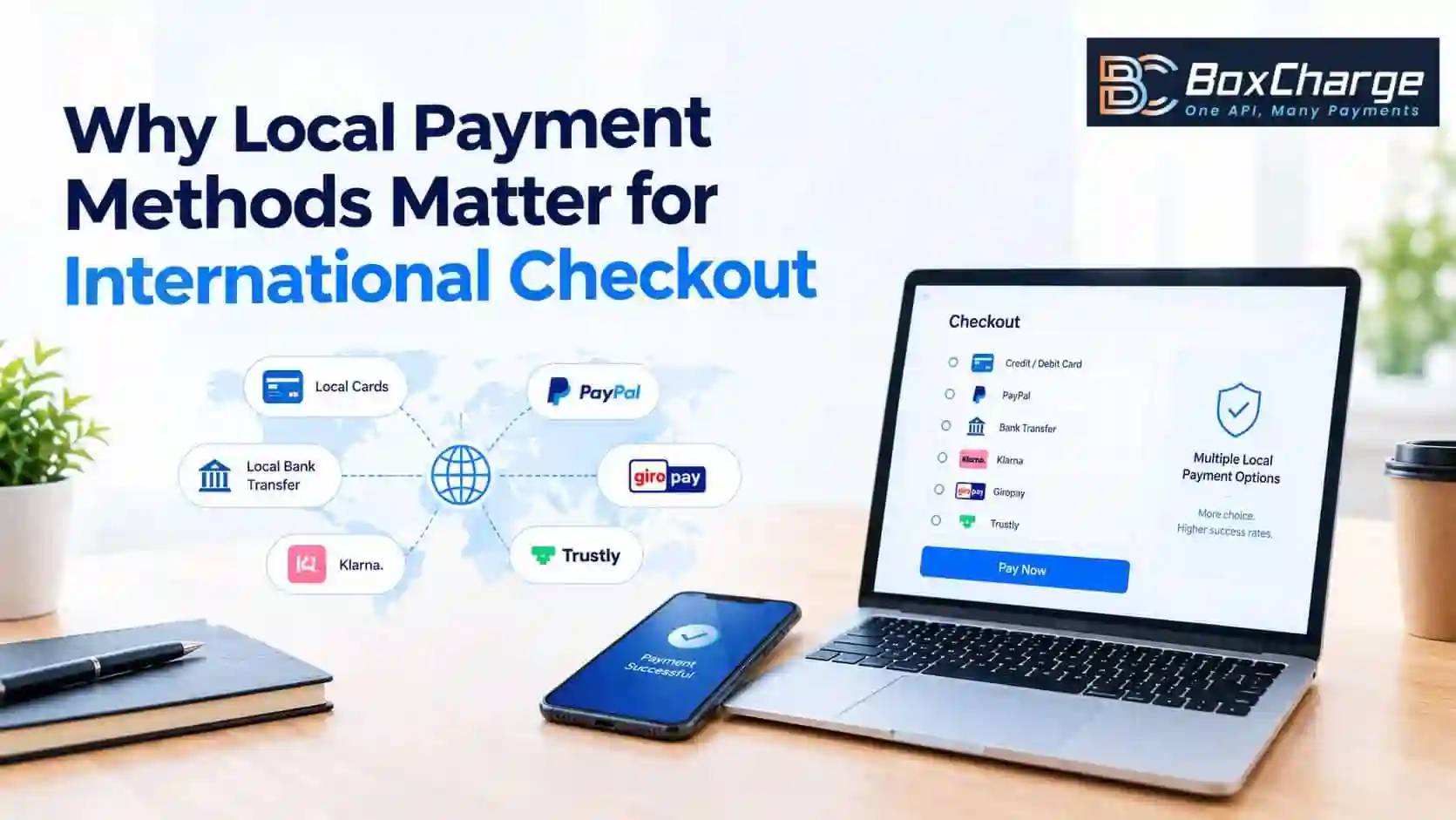
Local payment methods are becoming a critical part of international checkout strategy. For businesses selling across borders, accepting Visa and Mastercard alone is no longer enough to create a genuinely local payment experience. Customers in different countries have different expectations around cards, digital wallets, bank transfers, account-to-account payments, QR payments, and other regional payment methods.
For high-risk merchants, the issue is even more complicated. A customer may be ready to purchase, but the transaction can still fail because the preferred local payment method is unavailable, the payment is routed through an unsuitable acquiring setup, the transaction triggers additional risk controls, or the merchant cannot offer a payment option that customers already trust.
Payment localization addresses part of this problem by adapting checkout to the market rather than expecting every customer to pay the same way.
Current payment-industry research reflects this shift. Mastercard says local payment methods are increasingly central to global commerce, while Adyen notes that payment preferences vary significantly by region.
What Are Local Payment Methods?
Local payment methods are payment options that are particularly familiar or widely used in a specific country or region.
Examples include:
UPI in India
Pix and Boleto in Brazil
iDEAL/Wero in the Netherlands
Bancontact in Belgium
BLIK in Poland
SEPA-based payments across Europe
Digital wallets such as Alipay and WeChat Pay in parts of Asia
Local bank transfers and account-to-account payment systems
Mobile money and cash-based payment options in selected markets
The important point is not simply offering more payment buttons.
It is offering the right payment methods for the customers you actually want to serve.
Payment localization also extends beyond the payment method itself. Currency, checkout language, payment instructions, mobile experience, and local regulatory requirements can all influence how familiar and trustworthy the checkout feels.
Why International Customers Abandon a Checkout
Imagine a customer in Brazil visiting an international website.
The product is available. The price looks reasonable. Shipping works. The customer reaches checkout — and sees only international credit cards.
Technically, the merchant accepts payments from Brazil.
Commercially, however, the checkout may not feel designed for Brazil.
The same problem can appear in almost every region. A shopper may have a preferred wallet or bank-based payment method and simply decide not to complete the transaction when that option is missing.
Recent payment research continues to highlight the connection between payment choice and checkout conversion. Paddle, for example, reports that consumers can abandon purchases when their preferred payment method is unavailable.
This creates an important distinction:
Being able to accept an international payment is not the same as providing an optimized international checkout.
For merchants expanding internationally, that distinction can directly affect revenue.
Why This Problem Is Harder for High-Risk Merchants
High-risk businesses already operate with more payment constraints than many mainstream merchants.
Depending on the business model, they can face:
More limited acquiring-bank options
Higher processing costs
Greater scrutiny during underwriting
Rolling reserves or settlement restrictions
Increased chargeback exposure
Transaction monitoring requirements
Geographic restrictions
Payment gateway limitations
Difficulties finding processors willing to support their industry
Longer onboarding and compliance reviews
Now add international expansion.
A high-risk merchant may need to support customers across several countries while maintaining acceptable approval rates, managing fraud, controlling chargebacks, and keeping settlements predictable.
That is where a poorly localized checkout becomes particularly expensive.
A customer might abandon before making a payment because their preferred method is missing. Another customer's card transaction might be declined because the payment is being processed cross-border rather than through a more appropriate local setup.
The merchant sees a failed transaction.
The underlying problem may be much larger.
Local Payment Methods Can Reduce Checkout Friction
The primary commercial benefit of local payment methods is familiarity.
Customers recognize the payment method, understand how it works, and may already use it regularly.
This reduces the mental friction associated with asking a customer to use an unfamiliar payment process.
For example, a business targeting India may consider UPI alongside cards. A merchant targeting Brazil may need to consider Pix. A business entering the Netherlands may examine iDEAL/Wero. The relevant choice depends on the target market and business model.
Current market guidance from payment providers consistently emphasizes that payment preferences differ significantly by geography.
For high-risk merchants, this can be especially valuable because every successful payment opportunity matters when the merchant is operating within tighter acquiring constraints.
Local Currency and Local Payments Work Together
Offering a local payment method while presenting prices in a foreign currency can still create friction.
Suppose a customer sees a payment option they recognize but has to calculate the final cost in another currency.
Questions immediately appear:
What exchange rate will be used?
Will my bank charge a foreign transaction fee?
Is the displayed price the final amount?
Will the merchant charge me in USD or my local currency?
Payment localization therefore needs to consider the complete checkout experience.
Local currency pricing can make the transaction easier to understand, while the appropriate local payment method can make the actual payment process more familiar.
Platforms such as Shopify now provide market-level controls for local payment methods and currencies, illustrating how localization is becoming part of mainstream international commerce infrastructure.
Local Payments Can Help International Merchants Go Beyond Cards
Cards remain important in global commerce, but they are only one part of the payment ecosystem.
Depending on the market, customers may prefer:
Digital wallets: convenient for mobile-first shoppers.
Bank transfers: useful for customers who prefer account-based payments.
Account-to-account payments: increasingly relevant where real-time or open-banking infrastructure is developed.
Buy now, pay later: potentially important for eligible consumer segments and specific product categories.
QR payments: particularly relevant in markets where mobile payments are deeply embedded in everyday commerce.
Cash-based or voucher payments: useful in selected markets where card penetration or banking access is different.
Mastercard's 2026 analysis describes this broader shift, noting that wallets, account-to-account payments, BNPL, and other regional payment methods are becoming increasingly important in global commerce.
The practical lesson for merchants is simple: do not build an international checkout around assumptions about how customers pay. Build it around the markets you are actually selling into.
What High-Risk Merchants Should Look for in a Payment Setup
Adding local payment methods is not enough by itself.
High-risk businesses should examine the entire payment infrastructure.
1. Geographic coverage
Check whether the payment provider genuinely supports the countries where your customers are located.
A provider may advertise "global payments" while supporting only selected local payment methods or currencies.
2. High-risk underwriting
Ask whether the provider actually supports your business category.
This matters because a payment method may technically be available while the underlying acquiring relationship does not support your industry.
3. Multi-acquirer capability
A multi-acquirer strategy can give merchants access to different acquiring relationships and processing routes.
For international high-risk businesses, this can be relevant when managing geographic coverage, authorization performance and operational continuity.
4. Currency and settlement options
Look beyond checkout.
Understand:
Processing currencies
Settlement currencies
Settlement schedules
FX costs
Reserve requirements
Refund handling
Chargeback processes
A payment method that converts well but creates difficult settlement conditions may not be commercially attractive.
5. Fraud and transaction monitoring
High-risk merchants cannot treat fraud prevention as an afterthought.
Local payment methods should fit into the merchant's wider fraud-screening, transaction-monitoring and chargeback-management strategy.
6. Recurring payment support
This is particularly important for subscriptions, memberships, SaaS businesses and other recurring models.
Not every local payment method supports recurring billing in the same way. Merchants should confirm whether the selected payment method supports their actual payment model before launching.
The Real Challenge: Managing Payment Complexity
The biggest mistake merchants make is thinking that international checkout means adding as many payment methods as possible.
It does not.
A checkout with 20 irrelevant options can be just as confusing as one with only cards.
The objective is payment relevance.
Stripe's payment-localization guidance similarly recommends prioritizing the payment methods that matter in each market rather than simply presenting customers with a large list of options.
A merchant targeting Germany, India, Brazil, and the Netherlands could therefore have four different payment strategies rather than one universal checkout.
That is particularly important for high-risk merchants because payment operations are already more complex. Adding unnecessary integrations can increase reconciliation, reporting, compliance, and technical workloads.
How to Build a More Effective International Checkout
A practical approach starts with your customer data.
Look at:
Q: Where are customers located?
Identify your highest-value geographic markets.
Q: How are customers currently attempting payment?
Review authorization, decline, and abandonment data.
Q: Which payment methods are missing?
Compare your checkout with actual local payment preferences.
Q: Where are transaction failures concentrated?
Break declines down by country, payment method, currency, and issuer where possible.
Q: Are high-risk transactions being routed appropriately?
Review your acquiring and payment gateway configuration.
Q: Can successful payments settle efficiently?
Consider settlement currency, timing, reserves, and reconciliation.
This creates a payment strategy based on actual commercial performance rather than assumptions.
Local Payment Methods Are Becoming Part of International Growth
International expansion is no longer simply about putting a website in front of customers in another country.
The payment experience has become part of market localization.
A customer in one country may expect a wallet. Another may prefer a bank transfer. Another may rely heavily on a domestic payment network. Meanwhile, high-risk merchants must consider those customer expectations alongside underwriting, fraud prevention, chargebacks, and settlement requirements.
That makes local payment methods for international checkout much more than a technical feature.
They can influence whether customers trust the checkout, whether transactions are completed, and whether a merchant can scale efficiently into new markets.
For high-risk businesses, where payment access can already be difficult, the objective should be to create a checkout that is locally relevant, operationally controlled, and supported by an acquiring structure capable of handling the business model.
As international commerce continues to become more localized at the payment level, merchants that understand these differences will be better positioned to build payment strategies around their actual customers rather than forcing every market through the same checkout experience.
Make International Payments Work for Your Business
If your high-risk business is expanding internationally, the right payment setup should go beyond simply accepting cards. BoxCharge can help merchants explore international payment processing, merchant account, and acquiring solutions designed around their business model, target markets, and payment requirements.
Talk to BoxCharge about building a more flexible international payment strategy for your business.