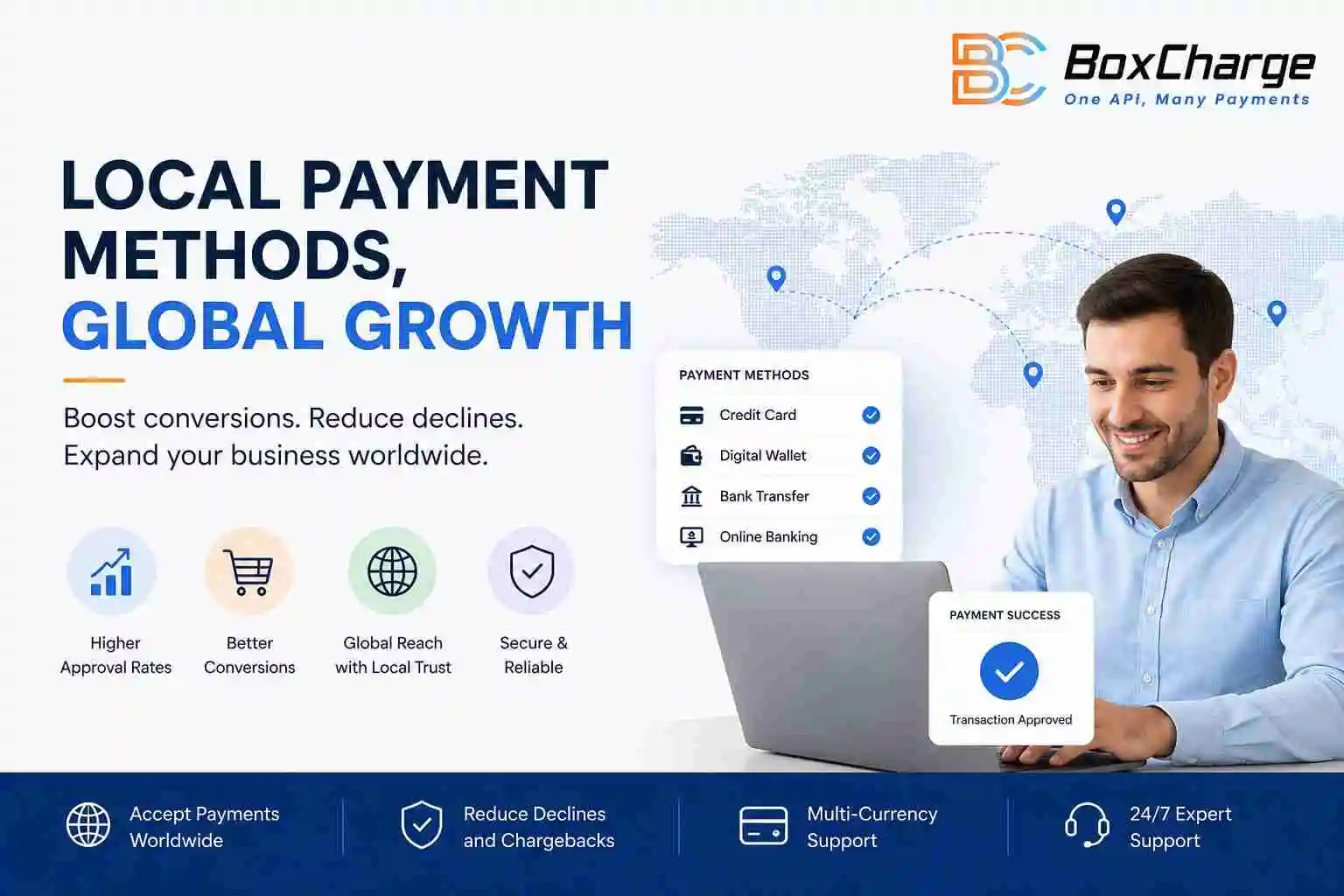
Local payment methods are no longer an optional feature for businesses expanding internationally—they're a necessity for increasing conversions, improving international payment processing, and reducing failed transactions. If your business wants to attract customers across multiple countries, relying solely on credit cards can cost you sales every single day. Customers expect to pay the way they do at home, and when they can't, they leave.
For businesses operating internationally, particularly high-risk businesses, this challenge is even more significant. Payment declines, account restrictions, rolling reserves, higher processing fees, and limited banking support already make accepting online payments difficult. Adding a checkout experience that doesn't support local payment preferences only creates another barrier between your business and potential revenue.
At BoxCharge, we've seen businesses invest thousands in digital marketing, SEO, and customer acquisition, only to lose customers at the final step because the payment experience wasn't built for global buyers. The businesses that scale internationally aren't always the ones with the best products—they're often the ones with the best payment infrastructure.
Why Local Payment Methods Have Become Essential for Global Businesses
Selling internationally is no longer about translating your website or shipping products overseas. Customers expect a buying experience that feels local from the moment they land on your website until the payment is complete.
Today's buyers want familiar currencies, trusted payment options, faster checkouts, and secure transactions. If they don't see a payment method they recognize, confidence drops immediately.
Think about your own shopping habits. If you reached the payment page of a website and found only unfamiliar payment options or a currency you didn't understand, you would probably hesitate before entering your card details. Your customers behave the same way.
This is why local payment methods, payment gateway solutions, and multi-currency payment processing have become essential components of every successful international payment strategy.
Businesses that adapt to local payment preferences consistently see:
Higher checkout conversion rates
Better payment authorization rates
Lower cart abandonment
Increased customer trust
More repeat purchases
Improved international revenue
The checkout page is no longer just where customers pay—it's where businesses either win or lose global sales.
The Hidden Cost of Ignoring Local Payment Preferences
Many businesses focus heavily on attracting visitors through SEO, paid advertising, and social media campaigns. Yet they overlook one of the biggest reasons customers abandon their purchase: payment friction.
Imagine spending months improving your search rankings and investing heavily in customer acquisition, only for a customer to leave because they couldn't pay using their preferred method.
That lost sale isn't simply one transaction.
You've also lost the marketing investment that brought the customer to your website in the first place.
For international businesses, this happens far more often than many realize.
Customers in Europe may prefer bank transfers alongside card payments.
Buyers across Asia-Pacific frequently rely on digital wallets and mobile-first payment experiences.
Consumers in Latin America often expect local banking options or installment payments.
Middle Eastern markets increasingly combine traditional banking with regional digital payment solutions.
Offering only one or two international card options sends a message that your business hasn't been built with global customers in mind.
Why High-Risk Merchants Feel This Problem More Than Anyone
Businesses operating in high-risk industries don't just compete for customers—they also struggle to find payment partners willing to support their growth.
Industries such as forex, gaming, digital services, travel, subscription businesses, nutraceuticals, adult platforms, cryptocurrency, and online marketplaces frequently encounter obstacles before a single payment is processed.
These businesses regularly face:
Merchant account application rejections
Higher processing fees
Rolling reserve requirements
Delayed settlements
Sudden account freezes
Payment gateway restrictions
Higher fraud screening
Increased chargeback monitoring
Cross-border transaction declines
Unfortunately, many legitimate businesses are treated as risky simply because of their Merchant Category Code (MCC), international customer base, or recurring billing model.
The result is frustrating.
A business secures customers through marketing but struggles to accept their payments.
In many cases, the issue isn't demand—it's payment infrastructure.
We've worked with merchants who believed their advertising campaigns were underperforming, only to discover that a significant percentage of legitimate customers were being declined during checkout. Once their payment setup was optimized with local payment methods, international merchant accounts, and a more reliable payment gateway, approval rates improved, and abandoned checkouts dropped noticeably.
For high-risk merchants, every approved transaction matters. Unlike traditional retailers, they often operate under stricter banking rules, making payment optimization one of the fastest ways to increase revenue without increasing advertising spend.
Local Payment Methods Build Trust Before the Transaction Is Complete
Trust is one of the biggest factors influencing online purchases.
Customers don't simply evaluate your products—they evaluate your entire buying experience.
When buyers recognize payment logos they've used for years, see prices in their own currency, and complete the purchase through familiar payment channels, they're more confident about completing the transaction.
That confidence translates directly into better business performance.
A localized checkout doesn't just improve the customer experience—it increases the likelihood that a transaction will be approved, completed, and repeated.
This is particularly important for businesses selling across multiple regions where customer expectations vary significantly.
Instead of asking customers to adapt to your payment system, successful global businesses adapt their payment system to the customer.
How Local Payment Methods Increase Payment Approval Rates
One of the most overlooked metrics in payment processing is the payment authorization rate. While many businesses focus on driving more website traffic, improving the percentage of successful payments often delivers a faster return on investment.
Imagine receiving 10,000 visitors each month and converting 300 of them into paying customers. If even 10–15% of legitimate transactions are declined because the payment method isn't optimized for the customer's region, your business is losing revenue that has already been earned.
For high-risk merchants, these losses can be even higher. Cross-border transactions are naturally subjected to additional fraud screening, stricter banking rules, and issuer-specific risk checks. Even genuine customers may receive a "declined" message without understanding why.
Supporting local payment methods helps reduce this friction because transactions are processed in a way that aligns with regional banking expectations. Customers are paying through payment channels they already know and trust, while issuing banks are more likely to recognize the transaction as legitimate.
Improving payment approval rates by even a few percentage points can generate substantial additional revenue over the course of a year—without increasing your marketing budget.
Local Acquiring vs. International Acquiring: Why It Matters
Many businesses assume that once they have a merchant account and a payment gateway, they are ready to sell globally. In reality, where and how a payment is processed has a significant impact on its success.
When every international transaction is routed through a single overseas acquiring bank, the payment often travels through multiple financial institutions before it reaches the customer's bank. Each additional step introduces more complexity, increases processing time, and raises the likelihood of a decline.
Local acquiring changes this process by allowing payments to be handled closer to the customer's issuing bank. This creates a smoother payment flow and typically leads to:
Higher authorization rates
Faster transaction processing
Reduced cross-border friction
Lower foreign transaction costs
Improved customer confidence
For businesses expanding into multiple countries, local acquiring is one of the most effective ways to improve international payment processing while delivering a better customer experience.
Why High-Risk Businesses Need More Than a Standard Payment Gateway
Traditional payment providers are designed to serve businesses with straightforward payment needs. While that works for many retailers, it rarely meets the demands of companies operating in high-risk industries.
A high-risk merchant account isn't simply a standard merchant account with higher fees. These businesses require payment solutions that can handle fluctuating transaction volumes, international customers, recurring billing, and increased regulatory scrutiny.
Unfortunately, many high-risk merchants experience the same cycle:
They secure a payment provider, begin processing transactions, and start growing. As transaction volume increases or chargeback ratios rise, the provider imposes rolling reserves, delays settlements, or closes the account altogether.
This disrupts cash flow, damages customer confidence, and forces the business to search for a new payment provider—often at the worst possible time.
Working with a provider experienced in high-risk payment processing reduces these risks by offering infrastructure built specifically for industries that require greater flexibility and long-term stability.
Payment Localization Reduces Cart Abandonment
Cart abandonment isn't always caused by pricing, shipping costs, or complicated checkout forms.
In many international markets, customers simply leave because they don't see a payment method they recognize.
Research across the ecommerce industry consistently shows that shoppers are far more likely to complete a purchase when they can pay using familiar and trusted payment options.
This is especially important for businesses entering new markets. Customers are already taking a chance by buying from a brand they may not know. A localized payment experience reassures them that the business understands their needs and operates professionally.
Offering alternative payment methods, local bank transfers, digital wallets, and multi-currency payments helps remove uncertainty during the final stage of the buying journey.
For high-risk merchants competing in crowded industries, even a small improvement in checkout completion can translate into significant revenue growth.
Fraud Prevention Should Protect Revenue—Not Block Legitimate Customers
Fraud prevention is a critical part of every online payment processing strategy, but many businesses make the mistake of treating every international transaction as high risk.
The result is unnecessary payment declines that frustrate genuine customers.
Modern fraud prevention uses intelligent risk analysis rather than rigid rules. Factors such as customer behaviour, device recognition, transaction history, and regional purchasing patterns help distinguish legitimate buyers from fraudulent activity.
This balanced approach allows businesses to reduce fraud while maintaining strong payment approval rates.
For high-risk merchants, this is particularly valuable. Excessive fraud leads to chargebacks and increased banking scrutiny, while excessive declines reduce revenue and damage customer relationships.
A payment strategy should protect the business without creating unnecessary obstacles for genuine customers.
Multi-Currency Payments Improve Customer Confidence
Customers want clarity before they pay.
Displaying prices only in a foreign currency forces customers to estimate exchange rates and worry about unexpected bank fees. This uncertainty creates hesitation, particularly for first-time buyers.
Supporting multi-currency payment processing allows customers to view prices in their local currency and understand exactly what they are paying.
For businesses, the benefits extend beyond customer experience. Multi-currency capabilities simplify international expansion, improve financial reporting, and reduce friction when entering new markets.
Combined with local payment methods, multi-currency support creates a checkout experience that feels familiar regardless of where the customer is located.
A Better Payment Experience Supports Long-Term Growth
Many businesses invest heavily in attracting new customers while overlooking the experience those customers have after clicking the "Buy Now" button.
Your payment process is not just an operational function—it is part of your sales strategy.
A reliable international payment gateway, supported by local payment methods, secure payment processing, and optimized authorization rates, helps businesses retain customers, increase repeat purchases, and build trust in new markets.
For high-risk businesses, this is even more important. Stable payment infrastructure reduces operational risk, protects cash flow, and provides the confidence needed to scale internationally instead of constantly worrying about payment disruptions.
Choosing the Right Payment Partner for Global Growth
Expanding into international markets requires more than a payment gateway that can process transactions. Your payment partner should understand regional banking requirements, compliance standards, fraud risks, and the unique challenges of high-risk payment processing.
Many businesses make the mistake of choosing a high-risk merchant account provider based solely on processing fees. While competitive pricing is important, the real value comes from higher payment approval rates, stable merchant accounts, reliable settlements, and the ability to support long-term growth.
Before selecting a payment provider, ask questions that directly impact your business:
Can they support local payment methods in your target markets?
Do they offer international merchant accounts for high-risk industries?
Can they process payments in multiple currencies?
How do they handle chargeback management and fraud prevention?
Is the payment infrastructure designed to scale as your business grows?
Will you have access to dedicated support if payment issues arise?
A provider that answers "yes" to these questions is far more likely to become a long-term growth partner rather than just another payment processor.
How BoxCharge Helps Businesses Expand Globally
At BoxCharge, we understand that payment processing is more than moving money from one account to another. It directly affects customer experience, conversion rates, cash flow, and business growth.
Our payment solutions are designed to help businesses accept payments confidently across international markets while addressing the challenges that many traditional providers struggle to solve.
Whether you're an ecommerce business entering new countries, a SaaS company with recurring billing, a forex broker, a travel platform, or another high-risk business, our team works to provide payment infrastructure that supports sustainable growth.
boxcharge offers solutions including:
High-risk merchant accounts tailored for industries that face banking restrictions.
Secure international payment gateways built for global transactions.
Support for local payment methods that improve checkout conversions.
Multi-currency payment processing for a seamless customer experience.
Cross-border payment solutions that reduce transaction friction.
Advanced fraud prevention and chargeback management tools.
Flexible settlement options designed for international businesses.
Dedicated payment specialists who understand the complexities of global commerce.
Instead of forcing merchants into a one-size-fits-all payment model, we focus on building payment strategies that match your industry, target markets, and long-term business objectives.
The Future of Global Commerce Is Local
International ecommerce continues to grow, but customer expectations are changing just as quickly.
Today's buyers expect businesses to understand their preferred payment methods, display prices in familiar currencies, and deliver a checkout experience that feels fast, secure, and effortless.
Businesses that continue relying on a limited payment strategy risk losing customers to competitors that have invested in payment localization.
This is particularly true for high-risk merchants, where every approved transaction has a direct impact on profitability. Improving payment approvals, reducing unnecessary declines, and offering familiar payment options can generate more revenue than simply increasing advertising spend.
The companies that succeed in international markets over the next decade won't necessarily be those with the biggest marketing budgets. They'll be the businesses that remove every barrier between customer intent and successful payment.
Investing in local payment methods, international payment processing, and a scalable payment gateway solution is no longer just an operational decision—it's a growth strategy.
Ready to Accept More Payments Worldwide?
If your business is struggling with international payment declines, low approval rates, limited payment options, or difficulty securing a high-risk merchant account, it's time to rethink your payment strategy.
BoxCharge helps businesses simplify global payment processing with secure, scalable, and conversion-focused payment solutions. From local payment methods and multi-currency payments to international merchant accounts and high-risk payment processing, we provide the infrastructure businesses need to grow with confidence.
Frequently Asked Questions
Q: What are local payment methods?
Local payment methods are payment options commonly used within a specific country or region, such as domestic bank transfers, digital wallets, real-time payment systems, and regional debit networks. They help businesses improve customer trust and increase successful payment completion.
Q: Why are local payment methods important for international businesses?
They reduce checkout friction, improve payment authorization rates, lower cart abandonment, and create a more familiar buying experience for customers in different markets.
Q: How do local payment methods benefit high-risk merchants?
For businesses operating in high-risk industries, local payment methods can improve transaction success rates, reduce unnecessary payment declines, strengthen customer confidence, and support international expansion without relying solely on credit card payments.
Q: Can local payment methods help reduce chargebacks?
Yes. While they don't eliminate chargebacks entirely, they reduce customer confusion by offering familiar payment experiences, transparent transactions, and trusted payment channels, all of which can lower the likelihood of payment disputes.
Q: Why should businesses choose BoxCharge?
boxcharge provides secure payment gateway solutions, international payment processing, high-risk merchant accounts, and local payment methods that help businesses improve payment performance, expand into new markets, and deliver a better checkout experience for customers worldwide.