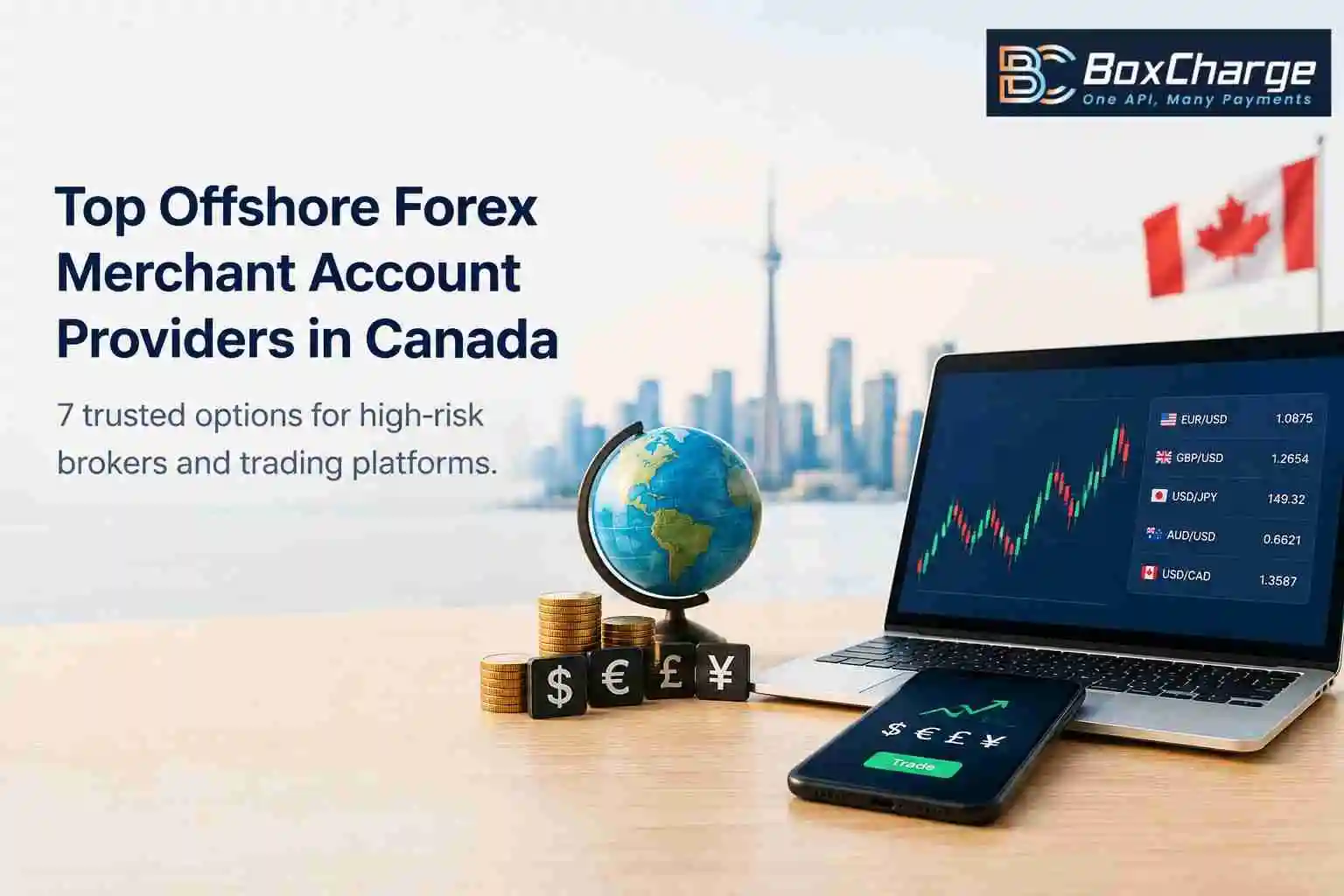
Finding a reliable offshore forex merchant account in Canada is rarely as simple as finding a payment processor that accepts card transactions. Forex brokers and trading platforms operate in one of the more closely scrutinized areas of online payments, where transaction volumes, international customers, chargeback exposure, licensing, and regulatory requirements can all affect merchant account approval.
For Canadian forex businesses, the challenge becomes even more practical. A broker may have clients paying from several countries, need CAD alongside USD and EUR, and require payment infrastructure that can handle deposits without creating unnecessary friction. At the same time, a single account review, unexpected reserve increase, or processing interruption can put significant pressure on cash flow.
An offshore merchant account can be one option for businesses that need international acquiring and multi-jurisdiction payment capabilities. However, offshore does not mean outside compliance requirements. The appropriate setup still depends on the broker's licensing, corporate structure, customer geography, processing history, risk profile, and the jurisdictions involved.
Why Forex Businesses Struggle With Payment Processing in Canada
Forex is commercially attractive, but payment processing can become a bottleneck.
A broker might have a functioning trading platform, a strong acquisition strategy, and growing customer deposits, yet still struggle to find stable card processing.
The problem usually becomes visible in several ways:
Merchant account applications are declined.
Card approval rates fall unexpectedly.
International transactions receive additional scrutiny.
Settlement terms become less favorable.
Rolling reserves tie up working capital.
Chargebacks create pressure on the acquiring relationship.
Accounts are placed under review.
A processor suddenly changes its risk appetite.
These problems are particularly difficult for high-risk merchants because payment processing is directly connected to customer experience.
If a trader cannot fund an account when the market is moving, they may simply use another broker.
That makes forex payment processing much more than a back-office function. It becomes part of the commercial infrastructure of the brokerage.
What Is an Offshore Forex Merchant Account?
An offshore forex merchant account is a payment-processing arrangement that can provide acquiring or merchant-account infrastructure through a jurisdiction or acquiring relationship outside the merchant's primary operating market.
For an international forex broker, this can potentially provide access to additional acquiring relationships, currencies, payment methods, or markets that may not be available through a conventional domestic setup.
However, businesses should not view offshore processing as a way around Canadian or international regulatory obligations.
The provider and acquiring bank will still assess the business model, ownership structure, licensing, transaction activity, customer locations, website disclosures, KYC/AML procedures, and expected processing volume.
The objective should be better payment infrastructure—not regulatory avoidance.
7 Offshore Forex Merchant Account Providers and Payment Platforms to Consider
1. BoxCharge – Global Payment Infrastructure for Forex Businesses
BoxCharge is positioned around global merchant services, cross-border payment processing, and payment infrastructure for businesses operating across international markets.
Its published forex material specifically addresses the problems faced by high-risk brokers, including declined applications, delayed settlements, frozen funds, transaction declines, and account termination. BoxCharge also describes forex merchant account support, international payment acceptance, multi-currency processing, payment gateway integration, fraud management, and scalable payment infrastructure.
For a Canadian forex business, the broader infrastructure is important because one acquiring route may not be sufficient as processing volume grows.
BoxCharge's current merchant-services information also highlights payment orchestration, cross-border gateway connectivity, alternative payment methods, 3DS2, tokenization, fraud prevention, and multiple acquiring connections, with availability dependent on merchant profile, jurisdiction, and partner availability.
Best suited for: Forex brokers and high-risk businesses looking for international merchant processing, payment orchestration, and scalable acquiring infrastructure.
2. Wise – Useful for International Business Payments and Currency Management
Wise is different from a specialist high-risk forex merchant acquirer, so Canadian brokers should evaluate it for the right use case.
Wise Business provides international business payment and currency-management capabilities, including multi-currency account details, international transfers, payment collection, and business spending tools. Wise says Canadian businesses can use its services to get paid and manage funds in multiple currencies.
That can make Wise relevant to a forex company's treasury and cross-border payment operations, particularly where the business needs to receive or move funds internationally.
It should not, however, be treated as a direct substitute for a dedicated high-risk forex merchant account. A broker looking for card acquiring for trader deposits needs to establish whether its particular business activity is eligible for the required service.
Best suited for: International business transfers, currency management, and multi-currency financial operations rather than specialist forex card acquiring.
3. InQuid – Forex and CFD Payment Infrastructure
InQuid positions its payment infrastructure specifically around forex brokers, CFD platforms, prop firms, and trading businesses.
Its published forex offering describes high-risk merchant accounts, multi-currency acquiring, fraud protection, 3D Secure, and international processing. It also highlights dedicated forex MIDs, local acquiring, chargeback prevention, and support for brokers operating across multiple markets.
InQuid also states that its merchant-account infrastructure supports international and offshore businesses, multi-currency settlement, and multiple payment methods.
For a Canadian broker targeting international traders, this type of specialized infrastructure can be more relevant than a generic e-commerce payment account.
Best suited for: Forex brokers, CFD businesses, prop firms, and trading platforms that require specialized high-risk payment infrastructure.
4. WebPays – International and High-Risk Payment Processing
WebPays focuses on international payment infrastructure and high-risk merchant processing.
Its published material describes an international payment gateway designed to centralize payments for businesses expanding across borders.
For forex merchants, the attraction of this type of setup is relatively straightforward: international traders can generate transactions across different regions, currencies, and payment environments, while the business needs payment infrastructure that can support that geographic spread.
A Canadian forex merchant evaluating WebPays should still ask specific questions about acquiring locations, supported jurisdictions, settlement currencies, reserve requirements, transaction limits, chargeback procedures, and the exact forex business models accepted.
Best suited for: International merchants looking for cross-border and high-risk payment processing capabilities.
5. PayCly – Forex Merchant Accounts and High-Risk Processing
PayCly specifically markets forex merchant account and payment-processing solutions for forex businesses.
Its published forex material describes merchant accounts designed for forex brokers and trading platforms, along with international payment processing, multiple currencies, payment gateway integration, chargeback prevention, and security tools.
PayCly also describes customized forex payment solutions and support for multiple payment methods and currencies.
For a Canadian forex business, the key consideration should not simply be the number of supported currencies. The merchant should establish whether the proposed acquiring arrangement supports its specific Canadian corporate structure, licensing position, target customer countries, transaction profile, and settlement requirements.
Best suited for: Forex brokers and trading platforms seeking a specialized high-risk merchant account and payment gateway combination.
6. Payoneer – Cross-Border Business Payments
Payoneer is another provider that should be considered for a different reason.
It is primarily a global business payment platform rather than a specialist offshore forex acquiring provider. Its services include cross-border business payments, local receiving accounts, multi-currency balances, payment requests, and international withdrawals. Payoneer currently supports Canadian-dollar receiving capabilities alongside several other major currencies.
For businesses operating internationally, this can be useful for managing payments from customers, partners, suppliers, or other business relationships.
Payoneer's published terms also make clear that availability is subject to eligibility, business activity, risk policies, AML requirements, and other conditions.
Therefore, a Canadian forex broker should confirm eligibility before treating Payoneer as part of its payment-processing infrastructure.
Best suited for: Cross-border collections, international business payments, and multi-currency fund management.
7. Amald – High-Risk Merchant Services for Forex Businesses
Amald positions itself as a merchant-services provider working with both standard and high-risk businesses.
Its published merchant-account material specifically lists forex trading among the high-risk industries it supports and describes credit-card processing, international currencies, fraud prevention, payment gateway services, and chargeback-related risk management.
Amald also describes international merchant-account solutions with multi-currency processing, payment gateway integration, 3D Secure and non-3D Secure options, fraud checking, and eCheck capabilities.
For a forex business considering an offshore or international setup, these capabilities can be relevant, but the merchant should still assess the actual acquiring bank, settlement terms, reserve structure, supported jurisdictions, and compliance requirements before signing an agreement.
Best suited for: High-risk and international merchants, including forex businesses seeking broader merchant-account and payment-gateway options.
What Should a Canadian Forex Broker Check Before Choosing a Provider?
The cheapest merchant account is not necessarily the most commercially useful one.
A broker should look beyond the advertised MDR and ask how the complete payment relationship will work.
1. Does the provider understand forex?
Forex has different risk characteristics from ordinary e-commerce.
The provider should understand trader deposits, recurring or repeat transactions, international customers, chargebacks, refunds, and the regulatory environment surrounding financial services.
2. Which acquiring banks are actually involved?
This question is often overlooked.
A provider may offer an attractive merchant account, but the underlying acquiring relationship ultimately determines where and how transactions can be processed.
Ask who the acquiring partner is, which jurisdictions it supports, and whether multiple acquiring routes are available.
3. What happens to your cash flow?
Ask about:
Settlement cycles
Rolling reserves
Reserve release periods
Payout currencies
Processing limits
Chargeback deductions
Refund procedures
Currency conversion
Account-review procedures
For a high-risk merchant, these terms can have a greater financial impact than a small difference in processing fees.
4. Can the setup scale with transaction volume?
A payment setup that works at CAD 100,000 per month may not be appropriate at CAD 1 million.
Sudden volume increases can trigger additional risk reviews, so brokers should discuss expected processing growth during underwriting rather than treating it as an afterthought.
5. How strong is fraud and chargeback management?
A forex merchant account should ideally be supported by appropriate fraud controls, transaction monitoring, 3D Secure, dispute-management procedures, and clear reporting.
Reducing preventable disputes protects both the merchant and its acquiring relationships.
The Real Pain Point: Getting Approved Is Not Enough
This is where many high-risk forex merchants make their first major mistake.
They focus on getting approved.
Then they discover that approval is only the beginning.
A broker can have an approved merchant account but still experience:
Low card approval rates → delayed settlements → rising reserves → restricted processing volume → cash-flow pressure
Consider a broker spending heavily on customer acquisition. Marketing costs are paid immediately, but part of the transaction revenue may be subject to settlement delays or reserves.
If the broker plans its budget using gross processing volume rather than net available funds, the business can quickly find itself short on working capital.
That is why stable forex payment processing matters more than simply finding a provider willing to onboard the business.
Offshore Forex Merchant Accounts: What Canadian Businesses Should Remember
An offshore structure can potentially provide access to international acquiring relationships and payment infrastructure, but it should never be viewed as a shortcut around regulation.
Canadian forex businesses should ensure that their corporate structure, licensing, customer onboarding, KYC/AML procedures, marketing practices, and payment activities are appropriate for every jurisdiction in which they operate.
The payment provider should be able to explain:
Where transactions are acquired
Where funds are settled
Which currencies are supported
What reserves apply
What countries are supported
What documentation is required
How compliance reviews work
What happens if transaction volumes increase
Clear answers to these questions are far more valuable than an attractive headline processing rate.
Final Thoughts
Choosing among the best offshore forex merchant account providers in Canada requires more than comparing transaction fees.
For high-risk forex businesses, the right payment infrastructure needs to support international customers, multi-currency transactions, fraud prevention, chargeback management, settlement stability, and long-term scalability.
BoxCharge, InQuid, PayCly, Amald, and WebPays are positioned around merchant and high-risk payment services, while Wise and Payoneer can be relevant to the broader cross-border payment and treasury side of an international operation. Their products are not interchangeable, and actual availability depends on underwriting, jurisdiction, licensing, and business activity.
For a Canadian forex broker, the best provider is ultimately the one that can demonstrate a compliant, commercially workable, and scalable payment structure—not simply the one promising the fastest approval.
Frequently Asked Questions
Q: What is an offshore forex merchant account?
An offshore forex merchant account is a payment-processing arrangement that uses acquiring or merchant-account infrastructure outside the merchant's primary jurisdiction. It can support international payment acceptance, but the business remains subject to applicable regulatory and compliance requirements.
Q: Why are forex businesses considered high risk?
Forex businesses can face elevated payment risk because of international transactions, financial-service regulation, chargeback exposure, customer disputes, transaction volumes, and the complexity of cross-border trading activity.
Q: Can a Canadian forex broker use an offshore merchant account?
Potentially, depending on the business structure, licensing, customer locations, acquiring bank, and provider's underwriting criteria. Offshore processing should not be treated as a way to avoid Canadian or other applicable regulatory obligations.
Q: What should I ask a forex merchant account provider?
Ask about acquiring banks, supported countries, settlement currencies, processing limits, rolling reserves, chargebacks, payout schedules, fraud controls, KYC/AML requirements, and what happens if your transaction volume increases.
Q: Is a low processing rate the most important factor?
No. For a high-risk forex business, payment stability, approval performance, settlement terms, reserve requirements, risk management, and scalability can be more commercially important than a small difference in the headline processing rate.
Q: Can one payment provider handle every forex market?
Not necessarily. Availability depends on the acquiring network, merchant jurisdiction, customer geography, licensing, card-network rules, and the provider's risk appetite. A multi-acquirer or multi-payment strategy can sometimes provide greater flexibility.
Looking for a Reliable Forex Payment Setup in Canada?
Choosing an offshore forex merchant account is about more than getting approved. Your payment setup needs to support international customers, manage transaction risk, provide predictable settlement, and scale as your trading volume grows.
BoxCharge helps forex brokers and high-risk businesses explore payment processing solutions built around their business model, target markets, transaction volume, and settlement requirements.
If payment declines, reserves, delayed payouts, or unstable processing are limiting your growth, talk to BoxCharge about a payment setup designed for your next stage of business.