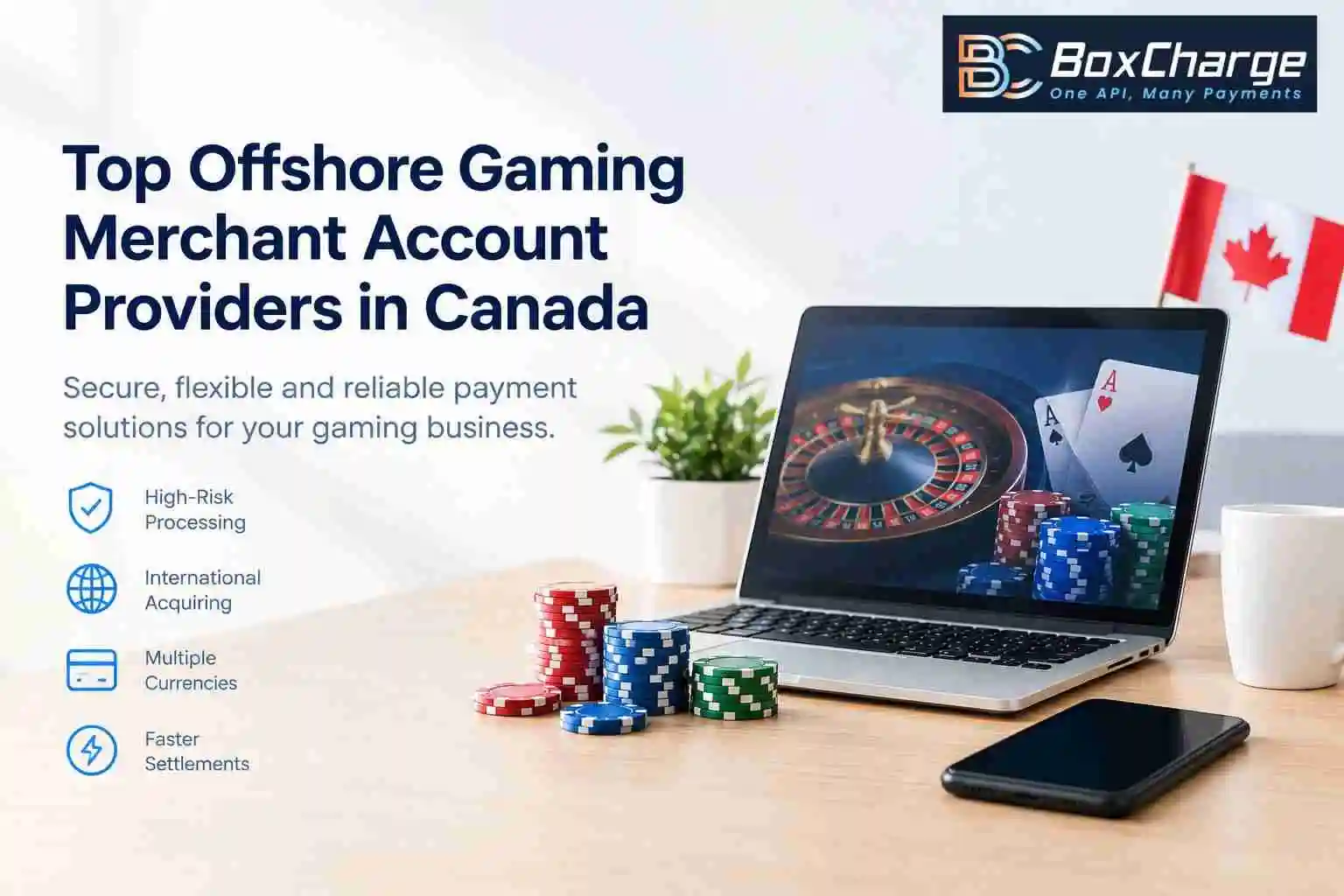
Finding the right offshore gaming merchant account in Canada is rarely just about getting a payment gateway connected to a gaming website. For online casinos, sportsbooks, poker platforms, lottery businesses, fantasy gaming operators, and other eligible gaming businesses, payment processing is closely connected to licensing, chargebacks, fraud prevention, transaction monitoring, customer geography, and settlement stability.
Canadian gaming merchants can also face an additional challenge when they want to accept payments internationally. A platform may have customers in Canada, the United States, Europe, or other markets, while the business needs to settle funds in CAD, USD, EUR, or other currencies.
That makes gaming payment processing a commercial decision, not just a technical integration.
For high-risk merchants, the consequences of choosing the wrong setup can be serious. A sudden account review, payment decline issue, rolling reserve, or processing restriction can affect player deposits and directly impact revenue.
Why Gaming Businesses Are Considered High Risk
Online gaming businesses can present a different risk profile from ordinary e-commerce.
Depending on the business model and jurisdiction, operators may deal with:
High transaction volumes
Frequent deposits and withdrawals
Chargeback exposure
Fraud and account takeover attempts
Multiple currencies
International customers
Regulatory and licensing requirements
Recurring or repeat transactions
Digital products with immediate delivery
Customer disputes
For a gaming operator, payment reliability directly affects player experience.
A customer who cannot fund an account may leave before making a deposit. A delayed withdrawal can create dissatisfaction. A high decline rate can reduce conversion. A chargeback spike can create additional pressure on the merchant-account relationship.
This is why high-risk gaming payment processing needs to be designed around the actual business model.
What Is an Offshore Gaming Merchant Account?
An offshore gaming merchant account is a payment-processing arrangement involving an acquiring or merchant-account structure outside the merchant's primary domestic market.
For an eligible Canadian gaming business, an international or offshore structure may provide access to different acquiring relationships, currencies, payment methods, or geographic processing capabilities.
However, offshore does not mean outside regulation.
Gaming operators must still consider the laws and licensing requirements applicable to the jurisdictions where they operate and where customers are located. Payment providers and acquiring banks may also conduct KYC, AML, sanctions, source-of-funds, website, ownership, and transaction-volume reviews.
The goal should therefore be stable and compliant international payment processing, not a way to bypass regulatory requirements.
8 Gaming Merchant Account Providers and Payment Platforms to Consider
1. BoxCharge – High-Risk Gaming Payment Infrastructure
BoxCharge is positioned around global merchant services and high-risk payment infrastructure, with dedicated material covering online gambling and gaming businesses.
Its published gaming guidance identifies online casinos, poker sites, sportsbooks, and fantasy gaming platforms as businesses that can face high transaction volumes, international payments, chargebacks, fraud exposure, and regulatory complexity. BoxCharge describes high-risk gaming payment solutions involving payment gateways, fraud screening, 3D Secure, chargeback controls, multiple currencies, PCI-DSS-related security, and international payment support.
BoxCharge also publishes a dedicated gaming merchant-account guide covering game publishers, esports platforms, digital goods, subscriptions, and other gaming models. The guide highlights global currencies, recurring billing, tokenization, 3D Secure, fraud monitoring, and chargeback protection as important considerations for gaming merchants.
For a Canadian operator, the main advantage of evaluating a specialized high-risk provider is that the payment setup can be assessed around the actual gaming business rather than forcing the business into a standard low-risk merchant model.
Best suited for: Eligible gaming businesses seeking high-risk merchant-account infrastructure, international payment processing, payment orchestration, and scalable acquiring options.
2. InQuid – Specialized iGaming Payment Processing
InQuid positions its payment infrastructure specifically around iGaming, casinos, sportsbooks, lotteries, and other gaming operators.
Its current iGaming offering describes dedicated gaming merchant accounts, multi-currency acquiring, fraud protection, 3D Secure 2.2, chargeback management, international acquiring, and offshore MIDs. It also states that its infrastructure supports cards, bank transfers, e-wallets, and alternative payment methods across multiple markets.
InQuid also emphasizes the challenges traditional processors can create for gaming businesses, including account closures, lower approval rates, limited currency support, and settlement delays.
For a Canadian gaming operator expanding internationally, multi-currency processing and local acquiring can become particularly important because payment performance can vary significantly between customer markets.
Best suited for: Online casinos, sportsbooks, lotteries, and other eligible iGaming businesses requiring specialized international payment infrastructure.
3. PayCly – Gaming and Casino Merchant Accounts
PayCly publishes dedicated material for gaming and casino merchant accounts and positions its services around high-risk businesses.
Its gaming merchant-account information describes industry-specific merchant accounts for businesses such as casinos, gambling, and fantasy gaming, along with international payment gateways.
Its casino merchant-account material also describes international payment acceptance, multiple payment methods, multiple currencies, dedicated MIDs, and fraud and chargeback controls.
For a Canadian gaming operator, however, the important step is to establish exactly which gaming activities are supported and under what licensing and jurisdictional conditions.
A gaming merchant account should be matched to the operator's actual business model rather than relying on a generic “high-risk” label.
Best suited for: Eligible casino, gambling, and gaming businesses looking for industry-specific high-risk merchant-account and payment-gateway options.
4. Amald – Online Gaming Merchant Accounts
Amald specifically markets online gaming merchant accounts and high-risk payment solutions.
Its published gaming material covers online poker, lotteries, mobile betting, multiplayer gaming, in-play betting, social betting, casinos, bingo, and horse-racing businesses. It also describes security measures, PCI DSS, KYC procedures, merchant-history reviews, and documentation requirements during onboarding.
Amald also states that it works with high-risk industries and offers online acquiring and alternative payment methods. Its published material identifies gaming and betting among the high-risk sectors it serves.
This type of industry specialization can matter for operators that have already experienced difficulties with conventional merchant-account applications.
Best suited for: Eligible online gaming, casino, betting, poker, lottery, and other high-risk gaming businesses.
5. WebPays – International High-Risk Payment Processing
WebPays is positioned around high-risk merchant accounts and international payment processing.
Its published high-risk payment material describes support for online gaming alongside other high-risk verticals and highlights international transactions, multiple currencies, fraud prevention, tokenization, 3D Secure, and alternative payment methods.
For Canadian gaming businesses, international processing can be particularly relevant when the customer base extends beyond Canada.
However, operators should investigate the actual acquiring arrangement behind any proposed account. The important questions include:
Which acquiring bank will process the transactions?
Which countries are supported?
Which currencies can be settled?
What reserve applies?
What are the transaction limits?
How are chargebacks managed?
What happens if monthly volume increases?
These questions matter more than a headline processing rate.
Best suited for: Eligible gaming and other high-risk businesses looking for international payment processing infrastructure.
6. Apple Pay – A Payment Method, Not an Offshore Merchant Account
Apple Pay is different from a merchant-account provider.
It is a digital wallet and payment technology that can be integrated through supported payment service providers. Apple states that merchants need a supporting payment service provider to accept Apple Pay, and its Canadian payment-platform directory includes multiple payment providers capable of supporting Apple Pay.
For gaming businesses, the important point is that Apple Pay availability does not automatically mean a gaming merchant is approved to process gambling transactions.
The underlying merchant account and payment provider still determine whether the operator and its transaction type are eligible.
Apple Pay can therefore be relevant as part of a broader payment-method strategy where the gaming operator, payment provider, and applicable network rules allow it.
Best suited for: Eligible merchants looking to add a digital-wallet payment method through a supported payment provider.
7. PayPal – Mainstream Payment Platform With Gaming Restrictions
PayPal is another major payment platform that Canadian gaming operators may encounter, but it should not be treated as a specialist offshore gaming merchant-account provider.
PayPal's Canadian/Braintree acceptable-use documentation lists gambling, including internet gaming, lotteries, contests, and sweepstakes, among restricted categories, with exceptions potentially available in some regions and subject to prior written approval.
That distinction is important.
A gaming business should never assume that having a standard PayPal business account means it can automatically process gaming transactions.
The operator must verify its specific activity, jurisdiction, licensing status, payment flow, and eligibility before relying on the platform.
Best suited for: Eligible businesses whose particular gaming activity and jurisdiction have been expressly approved under the applicable PayPal terms.
8. Stripe – General Payment Infrastructure With Gambling Restrictions
Stripe is widely used for online payments and supports businesses in Canada, but it is not a general-purpose solution for gambling businesses.
Stripe's current restricted-business policy explicitly lists gambling, internet gambling, casino games, sweepstakes, fantasy sports with monetary or material prizes, lotteries, and sports forecasting or odds-making among prohibited categories.
This makes Stripe important to understand when comparing gaming payment providers—not because it is a specialist offshore gaming processor, but because it demonstrates why mainstream payment infrastructure cannot automatically be assumed to support high-risk gaming.
A gaming operator should verify eligibility before integrating any mainstream payment platform into its core payment flow.
Best suited for: Eligible non-gambling gaming businesses and other permitted business models; real-money gambling operators should not assume eligibility.
What High-Risk Gaming Merchants Are Actually Struggling With
Getting a merchant account approved is only the first hurdle.
The more difficult problem can be keeping payment processing stable as the business grows.
Payment declines
A player can have sufficient funds and a legitimate card but still experience a declined transaction because of issuer rules, fraud filters, geographic restrictions, merchant configuration, or routing issues.
Repeated declines directly affect deposits and revenue.
Chargebacks
Gaming transactions can attract disputes related to fraud, unauthorized transactions, customer dissatisfaction, or confusion around billing.
For an operator processing thousands of transactions, even a relatively small increase in disputes can create meaningful financial exposure.
Rolling reserves
A reserve can protect an acquiring bank against future chargebacks and liabilities, but it also reduces the amount of revenue immediately available to the merchant.
For a fast-growing gaming business, this can create a cash-flow gap.
Settlement delays
A gaming operator may generate significant gross processing volume while still waiting for part of its funds to settle.
That can affect marketing budgets, supplier payments, player withdrawals, payroll, and general working capital.
Account reviews
A sudden increase in transaction volume can trigger additional scrutiny.
For example, if an operator normally processes CAD 200,000 per month and suddenly processes CAD 800,000, the acquirer may want to understand what changed.
That does not necessarily indicate a problem. It is simply part of risk management for high-volume businesses.
What Should Canadian Gaming Businesses Look for in an Offshore Merchant Account?
1. Gaming-industry experience
A provider should understand the difference between a conventional video-game merchant and a real-money gaming operator.
The underwriting requirements can be completely different.
2. Licensing compatibility
Before applying, confirm that your gaming license and target markets are supported.
Payment processing cannot compensate for an unsuitable licensing structure.
3. Multi-currency processing
International players may want to deposit in their local currency.
Supporting multiple currencies can reduce friction, although the actual currencies available depend on the acquiring relationship.
4. Fraud and chargeback management
Look for tools such as 3DS, transaction monitoring, velocity controls, fraud screening, chargeback alerts, and dispute-management capabilities.
5. Settlement terms
Don't focus only on processing fees.
Ask about:
Settlement timing
Rolling reserves
Reserve release
Payout currencies
Refund deductions
Chargeback deductions
Processing limits
Account-review procedures
6. Scalability
A payment setup that works for a small gaming startup may not be appropriate once the operator reaches significant international volume.
Discuss expected growth during underwriting.
Offshore Does Not Mean Unregulated
This is particularly important for Canadian gaming operators.
An offshore merchant account is not a shortcut around licensing, AML requirements, KYC obligations, card-network rules, or local gambling laws.
The payment provider and acquiring bank will still assess the merchant's business model, ownership, jurisdictions, transaction activity, and compliance framework.
A sustainable payment strategy should therefore be built around legitimate, licensed, and properly disclosed gaming activity where required.
The objective is not to hide the merchant's risk profile.
It is to work with a payment infrastructure that understands it.
How the Right Payment Setup Can Support Gaming Growth
The best payment setup is not necessarily the one with the lowest processing fee.
A gaming operator can lose more money from payment friction than from a slightly higher processing rate.
Consider a business investing heavily in player acquisition.
The advertising works.
New players arrive.
But a percentage of deposits fail because the merchant has limited acquiring coverage or poorly optimized routing.
The operator has paid to acquire the customer but cannot efficiently monetize the transaction.
That is a payment infrastructure problem.
For high-risk gaming businesses, payment performance should therefore be measured across:
Approval rate → Successful deposits → Chargebacks → Settlement → Available cash → Player experience
A stronger payment setup can help the business reduce dependency on a single processing route and build a more resilient payment operation where multiple acquiring or payment methods are commercially appropriate.
Final Thoughts
Choosing among the best offshore gaming merchant account providers in Canada requires more than comparing processing rates or looking for the fastest application.
Canadian gaming operators need to evaluate industry compatibility, licensing, customer geography, payment methods, currencies, fraud controls, chargeback management, settlement terms, reserves, and scalability.
BoxCharge, InQuid, PayCly, Amald, and WebPays are positioned around high-risk or gaming payment infrastructure, while Apple Pay is a wallet/payment method rather than a merchant account, and PayPal and Stripe have significant gambling eligibility restrictions that operators must review before considering them.
For a Canadian gaming business, the right payment partner is ultimately the one that can provide a commercially sustainable, compliant, scalable, and stable payment structure for the markets the business actually serves.
The goal isn't simply to get payments accepted today.
It is to build payment infrastructure that can continue supporting the business as transaction volume, player numbers, international markets, and operational complexity increase.
Frequently Asked Questions
Q: What is an offshore gaming merchant account?
An offshore gaming merchant account is a merchant-processing arrangement involving an acquiring or payment structure outside the merchant's primary domestic market. It may support international payment acceptance for eligible gaming businesses, subject to licensing, underwriting, compliance, and card-network requirements.
Q: Why are gaming businesses considered high risk?
Gaming businesses can face elevated payment risk because of chargebacks, fraud, regulatory requirements, international transactions, high transaction volumes, and the nature of real-money gaming transactions.
Q: Can a Canadian gaming business use an offshore merchant account?
Potentially, depending on the operator's business model, licensing, customer locations, corporate structure, acquiring relationship, and provider requirements. Offshore processing does not remove Canadian or international regulatory obligations.
Q: What should I ask a gaming merchant account provider?
Ask about the acquiring bank, supported gaming verticals, licensing requirements, countries, currencies, settlement times, rolling reserves, chargeback management, transaction limits, fraud controls, and what happens when processing volume increases.
Q: Does a gaming business need a specialized high-risk merchant account?
For real-money gaming and other high-risk gaming models, specialized payment infrastructure may be necessary because conventional payment providers can impose restrictions or decline the business. Eligibility ultimately depends on the provider, jurisdiction, business model, and applicable rules.
Q: Is the lowest processing rate the best option?
Not necessarily. For high-risk gaming merchants, payment approval rates, account stability, reserve requirements, settlement reliability, chargeback management, and international payment coverage can have a greater commercial impact than a small difference in the headline processing fee.
Looking for a More Reliable Gaming Payment Setup in Canada?
Gaming businesses need more than payment acceptance. High decline rates, chargebacks, rolling reserves, delayed settlements, and sudden account reviews can put pressure on revenue and working capital.
BoxCharge helps eligible gaming and high-risk businesses explore payment-processing solutions based on their business model, target markets, transaction volume, risk profile, and settlement requirements.
If you're planning to expand your gaming business across Canada or international markets, talk to BoxCharge about building a more stable and scalable payment-processing strategy.