For businesses processing payments across multiple markets, choosing between payment orchestration and multiple payment gateways is no longer just a technical decision. It can affect authorization rates, checkout reliability, operational costs, customer experience, and the ability to scale into new markets.
A single payment gateway may be enough for a small business operating in one market. But as transaction volumes increase and merchants add currencies, payment methods, countries, and acquiring relationships, the limitations of a single-provider setup can become more visible.
That is where payment orchestration enters the conversation.
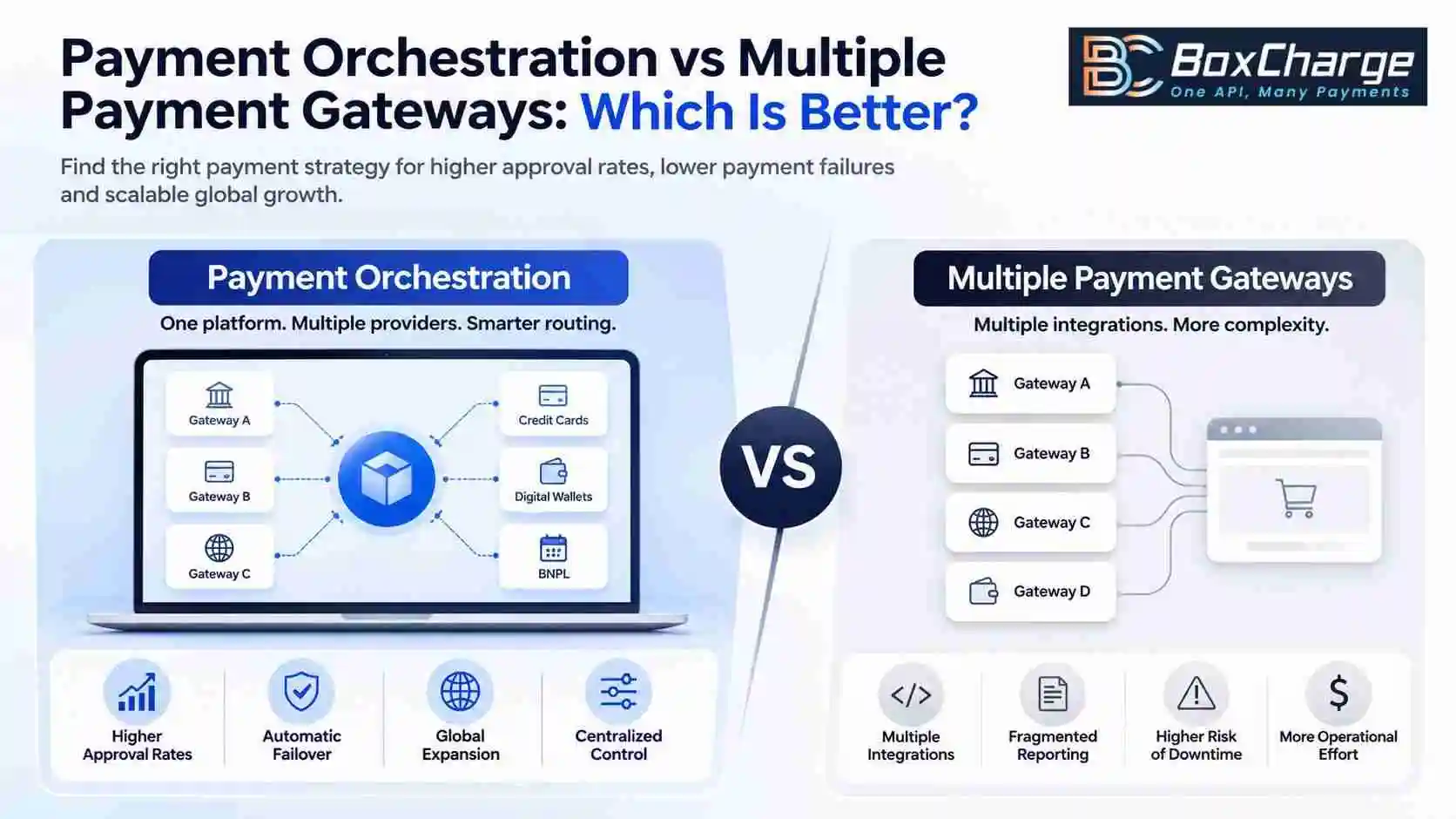
A payment orchestration layer can connect a merchant with multiple gateways, processors, acquirers, and payment methods through a unified integration. It can then use rules to determine how transactions should be routed, including by geography, payment method, provider performance, or failover requirements.
But orchestration is not automatically better.
For some merchants, running two or more direct gateway integrations may be simpler and more cost-effective. For others—particularly international, subscription-based, enterprise, and high-risk businesses—the additional control offered by orchestration can make a significant commercial difference.
What Is Payment Orchestration?
Payment orchestration is essentially a control layer between a merchant's payment environment and its underlying payment providers.
Instead of building separate payment integrations for every gateway or processor, the merchant connects to the orchestration platform. The platform can then coordinate different providers from one environment.
Depending on the solution, capabilities may include:
Smart payment routing
Multiple processor connections
Transaction retries
Failover routing
Payment-method management
Tokenization
Centralized reporting
Reconciliation support
Performance monitoring
Rules based on geography, cost, or transaction characteristics
Stripe describes orchestration as sitting above payment processing and coordinating transactions across multiple gateways, acquirers, processors, and payment methods.
The important distinction is that orchestration does not replace the underlying payment providers. It coordinates them.
That can be particularly useful when a merchant has outgrown a one-gateway setup.
How Multiple Payment Gateways Work
A multiple payment gateway strategy means a merchant maintains direct relationships or integrations with two or more payment gateways or processors.
For example, an international e-commerce company could use one provider for U.S. card transactions, another for European acquiring, and a third for a particular alternative payment method.
This approach can provide redundancy and market flexibility.
However, the merchant generally has to manage each integration independently.
That can mean separate:
APIs
Dashboards
Reporting formats
Settlement processes
Contracts
Technical documentation
Provider relationships
Fraud configurations
Reconciliation workflows
For a smaller business, this may be manageable.
For a merchant processing millions of transactions across several regions, the operational burden can become substantial.
PayPal describes this challenge as one reason larger businesses consider payment orchestration: managing multiple providers can create complexity around fees, integrations, reporting, and expanding into new markets.
Payment Orchestration vs Multiple Payment Gateways: The Core Difference
The easiest way to understand the distinction is to look at where the payment logic lives.
With multiple gateways, the merchant typically manages the relationships and routing logic across individual integrations.
With orchestration, a central layer coordinates those providers.
Factor | Multiple Payment Gateways | Payment Orchestration |
Integration | Multiple direct integrations | One central orchestration layer |
Routing | Usually merchant-managed | Rules-based centralized routing |
Failover | Often manually configured | Can be automated |
Reporting | Potentially fragmented | Centralized |
Provider switching | More development work | Generally easier |
Market expansion | New integrations may be required | Providers can be added through the orchestration layer |
Operational complexity | Can increase quickly | Centralized, but orchestration itself adds complexity |
Best fit | Smaller or focused businesses | Complex, high-volume, multi-market businesses |
The choice ultimately depends on the merchant's transaction volume, geographic footprint, technical resources, risk profile, and growth plans.
Smart Payment Routing Can Improve Payment Control
One of the strongest commercial arguments for orchestration is smart payment routing.
Instead of sending every transaction through the same provider, an orchestration platform can apply predefined rules to determine the preferred route.
For example:
Customer location → payment method → currency → transaction characteristics → preferred processor
A European card transaction might follow a different route from a U.S. transaction.
Similarly, a merchant could prioritize one processor for cost, another for regional performance, or another as a backup.
Stripe's current orchestration documentation describes routing payments across multiple processors, retrying failed transactions through another processor, and monitoring payment performance across providers.
This doesn't guarantee higher authorization rates.
The actual benefit depends on the quality of the providers, routing rules, transaction data, and merchant configuration.
That distinction matters. A routing layer is only as effective as the payment infrastructure behind it.
Payment Failures Are More Expensive for High-Risk Merchants
High-risk merchants have another reason to examine their payment architecture carefully.
A legitimate high-risk business may already face stricter underwriting, restricted provider availability, higher chargeback exposure, rolling reserves, transaction limits, or additional compliance reviews.
Now add a gateway outage or declining authorization performance.
For a conventional retailer, that may mean several hours of lost sales.
For a high-risk subscription business, gaming merchant, forex platform, digital service provider, or other specialized merchant, the consequences can extend beyond one failed transaction.
A customer might:
Abandon checkout
Fail to renew a subscription
Contact support
Switch to a competitor
Attempt multiple transactions
Trigger additional fraud rules
Merchants often describe the experience as frustrating because they know the customer is legitimate, yet the transaction still does not complete.
The challenge is finding the balance between payment acceptance and risk management.
Adding another gateway doesn't automatically solve this problem. An orchestration strategy can provide more routing options, but the merchant still needs compliant acquiring relationships and appropriate risk controls.
Payment Orchestration for High-Risk Businesses
For high-risk businesses, payment orchestration can be attractive because it can reduce dependence on one payment route.
Suppose a legitimate merchant has two approved processing relationships.
With a single-gateway setup, every transaction depends on that provider's availability, geographic coverage, risk rules, and performance.
With a properly structured multi-provider environment, the merchant may be able to distribute transactions according to predefined criteria.
This can create greater operational flexibility.
However, merchants should not confuse orchestration with a way around underwriting.
An orchestration platform does not make a restricted business automatically acceptable to an acquirer. Each underlying provider can still apply its own underwriting, compliance, transaction-monitoring, and risk requirements.
That is especially important for businesses in industries such as gaming, forex, nutraceuticals, adult services, travel, subscriptions, and other sectors that can receive enhanced scrutiny.
The right approach is to build legitimate, compliant payment redundancy, not to use multiple providers to bypass restrictions.
Multiple Payment Gateways Can Still Be the Better Choice
Payment orchestration sounds sophisticated, but sophisticated doesn't always mean necessary.
A business operating primarily in one country with moderate transaction volumes may gain little from introducing an additional orchestration layer.
If the merchant has:
One primary market
One or two payment methods
Stable transaction volumes
Limited technical requirements
A reliable payment provider
then direct gateway integrations may be perfectly reasonable.
Adding orchestration introduces another technology layer that must be implemented, monitored, maintained, and understood by the business.
Adyen makes a similar point in its 2026 discussion of orchestration: it can provide resilience and flexibility for high-volume businesses, but it can also shift complexity into a new operational layer and does not guarantee better authorization rates, lower costs, or improved customer experience.
That is an important reality check.
Payment Gateway Redundancy vs Payment Orchestration
Redundancy is one of the main reasons merchants adopt multiple payment gateways.
If Provider A experiences an outage, Provider B may remain available.
But redundancy alone isn't the same as orchestration.
With direct gateway integrations, the merchant may have to determine when and how transactions should move between providers.
An orchestration platform can automate some of those decisions using predefined routing and failover rules.
That distinction becomes more valuable as transaction volume increases.
Imagine a business processing 50,000 transactions per month. Manually monitoring multiple providers and deciding where transactions should go can quickly become inefficient.
A centralized routing layer can provide a more structured approach.
International Payment Processing Makes the Decision More Important
Geography is another major factor.
Customer payment preferences vary by market. A merchant expanding from the U.S. into the UK, Germany, France, Canada, or other European markets may need different payment methods, acquiring relationships, currencies, and compliance processes.
A single gateway can sometimes provide broad international coverage.
But if the merchant needs multiple regional providers, international payment processing can become significantly more complicated.
Orchestration can help centralize those connections.
Stripe notes that orchestration can allow businesses to add gateways, local processors, and payment methods without repeatedly redesigning the front-end checkout experience.
For merchants pursuing international growth, that flexibility can be commercially valuable.
Payment Orchestration and Reconciliation
Finance teams should not overlook reconciliation.
Running several payment gateways independently can result in different transaction IDs, reporting structures, settlement schedules, fee models, and currencies.
That can make it harder to answer basic questions:
How much did we process today?
Which provider processed the transaction?
What was the processing fee?
Has the payment settled?
Was the transaction refunded?
Which transactions failed?
Which processor is performing best?
A centralized payment environment can make this data easier to analyze.
However, merchants should check exactly what the orchestration platform provides. Centralizing payment data does not automatically eliminate settlement reconciliation or accounting work.
Which Is Better for Your Business?
There is no universal winner in the payment orchestration vs multiple payment gateways debate.
Choose a simpler multi-gateway strategy when your payment environment is relatively straightforward, and your team can comfortably manage the integrations.
Consider orchestration when:
You operate across several countries
Transaction volume is substantial
You use multiple acquirers or processors
Provider redundancy is important
Payment routing affects revenue
You need centralized reporting
Your technical team wants one payment integration
You frequently add payment methods or providers
High-risk processing requires greater payment flexibility
The more complex your payment environment becomes, the more valuable centralized control can be.
The Cost Question: Don't Compare Fees Alone
Merchants often compare gateway pricing and orchestration fees as if they were the only variables.
That misses the bigger commercial picture.
The real calculation should consider:
Processing fees + engineering costs + operational costs + payment failures + downtime + reconciliation + market expansion costs
A cheaper gateway may become expensive if it creates significant engineering work or payment friction.
Likewise, an orchestration platform may not make financial sense for a merchant with low volume and simple payment requirements.
The correct question isn't:
"Which option has the lowest fee?"
It is:
"Which payment architecture produces the best overall commercial outcome for our business?"
A Practical Payment Strategy for Growing Merchants
For many growing businesses, the answer may not be choosing between orchestration and multiple gateways immediately.
A practical progression can look like this:
Stage 1: Start with one reliable payment provider.
Stage 2: Monitor authorization rates, declines, costs, chargebacks, and geographic performance.
Stage 3: Add a second provider when there is a genuine business requirement.
Stage 4: Assess whether multiple direct integrations are becoming difficult to manage.
Stage 5: Introduce orchestration when centralized routing, failover, reporting, and provider management justify the additional layer.
This approach keeps the technology aligned with actual business needs instead of adding complexity simply because the architecture looks more advanced.
The Bottom Line: Orchestration or Multiple Gateways?
Payment orchestration is generally more compelling for complex, high-volume, international merchants that need centralized control across multiple payment providers.
Multiple payment gateways can be the better choice for smaller or less complex businesses that need redundancy without introducing another technology layer.
For high-risk merchants, the decision deserves even more attention. Payment stability, acquiring relationships, compliance, fraud controls, chargebacks, and settlement all need to work together.
The goal isn't simply to connect as many gateways as possible.
It's to create a payment environment where legitimate transactions have the best reasonable chance of completing, failures can be managed intelligently, and the business isn't unnecessarily dependent on a single payment route.
Build a Payment Stack That Can Scale With You
If your business is evaluating payment orchestration, multiple payment gateways, multi-acquirer processing, or high-risk payment infrastructure, start by mapping your current transaction flows, markets, decline rates, payment methods, and provider dependencies.
BoxCharge can help businesses assess payment infrastructure around their specific operating model and growth requirements, with a focus on building a more flexible payment environment rather than adding technology for its own sake.
The right payment architecture isn't the one with the most gateways. It's the one that gives your business the right balance of reliability, control, scalability, and payment performance.