Payment orchestration sounds like another piece of fintech terminology until you have actually dealt with a payment operation that is getting complicated.
At the beginning, most businesses don't need much. They connect a payment gateway, choose a processor, add card payments to the checkout and move on. It works. Customers pay. Money settles. There isn't much reason to think about what happens behind the transaction.
Then the business grows.
Suddenly there are customers in different countries, different currencies, different card types and different payment preferences. One processor performs well in one market but poorly in another. A transaction that was approved yesterday starts getting declined today. A provider has an outage. A new acquiring relationship is needed.
For a growing merchant, particularly a high-risk merchant, this is where payment infrastructure stops being a background function and starts affecting revenue.
That is essentially where payment orchestration comes in.
Payment Orchestration Explained Without the Fintech Jargon
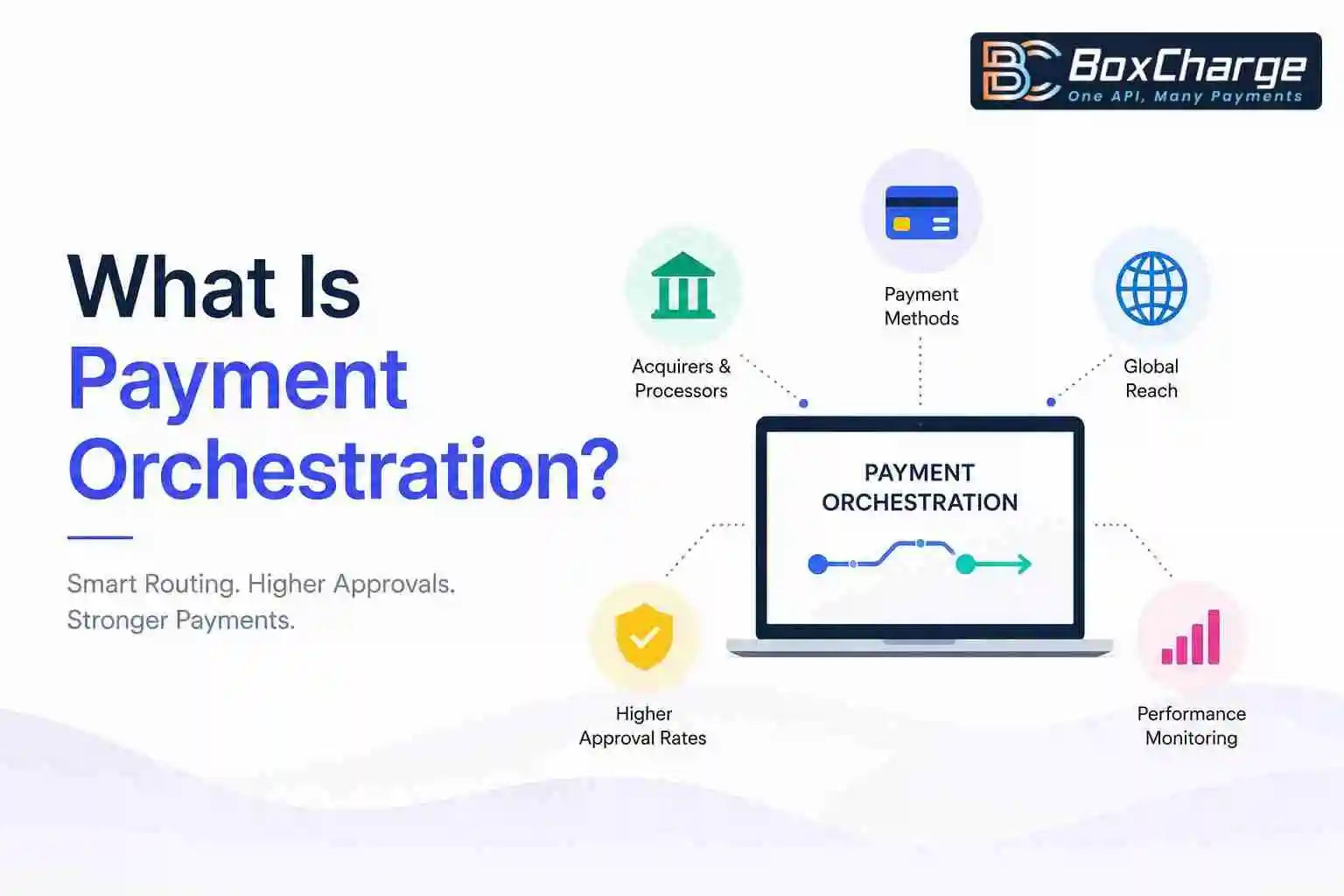
At its core, payment orchestration is a way of managing multiple payment providers, processors, acquirers, and payment methods through a central technology layer.
Instead of sending every transaction through one predetermined route, a merchant can use smart payment routing to decide where different transactions should go.
The decision can be based on factors such as the customer's location, currency, payment method, transaction characteristics, processor availability or historical performance.
Imagine an online business selling across the UK and Europe. It may discover that one acquiring partner performs particularly well for UK card transactions, while another delivers stronger results in a particular European market.
With a single-provider setup, the merchant has little room to react.
With a properly configured orchestration setup, the business can route transactions according to those differences.
That is the practical value of payment orchestration. It gives the merchant more control over what happens after the customer clicks "Pay."
Why One Payment Provider Isn't Always Enough
I've seen merchants make the same assumption repeatedly: if a payment provider works today, it should continue working as the business grows.
Unfortunately, payment processing doesn't always work that way.
A provider may be perfectly suitable at £50,000 in monthly volume and become difficult to manage at £500,000. A business may expand into a market where its existing acquirer has weaker approval performance. A payment method that works well in one country may not be the preferred option somewhere else.
There is also the simple problem of dependency.
If your entire payment operation depends on one provider and that provider experiences a technical issue, conducts an account review or changes its risk appetite, your business feels the impact immediately.
This is why more established merchants look at multi-acquirer payment processing and multiple payment routes as part of their wider payment strategy.
It isn't necessarily about replacing the original provider.
It is about not putting the entire business on one payment rail.
Where High-Risk Merchants Feel the Pressure First
This becomes considerably more important for businesses operating in high-risk industries.
A high-risk merchant already has more to think about than a conventional eCommerce business. Depending on the industry and business model, there can be stricter underwriting, higher processing costs, rolling reserves, transaction monitoring, chargeback concerns and more limited acquiring options.
Then comes the growth problem.
A merchant gets approved, builds its customer base and starts processing successfully. Transaction volume increases. International sales begin to pick up.
And then the questions start.
Why have approval rates changed?
Why are certain transactions declining?
Why is settlement taking longer?
Why is the processor asking for additional information?
Why is a particular market performing differently?
These are not hypothetical questions for many high-risk merchants. They are operational problems that can affect cash flow and customer acquisition.
And this is where I would make an important distinction: payment orchestration doesn't remove merchant risk.
It doesn't magically make a high-risk business low risk, and it doesn't override the underwriting policies of banks, acquirers or payment providers.
What it can do is give an eligible merchant more flexibility in how its payment infrastructure is organized.
That difference matters.
Smart Payment Routing Is About Making Better Decisions
One of the most misunderstood parts of orchestration is smart payment routing.
Some businesses hear "smart routing" and assume it means sending a failed transaction to another processor automatically.
That's not really the point.
Good routing is about making a better decision before and, where appropriate, after a transaction attempt.
A merchant might decide that transactions from a particular region should use one acquiring route because it performs better there. Another route might be more suitable for a specific currency or payment method.
The routing engine can use those rules to direct the transaction.
Over time, the merchant can look at the results and ask the questions that actually matter:
Which acquirer is producing the strongest approval performance?
Where are declines concentrated?
Which markets are creating more payment friction?
Is a particular payment method underperforming?
Are we paying more for a route without getting better results?
That is much more useful than simply looking at a single overall approval percentage.
What Happens When a Payment Fails?
This is where payment cascading and failover can become useful.
Let's say a customer attempts a legitimate transaction and the preferred payment route returns an eligible soft decline.
Depending on the reason for the decline and the merchant's configured rules, the transaction may be eligible for another route.
The idea is simple: don't let a recoverable payment failure automatically become a lost customer.
But there is a big caveat here.
You should never treat cascading as "try every processor until something works."
Payment retries have to be handled intelligently. Certain declines should not be retried, and indiscriminate retrying can create duplicate transactions, additional risk and a poor customer experience.
A serious payment orchestration platform therefore needs rules around when a transaction can be retried, where it should go and why.
That is one of the differences between a genuine payment strategy and simply connecting several gateways.
International Payments Make the Problem Bigger
Domestic payment processing can be relatively straightforward.
International commerce isn't.
A business selling into the UK, Germany, France, the United States and Australia isn't dealing with one uniform payment environment. Customer preferences differ. Card behavior differs. Currency requirements differ. Acquiring relationships differ.
Even the checkout experience customers expect can vary by market.
This is why international payment processing increasingly involves more than simply accepting Visa and Mastercard.
Businesses may need local acquiring, multiple currencies, alternative payment methods and different payment providers.
A merchant that tries to solve all of this with one payment connection can eventually find itself fighting its own infrastructure.
Orchestration gives the business another option: build a payment layer that can accommodate those differences instead of forcing every transaction through the same route.
The Cost of Payment Failures Is Bigger Than the Transaction
One thing that gets overlooked in payment discussions is what a decline actually costs.
Suppose a customer reaches your checkout after clicking a paid advertisement.
You've already paid for the impression.
You've paid for the click.
Your website has done its job.
The customer has chosen the product.
They're ready to buy.
Then the payment fails.
If they don't return, the processing problem has effectively turned into a customer acquisition cost problem.
This is why payment performance should be looked at alongside digital marketing and conversion data.
A merchant can spend thousands improving landing pages, running better campaigns and optimizing checkout speed, only to lose qualified customers because its payment infrastructure isn't performing consistently.
From an eCommerce payment processing perspective, the payment step is part of the conversion funnel—not something that happens after the funnel has finished.
Payment Orchestration Isn't Just About Approval Rates
Approval rates are important, but they're not the whole story.
A merchant should also look at:
Processing costs
Settlement performance
Chargeback exposure
Provider availability
Regional performance
Currency support
Payment method coverage
Customer experience
Operational workload
For example, choosing the route with the lowest processing cost may not make sense if that route consistently produces weaker approvals.
Likewise, a processor with excellent approval performance isn't necessarily the right choice if settlement terms create cash-flow problems.
This is why experienced payment teams look at the overall economics of payment processing, rather than chasing one metric.
The best route is the one that makes commercial sense for that particular transaction and market.
Does Payment Orchestration Reduce Chargebacks?
Not directly.
This is another area where the terminology gets overpromised.
Payment orchestration can help organize payment flows and provide greater visibility, but it doesn't automatically solve fraud or chargebacks.
A merchant still needs sensible fraud controls, clear billing descriptors, appropriate authentication, customer support and a strong dispute-management process.
For high-risk payment processing, this becomes even more important.
The objective isn't simply to approve as many transactions as possible.
It's to approve legitimate transactions while managing the risks that come with accepting payments.
A high approval rate means very little if the merchant later faces an unsustainable level of fraud or disputes.
What Should a Business Look for in a Payment Orchestration Solution?
If you're evaluating payment orchestration solutions, I'd start with the business problem rather than the feature list.
Ask yourself:
“How many payment providers do we actually need?”
If you only process domestic transactions through one provider, orchestration may add unnecessary complexity.
But if you're operating internationally, working with multiple acquirers or dealing with different payment methods, the calculation changes.
Then look at routing.
Can you create rules around geography, currency, payment method and provider performance?
Look at failover.
If a provider becomes unavailable, does your infrastructure have an appropriate alternative?
Look at reporting.
Can you actually understand why transactions are succeeding or failing across different providers?
And, particularly for high-risk businesses, ask about the underlying acquiring relationships.
Technology is only one part of payment infrastructure. If the connected providers don't support your business model or target markets, an excellent orchestration platform won't solve the underlying problem.
Payment Orchestration and the Future of Global Commerce
The payment industry has changed considerably because businesses no longer sell within neat geographical boundaries.
A customer can discover a company through social media in the morning, visit its website from another country, pay in a local currency and expect the same checkout experience as a domestic buyer.
Merchants have to adapt to that reality.
That means payment infrastructure needs to become more flexible.
Payment orchestration is one response to that change. Instead of treating payment processing as a single connection between a merchant and a provider, it treats the payment environment as an ecosystem of providers, acquiring relationships, payment methods and routes.
For larger international businesses, that approach makes practical sense.
For high-risk merchants, it can be even more valuable because the cost of payment disruption is often higher and the number of available processing options can be smaller.
But orchestration should be implemented with discipline.
More providers do not automatically mean better payments.
More routes do not automatically mean higher approval rates.
And more technology does not automatically mean better results.
The value comes from understanding the transaction data and using that information to make better routing and payment decisions.
Final Takeaway
So, what is payment orchestration?
In simple terms, it is the infrastructure that helps a merchant coordinate multiple payment providers and routes instead of depending entirely on one.
But the bigger idea is about control.
Control over where transactions go.
Control over how different markets are handled.
Control over payment-provider dependency.
And, most importantly, better visibility into what is happening between the customer clicking "Pay" and the money reaching the merchant.
For businesses operating internationally or in high-risk sectors, that control can have a direct commercial impact.
If payment performance is becoming difficult to manage, adding another payment gateway isn't necessarily the answer. The better question may be whether the business needs a smarter way to manage the payment providers it already has—and the ones it may need tomorrow.
For businesses exploring a more flexible payment infrastructure, BoxCharge's Payment Orchestration solution provides a framework for multi-acquirer connectivity, intelligent routing, cascading, failover and payment-performance monitoring.