
Getting approved for a merchant account is often the first major hurdle for a high-risk business. But approval is only the beginning.
A payment provider may approve the account, connect the business to a payment gateway, and offer competitive processing rates, yet still hold back a percentage of processed funds through a rolling reserve. For merchants with tight operating margins or fast growth, that reserve can have a significant effect on available working capital.
This is why businesses researching rolling reserves for high-risk merchant accounts should look beyond the headline processing rate. The percentage being held, release period, reserve calculation, and conditions for changing the reserve can all affect the real cost of payment processing.
For high-risk merchants, understanding these terms before signing a merchant agreement can prevent unpleasant cash-flow surprises later.
What Is a Rolling Reserve?
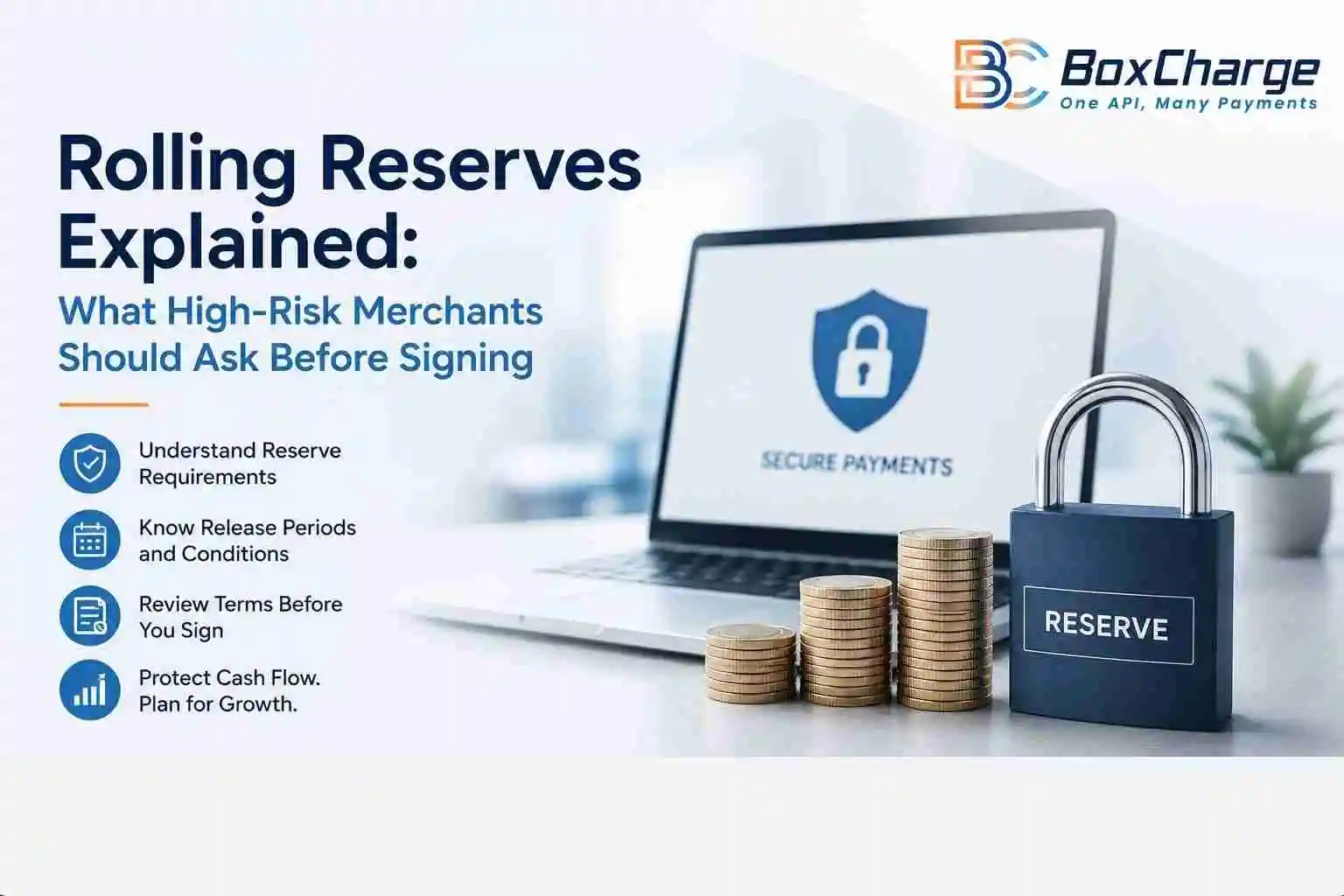
A rolling reserve is a portion of a merchant's processed funds that a payment provider temporarily withholds as protection against potential future liabilities.
Those liabilities can include:
Chargebacks
Refunds
Fraud-related losses
Customer disputes
Unresolved transactions
Other obligations under the merchant agreement
For example, if a business processes £100,000 and has a 10% rolling reserve, £10,000 may be retained according to the terms of the agreement while the remaining funds are settled normally.
The retained amount is generally released after a specified period. With a 90-day rolling reserve, for example, funds associated with older transactions may be released as newer transactions enter the reserve period.
However, a 10% reserve does not tell you the whole story.
The merchant needs to understand how the percentage is calculated, when funds are released, whether the reserve can change, and what happens if the account is terminated.
Why Do High-Risk Merchants Face Rolling Reserves?
Payment processors and acquiring banks take on financial exposure whenever they process card transactions.
A transaction may be approved today, but a customer could dispute it weeks later. If a merchant suddenly stops processing or becomes unable to meet its obligations, the acquirer still needs a way to cover potential liabilities.
A reserve provides that financial buffer.
High-risk businesses may receive additional scrutiny because their business model or transaction profile creates greater potential exposure. This can include industries with:
Higher chargeback rates
Recurring billing
International customers
Large transaction values
Long fulfilment periods
Financial products or services
Higher fraud exposure
Rapidly changing transaction volumes
Being classified as high-risk does not mean a business is illegitimate. A legitimate merchant can receive a high-risk classification because of its industry, customer profile, geography or payment characteristics.
The important issue is whether the merchant understands the financial conditions attached to that classification.
The Cash-Flow Problem High-Risk Merchants Often Overlook
Rolling reserves become particularly painful when a business is growing.
Consider an online merchant processing £250,000 per month with a 10% reserve requirement.
That could mean £25,000 of processing volume is tied up under the reserve arrangement, depending on how the agreement calculates the reserve.
At the same time, the merchant still needs to pay:
Staff
Suppliers
Advertising costs
Technology expenses
Rent
Taxes
Operational overheads
The business can therefore be profitable while still experiencing a working-capital squeeze.
This is one of the biggest challenges faced by high-risk merchant account holders.
The problem becomes more significant as processing volume increases. If the reserve is percentage-based, successful growth can mean a larger amount of money being held.
That is why merchants should calculate the potential cash-flow impact before accepting the proposed terms.
7 Questions to Ask Before Accepting a Rolling Reserve
1. What Percentage Will Be Held?
Start with the obvious question: What is the reserve percentage?
Get the exact figure in writing.
Don't rely on a verbal statement such as “a standard reserve may apply.” Ask whether the percentage is fixed for the duration of the agreement or whether the provider can change it.
A difference between 5% and 10% can represent a substantial amount of working capital for a high-volume merchant.
2. How Is the Reserve Calculated?
This question is just as important as the percentage.
Find out whether the reserve is calculated against:
Gross processing volume
Settled transactions
Daily volume
Monthly volume
Specific transaction types
Particular customer regions
Two providers could both advertise a 10% rolling reserve while applying completely different calculation methods.
The contract should make the calculation clear.
3. When Are Reserve Funds Released?
Ask for the exact release period.
Is it 30 days, 60 days, 90 days, or longer?
Also confirm whether the arrangement is genuinely rolling.
Under a rolling structure, funds associated with older transactions may become available as newer transactions enter the reserve period. Understanding this timing allows the merchant to forecast cash flow properly.
4. Can the Reserve Percentage Increase?
This is a critical question for growing businesses.
Some merchant agreements allow a provider to adjust reserve requirements if the perceived risk of the account changes.
Ask what can trigger an increase.
Possible factors may include:
Increased chargebacks
Sudden processing growth
New customer markets
Changes to products or services
Unusual transaction patterns
Compliance concerns
A merchant should know these conditions before processing begins rather than discovering them during an account review.
5. What Happens If the Merchant Account Is Terminated?
This question is frequently ignored.
If processing stops, the provider may still need to protect itself against future chargebacks and other liabilities. As a result, reserve funds may remain held after termination.
Ask:
How long can funds remain unavailable after termination?
Also establish whether the release process changes once the merchant account is closed.
For businesses that depend heavily on one payment processor, this can have a major effect on liquidity.
6. Is There Any Additional Reserve?
A rolling reserve may not be the only financial condition attached to a high-risk merchant account.
Depending on the underwriting decision, a provider may request other forms of financial protection.
Ask whether there is:
An upfront reserve
A fixed reserve
A rolling reserve
Additional security requirements
Request the complete financial structure in writing before signing.
7. Can the Reserve Be Reviewed?
If your processing history remains stable, ask whether the reserve can be reassessed.
A merchant with consistent volumes, low chargebacks, strong fraud controls, and good compliance practices may have a stronger case for a future commercial review.
The provider may not guarantee a reduction, but knowing whether a review is possible gives the merchant a clearer long-term picture.
Don't Choose a High-Risk Merchant Account on Rate Alone
Processing rates matter, but they should not be the only deciding factor.
A provider offering a slightly lower transaction fee may still be more expensive overall if it has restrictive settlement terms, higher reserves, or limited payment coverage.
When comparing high-risk merchant account providers, look at the complete cost structure.
This may include:
Processing fees
Gateway fees
Chargeback fees
Cross-border charges
Currency-conversion costs
Reserve requirements
Refund costs
Settlement fees
Monthly account charges
The cheapest advertised rate is not necessarily the cheapest payment solution.
For a growing merchant, predictable settlement and access to working capital can be more valuable than a small reduction in the transaction fee.
How Merchants Can Reduce Payment Risk
A reserve is not necessarily something a merchant should view as a red flag. It is a risk-management mechanism.
The better approach is to build a payment operation that demonstrates strong performance.
Strengthen fraud prevention
Use appropriate tools such as 3DS2, transaction monitoring, velocity controls and fraud screening to identify suspicious activity.
Improve chargeback management
Clear billing descriptors, transparent refund policies and responsive customer support can help reduce avoidable disputes.
Diversify payment methods
Where appropriate, merchants can consider cards, bank transfers, wallets and alternative payment methods instead of relying entirely on one payment route.
Avoid single-processor dependency
A business that depends completely on one payment relationship can face serious disruption if that account is reviewed, restricted or terminated.
Payment orchestration and multiple acquiring relationships can provide greater flexibility for eligible merchants.
BoxCharge provides payment infrastructure that includes payment orchestration, cross-border payment connectivity, alternative payment methods, smart routing, cascading, 3DS2 and tokenisation, giving merchants additional tools for building a more resilient payment setup.
What High-Risk Merchants Should Prepare Before Applying
Strong underwriting preparation can make the application process more straightforward.
A payment provider may request information such as:
Company registration documents
Business bank statements
Previous processing statements
Expected monthly volume
Average transaction value
Customer locations
Website and product information
Refund and cancellation policies
Terms and conditions
KYC/KYB information
Relevant licences or regulatory information
Most importantly, describe the business accurately.
Trying to present a high-risk business as something else can create larger problems later if the actual processing activity doesn't match the information provided during underwriting.
A Rolling Reserve Isn't Automatically a Bad Deal
High-risk merchants sometimes see the words “rolling reserve” and immediately assume the payment provider is offering poor terms.
That isn't necessarily the case.
A reserve can be a normal part of the risk arrangement between a merchant and its acquiring partner.
The real concern is lack of transparency.
Before signing, the merchant should know:
Q: How much is being held?
Q: How is it calculated?
Q: When will it be released?
Q: Can the percentage change?
Q: What triggers an account review?
Q: What happens if processing stops?
If those answers are clear, the merchant can model the potential cash-flow impact and make an informed commercial decision.
Final Takeaway
For high-risk businesses, the merchant-account agreement is about much more than the processing rate.
A rolling reserve can affect working capital, settlement availability and the ability to fund day-to-day operations. That's why merchants should evaluate reserve requirements alongside acquiring coverage, payment methods, fraud controls, settlement terms, chargeback management and scalability.
If your business is already dealing with unexpected reserves, payment declines, delayed settlements, processing restrictions, or account reviews, it may be time to reassess the underlying payment infrastructure rather than simply searching for a lower processing rate.
Need a More Flexible High-Risk Payment Setup?
BoxCharge helps eligible businesses evaluate merchant services, cross-border processing, payment orchestration, and alternative payment methods around their business model and target markets.
Talk to BoxCharge about your payment requirements and explore a payment setup designed around your processing needs.