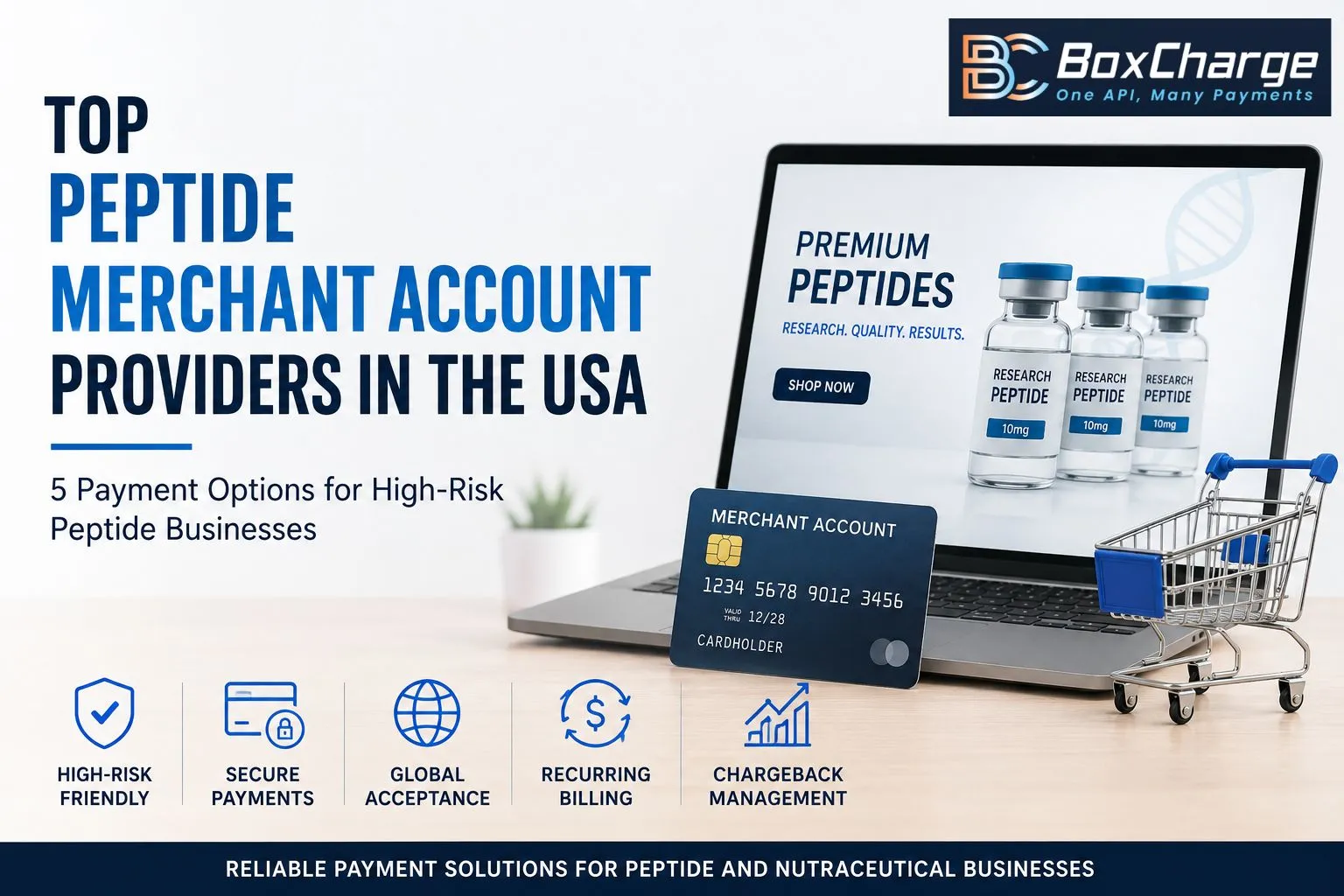
Selling peptides online can create a payment-processing problem that has little to do with the quality of the website or the number of customers a business has. Peptide merchant accounts are often considered specialized because payment providers may scrutinize the underlying product, intended use, claims made in marketing, subscription structure, customer geography, and regulatory status.
That does not mean every peptide business is automatically high risk. The payment profile depends heavily on what is being sold, how it is marketed, whether the products are legally permitted in the relevant jurisdiction, and how the merchant's acquiring partners classify the business.
For a legitimate U.S.-focused peptide business, choosing the right peptide payment processing setup is therefore about more than finding the lowest transaction rate. Merchants need to consider underwriting, chargeback exposure, recurring billing, fraud prevention, settlement terms, compliance documentation, and long-term account stability.
This guide looks at five payment providers worth researching for businesses operating in the peptide and broader high-risk/nutraceutical space. It is a comparison guide rather than a guarantee of approval. Actual availability depends on the merchant's products, claims, licensing or authorization where applicable, location, processing history, and acquiring-bank review.
What Is a Peptide Merchant Account?
A peptide merchant account is a payment-processing arrangement that allows an eligible peptide business to accept electronic payments from customers.
The account can connect the merchant's website or checkout system with payment processing infrastructure for transactions such as:
Credit and debit card payments
Recurring peptide subscriptions
One-time purchases
International transactions
Alternative payment methods
Refunds
Chargeback handling
Fraud screening
3D Secure authentication
Multi-currency transactions
The important distinction is that the term "peptide merchant account" describes the payment-processing requirements of the business, not a special banking account that automatically makes a peptide product permissible.
A merchant still needs to comply with applicable laws, payment-network rules, acquiring requirements, product restrictions, and any applicable regulatory requirements.
Why Peptide Businesses Can Be Considered High Risk
The biggest misconception is that a payment processor looks only at the product name.
In reality, underwriting can consider the entire business model.
For peptide merchants, factors can include the type of peptide being sold, how the product is described, whether it is intended for human use, the claims appearing on the website, refund and cancellation policies, average transaction value, subscription structure, customer geography, chargeback history, and regulatory documentation.
This is particularly important for businesses operating around research peptides, health supplements, wellness products, or other specialized products.
The distinction between a legitimate, properly documented product and a product making unsupported medical or therapeutic claims can materially affect payment eligibility.
The common payment pain points include:
Account rejection: Traditional payment providers may decline a business without offering a processing structure suitable for its risk profile.
Sudden account restrictions: A merchant can discover that its processing relationship has changed after transaction volume or product activity increases.
Rolling reserves: Higher-risk acquiring relationships may require reserves to protect against future chargebacks.
Chargebacks: Customers may dispute recurring purchases, claim they did not recognize the transaction, or challenge the product or service received.
Settlement delays: Funds held longer than expected can create cash-flow problems, particularly for growing businesses purchasing inventory or spending heavily on advertising.
Limited payment options: A merchant may need cards, alternative payment methods, and recurring billing rather than a basic checkout.
These challenges are why high-risk peptide payment processing requires a more thoughtful approach than simply connecting a standard payment gateway.
5 Peptide Merchant Account Providers to Research
1. BoxCharge
BoxCharge is a global merchant-services and payment infrastructure provider offering international merchant-account enablement, acquiring connectivity, cross-border payment processing, payment orchestration, alternative payment methods, and settlement infrastructure. Its published solutions emphasize multi-currency processing, smart routing, multiple acquiring relationships, fraud prevention, tokenization, and 3DS authentication.
For peptide businesses, the relevant question is not simply whether a provider calls itself "high risk." The merchant should establish whether its specific peptide products and business model are acceptable to the acquiring partner.
BoxCharge states that its merchant services are intended for legitimate businesses operating under applicable laws, with availability dependent on jurisdiction, documentation, and partner review.
That approach is particularly relevant for merchants that need international payment acceptance or want to avoid relying on a single domestic processing relationship.
Best suited for: Legitimate peptide and specialized e-commerce businesses seeking global merchant-account connectivity, multi-currency processing, payment orchestration, and cross-border capabilities, subject to underwriting.
2. PayCly
PayCly provides high-risk merchant accounts, international payment gateways, credit-card processing, alternative payment methods, and multi-currency payment infrastructure. Its published merchant-account information specifically discusses specialized processing for businesses that traditional financial institutions may classify as high risk.
PayCly also states that its payment infrastructure supports more than 100 payment methods and more than 100 international currencies, while its platform provides transaction reporting, settlement information, and international payment capabilities.
For a peptide merchant, those features can be relevant if the business sells internationally or needs more than a simple card-only checkout.
However, merchants should still ask for confirmation that their exact peptide product category, marketing claims, and customer markets are eligible before signing an agreement.
Best suited for: High-risk online businesses looking for international merchant accounts, multi-currency processing, and multiple payment methods.
3. InQuid
InQuid has a particularly relevant position for the peptide sector because its published high-risk merchant-account program specifically includes nutraceuticals, health supplements, weight-management products, sports nutrition, and nootropics among the verticals it supports.
Its high-risk infrastructure also emphasizes multiple acquiring relationships, dedicated account management, KYC/AML screening, chargeback management, and risk monitoring. InQuid states that its merchant-account platform can connect merchants to more than 40 acquiring relationships and supports multi-currency settlement.
This matters because many merchants in specialized health and supplement categories are not necessarily struggling with the first transaction. Their bigger problem is maintaining stable processing after volume increases.
A processor that understands the underlying risk profile can potentially provide a more appropriate underwriting conversation than a generic payment provider.
Best suited for: Nutraceutical, supplement, nootropic, and other specialized health-product businesses requiring high-risk payment infrastructure.
4. Amald
Amald provides high-risk and international merchant-account services and has published material describing support for businesses operating in specialized and higher-risk industries. Its international merchant-account material discusses online pharmaceutical businesses, online games, adult websites, and other higher-risk business models.
Amald also publishes information about high-risk payment gateways, including 3DS and non-3DS transaction processing and chargeback/fraud-management considerations.
For a peptide business, the important point is to obtain written confirmation of eligibility rather than assuming that an "international merchant account" automatically covers every peptide product.
The merchant should provide a complete description of its products, website, customer markets, transaction model, and relevant documentation during underwriting.
Best suited for: Specialized and high-risk online businesses looking for international merchant-account and payment-gateway options.
5. WebPays
WebPays positions itself around high-risk payment processing, merchant accounts, global payment gateway services, and payment solutions for specialized online industries. Its current public company profile describes services including high-risk merchant accounts, payment gateway solutions, and global processing, while its recent materials discuss multi-acquirer processing, fraud controls, and high-risk payment infrastructure.
For peptide merchants considering WebPays, due diligence is especially important. Public review platforms currently show mixed-to-negative customer feedback, including complaints about fees, onboarding, and fund handling; WebPays has responded publicly to some complaints and states that high-risk pricing and settlement terms are influenced by underwriting, KYC/KYB, compliance, and risk assessment.
That does not by itself determine whether the service is suitable for a particular merchant. It does mean prospective merchants should carefully verify the contracting entity, acquiring relationship, fee schedule, reserve terms, settlement conditions, and support arrangements before committing funds.
Best suited for: Merchants researching specialized high-risk payment infrastructure, provided they complete appropriate provider and contract due diligence.
Comparison: Peptide Merchant Account Providers
Provider | High-Risk Focus | Relevant Product Categories | International Processing | Key Consideration |
BoxCharge | High-risk & global merchant services | Specialized e-commerce and legitimate higher-risk businesses | Yes | Multi-acquirer, orchestration, multi-currency and cross-border capabilities |
PayCly | High-risk merchant processing | Specialized online and high-risk businesses | Yes | Multi-currency and alternative payment support |
InQuid | Dedicated high-risk infrastructure | Nutraceuticals, health supplements, nootropics and subscription businesses | Yes | Multiple acquiring relationships and risk-focused underwriting |
Amald | High-risk & international processing | Specialized online businesses | Yes | International merchant-account and gateway capabilities |
WebPays | High-risk payment processing | Multiple high-risk online categories | Yes | Conduct detailed due diligence on commercial and settlement terms |
Important: These providers should not be treated as interchangeable, and inclusion in this comparison does not mean that every provider accepts every peptide product. Eligibility can change according to the product, jurisdiction, marketing claims, transaction profile, acquiring bank, and compliance review.
Why High-Risk Peptide Merchants Struggle With Payment Processing
The hardest part for many high-risk merchants is not getting an application submitted. It is maintaining stable processing after approval.
Consider a peptide business that starts with $30,000 in monthly card volume and grows rapidly through paid advertising. Six months later, the business is processing several hundred thousand dollars.
The merchant may suddenly encounter additional questions about transaction volume, customer acquisition, refunds, product descriptions, or chargebacks.
If the original payment infrastructure was not designed around that growth, the merchant can face:
Processing limits
Increased reserves
Delayed settlements
Higher fees
Declining authorization rates
Additional compliance reviews
MID restrictions
Payment-account termination
For a subscription-based peptide business, the problem can become even more serious.
A failed recurring payment does not just represent one lost transaction. If payment retries are poorly managed, the merchant can lose an otherwise valuable customer.
Recurring Billing Is a Major Consideration
Many online health and supplement businesses use subscription models.
That creates a need for reliable peptide subscription payment processing.
A suitable infrastructure should be able to manage:
Recurring billing
Customer payment updates
Failed-payment retries
Cancellation requests
Refunds
Stored payment credentials
Transaction authentication
Chargeback documentation
The merchant should also make subscription terms extremely clear.
Customers should understand the billing frequency, price, renewal conditions, cancellation process, and refund policy before completing checkout.
That transparency can help reduce disputes and make the merchant's risk profile easier for an acquiring partner to understand.
Fraud and Chargeback Management for Peptide Businesses
Peptide payment processing can attract fraud risks similar to other online businesses selling valuable or specialized products.
Fraud controls may include:
3D Secure
Transaction monitoring
Velocity rules
Address verification
Device intelligence
Geographic controls
Risk scoring
Chargeback alerts
Manual transaction review
But fraud prevention should not be designed simply to block as many transactions as possible.
A system that rejects legitimate customers can damage revenue just as quickly as fraud.
The objective is to maintain a balance between payment approval, fraud prevention, customer experience, and compliance.
What Documents Do Peptide Merchants Need?
A strong application starts with transparency.
Depending on the provider and business model, merchants may be asked for:
Certificate of incorporation
Government-issued identification
Beneficial-owner information
Business bank statements
Processing history
Website URL
Product catalogue
Terms and conditions
Privacy policy
Refund policy
Shipping/fulfillment information
Subscription terms
Expected monthly volume
Average transaction value
Customer locations
Product compliance documentation where applicable
For specialized products, the acquiring partner may also want information about product composition, intended use, labeling, advertising claims, and applicable authorizations.
This is one reason merchants should avoid using vague descriptions during onboarding.
The payment provider should know exactly what the customer is buying.
How to Choose the Right Peptide Merchant Account
Before choosing a provider, ask these questions:
Does the provider support my exact product?
"Peptides" is a broad description. Different products can have very different regulatory and payment implications.
What is the reserve requirement?
A lower processing rate does not necessarily mean lower total cost if a significant percentage of revenue is held in reserve.
How long does settlement take?
Cash flow matters. Understand whether settlements are daily, weekly, or subject to additional holds.
Does the account support recurring payments?
This is essential for subscription-based models.
What happens if processing volume increases?
Ask whether transaction limits or additional underwriting will apply as the business scales.
How are chargebacks handled?
Understand fees, evidence requirements, alerts, representment, and merchant liability.
Which countries can customers come from?
International processing requires more than simply displaying multiple currencies.
Is the acquiring relationship transparent?
The merchant should understand who ultimately provides the acquiring relationship and which entity is responsible for the contractual payment service.
Is a “Peptide Merchant Account With Instant Approval” Realistic?
Searches for peptide merchant account instant approval are common because high-risk merchants often become frustrated with lengthy underwriting.
But merchants should be cautious with providers promising guaranteed approval without reviewing the business.
A legitimate processor still needs to understand:
What products are being sold
Where customers are located
How transactions are generated
Expected processing volume
Chargeback history
Business ownership
Compliance requirements
Fast onboarding can be useful, but instant approval should never be interpreted as guaranteed acceptance of every peptide product or business model.
Final Thoughts
Finding a peptide merchant account provider in the USA can be more complicated than opening a standard e-commerce merchant account. The challenge is not necessarily the payment technology itself. It is the combination of product classification, underwriting, fraud exposure, recurring billing, chargebacks, compliance, and acquiring-bank risk appetite.
For legitimate businesses, the strongest approach is transparency.
Have your product information ready. Keep your website policies clear. Explain your subscription model. Maintain accurate transaction records. Understand your customers and target markets. And make sure your payment provider understands exactly what your business sells.
The five providers covered here—BoxCharge, PayCly, InQuid, Amald, and WebPays—represent different approaches to specialized and high-risk payment processing. Their suitability will depend on the merchant's individual profile and the acquiring relationships available at the time of application.
For businesses considering high-risk peptide payment processing, BoxCharge offers global merchant services, cross-border payment connectivity, payment orchestration, multi-currency processing, and acquiring connectivity for legitimate businesses, with availability subject to jurisdiction, documentation, partner availability, and compliance review.
Ultimately, the right peptide merchant account is not simply the account that approves the application fastest. It is the payment infrastructure that gives a legitimate business the best chance of maintaining stable processing, predictable settlement, effective risk management, and room to scale.