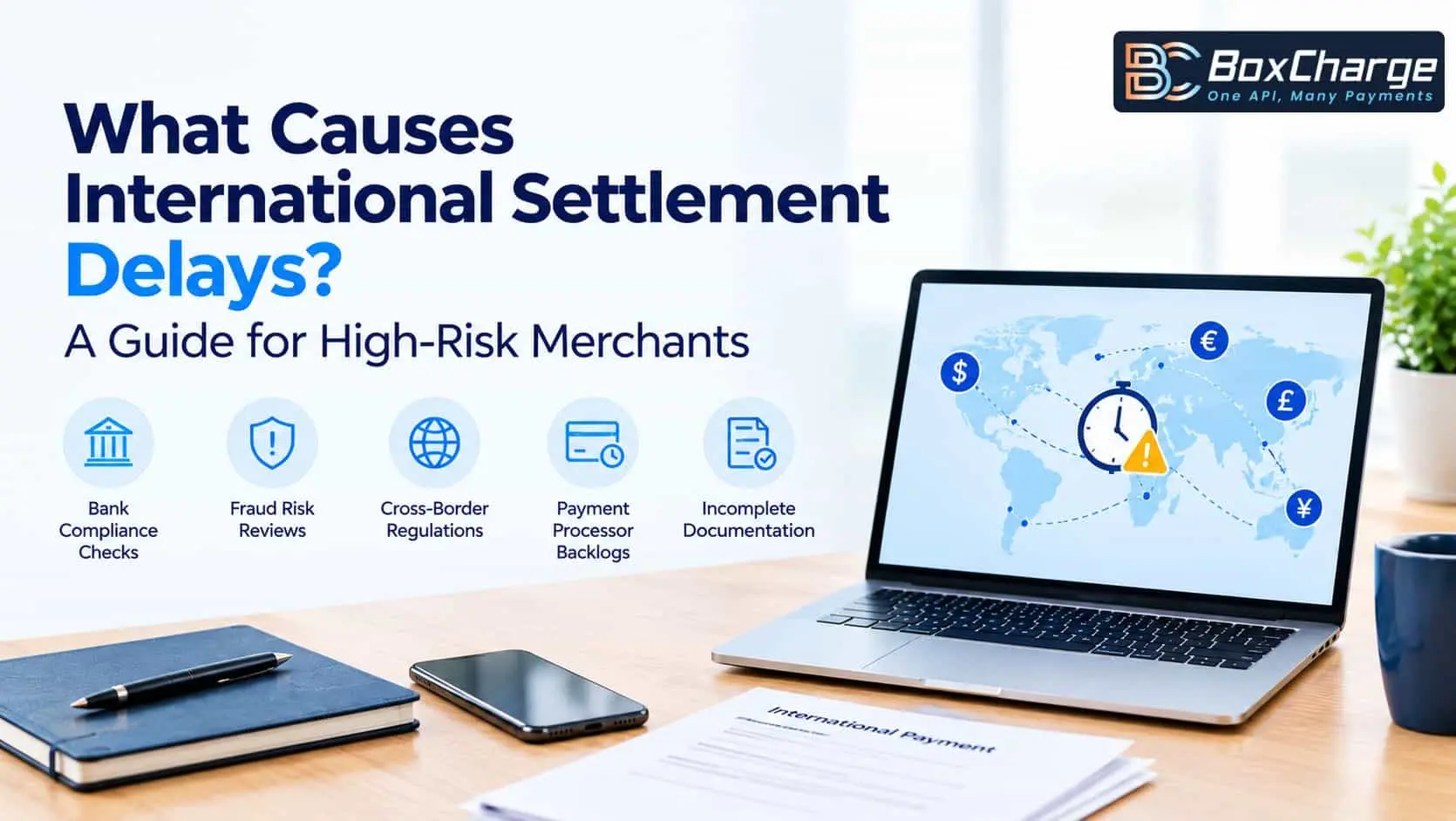
International settlement delays can create much bigger problems for a business than simply waiting a few extra days for funds to arrive. For merchants selling internationally, a delayed settlement can affect cash flow, supplier payments, payroll, advertising budgets, refunds, inventory purchases, and day-to-day operations.
The problem becomes even more serious for high-risk merchants, whose payment accounts may already operate under enhanced monitoring, rolling reserves, longer settlement windows, or additional compliance requirements.
So, what causes international settlement delays?
In most cases, the delay is connected to one or more factors across the payment chain: merchant account reviews, cross-border payment processing, compliance checks, currency conversion, banking cut-off times, chargebacks, risk monitoring, correspondent banks, or settlement reconciliation.
Understanding where these delays come from can help merchants choose a payment processing structure that provides better visibility and more predictable access to funds.
What Is an International Settlement Delay?
An international settlement delay occurs when funds from completed customer transactions take longer than expected to reach the merchant's designated bank account.
A card transaction does not move directly from a customer's card to a merchant's bank account. Several parties can be involved, including the payment gateway, acquiring bank, card network, issuing bank, payment processor, foreign exchange provider, and receiving bank.
For domestic transactions, this process can be relatively straightforward. Cross-border payments introduce additional layers.
A typical international payment may involve:
Authorization of the customer's transaction
Payment capture
Clearing through the card network
Acquirer processing
Risk and compliance screening
Currency conversion
Cross-border banking
Settlement reconciliation
Final payout to the merchant
A delay at any stage can affect when the merchant receives the money.
For a low-risk merchant with a straightforward transaction profile, a minor delay may be manageable. For a high-risk business processing significant transaction volumes, the same delay can create immediate working-capital pressure.
Why Do International Payments Take Longer to Settle?
There is no single reason behind every delayed international settlement. The cause often depends on the merchant's industry, transaction geography, acquiring setup, currencies, processing history, and risk profile.
1. Additional Compliance and KYC Checks
International payment processing requires merchants and transactions to meet regulatory and compliance requirements.
A processor or acquiring bank may review:
Merchant ownership information
Business registration documents
Beneficial ownership
Transaction patterns
Customer locations
Source of funds
Website and product information
Refund and cancellation policies
Previous processing history
When information needs to be verified, settlement may take longer.
For high-risk merchants, compliance checks can be more extensive. Industries such as online gaming, forex, nutraceuticals, adult services, digital subscriptions, and other higher-risk business models can receive greater scrutiny because of their chargeback, fraud, regulatory, or consumer-dispute exposure.
That does not automatically mean a transaction will be delayed. However, merchants operating in these sectors should understand that risk-based payment monitoring can influence settlement timelines.
2. Cross-Border Banking Networks
International transactions can pass through multiple financial institutions before funds reach the merchant.
Correspondent banking relationships, intermediary banks, local clearing systems, and international banking schedules can all influence settlement speed.
A payment may therefore be successfully processed from the customer's perspective while the merchant is still waiting for the final funds to arrive.
This distinction is important.
Payment approval does not necessarily mean the merchant has received the money.
Authorization confirms that a transaction can proceed. Clearing and settlement happen later.
For international businesses, this difference can have a significant impact on cash-flow forecasting.
3. Currency Conversion and FX Processing
Currency conversion can add another stage to the settlement process.
Suppose a customer pays in EUR while the merchant maintains a USD settlement account. The transaction may need to pass through currency conversion before the merchant receives the final settlement amount.
Depending on the acquiring and banking structure, this can involve:
FX conversion
Exchange-rate calculation
Currency reconciliation
Foreign exchange compliance
Multi-currency settlement
Additional banking instructions
Merchants accepting multiple currencies should therefore look beyond the headline transaction processing rate.
The settlement currencies, payout schedule, FX structure, and banking relationships can be equally important.
4. High-Risk Transaction Monitoring
High-risk merchants often experience settlement challenges that traditional businesses may not encounter.
Payment providers monitor transaction activity for indicators such as unusual transaction volumes, sudden changes in average ticket size, geographic anomalies, elevated refunds, fraud patterns, and chargeback activity.
If transaction activity differs significantly from the merchant's established profile, additional review may occur.
For a growing high-risk merchant, this can become frustrating.
A business may invest heavily in marketing, acquire new customers, and suddenly increase sales. From the merchant's perspective, this is positive growth.
From a payment risk perspective, however, a sudden increase in processing volume can trigger additional scrutiny.
This creates one of the most common pain points for high-risk account holders:
The business grows faster than the payment infrastructure is prepared to handle.
Without an appropriate acquiring setup, successful sales can create settlement pressure instead of improving cash flow.
5. Chargebacks and Refund Activity
Chargebacks can have a direct effect on merchant settlement.
A high chargeback ratio may lead an acquirer or payment processor to apply additional controls, reserves, or monitoring.
This is particularly relevant to merchants operating subscription businesses or sectors where customers may dispute transactions after purchase.
High-risk merchants can therefore face a difficult cycle:
More disputes → greater risk exposure → tighter controls → potentially slower access to funds.
A strong chargeback management strategy is consequently important for maintaining stable payment operations.
Merchants should monitor dispute ratios, refund patterns, customer complaints, transaction descriptors, and customer-service processes rather than treating chargebacks solely as a payment-processing issue.
6. Rolling Reserves and Delayed Payouts
A rolling reserve is one of the most important concepts high-risk merchants need to understand.
Under a reserve arrangement, a percentage of processed funds may be held for a defined period to protect the payment provider against future chargebacks, refunds, or other liabilities.
For example, a merchant could process a substantial amount of sales but have only part of the balance immediately available for payout.
This can make a merchant feel that money is "missing" when it is actually being held under the agreed reserve structure.
The issue is not necessarily the existence of a reserve. The bigger problem is when merchants do not understand:
The reserve percentage
The reserve release period
The settlement schedule
Which transactions are subject to the reserve
How reserves affect available working capital
Before accepting a high-risk merchant account, businesses should carefully review the commercial terms surrounding reserves and settlement.
7. Bank Cut-Off Times, Weekends and Holidays
International settlement is also affected by banking schedules.
A transaction processed close to a bank's daily cut-off time may be handled on the following business day. Weekends and public holidays can extend the effective settlement period.
International merchants also need to consider the working calendars of different countries.
For example, a merchant may operate from the UK, acquire transactions through Europe, and settle funds into an Asian bank account. Different banking schedules can influence when funds become available.
This is why merchants should evaluate settlement timing based on business days, not simply calendar days.
8. Incomplete or Incorrect Settlement Information
Operational mistakes can create avoidable settlement delays.
Incorrect bank details, mismatched account names, outdated company information, incomplete documentation, or incorrect beneficiary information may require manual intervention.
For international businesses, settlement instructions should be reviewed regularly.
Even a technically successful payment can encounter problems later if the receiving account cannot correctly accept or reconcile the funds.
9. Reconciliation Problems
Another overlooked cause of settlement delays is reconciliation.
A merchant may process payments through several currencies, gateways, acquirers, and banking accounts. Matching transactions, fees, refunds, chargebacks, reserves, and payouts can become increasingly complicated.
Without proper reconciliation, merchants may struggle to determine:
Which transactions have settled
Which payments remain pending
How much is being held
What fees were deducted
Whether an FX adjustment occurred
Why the expected payout differs from the actual payout
For businesses operating internationally, payment reconciliation is not simply an accounting task. It is an important part of payment visibility and cash-flow management.
How Settlement Delays Affect High-Risk Merchants
For high-risk businesses, delayed settlements can have consequences beyond inconvenience.
A merchant may have to pay suppliers before customer payments become available. Advertising platforms may require immediate payment. Employees, contractors, technology providers, and logistics partners still need to be paid on schedule.
This creates a cash-flow mismatch.
Imagine a merchant generates strong sales during a promotional campaign but has a seven-day settlement cycle. The business may appear profitable on paper while simultaneously struggling to access enough working capital to fund the next stage of growth.
This is why fast settlement, predictable payouts, multi-currency settlement, and reliable high-risk payment processing can be commercially important.
The goal should not simply be the fastest possible payout.
The goal is predictable and sustainable settlement that matches the merchant's business model.
How Can Merchants Reduce International Settlement Delays?
Merchants cannot eliminate every external banking or compliance delay, but they can reduce avoidable problems.
Choose the Right Acquiring Structure
A payment setup designed for the merchant's industry, countries, currencies, and risk profile is more appropriate than trying to force every business into a standard processing model.
High-risk businesses should work with providers that understand their processing requirements and can explain settlement conditions clearly.
Maintain Accurate Compliance Documentation
Keep corporate documents, ownership information, product details, invoices, customer policies, and banking information current.
When a provider requests additional information, responding quickly can help prevent unnecessary administrative delays.
Monitor Chargebacks and Fraud
Strong fraud prevention and dispute management can help protect the merchant's processing relationship.
Tools such as transaction monitoring, 3-D Secure where appropriate, velocity controls, customer verification, and clear billing descriptors can contribute to healthier payment operations.
Understand the Settlement Agreement
Before opening an international merchant account, ask specifically about:
Settlement frequency
Settlement currencies
Rolling reserves
Payout timeframes
Chargeback procedures
Cross-border fees
FX conversion
Minimum payout thresholds
Compliance reviews
Conditions that can change settlement terms
These details can matter just as much as the advertised processing fee.
What Should High-Risk Merchants Look for in a Payment Provider?
For high-risk businesses, choosing a payment provider should not be based solely on whether transactions can be accepted.
Merchants should evaluate the entire payment lifecycle.
A suitable solution may need to support high-risk merchant accounts, international payment processing, multiple currencies, reliable acquiring, risk management, chargeback handling, and predictable settlement.
It is also worth asking whether the provider can support the business as processing volume grows.
A payment setup that works at £20,000 per month may not be suitable at £200,000 or £1 million per month.
Scalability matters.
Final Thoughts
International settlement delays usually result from several interconnected factors rather than one simple issue. Compliance reviews, banking networks, currency conversion, chargebacks, reserves, reconciliation, transaction monitoring, and banking schedules can all affect when merchants receive their funds.
For high-risk merchants, the consequences can be more severe because cash flow is often closely connected to payment-provider risk controls.
The right approach is not simply to search for the fastest international payment processor. Merchants should look for a payment processing solution that combines reliable acquiring, transparent settlement terms, appropriate risk management, international coverage, and predictable access to funds.
At BoxCharge, businesses can explore payment structures built around their processing needs, including merchants operating across borders and in higher-risk industries.
With predictable settlement, merchants can plan cash flow with greater confidence, reinvest in growth, and spend less time wondering where their processed funds are.
Need More Predictable International Payment Settlement?
Settlement delays can put pressure on cash flow, especially for high-risk and cross-border businesses. BoxCharge helps merchants explore reliable payment processing solutions designed around their industry, transaction volume, markets, and settlement requirements.
Looking for a more suitable international merchant account? Talk to BoxCharge today and find a payment setup built for your business.