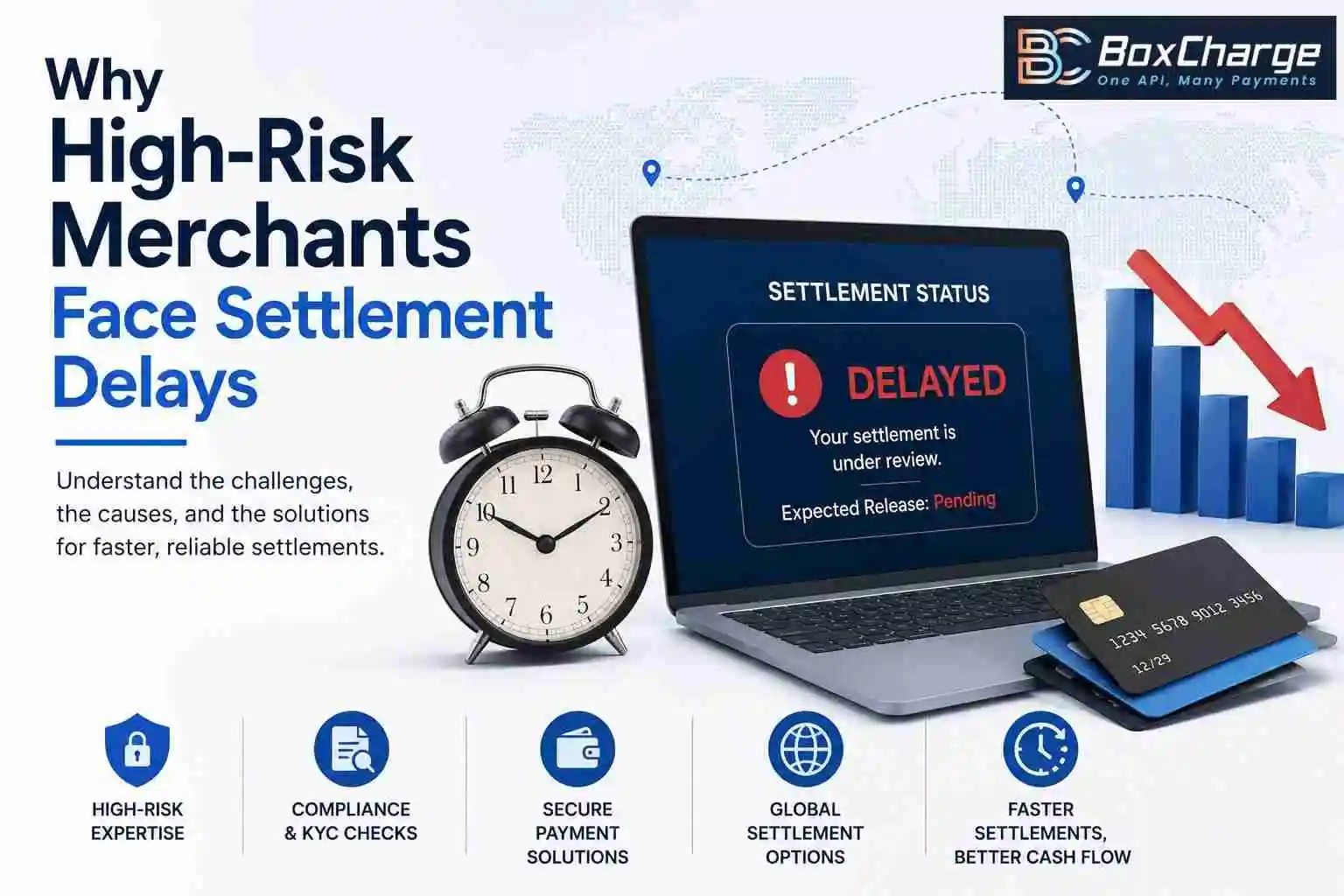
For a high-risk business, getting a transaction approved is only one part of getting paid. The real challenge often begins after the transaction has been processed: when the money needs to reach the business bank account.
A merchant can have strong sales, legitimate customers, and a functioning checkout, yet still face delayed settlements, reserve holds, additional compliance reviews, or unexpected requests for documentation. For businesses operating internationally, the problem can become even more complicated because card processing, acquiring, currency conversion, banking, and settlement are all connected.
This is why high-risk merchant accounts require a different approach to payment infrastructure.
Businesses in forex, iGaming, online subscriptions, digital services, nutraceuticals, travel, and other higher-risk sectors can experience additional scrutiny because of chargeback exposure, regulatory requirements, cross-border transactions, and unusual transaction patterns. BoxCharge's current high-risk payment guidance similarly identifies delayed settlements, rolling reserves, account reviews, and cross-border complexity as recurring issues for high-risk merchants.
For merchants, the question is no longer simply "How do I accept payments?"
It is:
"How do I make sure legitimate revenue moves through the payment and settlement system reliably?"
What Causes Settlement Delays for High-Risk Merchants?
Settlement delays happen when processed funds are not released to the merchant according to the expected settlement schedule.
There isn't one universal reason. A processor, acquirer, bank, or financial institution may delay settlement because of risk controls, compliance requirements, transaction activity, reserves, or operational issues.
Common triggers include:
A sudden increase in processing volume
Higher-than-expected chargebacks
Unusual transaction patterns
Cross-border transactions
Changes in business activity
Compliance reviews
New markets or currencies
Large individual transactions
Refund or dispute activity
Insufficient or outdated business documentation
For a standard merchant, a temporary review may be inconvenient.
For a high-risk merchant, it can become a serious cash-flow problem.
Imagine an online business processing $200,000 or $300,000 a month. The company still has to pay employees, suppliers, advertising platforms, technology providers, refunds, and other operating expenses even when part of its processing revenue is temporarily unavailable.
That is where high-risk payment processing becomes a financial-management issue rather than simply a payment-acceptance issue.
Why High-Risk Merchants Receive More Scrutiny
High-risk classification does not necessarily mean that a business is doing something wrong.
It generally means the acquiring or processing relationship carries a higher potential exposure to financial losses, disputes, fraud, regulatory problems, or cross-border complexity.
The classification can affect:
Processing fees
Reserve requirements
Settlement schedules
Underwriting requirements
Transaction limits
Supported payment methods
Geographic availability
Ongoing account monitoring
BoxCharge's published guidance notes that a merchant's transaction volume, customer geography, chargebacks, business activity, and compliance information can all contribute to additional reviews after approval.
This explains a frustrating experience many merchants encounter.
A business may spend weeks getting approved, process successfully for several months, and then suddenly receive a request asking:
"Why has your transaction volume changed?"
From the merchant's perspective, nothing is wrong. Sales are simply growing.
From the processor's perspective, however, the risk profile may have changed significantly.
The Cash-Flow Problem Behind Settlement Delays
Settlement delays are particularly painful because revenue on a dashboard isn't the same as cash available to operate the business.
Consider a subscription-based merchant.
Customers are paying successfully every day. The payment gateway shows successful transactions. Revenue is increasing.
But if the acquiring relationship introduces a reserve or settlement delay, the merchant may not have access to the same funds immediately.
That can create a dangerous cycle:
Higher sales → higher processing volume → additional scrutiny → delayed settlement → reduced working capital → slower business growth.
This is one reason experienced merchants don't evaluate payment providers solely by transaction fees.
They also examine settlement terms, reserve policies, supported currencies, acquiring relationships, and operational support.
How a High Risk Payment Gateway Can Help
A high-risk payment gateway is designed to connect eligible higher-risk merchants with payment-processing infrastructure capable of handling their specific risk profile.
But merchants should be careful about what "high-risk gateway" actually means.
A gateway by itself does not guarantee faster settlement or prevent an acquiring bank from conducting a review.
The broader infrastructure matters.
A stronger setup can include:
Multiple acquiring relationships
Intelligent transaction routing
Multi-currency processing
Fraud monitoring
Chargeback management
Transaction-level reporting
Recurring billing support
Alternative payment methods
Structured settlement arrangements
BoxCharge currently describes its infrastructure as combining merchant enablement, gateway connectivity, payment orchestration, alternative payment methods, and settlement solutions.
For a growing high-risk merchant, that broader architecture can be more valuable than simply having another checkout page.
Why International Payments Can Make Settlement More Complicated
International commerce introduces another layer of complexity.
A merchant may accept a customer's payment in GBP, process it through an international acquiring relationship, convert it into EUR or USD, and ultimately settle the funds into a business account.
Every additional step can introduce:
Currency conversion
Banking cut-off times
Cross-border fees
Compliance checks
Correspondent-bank dependencies
Reconciliation requirements
Different settlement schedules
This is why businesses expanding across the US, UK, Canada, Australia, and Europe often need to think about settlement infrastructure before international transaction volume becomes substantial.
An international payment setup should be designed around where customers are located, where transactions are acquired, which currencies are accepted, and where the merchant ultimately needs its funds.
Where IBAN Accounts Fit Into the Settlement Process
For businesses operating internationally, an IBAN-enabled account can be an important part of the broader settlement structure.
An IBAN, or International Bank Account Number, is a standardized account identifier used for bank transfers in participating countries. It helps financial institutions identify the receiving account and route transfers correctly.
An IBAN Account for Non-Residents can therefore be relevant to eligible international businesses that need banking or settlement capabilities outside their home market.
Similarly, a Corporate IBAN Account can provide an account structure for eligible businesses receiving and making international transfers.
However, merchants should understand an important distinction:
An IBAN account is not automatically the same thing as a merchant account.
A merchant account is part of the card/payment-acquiring infrastructure, while an IBAN-enabled account is generally used for bank-transfer-based receiving, holding, and sending of funds.
The two can complement each other.
Why IBAN Settlement Matters to High-Risk Businesses
For a business operating internationally, IBAN settlement can provide another route for managing business funds after payment processing.
BoxCharge's current IBAN guidance describes IBAN settlement as part of an international payment infrastructure that can support businesses dealing with cross-border payments, multiple currencies, and settlement requirements.
This becomes especially relevant when merchants need to separate payment acceptance from broader treasury and settlement operations.
For example, an international business might use:
Payment Gateway → Acquirer → Settlement → IBAN Account → Operating Bank Account
The exact structure varies by provider, jurisdiction, and business model, but the principle is important: payment acceptance and settlement are related but separate parts of the financial infrastructure.
Different IBAN Structures for International Businesses
Depending on eligibility and provider capabilities, merchants may encounter several types of IBAN solutions.
Virtual IBAN Account
A Virtual IBAN Account can provide an account identifier associated with an underlying banking or payment structure.
For international businesses, virtual account structures may simplify receiving payments and reconciliation.
However, merchants should always confirm whether the account supports the currencies, countries, transaction types, and business activities they require.
Multi-currency IBAN Account
A Multi-currency IBAN Account can be useful for businesses receiving funds in multiple currencies.
Instead of converting every incoming payment immediately, an eligible multi-currency structure may allow the business to manage supported currencies within the broader account arrangement.
This can potentially simplify international reconciliation and reduce unnecessary currency conversions.
IBAN Account for Fintech Companies
Fintech businesses can have particularly complex payment flows because they may process funds across multiple customers, currencies, jurisdictions, or platforms.
An IBAN Account for Fintech Companies therefore needs to be evaluated based on the company's actual business model and regulatory position.
The important question is not simply whether an IBAN is available.
It is whether the underlying financial institution permits the intended activity.
High-Risk IBAN Accounts: What Merchants Need to Understand
Searches for a High-risk IBAN Account often come from merchants that have already experienced difficulties with traditional banking.
However, an IBAN provider still needs to conduct its own onboarding and compliance checks.
Being classified as high-risk does not mean that a business can bypass KYC, KYB, AML, sanctions screening, or other applicable requirements.
In fact, merchants should expect questions about:
Company ownership
Business activities
Source of funds
Expected transaction volume
Customer geography
Payment flows
Beneficial owners
Website activity
Licensing where applicable
A provider promising an account without meaningful due diligence should therefore be approached cautiously.
Online IBAN Account Opening: What Should Merchants Prepare?
Online IBAN Account opening can make international banking more convenient, but digital onboarding doesn't eliminate underwriting.
Businesses should generally be prepared to provide information such as:
Certificate of incorporation
Proof of business address
Director information
Beneficial-owner details
Identification documents
Business website
Description of business activities
Expected transaction volume
Source-of-funds information
Existing banking or processing information
Having this documentation ready can reduce unnecessary onboarding delays.
It also creates a clearer picture of the business for the financial institution.
IBAN Account for International Business: Is It Worth It?
For an IBAN Account for International Business, the value depends on how the business actually operates.
It can be useful when a company needs to:
Receive international bank transfers
Manage supported currencies
Simplify reconciliation
Make cross-border supplier payments
Separate payment processing from operating funds
Support international settlement flows
But an IBAN account should not be treated as a universal solution to every payment problem.
If the underlying issue is poor card authorization, an IBAN won't fix checkout declines.
If the problem is excessive chargebacks, an IBAN won't replace chargeback management.
If the issue is an acquiring-bank review, the merchant still needs appropriate payment-processing infrastructure.
The strongest strategy is to connect the pieces rather than expecting one account to solve everything.
How Merchants Can Reduce Settlement Delays
There are several practical steps high-risk businesses can take.
1. Keep Processing Data Consistent
If you expect a major increase in volume, communicate with your provider rather than allowing the change to appear unexpectedly.
2. Control Chargebacks
Monitor disputes continuously and identify why customers are challenging transactions.
3. Keep Compliance Documentation Current
Outdated corporate documents or inconsistent business information can create unnecessary friction.
4. Understand Reserve Requirements
Before signing an agreement, ask how reserves are calculated, when funds are released, and what events can change reserve terms.
5. Diversify Payment Infrastructure Where Appropriate
Multiple acquiring connections can reduce dependence on a single payment route when the business and provider structure support it.
6. Separate Payment Acceptance From Settlement Strategy
Your card-processing solution and banking/settlement structure should work together rather than operating as disconnected systems.
What Should High-Risk Merchants Ask Before Choosing a Provider?
Before selecting high-risk payment processing, don't stop at:
"What is your processing rate?"
Ask:
What is the expected settlement cycle?
Are reserves required?
What triggers a settlement review?
Which acquiring banks support my industry?
Can I process multiple currencies?
Which countries are supported?
How are chargebacks monitored?
Can transaction volume scale?
Are IBAN settlement solutions available?
Can the infrastructure support international bank transfers?
What happens if transaction volume changes significantly?
How are compliance reviews handled?
These questions can reveal whether a payment provider is actually equipped for your business.
Building a More Reliable Settlement Strategy
The biggest mistake high-risk merchants make is treating settlement as something that happens automatically after payment approval.
It doesn't.
The entire payment ecosystem influences settlement: merchant underwriting, acquiring, transaction risk, chargebacks, compliance, currencies, banking relationships, and business activity.
For merchants operating internationally, combining appropriate high-risk payment processing with suitable banking and settlement infrastructure can create a more resilient financial operation.
An eligible business may, depending on its requirements, evaluate solutions involving a Corporate IBAN Account, Virtual IBAN Account, Multi-currency IBAN Account, or specialized IBAN payment settlement arrangement alongside its merchant-processing infrastructure.
The exact structure should always be based on the business's jurisdiction, activities, currencies, transaction flows, and compliance requirements.
Final Thoughts
Settlement delays are one of the most frustrating problems facing high-risk merchants because they can turn successful sales into unavailable working capital.
A merchant may have excellent products, growing customer demand, and healthy transaction volumes, yet still struggle when funds are held because of reserves, compliance reviews, chargebacks, unexpected transaction growth, or cross-border complexity.
The solution isn't simply to find a processor that promises the fastest payout.
It is to build a payment and settlement infrastructure designed around the business's actual risk profile.
BoxCharge provides IBAN and settlement solutions for high-risk payment processing, global merchant services, payment orchestration, and cross-border payment connectivity. Its current infrastructure is positioned around international merchants that need payment acceptance and settlement capabilities working together.
The right setup can help merchants move from constantly asking "Where is my money?" to having a clearer, more predictable view of how transactions move from customer payment to final settlement.
And for a high-risk business, that predictability isn't just convenient.
It is part of the infrastructure required to grow.