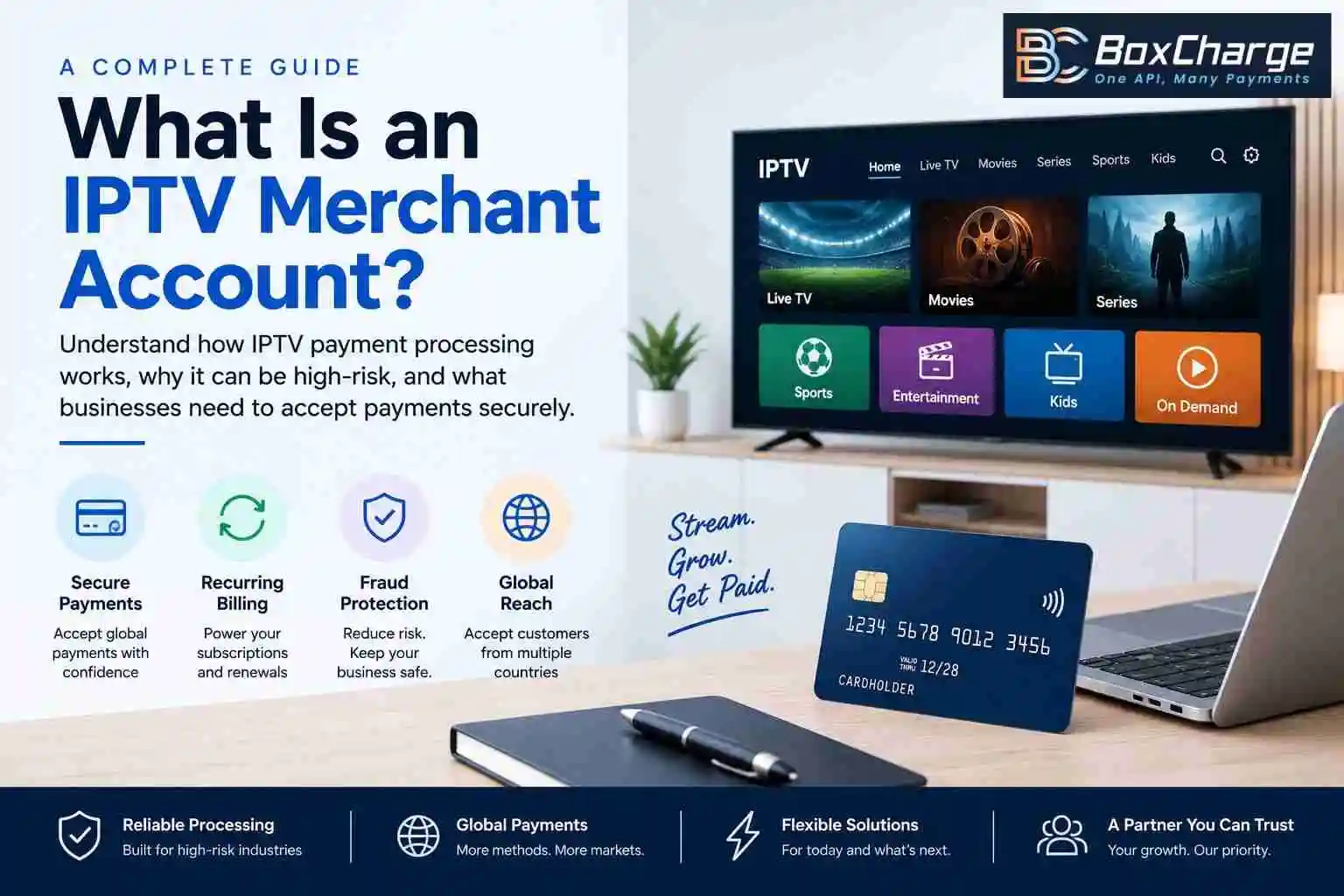
An IPTV merchant account is a specialized payment-processing setup that allows an eligible IPTV business to accept card and other electronic payments from customers for television and video services delivered over the internet. Unlike a conventional e-commerce merchant account, an IPTV payment setup may require closer attention to subscription billing, recurring transactions, chargebacks, customer geography, content rights, and the merchant's overall risk profile.
The term IPTV stands for Internet Protocol Television, meaning television or video content is delivered using Internet Protocol rather than traditional broadcast, satellite, or cable delivery. Cisco defines IPTV as video transport over IP and describes applications such as digital broadcast television and video on demand.
For legitimate IPTV providers, payment acceptance can become a significant operational issue. Customers expect subscriptions to renew smoothly, payments to work across countries, and failed transactions to be resolved quickly. Meanwhile, some payment providers apply additional underwriting to businesses whose models involve digital content, recurring billing, or higher dispute exposure.
That is where understanding IPTV merchant account services becomes important.
What Is an IPTV Merchant Account?
An IPTV merchant account is a business payment account arranged through an acquiring bank or payment processor to enable an IPTV provider to accept customer payments.
Depending on the business model, the payment setup can support:
Credit and debit card payments
Recurring IPTV subscriptions
One-time purchases
Multi-currency transactions
Online checkout payments
Alternative payment methods
Refunds
Chargeback management
Fraud monitoring
3D Secure authentication
International customer payments
It is important to understand that IPTV is a technology, not automatically an illegal or high-risk business category. IPTV can be used by legitimate broadcasters, telecom companies, content distributors, streaming services, and other businesses that have the appropriate rights to distribute their content.
The payment risk comes from the business model and transaction profile, not simply from the fact that a company uses IPTV technology.
Is IPTV Considered a High-Risk Business?
There is no universal rule that every IPTV provider is automatically high risk.
However, some IPTV businesses can face greater scrutiny from payment processors because of factors such as recurring subscriptions, elevated chargeback exposure, international customer bases, digital content disputes, unclear business models, or concerns about intellectual-property rights.
This distinction matters.
A licensed IPTV platform distributing content under valid agreements may have a very different risk profile from an operation selling access to television channels or sports content without the necessary authorization.
Payment providers can also have their own prohibited and restricted-business policies. For example, Stripe states that businesses selling or distributing licensed materials without appropriate authorization are prohibited from using its services, and it separately notes that some restricted categories require additional due diligence.
Therefore, an IPTV provider should never assume that a payment processor will approve its business simply because the company is legally registered.
Why IPTV Businesses Can Struggle With Payment Processing
For an IPTV provider, payment processing problems can directly affect recurring revenue.
Imagine a customer subscribes to a legitimate IPTV service for $25 per month. The first payment succeeds, but the next renewal fails because of an expired card, issuer decline, fraud screening, or processor restriction.
Multiply that situation across hundreds or thousands of subscribers and the merchant can quickly experience revenue leakage.
1. Chargebacks and Subscription Disputes
Recurring billing can create disputes when customers forget about a subscription, fail to recognize the billing descriptor, misunderstand cancellation terms, or claim that a service was not delivered as expected.
Digital services can be particularly challenging because there is no physical product being shipped to demonstrate fulfillment.
An effective IPTV payment gateway therefore needs more than basic authorization. Merchants should consider transaction records, customer communication, cancellation processes, refund policies, authentication, and dispute-management procedures.
2. Payment Account Restrictions
High-risk or higher-scrutiny merchants sometimes discover that their payment provider has limitations that were not obvious during onboarding.
A provider may ask for additional documentation, information about the business model, proof of licensing, customer acquisition details, expected transaction volumes, or evidence supporting the merchant's right to distribute its content.
Stripe's current policies illustrate why this matters: some restricted businesses may require additional review, while businesses involving illegal products or services are not eligible.
3. International Transactions
Many IPTV services target customers across multiple countries.
That creates additional payment considerations, including:
Currency conversion
Cross-border card acceptance
Local payment methods
International fraud patterns
Different consumer expectations
Regional compliance requirements
Settlement currencies
A provider looking for international IPTV payment processing should therefore evaluate whether its payment infrastructure can support its actual customer geography.
4. Recurring Payment Failures
For subscription-based IPTV businesses, recurring payments are fundamental.
A merchant may acquire a customer successfully but still lose revenue if renewal transactions repeatedly fail.
This is why IPTV subscription payment processing should include mechanisms for handling expired cards, soft declines, retries, authentication requirements, refunds, and cancellations.
The goal is not simply to process the first transaction. It is to maintain a reliable payment relationship throughout the customer lifecycle.
What Features Should an IPTV Merchant Account Have?
The right setup depends on the business model, but several features can be particularly useful.
Recurring Billing
If customers pay monthly, quarterly, or annually, recurring billing should be a core capability.
The merchant should be able to manage subscription cycles, renewals, failed transactions, refunds, cancellations, and payment-method updates without creating unnecessary manual work.
Multi-Currency Processing
For IPTV providers serving international customers, accepting major currencies can reduce friction during checkout.
A global payment infrastructure can also help merchants separate authorization, currency conversion, and settlement requirements more effectively.
Fraud Prevention
IPTV merchants should take fraud seriously because digital services can be targeted by stolen payment credentials, account abuse, automated transactions, and friendly-fraud claims.
An effective IPTV payment processing solution may incorporate tools such as:
3D Secure
Velocity controls
Transaction monitoring
Address verification
Card security checks
Device or behavioral signals
Geographic rules
Chargeback monitoring
The challenge is finding the right balance.
Overly aggressive fraud rules can reject genuine customers, while insufficient controls can increase fraud and chargebacks.
Clear Settlement Terms
Merchants should understand exactly how and when they receive their money.
Before opening an IPTV merchant account, ask about:
Settlement timeframes
Settlement currencies
Processing fees
Chargeback fees
Refund handling
Reserve requirements
Transaction limits
Cross-border costs
A low advertised processing rate is not particularly useful if the merchant later faces unpredictable reserves or settlement restrictions.
Why Content Licensing Matters to IPTV Payment Processing
One of the most important issues in IPTV payments is content authorization.
The IPTV technology itself does not determine whether a service is legitimate. The critical question is whether the business has the appropriate rights to distribute the television programming, films, sports, or other copyrighted material it sells.
UK government guidance on copyright explains that protected material generally requires permission, a licence, acquisition of the relevant rights, or a valid copyright exception.
Government guidance on illicit streaming also makes an important distinction: streaming technology and devices can be used legitimately, but using them to access television programmes, films, or subscription sports content without the required authorization or subscription can constitute illicit streaming.
For payment providers, this distinction matters because intellectual-property risk can become financial and reputational risk.
Stripe, for example, explicitly prohibits sales or distribution of licensed materials without appropriate authorization and also prohibits services that infringe third-party intellectual-property rights.
Therefore, legitimate IPTV businesses should be prepared to demonstrate their content rights during payment underwriting when requested.
What Documents May Be Required for an IPTV Merchant Account?
Underwriting requirements vary between providers, but an IPTV business may be asked for documentation such as:
Company registration documents
Identity information for beneficial owners
Business website
Terms and conditions
Privacy policy
Refund and cancellation policy
Description of the IPTV service
Expected monthly processing volume
Average transaction value
Customer geography
Bank account information
Content licensing or distribution agreements where applicable
Previous processing statements
Chargeback history
Being prepared can make the application process considerably smoother.
One of the biggest mistakes merchants make is providing a vague description such as "online TV service" when the provider actually needs to understand the exact products, customers, countries, billing structure, and content rights involved.
IPTV Merchant Account vs. Standard Merchant Account
The difference is not necessarily that every IPTV business needs a completely different type of bank account.
Rather, the payment-processing arrangement and underwriting requirements may be different.
A standard online retailer might sell physical products with a straightforward one-time transaction. An IPTV provider may operate recurring subscriptions, sell digital access, process international transactions, and face higher levels of customer disputes.
Feature | Standard E-commerce Merchant Account | IPTV Merchant Account |
One-time card payments | Usually supported | Usually required |
Recurring billing | Optional/common | Often essential |
Digital services | Sometimes | Core business model |
International payments | Depends on provider | Often important |
Chargeback management | Important | Particularly important |
Content-rights review | Usually limited | May be important |
Fraud controls | Standard | Often requires stronger controls |
Underwriting | Standard business review | May require additional business information |
Multi-currency | Provider dependent | Often valuable |
Subscription management | Provider dependent | Frequently essential |
The important point is that an IPTV merchant account is not automatically a workaround for payment restrictions. A merchant still needs to meet the acquiring bank's, processor's, card network's, and applicable regulatory requirements.
How High-Risk IPTV Merchants Can Improve Payment Stability
Merchants operating in higher-risk segments should focus on reducing the factors that make processors uncomfortable.
That starts with transparency.
The provider should clearly explain what customers are buying, where the content comes from, how subscriptions work, how customers cancel, and how refunds are handled.
Strong operational practices can include:
Use clear billing descriptors. Customers should recognize the business name appearing on their statements.
Make cancellation simple. Difficult cancellation processes can contribute to disputes and chargebacks.
Maintain accurate customer records. Transaction, authentication, communication, and service records can be valuable during disputes.
Monitor chargebacks. A sudden increase should be investigated rather than treated as an unavoidable cost of doing business.
Keep licensing documentation organized. Legitimate content rights should be easy to demonstrate when required.
Avoid misleading marketing. Claims about channels, sports events, movies, pricing, or access should accurately reflect what the customer receives.
Do not hide the business model. Attempting to disguise an IPTV business during payment onboarding can create greater problems later.
How to Choose an IPTV Payment Gateway
When evaluating best IPTV merchant account providers, merchants should look beyond transaction fees.
Ask:
Q: Does the provider support my exact IPTV business model?
Q: Can it process recurring subscription payments?
Q: Which countries and currencies are supported?
Q: What payment methods are available?
Q: What documentation is required during underwriting?
Q: Are content licensing documents required?
Q: How are chargebacks handled?
Q: Are reserves or rolling reserves required?
Q: What are the settlement timelines?
Q: What happens if transaction volume increases significantly?
Q: Does the gateway support 3D Secure and fraud monitoring?
Q: Are there restrictions on specific types of digital content?
These questions can reveal whether a provider is genuinely suitable or simply advertising generic online payment processing.
What About an IPTV Merchant Account With Instant Approval?
Searches for an IPTV merchant account with instant approval are understandable, particularly for merchants that have already experienced account closures or lengthy underwriting.
However, businesses should be cautious about providers promising guaranteed approval without reviewing the business.
A legitimate payment relationship requires the processor and acquiring partners to understand the merchant's activities and risk profile.
Fast onboarding can be valuable. Guaranteed approval regardless of business model, content rights, transaction history, or jurisdiction is a different matter.
For a legitimate IPTV company, transparency is generally a better long-term strategy than attempting to find a processor willing to overlook important information.
Final Thoughts
So, what is an IPTV merchant account?
It is a payment-processing arrangement designed to help an eligible IPTV provider accept customer payments, often including recurring subscriptions and international transactions, while addressing the specific operational and risk considerations associated with digital video services.
IPTV itself is simply a method of delivering television or video through Internet Protocol. The important distinction is whether the provider has the necessary rights to distribute its content and whether its business model meets the requirements of its payment partners.
For high-risk IPTV merchants, payment processing can be frustrating. Declined transactions, chargebacks, recurring-payment failures, reserves, account restrictions, and additional underwriting can all affect revenue and customer retention.
The solution is not to treat every IPTV company as high risk or to search for a processor that ignores underwriting. Instead, merchants should build a transparent payment operation around legal content distribution, reliable subscription billing, fraud prevention, clear customer policies, and appropriate acquiring relationships.
For legitimate IPTV businesses evaluating their payment infrastructure, BoxCharge can be considered as part of a broader review of merchant-account and payment-processing requirements. The right setup should ultimately be based on the company's business model, target markets, transaction profile, content rights, and long-term payment requirements.
The strongest IPTV payment strategy is not simply the one that gets a merchant account approved—it is the one that can continue supporting legitimate transactions as the business grows. Contact BoxCharge