International Payment Processing

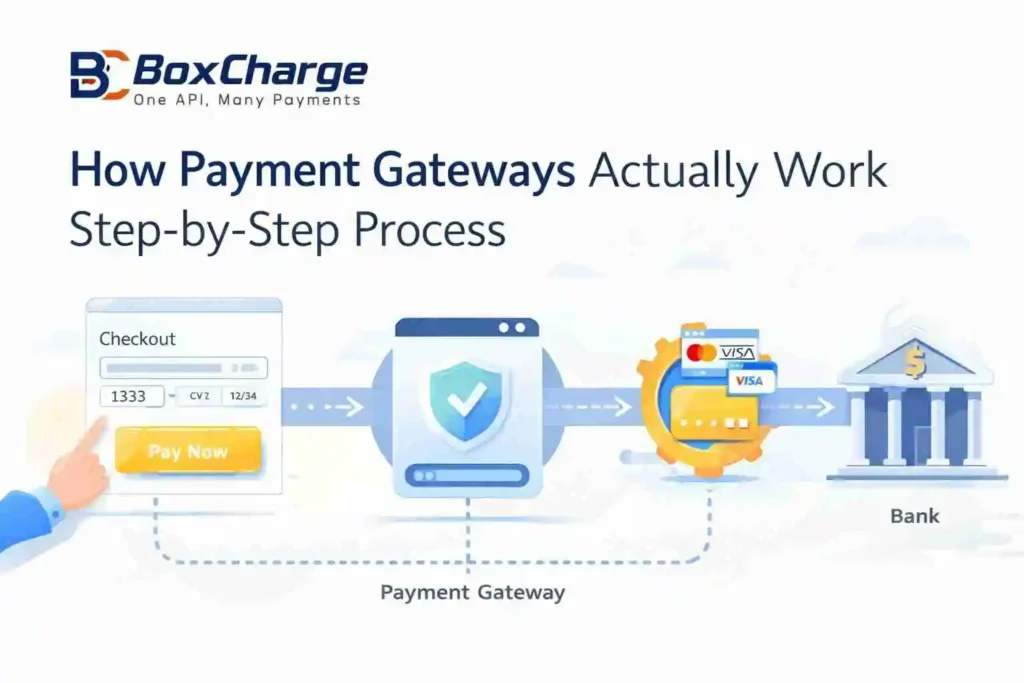
How payment gateways work step by step from customer checkout to bank approval and payment settlement process
International Payment Processing

How Payment Gateways Actually Work: Step-by-Step Process

If you run an online business, you’ve probably had this moment—A customer is ready to pay… and the transaction just fails. No clear reason. No warning. Just gone. That’s usually where the payment gateway comes in—or more accurately, where things start to break. Most guides explain this in a very technical way. Let’s keep it simple and real instead. So, what is a payment gateway? At its core, a payment gateway is just the system that moves payment information from your website to the bank and brings back an approval or decline. That’s it. But inside those few seconds, there’s a chain of checks happening—security, fraud, bank rules, risk scoring—all stacked on top of each other. And if you’re in a high-risk space, those checks get stricter. What actually happens when someone pays you Let’s walk through it as it happens in real life. Step 1: Someone clicks “Pay” The customer enters their card details. Could be debit, credit, wallet—doesn’t matter. At this point, your checkout already plays a role.If it looks slow or sketchy, people drop off before anything even starts. Step 2: The data gets locked (encrypted) Before anything moves, the payment gateway encrypts the data. This is where things like PCI DSS compliance come in. It’s basically making sure sensitive card details aren’t exposed. You don’t see this part—but it’s critical. Step 3: It gets passed to the processor Now the request moves to the payment processor. Think of this as the courier. It doesn’t decide anything—it just passes the request along to the right places. Step 4: Card networks step in The request hits networks like Visa or Mastercard. They don’t approve or reject either—they route it to the customer’s bank. Step 5: The bank makes the call This is the moment that actually matters. The bank checks: And then… approve or decline. If you’re using a high-risk merchant account, this is where things often go wrong. Step 6: Response comes back The decision travels all the way back to your site. The whole thing usually takes 2–5 seconds.Feels instant—but a lot is happening in between. Step 7: The money doesn’t arrive instantly Even after approval, the money isn’t in your account yet. It goes through a settlement process, which can take a couple of days. For high-risk businesses, sometimes longer. Why high-risk merchants struggle more than others Now let’s talk about the part most blogs avoid. If you’re in forex, gaming, subscription billing, or similar industries, you’ve probably noticed this already. Payments fail more often. Accounts get flagged faster. Here’s why. 1: Banks don’t trust the category easily Some industries are labeled “high-risk” by default. So even if your business is clean, the system treats it cautiously. That affects your payment processing from day one. 2: Chargebacks hurt more than you think A few disputes here and there might not seem like a big deal. But for banks, chargeback management is a major signal. Cross a certain threshold, and approvals start dropping. Quietly. 3: Fraud filters can be too aggressive This one’s frustrating. Legitimate customers get declined because the system thinks something is off. High-risk businesses deal with this more because filters are tighter. 4: Fewer options, more dependency Not every merchant account provider works with high-risk industries. So you’re often stuck relying on limited gateways. If one fails, everything slows down. 5: Global payments make it worse If you’re dealing with international customers, things get even more complicated. Different regions, currencies, rules—it all adds friction to your online payment processing. What this looks like in real life You’re getting traffic. People are clicking. They want to pay. But: At first, it feels like a marketing issue. Most of the time, it’s not. It’s the payment gateway setup. What actually helps There’s no magic fix, but a few things make a noticeable difference. 1: Use a gateway that supports high-risk properly Not just “accepts” it—but is built for international high-risk payment processing. There’s a difference. 2: Don’t rely on a single route If all transactions go through one path, you’re exposed. Smart routing helps distribute risk and improve approvals. 3: Clean up your checkout Simple things: They reduce drop-offs more than people expect. 4: Pay attention to decline patterns Most businesses ignore this. But decline codes tell you exactly where things are breaking in your payment system. 5: Keep chargebacks under control This isn’t just about refunds—it directly impacts approvals. Better communication with customers helps more than complex tools. Where most businesses mess this up Honestly, it’s usually not complicated mistakes. It’s things like: These things add up quietly. Final thought A payment gateway isn’t just a technical tool sitting in the background. It directly decides: And if you’re in a high-risk space, it matters even more. Understanding how it works doesn’t fix everything overnight—but it helps you stop guessing. And that alone puts you ahead of most businesses dealing with the same problem.

How Payment Gateways Actually Work: Step-by-Step Process Read Post »

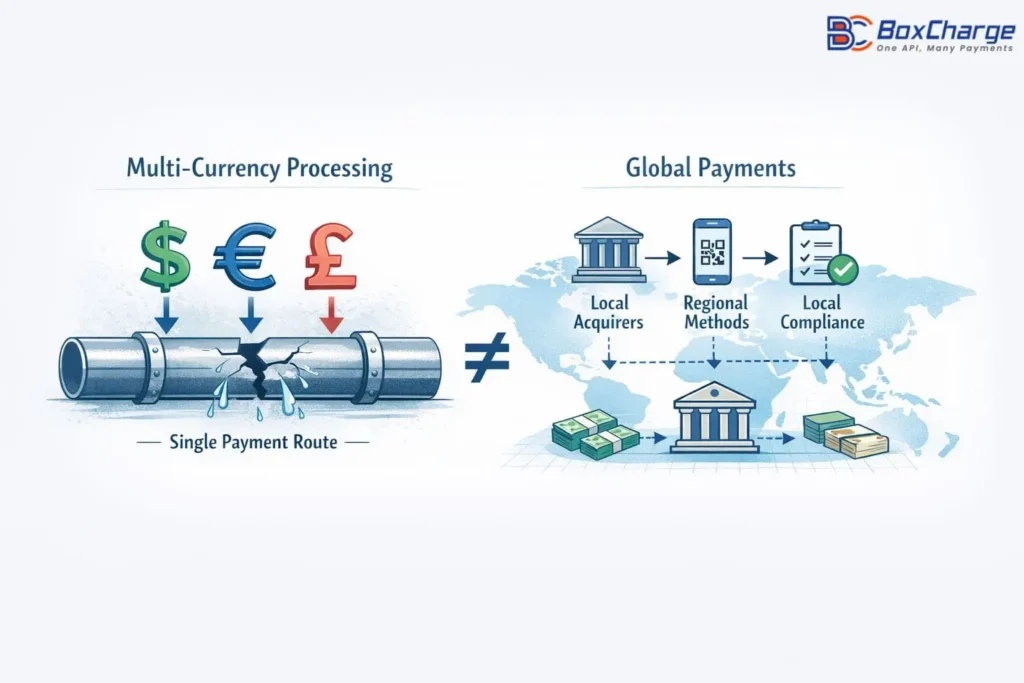
Multi-currency processing vs global payments comparison
International Payment Processing

Multi-Currency Processing Isn’t Global Payments — Here’s Why It Still Fails at Scale

Many online businesses believe that once they enable multi-currency processing, they are “global-ready.” Prices show in local currency, customers feel comfortable at checkout, and everything appears optimized for international sales. But in reality, multi-currency processing is not the same as global payments. For e-commerce brands, SaaS platforms, subscription businesses, and high-risk merchants, relying on currency conversion alone often leads to payment failures, unstable revenue, and declining approval rates. This is why global businesses increasingly shift toward payment diversification strategies and alternative payment methods—not as a trend, but as a stability layer. This guide explains why multi-currency processing falls short, why payment methods fail, and what businesses must do to achieve true payment stability in e-commerce. What Multi-Currency Processing Actually Does (and Doesn’t Do) Multi-currency processing allows customers to pay in their local currency while the merchant settles in a base currency. It improves transparency and reduces confusion at checkout. However, it does not solve deeper payment infrastructure problems, such as: This is why businesses still experience high decline rates even when they support dozens of currencies. Currency ≠ infrastructure. Why Payment Methods Fail Even with Multi-Currency Enabled If customers can pay in local currency, why do transactions still fail? Because most failures happen after currency selection. Here are the real reasons why payment methods fail: 1. Transactions Are Still Processed Cross-Border Even when a customer pays in their local currency, the transaction may be routed through a foreign acquiring bank. Issuer banks detect this mismatch and decline the payment. 2. Card Networks Apply Regional Risk Filters Visa and Mastercard apply different risk thresholds depending on geography. High-risk verticals, digital goods, and subscriptions are especially affected. 3. Local Payment Preferences Are Ignored In many markets, cards are not the primary payment method. When businesses rely only on cards, they miss large segments of buyers. 4. Single-Processor Dependency One gateway, one acquirer, one failure point. When routing fails, revenue stops. This is why multi-currency alone cannot reduce payment failures at scale. Payment Stability in E-commerce Requires More Than Currency Options Payment stability, which ecommerce businesses depend on, comes from resilience—not presentation. A stable payment system must handle: Multi-currency setups lack redundancy. When something breaks, there is no fallback. This is where alternative payment methods importance becomes clear. Alternative Payment Methods Are a Stability Layer, Not an Add-On Alternative payment methods (APMs) are no longer optional for global businesses. They are a core part of a payment diversification strategy. Examples include: APMs reduce dependence on card networks and dramatically improve authorization rates in many regions. More importantly, they keep revenue flowing when cards fail. Payment Diversification Strategy: The Real Difference Maker A payment diversification strategy spreads transaction risk across: This approach helps businesses: Global businesses don’t ask, “How many currencies do we support?”They ask, “How many ways can customers successfully pay?” Why Global Payments Are an Infrastructure Problem, Not a UX Problem Multi-currency processing focuses on the user interface.Global payments focus on backend execution. True global payment infrastructure includes: Without this, businesses face hidden decline risks—even with a polished checkout experience. A Realistic Scenario (What Actually Happens) Consider a subscription-based ecommerce business selling digital services across Europe and Asia. They support EUR, GBP, and USD. Prices look local. Customers convert well. But behind the scenes: The business assumes the issue is fraud or customer behavior.In reality, the problem is a lack of global payment infrastructure. How Businesses Can Reduce Payment Failures Globally To reduce payment failures, global businesses should: This layered approach improves long-term payment stability, especially for high-risk industries. Multi-Currency vs Global Payments (Quick Snapshot) Understanding this distinction prevents costly scaling mistakes. Why High-Risk and Subscription Businesses Feel This First High-risk merchants, adult businesses, streaming platforms, gaming sites, and subscription-based services face stricter issuer scrutiny. For these businesses: This makes payment diversification strategy and alternative payment methods essential—not optional. Where boxcharge Fits In Boxcharge works with global and high-risk merchants to design resilient international payment infrastructure, not just currency support. By combining: Businesses gain stability, scalability, and higher lifetime value. Frequently Asked Questions 1: Are alternative payment methods safer than card payments? Alternative payment methods are not universally safer, but they reduce reliance on card networks and issuer approvals, improving overall payment stability. 2: Do alternative payment methods reduce payment failures? Yes. In many regions, alternative payment methods significantly reduce payment failures by aligning with local payment behavior. 3: Is multi-currency processing enough for global ecommerce? No. Multi-currency processing does not address acquiring, routing, or compliance issues that cause international payment declines. 4: Why do payment methods fail even when customers pay in local currency? Because transactions are often processed cross-border, triggering issuer bank risk checks despite local currency pricing. 5: Are alternative payment methods required for global businesses? For scalable global operations, alternative payment methods are essential to maintain payment stability and approval rates. Final Thought: Currency Is Just the Surface Multi-currency processing helps customers understand prices.It does not guarantee successful payments. For businesses serious about global expansion, payment stability ecommerce-wide comes from infrastructure, diversification, and adaptability—not currency symbols. If your business is experiencing unexplained declines, failed subscriptions, or regional inconsistencies, the issue isn’t currency. It’s how your payments are built.

Multi-Currency Processing Isn’t Global Payments — Here’s Why It Still Fails at Scale Read Post »

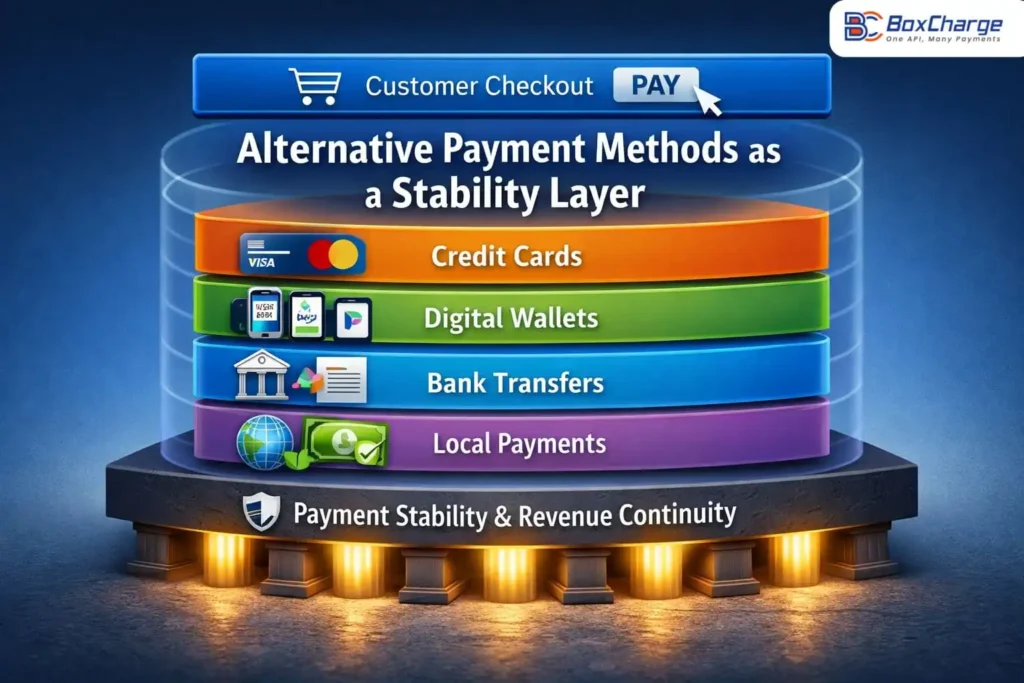
Alternative payment methods create payment stability for online businesses
International Payment Processing

Alternative Payment Methods Are a Stability Layer, Not a Trend

Online payments are no longer just about speed or convenience. For modern digital businesses, especially those operating globally or in regulated sectors, payment stability has become a core operational requirement. This is where the importance of alternative payment methods becomes clear. They are not a passing trend or optional add-on. They function as a stability layer that protects revenue, reduces payment failures, and ensures business continuity when traditional payment rails fail. The Growing Importance of Alternative Payment Methods Card payments still dominate many markets, but relying on a single payment method exposes businesses to unnecessary risk. Declines, compliance blocks, issuer restrictions, and regional limitations can interrupt revenue without warning. The importance of alternative payment methods lies in their ability to diversify payment acceptance. When cards fail, wallets, bank transfers, local payment methods, or account-to-account solutions keep transactions flowing. For e-commerce businesses, SaaS platforms, and subscription models, this diversification is no longer optional — it is foundational. Why Payment Methods Fail More Often Than Businesses Expect Understanding why payment methods fail is essential to building a resilient payment stack. Common failure points include: These failures often occur without any issue on the customer’s side. From their perspective, the checkout simply “doesn’t work.” This is why businesses that rely only on cards experience higher abandonment and revenue leakage. Payment Stability in E-commerce Depends on Diversification Payment stability in e-commerce is not achieved by optimizing a single gateway. It is achieved through a payment diversification strategy. A diversified setup distributes transaction risk across multiple rails: If one method fails, another succeeds — silently and instantly. This redundancy is what turns payment infrastructure from a fragile system into a resilient one. Payment Diversification Strategy: Designing for Continuity A strong payment diversification strategy is proactive, not reactive. Instead of waiting for declines to rise or accounts to be reviewed, businesses design their checkout to support multiple payment options from day one. Key benefits include: Diversification is not about offering “more choices.” It is about engineering reliability. How Alternative Payment Methods Reduce Payment Failures One of the biggest advantages of alternative payment methods is their ability to reduce payment failures caused by card-specific limitations. For example: By spreading transaction volume across multiple rails, businesses dramatically reduce the impact of any single failure point. This directly improves approval rates and customer experience. Alternative Payment Methods as a Stability Layer When viewed strategically, alternative payment methods sit beneath the checkout experience as a stability layer. They: This is why forward-thinking businesses no longer ask whether they need alternative payment methods — they ask how many and how well integrated they should be. Global Expansion Makes Payment Diversification Essential As businesses expand internationally, payment complexity increases. Different regions prefer different methods. Cards may dominate in one market but underperform in another. Without local payment options, approval rates drop, and customer trust erodes. A diversified payment stack enables: This is where alternative payment methods move from “nice to have” to mission-critical. Subscription Models Depend on Payment Stability Recurring revenue models are especially vulnerable to payment failures. Expired cards, issuer rejections, or network disruptions can silently cancel subscriptions. Alternative payment methods protect recurring revenue by providing: For subscription-based businesses, payment stability is directly tied to lifetime value. Why Stability Matters More Than Trends Trends come and go. Infrastructure decisions last. Businesses that treat alternative payment methods as a trend often adopt them too late — after declines rise, accounts are flagged, or growth stalls. Those who treat them as a stability layer build resilient systems that scale without disruption. Frequently Asked Questions 1: Are alternative payment methods safer than cards? In many cases, yes. Bank-based and push payment methods reduce fraud exposure and chargebacks compared to traditional card transactions. 2: Do alternative payment methods reduce payment declines? Yes. They bypass many issuer and network-level decline reasons, helping reduce payment failures across regions. 3: Are alternative payment methods required for global businesses? For global e-commerce and subscription businesses, they are increasingly essential to maintain approval rates and payment stability. Final Thoughts The conversation is no longer about trends. It is about resilience. The importance of alternative payment methods lies in their ability to stabilize revenue, reduce payment failures, and future-proof businesses against an increasingly complex payment landscape. For e-commerce, subscription platforms, and global merchants, alternative payment methods are not an upgrade — they are a foundation.

Alternative Payment Methods Are a Stability Layer, Not a Trend Read Post »

Scroll to Top