Accept payment online is no longer just a convenience for businesses; it is a fundamental requirement for selling products, delivering services, and reaching customers across different markets. From subscription platforms and e-commerce stores to forex brokers, gaming businesses, and other high-risk industries, the ability to collect payments securely can directly influence revenue, customer trust, and long-term growth.
However, accepting online payments is not equally straightforward for every business. While a conventional retailer may be able to open a payment processing account with relative ease, a high-risk merchant can face additional underwriting checks, higher processing fees, rolling reserves, delayed settlements, and even sudden account restrictions.
The real challenge is not simply finding a way to accept card payments. It is finding a payment infrastructure that supports the business model, manages transaction risk, and remains reliable as the company grows.
For businesses evaluating online payment processing solutions, understanding how payment gateways, merchant accounts, acquiring banks, and fraud-prevention systems work together is an important first step.
What Does It Mean to Accept Payment Online?
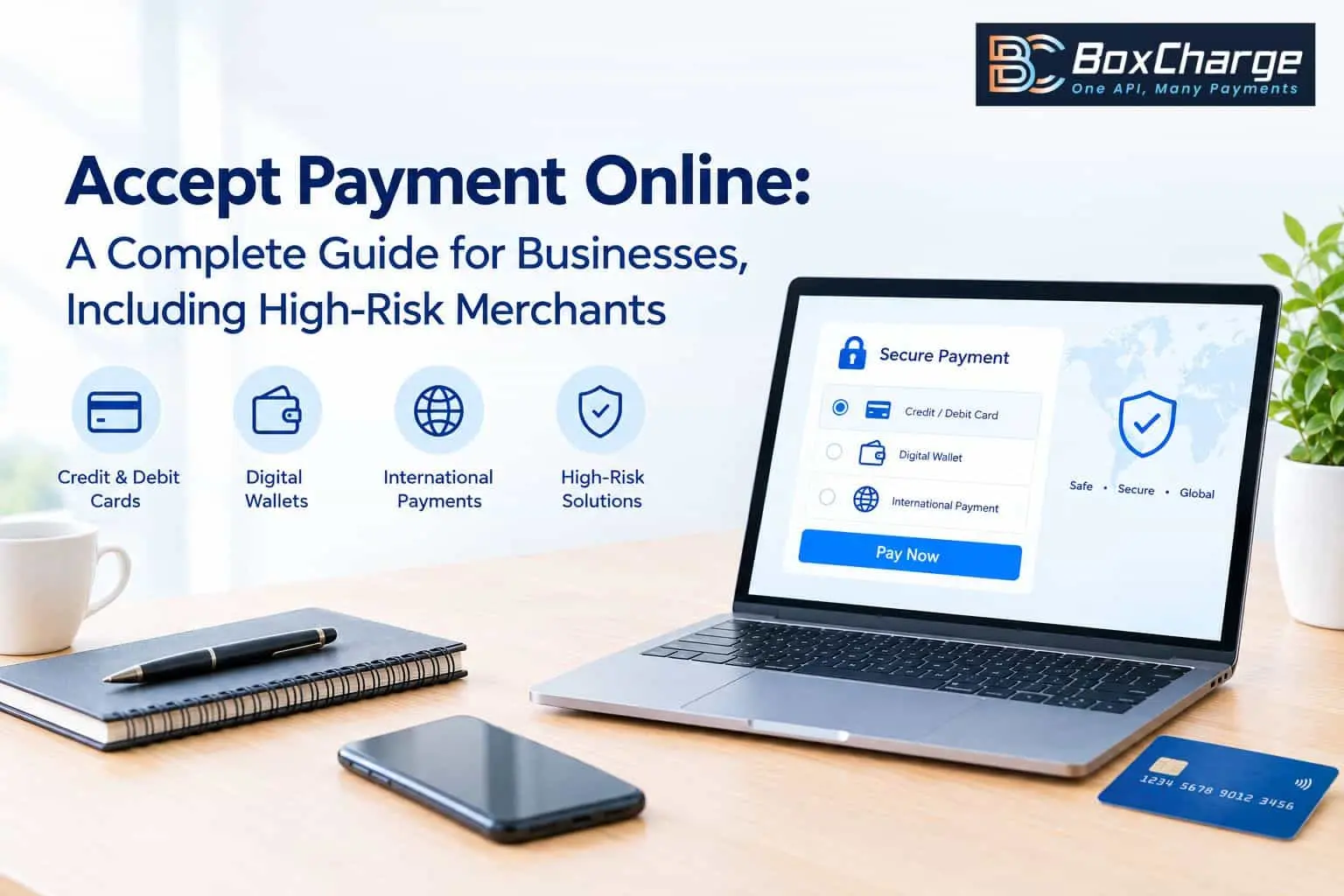
To accept payment online means allowing customers to pay for products or services through a website, mobile application, payment link, subscription page, or another digital checkout method.
Depending on the business and its location, available options may include:
Credit and debit cards: Widely used for e-commerce, digital services, and recurring payments.
Digital wallets: Options such as Apple Pay and Google Pay, where supported, can simplify checkout.
Bank transfers: Useful for certain business-to-business transactions, larger payments, and markets where bank-based payments are common.
Payment links: Allow businesses to collect payments without building a complete online checkout.
Recurring payments: Help subscription businesses collect scheduled payments, subject to customer authorization and applicable requirements.
Local payment methods: Can make checkout more familiar to customers in specific countries.
The right combination depends on the target market, average transaction value, customer preferences, regulatory obligations, and the merchant's risk profile.
The Federal Reserve's Payments Study provides useful research on noncash payment trends, including card payments and alternative payment methods. Its findings reinforce why businesses should consider payment preferences and transaction types when designing their checkout experience.
How Does Online Payment Processing Work?
Online payment processing involves several connected systems. Understanding their roles helps merchants evaluate providers more effectively.
1. The customer initiates payment: The customer selects a product or service and enters payment details or chooses an available digital payment method.
2. The payment gateway securely transmits the request: The gateway connects the checkout interface with the payment processing infrastructure. Depending on the setup, it may support encryption, tokenization, authentication, and fraud screening.
3. The processor and acquiring partners route the transaction: The transaction is sent through the relevant payment network to the card issuer or other payment provider for authorization.
4. The transaction receives a decision: The issuer or relevant payment system approves or declines the request. Approval does not guarantee that the transaction can never be disputed or reversed.
5. Settlement and payout follow: Approved transactions move through clearing and settlement processes. The merchant receives funds according to the provider's payout schedule, less applicable fees, reserves, refunds, or other adjustments.
These stages are related but distinct. A gateway may provide the checkout connection without being the acquiring bank, while a payment service provider may combine several functions under one service.
For merchants, this distinction matters because a provider's ability to accept a transaction, its authority to approve a merchant account, and the timing of payouts are separate considerations.
Why High-Risk Merchants Struggle to Accept Payment Online
High-risk merchants often face additional scrutiny because of their industry, transaction characteristics, expected disputes, regulatory exposure, or financial history. Classification varies by provider, payment network, jurisdiction, and business model.
A business being classified as high-risk does not automatically mean it is illegitimate. It means the acquiring partner may assess its potential exposure differently.
1. Limited access to suitable merchant accounts
Some mainstream payment providers restrict particular industries or decline businesses whose risk profiles do not fit their underwriting criteria.
This creates a practical problem for merchants in sectors such as online gaming, adult services, forex, travel, subscription services, and certain nutraceutical or research-product categories. Businesses may spend considerable time applying for accounts only to discover that their industry is unsupported.
The solution is not to conceal the business model. Merchants should seek a payment provider or acquiring partner that explicitly supports their specific activity and can explain its underwriting requirements.
2. Higher processing fees and reserve requirements
High-risk merchants may encounter higher transaction fees, account setup costs, monthly minimums, chargeback-related expenses, and rolling reserves.
A rolling reserve is an agreed portion of processing revenue withheld temporarily to cover potential refunds, disputes, or other liabilities. Its percentage, duration, release schedule, and conditions vary by agreement.
These arrangements can place considerable pressure on cash flow. A merchant may record strong sales but have less working capital available for inventory, advertising, payroll, or supplier payments.
Businesses should therefore compare the total cost of acceptance, not just the advertised transaction rate.
3. Chargebacks and transaction declines
Chargebacks can arise when customers dispute transactions, fail to recognize billing descriptors, claim non-delivery, or challenge recurring charges. Fraudulent card use and customer confusion can also contribute to disputes.
High-risk merchants may be especially exposed when customers have recurring billing arrangements, services are delivered over time, or transaction values are relatively high.
A high decline rate creates another problem. Legitimate customers may be unable to complete purchases, while overly permissive controls can increase fraud exposure.
Effective payment processing requires a balance between fraud prevention and conversion. Clear billing descriptors, transparent refund policies, reliable customer support, accurate transaction data, and appropriate authentication can help merchants manage these competing priorities.
4. Delayed settlements and unexpected restrictions
Settlement delays can create operational uncertainty, particularly when a business depends on daily cash flow.
Merchants may face additional reviews when transaction volumes change sharply, refund levels rise, or processing activity differs significantly from the original underwriting profile. In some cases, providers may impose restrictions or terminate an account under their contractual terms.
Before signing an agreement, merchants should ask how reserves are calculated, which events can trigger a review, how payout delays are communicated, and what happens to outstanding balances if an account closes.
5. Cross-border payments and compliance
Businesses selling internationally need to consider currency conversion, cross-border fees, local payment preferences, customer authentication, and country-specific restrictions.
High-risk merchants may face additional documentation requirements, including evidence of business registration, ownership, licenses where applicable, product details, refund policies, and proof of fulfillment.
These requirements are not merely administrative hurdles. They help payment partners evaluate the legitimacy of the business, understand its customers, and determine whether its transactions can be supported within applicable rules.
How to Choose the Right Online Payment Processing Solution
The best payment solution is not necessarily the one with the lowest fees or the largest list of supported payment methods. It is the one that fits the merchant's business model, risk profile, operational requirements, and target markets.
Evaluation factor | What merchants should check |
Industry acceptance | Is the exact business activity supported in the intended countries? |
Total processing cost | What are the transaction fees, fixed charges, reserves, and dispute fees? |
Settlement terms | How often are payouts made, and under what conditions can they be delayed? |
Payment methods | Are the methods customers actually use supported? |
Fraud management | Are authentication, transaction monitoring, and dispute tools available? |
Integration | Does the solution work with the existing website, platform, or billing system? |
Customer support | Can the merchant obtain timely help with failed payments and account reviews? |
Scalability | Can the setup accommodate higher volumes and new markets, subject to approval? |
A written comparison of these factors can reveal differences that a simple fee comparison misses.
For example, a provider offering a lower processing rate may have reserve terms that tie up more working capital. Another provider may support the merchant's industry but lack the local payment methods needed for expansion.
Merchants should request a complete fee schedule and written terms before committing to a provider.
Security and Compliance When You Accept Payment Online
Payment security is essential for every merchant, regardless of transaction volume or industry classification. A payment system that converts well but exposes customer information can create financial, legal, and reputational problems.
The PCI Security Standards Council (PCI SSC) publishes the Payment Card Industry Data Security Standard (PCI DSS), which establishes baseline technical and operational requirements for protecting payment account data.
Businesses should consider the following safeguards:
Secure checkout: Use reputable payment technology and protect payment information during transmission.
Tokenization: Where supported, replace sensitive card details with tokens to reduce the need to handle raw card data.
Fraud monitoring: Identify unusual transaction patterns and apply proportionate risk controls.
Authentication: Use appropriate customer verification measures, including additional authentication where required or supported.
Transparent policies: Publish clear terms, cancellation procedures, refund policies, and recurring billing disclosures.
Ongoing compliance: Understand which PCI DSS obligations apply to the business and verify the security responsibilities of third-party providers.
Importantly, outsourcing payment processing does not automatically remove every merchant responsibility. PCI SSC explains that merchants must still understand their compliance obligations and ensure their providers protect payment data appropriately. Its merchant security resources offer practical guidance on choosing vendors and maintaining a secure payment environment.
High-risk merchants should also confirm that their products, services, advertising practices, and transaction flows comply with their provider's terms and applicable laws. No payment gateway can guarantee fraud-free transactions or eliminate the possibility of account restrictions.
How to Start Accepting Payments Online: A Practical Checklist
For businesses planning to introduce or improve online payment acceptance, the following process provides a practical starting point.
Define your business model: Document what you sell, how customers pay, whether billing is recurring, your average transaction value, and the countries you serve.
Confirm industry eligibility: Ask prospective providers whether they support your exact business category, products, sales channels, and geographic markets.
Prepare underwriting documents: Depending on the provider and jurisdiction, these may include business registration, identity verification, ownership information, bank details, website terms, refund policies, and fulfillment evidence.
Compare commercial terms: Review transaction fees, setup costs, reserves, payout schedules, chargeback fees, and termination conditions.
Integrate and test checkout: Verify successful payments, declined transactions, refunds, cancellations, customer notifications, and reconciliation reports before launch.
Monitor performance after launch: Track authorization rates, checkout abandonment, chargebacks, refunds, settlement timing, and the reasons transactions fail.
This process helps businesses avoid a common mistake: choosing a payment provider based on initial convenience without evaluating whether the arrangement will remain suitable as transaction volumes increase.
Why BoxCharge Is Worth Considering for High-Risk Payment Needs
For businesses that struggle to secure suitable payment processing, finding a provider that understands their operating model is an important part of the evaluation process.
BoxCharge is a relevant option for merchants researching payment solutions for higher-risk business categories. Businesses can explore BoxCharge to discuss their payment processing requirements and assess whether an appropriate solution is available for their industry, operating countries, and transaction profile.
Before proceeding, merchants should confirm industry eligibility, acquiring arrangements, supported payment methods, pricing, reserve conditions, settlement schedules, and compliance requirements directly with the provider.
The objective is not simply to open a merchant account. It is to establish a payment setup that supports legitimate transactions, offers clear commercial terms, and aligns with the company's long-term operational needs.
Frequently Asked Questions
Q. How can I accept payment online for my business?
You can accept payments online through a payment gateway, merchant account, payment service provider, hosted checkout, or payment link. The appropriate setup depends on your business model, target market, preferred payment methods, and eligibility requirements.
Q. Can high-risk businesses accept credit card payments online?
Yes. Some acquiring banks and payment providers support eligible high-risk businesses. Approval depends on factors such as the industry, business model, location, transaction history, compliance documentation, and the provider's underwriting policies.
Q. What is the difference between a payment gateway and a merchant account?
A payment gateway connects the checkout experience to payment processing infrastructure. A merchant account is an account arrangement used to facilitate card-payment acceptance and settlement. Some providers bundle these functions, while others rely on separate partners.
Q. Why are online payments declined?
Payments may be declined because of insufficient funds, incorrect payment details, issuer security controls, authentication failures, suspected fraud, unsupported cards, or processor restrictions. Merchants should examine decline codes and transaction data rather than assuming every decline indicates fraud.
Q. How much does it cost to accept payments online?
Costs vary by provider, payment method, country, transaction value, and risk category. Potential charges include per-transaction fees, fixed processing charges, monthly fees, cross-border costs, chargeback fees, and rolling reserves. Request a complete fee schedule before choosing a solution.
Q. How can high-risk merchants reduce payment processing problems?
Merchants can improve payment operations by selecting an appropriately matched provider, maintaining accurate business documentation, using proportionate fraud controls, communicating billing terms clearly, responding promptly to disputes, and monitoring transaction performance.
Q. Is online payment processing secure?
It can be designed to provide strong security, but no system is risk-free. Merchants should use appropriate payment security controls, reputable providers, secure checkout technology, and applicable PCI DSS compliance processes.
Conclusion: Accept Payment Online With a Strategy Built for Growth
To accept payment online successfully, businesses need more than a checkout button. They need a reliable combination of payment technology, suitable acquiring arrangements, transparent commercial terms, effective risk management, and a customer experience that makes completing a transaction straightforward.
For high-risk merchants, the decision requires even greater care. Limited provider access, higher fees, rolling reserves, chargebacks, settlement uncertainty, and compliance requirements can all affect the ability to operate profitably.
The strongest approach is to evaluate payment partners against the actual needs of the business rather than focusing on headline pricing alone. By prioritizing industry compatibility, security, settlement transparency, and scalability, merchants can make better-informed decisions about their payment infrastructure.
If your business is looking for ways to accept payment online, contact BoxCharge and discuss your requirements to determine whether its payment solutions are suitable for your business model.