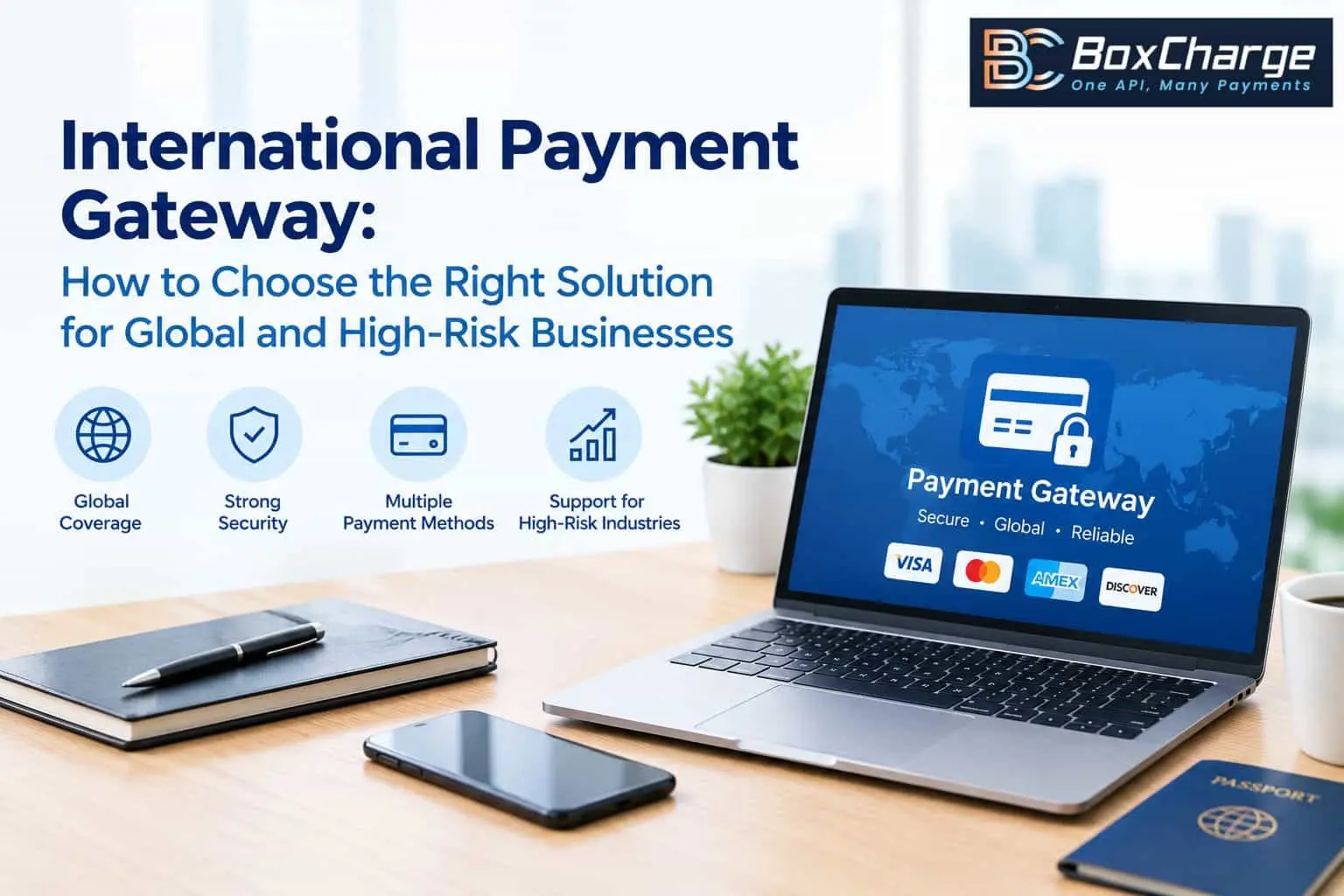
An international payment gateway helps businesses accept payments from customers in different countries, process transactions across currencies, and provide a smoother checkout experience. For growing companies, the right gateway can support global expansion. For high-risk merchants, however, choosing a payment provider involves much more than accepting Visa or Mastercard.
Businesses operating in industries such as online gaming, forex, adult entertainment, subscription services, travel, and certain digital products often face additional scrutiny from payment providers. They may encounter higher processing fees, rolling reserves, delayed settlements, restrictive transaction limits, or sudden account reviews that interrupt cash flow.
For these businesses, an international payment gateway must do more than process payments. It should support cross-border transactions, accommodate the merchant's risk profile, offer transparent settlement terms, and help maintain payment continuity as the business grows.
This guide explains how international payment gateways work, what businesses should evaluate before choosing a provider, and why high-risk merchants need a payment infrastructure designed around their operational requirements.
What Is an International Payment Gateway?
An international payment gateway is a technology service that securely transmits payment information between a customer, a merchant's website or application, and the payment processing ecosystem. It enables businesses to accept payments from customers in different countries using supported payment methods and currencies.
Depending on the provider and acquiring arrangements, an international payment gateway may support:
Cross-border credit and debit card payments.
Multi-currency pricing and payment acceptance.
International payment processing and settlement.
Alternative payment methods, such as digital wallets and local payment options.
Fraud screening, transaction monitoring, and authentication tools.
Recurring billing for subscriptions and membership businesses.
Integration with ecommerce platforms, billing systems, and payment APIs.
A gateway is not necessarily the same as a merchant account or payment processor. The gateway transmits transaction information, while the acquiring bank or payment processor facilitates authorization and processing. A merchant account, where required, enables a business to receive card-payment proceeds under the provider's agreed terms.
Some providers combine these services into a single offering, while others require merchants to arrange them separately.
The key distinction: an international payment gateway provides the technical infrastructure for accepting payments across borders, but the merchant's acquiring arrangements determine important factors such as supported business categories, processing limits, settlement terms, and risk requirements.
Why Businesses Need an International Payment Gateway
Expanding into international markets can increase revenue, but it also introduces new payment challenges. Customers may use different currencies, issue cards through different banks, and expect familiar payment methods at checkout.
A business selling to customers in the United Kingdom, Australia, the United States, or the European Union needs a payment setup that works across its target markets without creating unnecessary friction.
1. Accept Payments From International Customers
An international payment gateway helps businesses accept eligible payments from overseas customers, subject to the provider's supported markets, card schemes, acquiring arrangements, and risk policies.
For ecommerce brands, SaaS companies, digital service providers, and subscription businesses, broader payment acceptance can make international expansion more practical.
2. Improve the Checkout Experience
A complicated checkout can cause customers to abandon their purchases. Clear pricing, familiar payment methods, responsive checkout pages, and appropriate authentication can help reduce friction.
Visa's guide Optimize Your Cross-Border Ecommerce Payment Acceptance, discusses cross-border payment considerations, transaction disclosures, and the customer experience.
Merchants should also explain currency conversion and any applicable taxes or additional charges clearly before customers complete their purchases.
3. Manage Multiple Currencies
Multi-currency payment acceptance allows customers to pay in supported currencies, while the merchant may receive settlement in a different currency.
Before choosing a provider, businesses should establish:
Which transaction currencies are supported.
Which currencies are available for settlement.
How foreign exchange conversion is calculated.
Whether conversion and cross-border fees apply.
How refunds and chargebacks are handled when exchange rates change.
A gateway advertising multi-currency support does not necessarily provide settlement in every currency. Confirm the exact arrangement in the provider's commercial terms.
4. Support Business Growth Across Markets
A payment solution that works for a small domestic business may not suit a company processing transactions across several countries.
Growing merchants need reliable reporting, integrations, recurring billing, fraud controls, and a clear process for handling payment disputes. They should also understand whether transaction limits, reserve requirements, or additional underwriting apply as processing volumes increase.
Why High-Risk Merchants Struggle to Find the Right Payment Gateway
For high-risk businesses, choosing an international payment gateway can be significantly more difficult than it is for a conventional retailer.
Payment providers assess risk based on factors such as the merchant's industry, transaction patterns, expected chargebacks, customer location, delivery model, regulatory exposure, and financial history. Some business categories require specialist underwriting or acquiring arrangements.
A merchant can have a legitimate business, genuine customers, and a functioning website yet still struggle to secure suitable payment processing.
1. Merchant Account Rejections and Restricted Access
Industries such as online gambling, forex trading, adult entertainment, and certain subscription-based services may face stricter underwriting requirements. Some providers do not support these categories at all.
Repeated applications can waste time and delay expansion. Businesses may also struggle to identify whether a rejection relates to their industry, jurisdiction, ownership structure, documentation, or transaction profile.
The practical solution is to seek an international payment gateway provider that explicitly reviews the merchant's business category and target markets. Approval must still be subject to underwriting, compliance checks, and the provider's risk appetite.
2. High Processing Fees and Rolling Reserves
High-risk merchants may face higher processing costs, rolling reserves, or other risk-related financial conditions.
A rolling reserve generally means that an agreed percentage of processing proceeds is withheld for a specified period to cover potential refunds, disputes, and other liabilities. The percentage, release schedule, and applicable conditions vary by agreement.
These arrangements can create serious cash-flow pressure. A merchant may have sales revenue recorded in its dashboard but lack immediate access to the full amount needed to pay advertising costs, suppliers, staff, or affiliate commissions.
When comparing high-risk merchant account providers, businesses should request a written breakdown of processing fees, reserve percentages, release periods, settlement schedules, chargeback fees, and termination conditions.
3. Sudden Account Reviews and Payment Interruptions
A rapid increase in transaction volume, a change in customer geography, unusual refund activity, or a rise in disputed transactions may trigger a payment provider's review.
For a high-risk merchant, a review can mean additional documentation, delayed payouts, reduced processing limits, or suspension of payment acceptance, depending on the circumstances and contract.
This creates a difficult operational situation: customers may still be ready to purchase, but the business cannot reliably predict when funds will become available.
Merchants should choose providers with clear escalation procedures, defined communication channels, and transparent policies for account reviews. They should also maintain sufficient working capital to manage reasonable settlement delays.
4. Chargebacks, Fraud, and False Declines
High-risk merchants can face a challenging combination of fraudulent transactions, friendly fraud, legitimate customer disputes, and issuer declines.
Overly aggressive fraud screening can reject genuine customers, while insufficient controls can increase financial losses and chargeback exposure.
A capable international payment gateway should support suitable fraud screening, transaction monitoring, authentication options, and dispute reporting. Merchants should evaluate these tools against their own risk profile rather than assuming that more restrictive screening is always better.
Useful controls include clear billing descriptors, accurate product descriptions, transparent cancellation terms, accessible customer support, and prompt refund handling.
5. Limited Support for International Expansion
A payment provider may accept a merchant's domestic transactions but decline payments from certain countries or card types. Another may support international cards but impose restrictions on settlement currencies or business locations.
For high-risk account holders, these limitations can undermine expansion plans after a website, marketing campaign, or regional launch is already underway.
Before signing an agreement, merchants should confirm their eligible countries, supported payment methods, settlement destinations, currency options, and any restrictions tied to their industry.
How to Choose the Best International Payment Gateway for Your Business
The best international payment gateway is not necessarily the one with the lowest advertised transaction fee. It is the solution that fits the merchant's business model, target markets, risk category, technical requirements, and cash-flow needs.
Use the following criteria when evaluating providers.
Evaluation factor | What to check |
International acceptance | Eligible countries, card types, and payment methods |
High-risk underwriting | Whether the provider accepts your specific industry and business model |
Pricing | Processing fees, cross-border costs, FX charges, and additional fees |
Settlement | Payout frequency, settlement currencies, reserve terms, and withdrawal restrictions |
Fraud prevention | Risk scoring, authentication, monitoring, and dispute tools |
Integration | APIs, hosted checkout, ecommerce plugins, and recurring billing |
Reporting | Transaction-level data, reconciliation, refunds, and chargeback visibility |
Support | Availability, escalation process, and assistance during payment disruptions |
Compliance | Applicable security standards, regulatory obligations, and data protection requirements |
Compare the Total Cost, Not Just the Transaction Rate
Suppose two providers offer different processing rates. One charges a lower transaction fee but has higher currency conversion costs, additional cross-border charges, and a less favourable reserve arrangement. The other charges a higher headline rate but offers settlement terms that better fit the merchant's working-capital cycle.
The lower advertised rate may not result in the lower overall cost.
Compare the total cost of processing using your expected transaction volume, average order value, international sales mix, refund rate, and likely currency conversions. Request a written quotation based on your actual business profile.
Verify the Provider and Its Commercial Terms
Businesses should establish which legal entity supplies each part of the service, who holds or settles funds, and which contractual terms govern disputes, reserves, and termination.
In the UK Financial Conduct Authority (FCA) explains how consumers can check payment service providers and understand how their money is protected. The FCA also provides a Financial Services Register for checking relevant firms and permissions.
A provider's registration or authorisation should be checked against the actual service offered and the applicable jurisdiction. It should not be treated as a blanket guarantee of merchant approval or business suitability.
International Payment Gateway Security and Compliance Requirements
Security and regulatory compliance should be central to every payment infrastructure decision, especially for businesses processing international transactions or operating in higher-risk sectors.
PCI DSS and Payment Data Protection
The Payment Card Industry Data Security Standard (PCI DSS) establishes security requirements for entities that store, process, or transmit payment card data, as well as certain systems that can affect the security of that data.
Merchants should understand their compliance responsibilities even when using a third-party gateway. Hosted checkout solutions can reduce direct exposure to cardholder data, but they do not automatically eliminate every compliance obligation.
Read the official PCI Security Standards Council website for information about payment card security requirements.
Strong Customer Authentication for European Payments
Businesses serving customers in the European Economic Area should evaluate the authentication requirements applicable to their transactions.
Under the European Union's revised Payment Services Directive (PSD2), Strong Customer Authentication (SCA) applies to specified electronic payment situations, subject to applicable exemptions. The exact requirements depend on the transaction and regulatory framework.
The European Commission's PSD2 resources provide official information about the regulatory framework.
A gateway supporting appropriate authentication flows can help merchants address these requirements, but businesses should confirm the provider's capabilities and their own compliance responsibilities.
Fraud Monitoring and Transaction Transparency
International merchants should look for risk-management tools that help identify suspicious activity without unnecessarily disrupting legitimate purchases.
Useful features may include transaction velocity checks, device and location signals, 3-D Secure support, configurable risk rules, and dispute monitoring. Their availability and effectiveness depend on the provider and implementation.
Businesses should also maintain accurate records of customer consent, orders, delivery or service fulfilment, refunds, and customer communications. These records can support dispute management and help demonstrate responsible operating practices.
Which Businesses Should Consider an International Payment Gateway?
An international payment gateway may be useful for a range of business models, although eligibility varies by provider.
Ecommerce businesses: Companies selling physical products across borders need dependable payment acceptance, refund handling, and currency support.
SaaS and subscription businesses: Recurring billing, payment retries, and account-updater capabilities can help manage ongoing customer payments.
Forex and financial services businesses: These merchants may require specialist acquiring arrangements, with approval dependent on the precise service, licensing status, and jurisdiction.
Online gaming businesses: Gaming operators need providers that assess their specific activities and support the relevant jurisdictions and payment flows.
Adult entertainment businesses: Merchants may need specialist high-risk payment processing, with clear policies covering permitted content, age verification where applicable, and compliance obligations.
Travel and other advance-payment businesses: Long fulfilment periods can create additional refund, dispute, and reserve considerations.
For each category, merchants should obtain explicit confirmation that the provider accepts their particular business model. A gateway's general international capabilities do not establish that every industry or country is supported.
How BoxCharge Can Help Businesses Explore Payment Processing Options
Businesses searching for an international payment gateway should assess their payment requirements before committing to a provider. This is particularly important for high-risk merchants, where an unsuitable agreement can affect cash flow, customer experience, and long-term growth.
BoxCharge can be considered as a starting point for businesses exploring merchant account and payment processing options. Merchants evaluating BoxCharge should discuss their industry, business registration, target countries, expected monthly processing volume, average transaction value, and settlement requirements to determine whether a suitable arrangement is available.
Before proceeding, request clarity on:
Whether your business category and operating jurisdictions are supported.
Which international cards and payment methods can be accepted.
The full pricing structure, including reserves and cross-border fees.
Expected settlement schedules and any restrictions on payouts.
Available fraud prevention, reporting, and integration features.
The documentation required for underwriting and ongoing reviews.
No payment provider can guarantee approval, uninterrupted processing, or specific settlement terms without assessing the merchant and agreeing to the relevant conditions.
Looking for an international payment gateway for a high-risk business? Contact BoxCharge to explore payment processing options and discuss your business requirements. The goal is to find a solution that supports international growth while keeping payment costs, risk controls, and cash-flow expectations clear.
Frequently Asked Questions
Q: What is the best international payment gateway?
The best international payment gateway depends on your target countries, currencies, business category, transaction volume, integration requirements, and settlement needs. High-risk merchants should prioritise providers that explicitly support their industry and offer transparent commercial terms.
Q: Can a high-risk business get an international payment gateway?
Yes, some providers specialise in high-risk payment processing. Approval depends on the merchant's industry, jurisdiction, compliance status, financial profile, transaction history, and the provider's underwriting criteria.
Q: Can an international payment gateway accept multiple currencies?
Many gateways support payments in multiple currencies, but supported transaction currencies and settlement currencies may differ. Merchants should confirm foreign exchange rates, conversion fees, and settlement options before signing an agreement.
Q: What fees should businesses compare?
Businesses should review transaction fees, cross-border charges, currency conversion costs, monthly fees, chargeback fees, refund costs, reserve requirements, and other contractual charges. Comparing total processing costs gives a more realistic picture than comparing headline rates alone.
Q: Is an international payment gateway the same as a merchant account?
No. A gateway transmits payment information, while a merchant account provides the relevant arrangement for receiving card-payment proceeds where required. Some providers combine gateway, processing, and merchant account services into one offering.
Q: How can high-risk merchants reduce payment disruptions?
Merchants can improve operational resilience by maintaining accurate transaction records, monitoring chargebacks, using appropriate fraud controls, providing clear refund policies, and maintaining adequate working capital. They should also understand reserve terms, account-review procedures, and the process for resolving payment issues.
Conclusion
The best international payment gateway provider can help businesses reach customers across borders, support multiple currencies, and build a checkout experience suited to international growth. But the right solution must offer more than basic transaction acceptance.
For high-risk merchants, the real challenge is finding a provider whose underwriting policies, settlement arrangements, fraud controls, and technical capabilities match the business's needs. Unclear fees, restrictive account terms, delayed payouts, and unsuitable risk controls can undermine growth even when customer demand is strong.
By comparing providers carefully, reviewing contractual conditions, and preparing for the compliance requirements of each target market, businesses can make better-informed payment infrastructure decisions.
For merchants considering their next stage of expansion, choosing the right international payment gateway is not simply a payment technology decision; it is a decision about operational stability, customer experience, and sustainable growth.