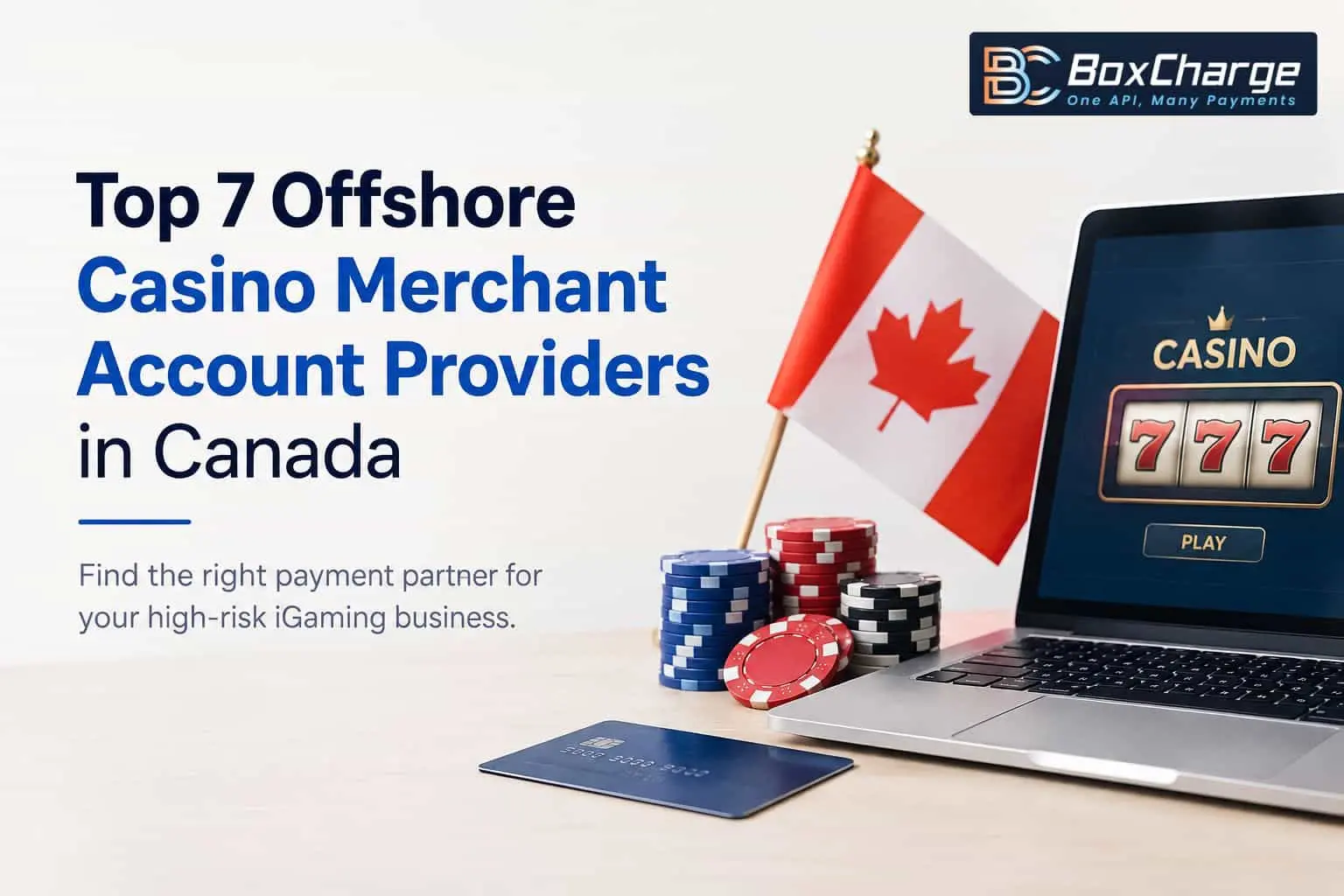
Offshore casino merchant account providers in Canada are becoming an important consideration for online casino operators that need international payment acceptance, reliable settlements, multi-currency processing, and better control over payment risk.
Running an online casino in Canada is not simply about attracting players. The real challenge often begins when those players try to deposit money.
A casino can have a strong brand, a licensed operation, excellent customer support, and consistent traffic—and still lose revenue because a payment gets declined, a merchant account is placed under review, or settlements are delayed.
This is why casino merchant accounts, offshore payment processing, gambling payment gateways, and high-risk merchant account solutions deserve serious attention before an operator scales into new markets.
For this comparison, the following seven names are worth researching: BoxCharge, WebPays, PayCly, Amald, Inquid, PayPal, and Wise. Their suitability is not identical, however. High-risk operators should always confirm licensing, jurisdiction, acquiring availability, underwriting requirements, and gambling-sector eligibility before applying.
Why Canadian Casino Merchants Struggle With Payment Processing
Online gambling is treated differently from conventional eCommerce because the payment risk is fundamentally different.
Casino transactions can involve frequent deposits, withdrawals, international customers, card-not-present payments, bonus abuse, account takeovers, chargebacks, and unusual transaction patterns.
A merchant may therefore encounter:
Declined applications
Sudden payment restrictions
Rolling reserves
Delayed settlements
High processing costs
Low card approval rates
Cross-border payment declines
Limited payment methods
Difficult chargeback management
Additional compliance reviews
The frustrating part is that these problems can happen even when the casino itself is legitimate.
A compliant operator may still be classified as high risk because of the nature of gambling transactions. BoxCharge's own casino merchant account guidance highlights high transaction volumes, international payments, chargebacks, fraud exposure, and regulatory differences as major reasons casino businesses receive additional scrutiny.
That is why choosing an online casino payment processing partner should happen before payment problems start—not after the first account termination.
1. BoxCharge
BoxCharge is particularly relevant for Canadian operators looking for high-risk payment infrastructure built around gambling and iGaming requirements.
Its casino payment solutions are positioned around areas such as high-risk merchant accounts, payment gateway integration, international processing, fraud controls, 3D Secure, tokenization, chargeback management, and multi-currency payments.
For an offshore casino operator, the important advantage is not simply being able to accept cards. The larger question is whether the payment architecture can continue functioning as transaction volume and geographic coverage increase.
A growing casino may need different acquiring relationships, alternative payment methods, smart routing, and stronger fraud screening as its customer base expands.
BoxCharge's payment infrastructure includes merchant accounts, gateways, payment orchestration, alternative payment methods, smart routing, 3DS, tokenization, and fraud controls.
Potential fit: Online casinos, iGaming operators, sportsbooks, poker platforms, and other eligible high-risk gaming businesses.
What to verify: Licensing requirements, supported Canadian corridors, settlement currencies, reserves, transaction limits, chargeback thresholds, and acquiring jurisdictions.
2. WebPays
WebPays is another name appearing in the high-risk payment processing space, with a focus on international and gaming-related payment infrastructure.
Its published business profile identifies casino, gambling, gaming, and betting among the sectors it targets, alongside payment gateway and high-risk merchant account services.
For casino operators, the attraction of an international payment provider is generally the ability to build payment flows around different customer regions rather than relying entirely on one domestic processing route.
That becomes increasingly important when a Canadian casino serves customers across multiple markets.
WebPays also promotes multi-currency processing, alternative payment methods, international payment infrastructure, and high-risk payment support.
However, merchants should perform thorough due diligence before committing funds or signing an agreement. Public third-party reviews include both positive and serious negative claims, including complaints about upfront fees and service delivery. Those claims are allegations from reviewers rather than verified findings, but they are still a reason for merchants to conduct proper commercial and compliance checks before onboarding.
Potential fit: International high-risk merchants and gaming operators seeking alternative payment infrastructure.
What to verify: Acquirer identity, Canadian eligibility, complete fee schedule, reserve policy, settlement timing, contract terms, and whether the proposed setup is genuinely appropriate for licensed casino activity.
3. PayCly
PayCly focuses heavily on high-risk merchant accounts and industry-specific payment processing, including casino and gambling businesses.
Its casino merchant account offering describes support for multiple payment methods and currencies, international processing, dedicated merchant IDs, fraud prevention, and chargeback controls.
This type of specialization matters because gambling businesses do not necessarily fit the risk models used for ordinary online retail.
PayCly also describes its gambling payment infrastructure as supporting card-not-present transactions, e-wallets, multiple currencies, and international payment processing.
For an operator expanding beyond Canada, multi-currency processing can be commercially important. Customers are more likely to complete deposits when the checkout experience supports familiar payment methods and currencies.
At the same time, casino operators should not evaluate a provider simply by looking at the advertised number of currencies or payment methods.
The more important questions are:
Where is the transaction acquired? Who underwrites the merchant? What jurisdictions are supported? How are reserves calculated? What happens if chargebacks increase?
Those answers determine whether the payment solution can actually support long-term casino growth.
Potential fit: Online casino and gambling businesses looking for specialized high-risk payment processing.
What to verify: Canadian market availability, licensing requirements, acquiring partners, settlement schedule, reserve requirements, and chargeback procedures.
4. Amald
Amald positions itself as a merchant service provider serving both conventional and high-risk businesses, including casino, gambling, online gaming, lottery, and other higher-risk categories.
Its published casino solution highlights 3D Secure and non-3D Secure payment processing, multiple currencies, and high-risk payment gateway infrastructure.
Amald also describes support for payment gateways, credit card processing, alternative payment methods, high-risk merchant accounts, multi-MID arrangements, and fraud prevention tools.
For casino businesses, multi-MID capability can be worth examining because relying on one processing relationship can expose a growing operator to significant continuity risk.
Imagine a casino spending heavily on advertising in Canada, finally building a strong player base, and then experiencing payment disruption because its only processor changes its risk appetite.
The resulting problem is bigger than a few declined cards. Deposits fall, players leave, support tickets increase, withdrawal pressure grows, and the operator's acquisition costs effectively become harder to recover.
Potential fit: High-risk casino and gaming merchants looking for international acquiring and merchant account options.
What to verify: Acquiring-bank relationships, MID structure, Canadian availability, reserve terms, settlement timing, and compliance documentation.
5. Inquid
Inquid is a newer high-risk payment infrastructure provider with a dedicated iGaming and casino offering.
Its published iGaming solution specifically targets online casinos, sportsbooks, lotteries, and gaming platforms, with features including multi-currency acquiring, dedicated gaming MIDs, AI-based fraud controls, 3D Secure 2.2, chargeback tools, and international processing.
The company also promotes offshore and onshore merchant account structures, local acquiring and payment routing for gaming businesses.
This is relevant to casino operators because payment performance can vary considerably between customer markets.
A transaction that works well through one acquiring route may perform poorly through another. Local acquiring, smart routing and transaction-level risk controls can therefore become important tools for improving authorization performance.
Inquid also positions its infrastructure around fraud patterns specific to iGaming, including bonus abuse, multi-accounting and collusion.
Potential fit: Online casinos, sportsbooks, lotteries and other iGaming operators requiring international payment infrastructure.
What to verify: Actual Canadian acquiring coverage, licensing requirements, pricing, reserve structure, withdrawal capabilities, and the jurisdictions covered by the proposed merchant account.
6. PayPal
PayPal is a different type of option and should not automatically be treated as a conventional offshore casino merchant account provider.
In Canada, PayPal's acceptable-use policy lists gambling, gaming, prize draws, and contests as activities requiring pre-approval, provided the operator and customers are located exclusively in jurisdictions where the activities are legally permitted.
That distinction is important.
A casino cannot simply assume that opening a PayPal business account means it can process gambling deposits.
Approval depends on the merchant's business model, geography, legal position, and PayPal's requirements.
For an eligible operator, PayPal can potentially provide an additional payment option. Still, view it as a supplementary payment method subject to approval, not a substitute for a specialist casino merchant account.
Potential fit: Eligible gambling businesses that can satisfy PayPal's pre-approval requirements.
What to verify: Canadian gambling eligibility, pre-approval status, permitted customer jurisdictions, transaction restrictions, and account-review procedures.
7. Wise
Wise requires the biggest qualification in this list.
Wise is not a suitable general-purpose casino payment processor for Canadian gambling businesses.
Its current gambling policy states that Wise does not support businesses involved in gambling and specifically lists Canada among jurisdictions where gambling-related transfers are not permitted.
So why include it in a provider comparison?
Because casino operators researching offshore merchant accounts, international payment processing, and global business accounts will encounter Wise during their research—and assuming it can be used for casino processing could create a serious operational problem.
For a Canadian casino, the practical conclusion is simple: do not build your gambling payment strategy around Wise without explicit confirmation that your exact business activity and transaction flow are permitted.
This is actually an important lesson for high-risk merchants: a recognizable financial brand is not necessarily a suitable high-risk payment provider.
What Should Canadian Casino Operators Look for in an Offshore Merchant Account?
Choosing a provider based purely on transaction fees is one of the easiest mistakes a high-risk merchant can make.
A provider advertising a slightly lower MDR may become much more expensive if it produces poor authorization rates, slow settlements or excessive reserves.
Before signing an agreement, evaluate:
Licensing and compliance
Make sure your casino is legally permitted to operate in every market you target. Payment processing does not replace gambling licensing.
Acquiring location
Ask where transactions are actually acquired and which entity holds the merchant relationship.
Settlement speed
For high-volume casinos, delayed settlement can quickly become a working-capital problem.
Rolling reserves
Understand how much money can be withheld, for how long, and under what circumstances the reserve can increase.
Chargeback management
Ask what happens when dispute ratios rise and whether the provider offers alerts, representment support, fraud screening, or transaction monitoring.
Multi-currency processing
If your players are spread across Canada and international markets, CAD alone may not be enough.
Alternative payment methods
Cards remain important, but e-wallets, bank payments, and other local methods can improve payment choice and reduce dependence on one rail.
Account stability
Perhaps the most important question is simple:
What happens if your processing volume doubles?
A payment provider that works at $50,000 per month may not necessarily work at $500,000.
The Real Cost of Choosing the Wrong Casino Payment Provider
High-risk merchants often discover the real cost of poor payment processing only after something goes wrong.
A payment account gets reviewed.
Then settlements slow down.
A reserve is increased.
Customer deposits start failing.
The support team receives hundreds of complaints.
Players move to competitors.
Meanwhile, marketing expenses continue.
This is why casino payment processing should be treated as part of the business infrastructure rather than an afterthought.
The right solution is not necessarily the provider with the cheapest advertised rate. It is the payment structure that can support your licensing position, customer geography, transaction profile, fraud exposure, and growth plans.
Final Thoughts
The best offshore casino merchant account providers in Canada are not simply the companies that promise fast approval. The more important question is whether the proposed payment infrastructure is sustainable once the casino begins processing real transaction volume.
BoxCharge, WebPays, PayCly, Amald and Inquid are worth researching for specialist high-risk and iGaming payment infrastructure, while PayPal has a more conditional gambling model requiring approval. Wise, meanwhile, should be approached with caution because its published policy does not support gambling businesses or gambling-related transfers involving Canada.
For a Canadian casino operator, the strongest payment strategy is ultimately the one that combines regulatory compliance, reliable acquiring, strong authorization performance, fraud prevention, manageable reserves, predictable settlements, and enough payment flexibility to support international growth.
If your current processor is declining legitimate transactions, delaying settlements, or making it difficult to scale into new markets, it may be time to reassess the underlying payment infrastructure rather than simply searching for another gateway.