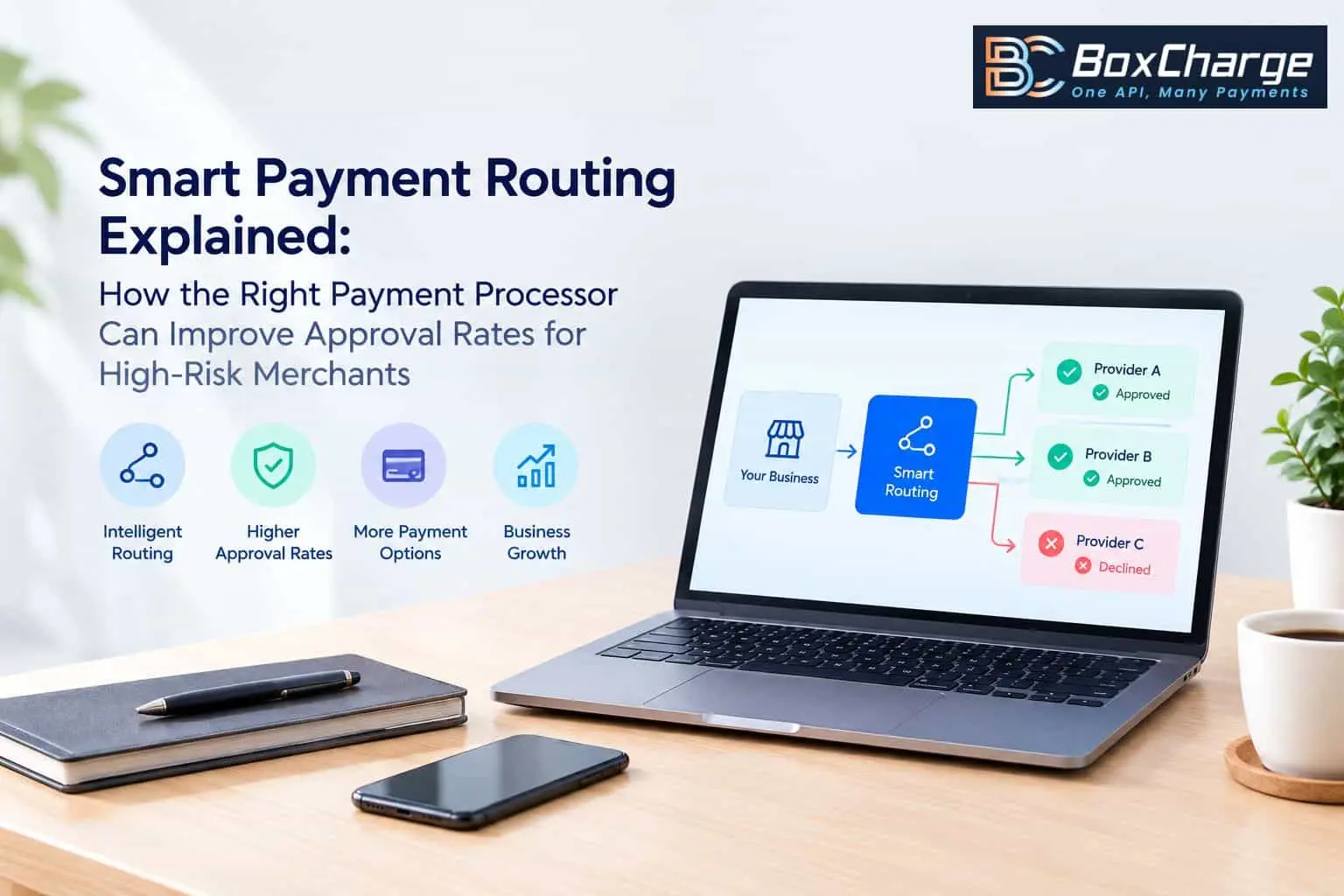
Smart payment routing helps businesses send transactions through the payment processor, acquiring bank, or payment network best suited to a particular transaction. Instead of relying on a single processing route for every customer, an intelligent routing system can evaluate factors such as transaction currency, customer location, processing costs, historical approval performance, and processor availability before selecting a route.
For international and high-risk merchants, this can make a meaningful difference. A transaction may be declined because of issuer risk controls, an unsuitable acquiring route, incomplete payment information, or a temporary processor issue. The challenge is that every unsuccessful payment can mean lost revenue, additional customer support work, and a customer who may not return.
So, what actually happens after a customer clicks “Pay”? And how can smart payment routing help merchants improve payment performance without increasing fraud exposure or processing costs?
Understanding the journey from checkout to authorization reveals why payment routing has become an important consideration for businesses accepting payments across multiple markets.
What Is Smart Payment Routing in Payment Processing?
Smart payment routing, also called intelligent payment routing or payment orchestration routing, is a technology-driven process that selects an appropriate payment route for a transaction based on predefined rules, real-time conditions, or historical performance data.
A payment route may involve a payment gateway, payment processor, acquiring bank, card network, and the customer's issuing bank. The exact configuration depends on the merchant's payment infrastructure.
For example, an international subscription business might receive card payments from customers in the UK, Germany, Canada, and Australia. If it has access to multiple acquiring relationships, its routing system may direct eligible transactions to a route that supports the relevant currency, market, payment method, and risk requirements.
The objective is not simply to choose the cheapest processor. It is to balance:
Authorization rates: The proportion of submitted payment authorization requests approved by issuers.
Processing costs: Acquiring fees, gateway charges, currency conversion costs, and other applicable expenses.
Payment reliability: The ability to maintain processing when a provider experiences downtime or technical issues.
Fraud prevention: The ability to identify suspicious transactions and apply appropriate controls.
Customer experience: A checkout process that is secure, consistent, and convenient.
Stripe's guide to intelligent payment routing explains how routing engines can assess transactions, compare cost and performance, select routes, and use transaction outcomes to inform future decisions.
For merchants operating in high-risk industries, these capabilities are especially relevant because payment acceptance depends on more than the customer having sufficient funds. Acquirer appetite, business category, fraud exposure, transaction patterns, and underwriting conditions also matter.
What Happens After a Customer Clicks “Pay”?
A customer sees a simple payment button. Behind it, several systems may communicate within seconds to determine whether the transaction can proceed.
Step 1: The customer submits payment details
When a customer clicks “Pay,” the checkout sends the required payment information to the merchant's payment infrastructure. Depending on the integration, sensitive card data may be handled by a hosted payment page, secure payment fields, or tokenization.
The payment gateway or payment platform validates the request and passes the necessary information into the processing flow. Checks can include whether required fields are present, the transaction amount is valid, and the payment method is supported.
A poor checkout integration can create friction before a transaction even reaches an issuer. Incorrect currency settings, expired payment credentials, unsupported card types, and technical errors can prevent legitimate payments from progressing.
Step 2: Fraud screening and authentication take place
The payment system may evaluate the transaction against fraud rules, device information, customer history, transaction value, location signals, and other available data.
For transactions that require additional verification, the merchant or payment provider may use 3-D Secure authentication.
According to EMVCo's official 3-D Secure guidance, EMV 3DS enables merchants and card issuers to exchange transaction, payment, and device information to help authenticate customers and reduce card-not-present fraud.
Depending on the risk assessment, a customer may complete the payment without a visible challenge or be asked to verify their identity using an additional authentication method.
For high-risk merchants, the objective is to strike the right balance between security and checkout completion. Weak controls can increase fraud exposure, while poorly configured controls may introduce unnecessary friction for legitimate customers.
Step 3: Smart payment routing chooses the processing path
This is where intelligent payment routing becomes important.
The routing engine assesses the transaction against the rules and data available to it. These may include:
The customer's country and transaction currency.
The card type and supported payment method.
The merchant's approved acquiring relationships.
Historical authorization rates for eligible routes.
Processing fees and currency conversion considerations.
Processor availability, response times, and technical errors.
Risk restrictions and contractual routing requirements.
Suppose a UK-based online merchant accepts payments from customers in several countries. If it has two approved acquiring routes that support a particular transaction, the routing engine may select the route expected to offer a suitable combination of reliability, cost, and authorization performance.
However, not every transaction can be sent through every provider. Merchant category restrictions, acquiring agreements, card-network requirements, regional coverage, and risk policies can limit the available choices.
Smart routing therefore works best when the merchant has legitimate, compatible processing options rather than simply a long list of payment providers.
Step 4: The acquiring and card-network infrastructure forwards the request
Once the route is selected, the payment authorization request travels through the relevant processing infrastructure toward the customer's issuing bank.
The issuer evaluates the request using its own decision systems. It may consider available funds or credit, account status, fraud signals, authentication results, and other factors.
This distinction matters: a payment routing engine can influence where an authorization request goes, but it cannot guarantee that the issuing bank will approve it.
A suitable route may improve the chance of a successful authorization in some circumstances. It cannot override issuer decisions, bypass required authentication, or turn an invalid transaction into a legitimate one.
Step 5: The payment receives an authorization decision
The issuer returns an approval or decline response, or the transaction may require further action depending on the payment flow.
If approved, the payment may proceed to capture and later clearing and settlement, depending on the merchant's integration and transaction type. Funds do not necessarily reach the merchant's bank account immediately.
If declined, the system needs to distinguish between a potentially recoverable technical problem and a genuine issuer refusal. Retrying every declined transaction through another processor is not an appropriate strategy; repeated attempts can create additional costs, customer confusion, and fraud concerns.
A well-designed routing system uses clear rules for when an alternative route is permitted and when the customer should instead be asked to update payment details or contact their bank.
Why High-Risk Merchants Need Smarter Payment Routing
High-risk businesses often face payment challenges that traditional payment setups do not fully address. Industries such as online gaming, forex, adult services, subscription businesses, travel, and certain digital services may encounter stricter underwriting, higher fraud exposure, elevated chargeback risk, and limited access to acquiring providers.
These challenges can affect payment acceptance even when customers genuinely want to complete their purchases.
1. Legitimate transactions are declined
A decline does not always mean a customer lacks sufficient funds. Issuer fraud controls, regional processing differences, inaccurate transaction data, and technical issues can also contribute.
For merchants with international customers, one acquiring route may perform differently from another across particular markets or card types.
Intelligent payment routing can use historical performance and configured rules to direct eligible payments toward suitable routes. This may help recover some legitimate transactions, although it cannot eliminate issuer declines.
2. Finding a willing acquiring bank is difficult
High-risk merchants may struggle to secure a merchant account because providers assess their industry, business model, projected transaction volume, chargeback history, and compliance procedures.
Even after approval, merchants must work within the acquiring agreement's restrictions. A provider that supports one high-risk business category may not accept another.
Smart routing cannot make an unapproved provider available. Merchants need suitable acquiring relationships, clear underwriting arrangements, and processing routes that explicitly support their business category.
For businesses exploring international merchant accounts, the priority should be finding a provider with relevant industry experience, transparent terms, and appropriate geographic coverage—not simply choosing the provider with the lowest advertised fee.
3. Cross-border payments become more expensive
International payments can involve acquiring fees, currency conversion, cross-border charges, and differences in local processing arrangements.
For example, a merchant selling subscriptions to customers across Europe and North America may find that processing costs and approval performance vary by market.
Where supported by the merchant's agreements and infrastructure, routing eligible payments through an appropriate local or regional acquirer may improve the overall cost and performance balance.
However, local acquiring is not automatically cheaper, and the benefits depend on the transaction, provider pricing, regulatory requirements, and settlement arrangements.
4. A processor outage can interrupt sales
When a merchant depends on one payment provider, a technical outage or connectivity problem can prevent customers from completing purchases.
For a high-risk business operating around the clock, even a short interruption can affect revenue, customer confidence, and recurring billing.
A multi-acquirer payment setup can provide an alternative route when a primary provider experiences a qualifying technical failure. Intelligent routing can support this resilience by detecting eligible failure conditions and directing transactions to a pre-approved alternative.
This is different from retrying a payment that an issuer has explicitly declined. Failover policies should distinguish technical failures from issuer decisions to avoid unnecessary retries and duplicate payment risks.
5. Fraud and chargebacks put account stability under pressure
High-risk merchants must monitor fraud and chargebacks closely because elevated losses can lead to additional fees, tighter processing conditions, reserve requirements, or account termination.
Payment routing should therefore work alongside fraud monitoring, customer authentication, transaction limits, and dispute management.
The PCI Security Standards Council's PCI DSS guidance explains the role of payment card data security standards in protecting account data across the payment ecosystem.
Routing is not a substitute for PCI DSS compliance or effective fraud controls. The aim is to improve legitimate payment performance while maintaining the security and risk standards required by the merchant's providers.
How Smart Payment Routing Can Improve Business Performance
When properly configured, intelligent payment routing can support several commercial objectives.
Business objective | How routing may help |
Improve authorization performance | Selects eligible routes using historical approval data and transaction conditions. |
Reduce avoidable processing costs | Compares available routes using applicable fees and currency considerations. |
Maintain payment continuity | Supports failover when a processor or connection experiences a qualifying technical failure. |
Support international expansion | Uses routes that are approved for the relevant markets, currencies, and payment methods. |
Improve payment visibility | Centralizes route-level transaction data to help identify performance problems. |
Reduce manual payment operations | Automates routing decisions that would otherwise require manual intervention. |
The commercial value depends on the quality of the routing rules, the number of genuinely usable routes, provider performance, and the merchant's transaction profile. Results should be measured against a baseline rather than assumed from the presence of routing technology alone.
What Should Merchants Look for in a Smart Payment Routing Solution?
Choosing a payment gateway or payment orchestration platform requires more than checking whether it supports multiple processors. Merchants should assess the capabilities that affect their actual business operations.
Routing rules and decision transparency
Ask whether routing decisions can be based on transaction currency, geography, payment method, processor availability, historical performance, and cost.
The provider should also explain how routing decisions are logged, how rules are changed, and whether merchants can review why a transaction followed a particular route.
High-risk industry support
Confirm that the provider and its acquiring partners explicitly support the merchant's business category, countries of operation, transaction patterns, and recurring payment model where applicable.
A platform advertising multi-acquirer connectivity does not necessarily mean every connected acquirer will accept the merchant.
Retry and failover controls
Ask how the system distinguishes technical errors from issuer declines, authentication failures, and other non-recoverable outcomes.
Retry rules should be carefully controlled, with safeguards against duplicate transactions and repeated attempts that could increase fraud risk.
Reporting and performance monitoring
Merchants should be able to compare authorization rates, decline reasons where available, processing costs, latency, chargebacks, and performance by market or payment route.
Useful reporting helps businesses identify whether a decline problem comes from checkout design, issuer behaviour, provider connectivity, fraud controls, or a particular market.
Security and compliance
Confirm how the provider handles sensitive payment information, tokenization, access controls, and applicable PCI DSS responsibilities. Merchants should understand which security obligations remain with them and which are handled by their payment service providers.
For international ecommerce, authentication capabilities also deserve attention. EMVCo's 3-D Secure resources explain how authentication can help protect card-not-present transactions while supporting a smoother customer experience.
Smart Payment Routing vs. a Single Payment Gateway
A single payment gateway can be sufficient for a business with straightforward payment needs. As transaction volumes, customer locations, and operational risks increase, however, relying on one processing route may create limitations.
The distinction is that a gateway primarily facilitates payment communication, while a smart routing system makes decisions about which eligible processing route should handle a transaction. Some payment platforms combine both capabilities.
Feature | Single processing route | Smart payment routing |
Route selection | One configured route | Selects from available eligible routes |
Processor outage | May interrupt payment acceptance | Can support alternative-route failover |
Cost optimization | Limited route-level comparison | Can compare available routes and applicable costs |
International payments | Depends on the chosen provider's coverage | Can select among approved routes for supported markets |
Performance analysis | Primarily reflects one route | Can compare performance across routes |
A smart routing solution does not automatically outperform a well-configured single gateway. Businesses should compare the additional costs and complexity of multi-acquirer processing against measurable improvements in approval performance, resilience, and operating efficiency.
How to Measure Whether Smart Routing Is Working
Before implementing a new payment routing solution, merchants should establish a baseline using their existing payment data.
Track the following metrics:
Authorization rate: The percentage of submitted authorization requests approved by issuers. Define the denominator consistently when comparing providers.
Payment conversion rate: The percentage of checkout attempts that result in completed purchases.
Technical failure rate: The percentage of transactions affected by connectivity issues, timeouts, or processing errors.
Cost per successful payment: Total relevant processing costs divided by successful payments, using a consistent cost definition.
Chargeback rate: The proportion of transactions that result in chargebacks, measured using a consistent methodology and reporting period.
Settlement and payout timing: The time between transaction processing, settlement, and funds reaching the merchant's bank account.
Consider a hypothetical merchant processing 10,000 authorization requests per month. If its authorization rate increases from 80% to 83%, that represents 300 additional approved authorization requests, assuming the same transaction mix and measurement method.
That is a useful performance indicator, but it does not mean the merchant has automatically gained 300 completed sales. Some approved payments may not be captured, may later be refunded, or may fail to settle. Actual incremental revenue must be established using completed transactions and appropriate cost and risk adjustments.
Merchants should also compare results by country, card type, transaction value, and customer segment. An improvement in the overall authorization rate can conceal higher processing costs or weaker performance in a particular market.
Frequently Asked Questions About Smart Payment Routing
Q: What is smart payment routing in simple terms?
Smart payment routing is a system that selects an appropriate available payment processing route for each eligible transaction. It can use predefined rules, transaction characteristics, processor availability, historical approval performance, and cost considerations to make that decision.
Q: Can smart payment routing increase payment approval rates?
It can improve authorization performance when different eligible routes have meaningfully different outcomes for particular transactions. Results depend on issuer decisions, merchant risk, provider capabilities, and the quality of the routing rules. No routing solution can guarantee approval.
Q: Is smart payment routing suitable for high-risk merchants?
It can be suitable for high-risk merchants that have access to multiple compatible, approved acquiring routes. Before implementation, businesses should confirm industry acceptance, underwriting requirements, regional coverage, pricing, and compliance obligations with each relevant provider.
Q: Does smart routing reduce payment processing fees?
Potentially. A routing engine can compare eligible routes and direct transactions according to configured cost objectives. Savings depend on actual provider fees, interchange arrangements, currency conversion, cross-border charges, and other costs. Lower fees should not be pursued at the expense of payment reliability or risk controls.
Q: Can a payment be retried automatically after a decline?
Some payment platforms support controlled retries or alternative routing for specific failure conditions. However, a technical timeout is different from an explicit issuer decline. Retry decisions should follow processor guidance, card-network requirements, and applicable rules, with safeguards against duplicate charges and unnecessary repeated attempts.
Q: Does payment routing speed up merchant settlement?
Not necessarily. Routing may influence which acquirer processes a transaction, and different acquiring arrangements can have different settlement terms. However, an authorization approval does not guarantee immediate settlement or payout. Merchants should evaluate funding schedules, reserves, fees, and contractual settlement conditions separately.
Build a More Reliable Payment Strategy with BoxCharge
Smart payment routing is not just a technical feature. For international and high-risk merchants, it can be part of a broader strategy to improve payment acceptance, manage processing costs, maintain transaction continuity, and support expansion into new markets.
The most effective approach starts with understanding where payments fail, which acquiring routes are genuinely available, and what the transaction data reveals. From there, businesses can assess whether intelligent routing, additional acquiring relationships, better fraud controls, or a combination of these measures offers the strongest commercial benefit.
BoxCharge helps businesses explore payment processing options suited to their operating models and international requirements. If your business faces recurring declines, limited acquiring options, or challenges managing cross-border payments, reviewing your existing payment infrastructure is a practical starting point.
Contact BoxCharge to learn more about payment processing solutions for international and high-risk businesses, and discuss the requirements your business needs to meet before selecting a suitable payment setup.