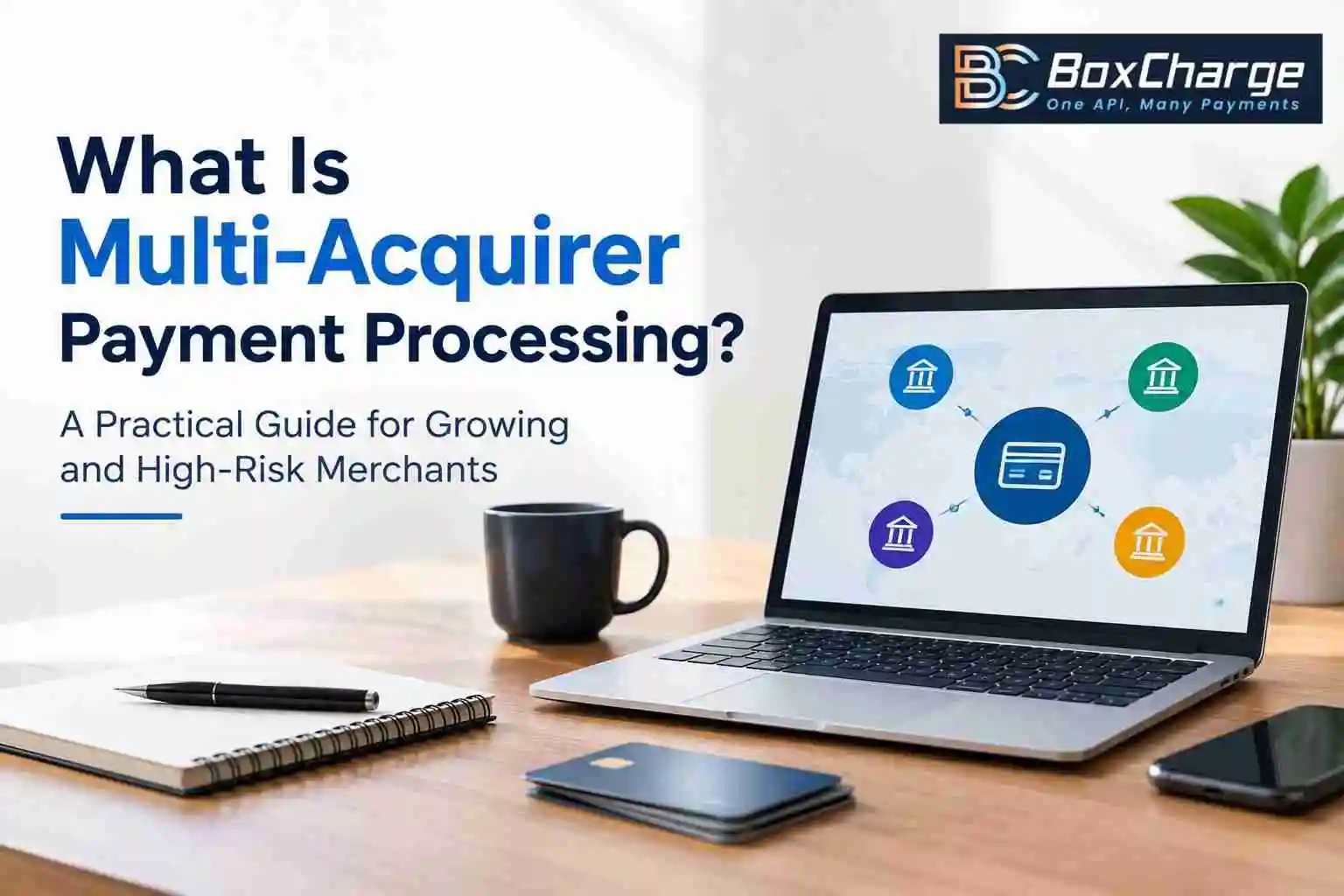
For businesses processing significant online transaction volumes, relying on one payment processor or acquiring a bank can become a serious commercial risk. Multi-acquirer payment processing gives merchants access to two or more acquiring partners so transactions can be routed through the most suitable payment route based on factors such as geography, currency, card type, risk, and processing performance.
This approach is becoming increasingly relevant for high-risk merchants, international businesses, and companies operating across multiple markets. A single account decline, processor outage, compliance review, or sudden change in acquiring policy can disrupt the payment flow and immediately affect revenue.0
A multi-acquirer setup is designed to reduce that dependency.
Rather than asking, “Which payment processor has the lowest fee?” merchants increasingly need to ask, “How resilient is my payment infrastructure if one processing route stops working?”
What Is Multi-Acquirer Payment Processing?
Multi-acquirer payment processing means connecting a business to multiple acquiring banks or payment processors instead of depending on a single acquiring relationship.
An acquirer is the financial institution or acquiring partner that processes card transactions for the merchant and connects to the card networks. In a traditional setup, a merchant may send most or all card transactions through one processor and one acquiring route.
A multi-acquirer model creates several routes.
For example, a merchant could have:
Acquirer A handling UK transactions
Acquirer B handling European transactions
Acquirer C handling selected international cards
A backup processor available when the primary route declines or becomes unavailable
The technology coordinating these connections is often referred to as payment orchestration or a payment orchestration platform.
Modern orchestration can sit between the merchant's checkout and multiple gateways, processors, and acquirers, applying routing rules and managing retries, authentication, monitoring, and reconciliation.
The result is a payment infrastructure designed around flexibility rather than dependence on a single provider.
Why Are Merchants Moving to a Multi-Acquirer Model?
The answer is simple: one payment route can become a single point of failure.
A processor may work perfectly for months and then experience an outage. An acquiring bank may review a merchant's activity after a change in transaction volume. A business expanding into a new market may discover that its existing acquirer has poor approval performance in that region.
There can also be commercial limitations.
One acquirer may offer strong rates but weak international coverage. Another may perform better for certain card ranges or countries. A third may have better capabilities for a particular high-risk vertical.
Multi-acquirer processing allows businesses to build around those differences instead of forcing every transaction through the same route.
Smart routing can consider factors such as geography, currency, card details, risk, cost, and recent processor performance when selecting a route.
For merchants with substantial transaction volumes, that flexibility can become a meaningful revenue and risk-management advantage.
How Multi-Acquirer Payment Processing Works
The basic process is easier to understand than the terminology suggests.
Step 1: Customer Starts Checkout
A customer enters their payment details on the merchant's website or application.
Step 2: Transaction Enters the Payment Layer
Instead of automatically sending the transaction to one fixed processor, the payment infrastructure evaluates available routes.
Step 3: Routing Rules Select an Acquirer
The system can consider predefined rules such as:
Customer location
Card country or BIN
Transaction currency
Merchant category
Transaction value
Risk score
Acquirer availability
Historical approval performance
Processing cost
Step 4: Transaction Is Authorised
The selected acquiring route sends the transaction through the appropriate payment network and issuing bank.
Step 5: Failed Transactions Can Be Re-Routed
Where technically and contractually appropriate, a soft decline or failed route can trigger a retry or alternative route.
This is often called cascading or payment failover.
The objective is not to blindly retry every declined payment. Repeated retries can increase risk and create poor customer experiences. The routing strategy needs to distinguish between recoverable declines, hard declines, and transactions that should not be retried.
Step 6: Settlement and Reconciliation
The merchant receives settlement through the applicable acquiring relationships while transaction information is consolidated for reporting and reconciliation.
This final stage is particularly important. Adding processors without unified reporting can create a different problem: multiple payment accounts, multiple settlement reports, and fragmented chargeback data.
Multi-Acquirer Processing vs. Single-Acquirer Processing
A single-acquirer setup is easier to launch.
One integration, one commercial relationship, and one settlement flow can make sense for a small business with straightforward transaction requirements.
But the weaknesses become more obvious as the business grows.
Single Acquirer | Multi-Acquirer |
One primary processing route | Multiple processing routes |
Greater provider dependency | Lower concentration risk |
Limited routing flexibility | Smart routing opportunities |
One approval profile | Multiple acquiring profiles |
One point of operational failure | Backup processing capability |
Simpler reconciliation | More complex but centralised reconciliation |
May work for smaller merchants | Better suited to complex or high-volume businesses |
Multi-acquirer processing is not automatically better for every business. The additional connections create operational and technical complexity.
The commercial benefit appears when the additional flexibility is worth more than that complexity.
Why High-Risk Merchants Have More to Gain
For high-risk merchants, payment continuity can be more difficult to achieve.
Businesses in sectors such as iGaming, forex, adult, nutraceuticals, subscriptions, travel, and certain financial or digital-asset categories may face greater scrutiny because of chargeback exposure, fraud risk, regulatory requirements, or the nature of the business model.
That creates several familiar problems.
Merchant Account Approval
A high-risk business may have fewer acquiring options than a conventional retailer.
Higher Processing Costs
High-risk accounts can carry higher pricing and additional risk controls because the processor is taking on greater exposure.
Rolling Reserves
An acquirer may hold back part of the merchant's settlement to protect against future disputes, refunds, or other losses. Reserve structures can create significant cash-flow pressure when transaction volumes increase.
Chargebacks
A rise in chargebacks can lead to closer monitoring and potentially tougher processing conditions. Acquirers actively monitor merchant portfolios for excessive chargeback activity.
Sudden Processing Restrictions
A merchant can also face reviews after unusual transaction growth, increased disputes or changes to the business profile.
For these merchants, relying entirely on one processing relationship creates concentration risk.
If that relationship is interrupted, the business may not have another route ready to absorb the transaction volume.
That is where multi-acquirer payment processing for high-risk merchants becomes particularly valuable.
How Multi-Acquirer Processing Can Improve Payment Approval Rates
Approval rates vary between acquiring routes.
The same customer transaction may perform differently depending on the merchant's acquiring setup, customer geography, card issuer, currency, and transaction characteristics.
A multi-acquirer strategy can use historical performance data to identify stronger routes.
For example, if an acquirer consistently produces better approval results for a particular European card segment, the merchant may route more eligible transactions through that connection.
This is the foundation of smart payment routing.
Instead of treating every transaction identically, the payment system makes routing decisions according to the merchant's actual processing data.
Higher approval rates can mean more completed sales.
For a business processing thousands or millions of pounds in transactions, even a modest improvement in legitimate payment acceptance can have a meaningful impact on revenue.
Multi-Acquirer Processing and Payment Orchestration
The two terms are closely connected but not identical.
Multi-acquirer processing describes the underlying acquiring structure: the merchant has multiple acquiring relationships.
Payment orchestration describes the technology layer used to connect, control, and optimise those relationships.
A payment orchestration platform can provide:
Multi-acquirer connectivity
Smart payment routing
Transaction retries
Failover
3D Secure coordination
Token management
Fraud integration
Payment analytics
Chargeback visibility
Unified reporting
Reconciliation
This becomes especially useful when a merchant has outgrown a single payment gateway and needs one operating layer across multiple providers.
Without orchestration, a merchant may end up managing several integrations independently.
That can create unnecessary development work and make payment optimisation harder.
Is Multi-Acquirer Processing Only for Large Businesses?
No.
However, the business needs to justify the additional infrastructure.
A small merchant processing a few thousand pounds per month may not need multiple acquiring connections.
A growing international merchant processing hundreds of thousands or millions in monthly transactions may have a much stronger commercial case.
The model becomes particularly attractive when the business has:
High transaction volumes
International customers
Multiple currencies
High-risk classification
High chargeback exposure
Different approval rates by market
Multiple payment methods
Recurring billing
Significant revenue concentration with one processor
Expansion plans across new regions
For these businesses, payment processing is no longer simply a back-office function. It becomes part of the revenue infrastructure.
What Should Merchants Look for in a Multi-Acquirer Payment Provider?
Choosing a provider requires more than asking how many acquirers are connected.
Merchants should evaluate the entire infrastructure.
1. Acquirer Coverage
Find out which acquiring banks and processors are actually available for your business model and target markets.
2. Smart Routing
Ask how routing decisions are made and whether rules can be configured around geography, currency, card type, risk, and performance.
3. Failover and Cascading
Understand which declines can be retried and how the system prevents inappropriate repeated attempts.
4. Token Portability
If a merchant changes or adds an acquirer, payment credentials should not become unnecessarily difficult to migrate or reuse.
5. Fraud and Risk Controls
Multi-acquirer processing should work alongside fraud detection and authentication rather than operating as a disconnected routing tool.
6. Unified Reporting
A merchant needs one view of transaction performance, declines, chargebacks, and settlements across providers.
7. Settlement Transparency
Compare actual settlement conditions, reserves, payout timelines, and currencies rather than looking only at headline transaction rates.
The Cost Question: Is Multi-Acquirer Processing Worth It?
This is where merchants need to look beyond the advertised processing fee.
The cheapest acquiring route is not necessarily the most profitable.
Suppose an acquirer offers a lower processing rate but generates more declines. Another route may cost slightly more per transaction but approve significantly more legitimate payments.
The second route could produce better net revenue.
For high-risk businesses, the calculation also needs to account for:
Chargeback costs
Reserve requirements
Declined transaction revenue
Payment downtime
Fraud losses
Gateway fees
Cross-border costs
Currency conversion
Operational overhead
High-risk payment processing should therefore be evaluated on total payment economics, not simply the percentage displayed on a pricing page.
When Should a Business Consider Multi-Acquirer Processing?
There is no universal transaction threshold.
However, several warning signs suggest that a business may have outgrown a single acquiring relationship.
If one processor represents almost all of your online payment volume, you have concentration risk.
If approval rates vary significantly by market, there may be a routing opportunity.
If payment downtime directly affects daily revenue, redundancy becomes more important.
If you are entering new countries, your existing acquirer may not provide the best coverage.
And if your business is high risk, having no backup processing strategy can leave you particularly exposed to account reviews, reserves, or processing interruptions.
The best time to build a backup is before the primary route fails.
Building a More Resilient Payment Infrastructure
A strong multi-acquirer strategy should not mean connecting every available processor.
The goal is controlled diversification.
A practical structure might include:
1: Primary acquirer: Handles the majority of eligible transactions.
2: Secondary acquirer: Provides an alternative route for selected regions, currencies, or card types.
3: Backup route: Provides additional resilience if the primary route becomes unavailable.
4: Orchestration layer: Controls routing, retries, monitoring, and reporting.
5: Risk layer: Handles fraud screening, authentication, and transaction controls.
6: Reconciliation layer: Brings settlement and transaction data into one operational view.
This structure allows merchants to optimise payment acceptance without losing control over the overall payment operation.
Final Thoughts: Make Your Payment Infrastructure Harder to Break
The best multi-acquirer payment processing provider is ultimately about reducing dependency.
For a growing business, one processor may be enough for a while. But as transaction volumes, markets, and risk exposure increase, the consequences of relying on a single acquiring route become harder to ignore.
For high-risk merchants, the stakes can be even higher. A processing interruption can affect customer payments, cash flow, payroll, marketing budgets, and overall business continuity.
A multi-acquirer strategy can provide greater routing flexibility, stronger payment redundancy and more opportunities to optimise transaction approval.
The important point is that multi-acquirer processing is not simply about having more payment providers. The real value comes from intelligently managing those connections.
With the right payment orchestration, routing rules, risk controls, and reporting, merchants can build a payment infrastructure that is designed for growth rather than one that has to be rebuilt every time a processor becomes unavailable.
Looking for a Multi-Acquirer Payment Processing Solution?
If your business is experiencing high decline rates, processor dependency, settlement issues, or difficulty maintaining a stable high-risk merchant account, BoxCharge can help you evaluate a payment-processing structure built around your business model.
Whether you need high-risk payment processing, multiple acquiring connections, international payment processing, payment gateway solutions, or payment orchestration, the right setup starts with understanding your transaction profile and the markets you serve.
Get in touch with BoxCharge - helps businesses build payment infrastructure designed for reliable, scalable transaction processing.