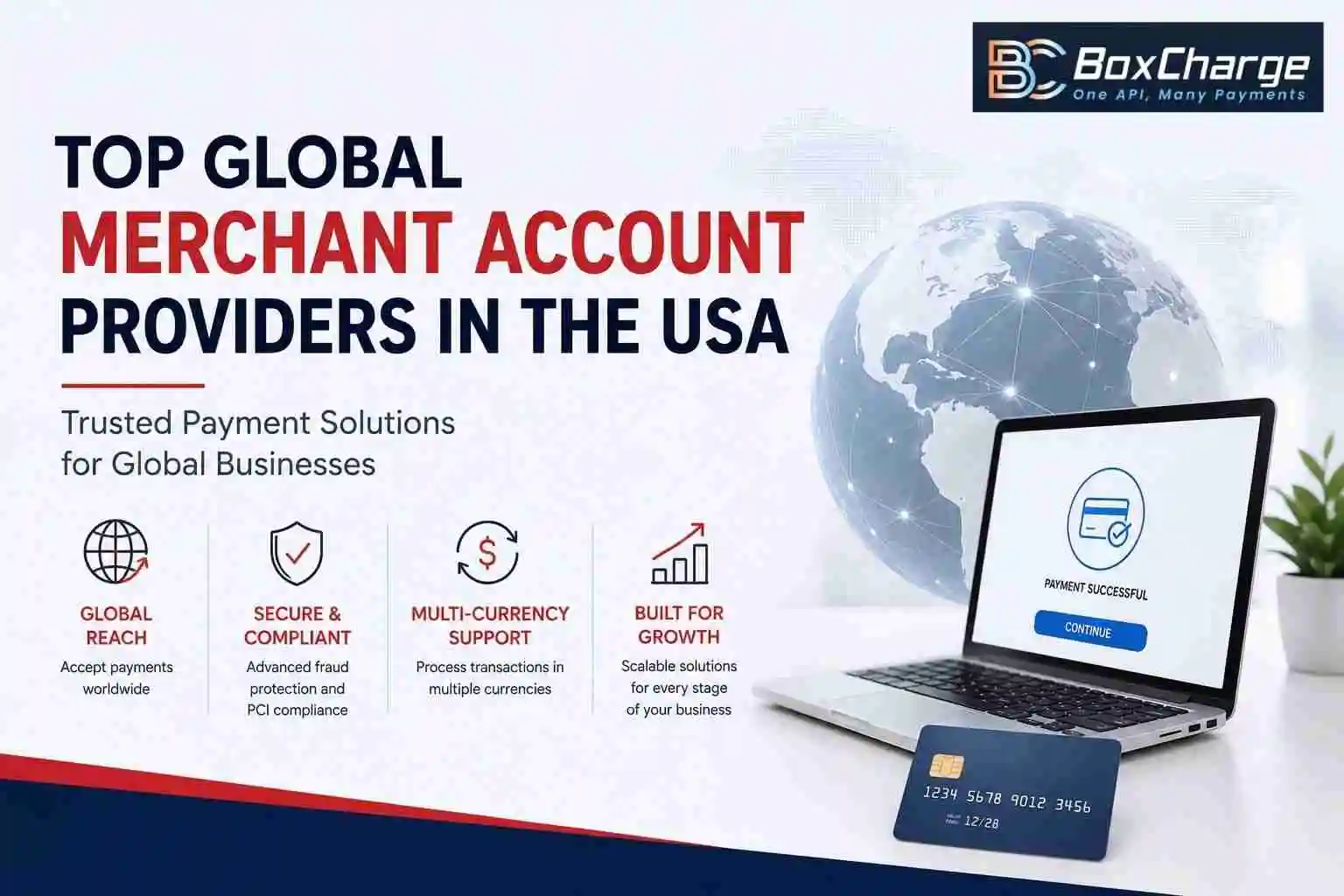
Finding the top global merchant account providers in the USA is not simply about choosing a company that accepts card payments. For businesses selling across borders, the right payment partner can influence approval, transaction stability, settlement speed, chargeback exposure, and the ability to scale into new markets.
The decision becomes even more important for high-risk merchants. Businesses operating in sectors such as gaming, forex, digital services, subscriptions, travel, adult products, and other elevated-risk categories can face stricter underwriting and ongoing monitoring. A provider that works well for a conventional ecommerce company may not necessarily be suitable for a high-risk business.
For U.S. merchants with international ambitions, the following eight providers are worth comparing based on their published payment capabilities, international services, merchant-account offerings, and high-risk payment positioning.
What Should You Expect From a Global Merchant Account?
A global merchant account should provide more than basic payment acceptance.
International merchants may need multi-currency processing, cross-border card acceptance, recurring billing, fraud prevention, chargeback management, alternative payment methods, payment gateway connectivity, and dependable settlement.
High-risk merchants have an additional layer of concern.
A business can be legitimate, profitable, and growing while still being classified as high risk because of its industry, transaction patterns, customer geography, subscription model, chargeback exposure, or regulatory environment.
That can result in additional underwriting requirements, processing limits, rolling reserves, delayed settlements, or periodic account reviews.
The right provider should therefore be evaluated according to the merchant's actual business model rather than simply its advertised processing rate.
1. BoxCharge
BoxCharge is positioned around global merchant services and payment infrastructure for businesses that require more specialized payment capabilities.
Its published solutions cover areas such as global merchant accounts, international payment processing, multi-currency acquiring, offshore merchant accounts, payment gateways, payment orchestration, alternative payment methods, and settlement solutions.
For a U.S. business expanding into markets such as the UK, Europe, Canada, or Australia, having access to broader payment infrastructure can be commercially useful.
This is particularly relevant for high-risk businesses that may need more than one processing route or payment method as their transaction volume grows.
A merchant should also look at how the provider approaches transaction routing, risk management, settlement, and payment continuity. If one processing route becomes less effective in a particular market, flexible infrastructure can help merchants manage the problem without completely rebuilding their payment stack.
For businesses searching for a global merchant account provider with a broader high-risk payment focus, BoxCharge is a provider worth evaluating.
2. PayCly
PayCly focuses strongly on high-risk merchant accounts and international payment processing.
Its published merchant-account services cover high-risk sectors including gaming, casino, forex, gambling, adult businesses, dating, and other industries that may face difficulties obtaining conventional merchant accounts. It also highlights international payment gateways, multi-currency processing, fraud prevention, and chargeback management.
This specialization can be important for merchants that have already experienced rejected applications from conventional processors.
High-risk merchants often discover that obtaining an account is only the beginning. Once transaction volume increases, processors may request updated financial information, review transaction patterns, adjust reserves, or reassess processing limits.
That makes scalability an important consideration when comparing high-risk merchant account providers.
PayCly can therefore be considered by businesses looking for specialized payment infrastructure rather than a generic payment solution.
3. WebPays
WebPays markets its services around merchant accounts, high-risk payment processing, payment gateways, offshore processing, and international payment acceptance.
Its published solutions emphasize high-risk merchant accounts, multi-currency processing, payment gateway integration, recurring billing, 3D Secure, and ecommerce integrations.
For online businesses, integration can be just as important as approval. A merchant may already be operating on an ecommerce platform or subscription system and cannot afford a complicated payment migration.
WebPays highlights integrations with several ecommerce and content-management environments, along with API-based options.
For merchants comparing international merchant account providers, the key questions should include supported markets, settlement currencies, transaction limits, reserve requirements, chargeback procedures, and the acquiring arrangement supporting the account.
The right infrastructure should fit the merchant's current operation while leaving room for future expansion.
4. Amald
Amald positions itself as a provider of merchant services and high-risk payment solutions for businesses operating across different industries.
Its published international merchant-account services highlight card processing, high-risk payment gateways, fraud prevention, chargeback management, eCheck processing, and multiple-currency capabilities.
Amald also markets high-risk merchant-account solutions for industries including online gaming, adult businesses, casino-related businesses, membership websites, travel, and other higher-risk categories.
For a merchant, the advantage of working with an industry-focused provider is that the underwriting conversation can be more relevant to the actual business model.
However, merchants should still examine the commercial terms carefully.
Before signing an agreement, ask about processing fees, reserve requirements, settlement schedules, minimum processing volumes, chargeback costs, and what happens when transaction volume increases.
These details can have a greater impact on profitability than the headline processing rate.
5. Inquid
Inquid focuses on high-risk payment processing and global merchant solutions, making it particularly relevant to businesses operating in industries where conventional payment providers may impose greater restrictions.
Its published services include high-risk merchant accounts, payment gateways, multi-currency processing, cross-border transactions, alternative payment methods, transaction routing, and fraud-management capabilities.
The company also positions its payment infrastructure toward sectors such as forex, casino, gaming, IPTV, cryptocurrency, and other digital businesses.
For high-risk merchants, payment routing can become increasingly important as transaction volumes grow.
A business might experience strong approval rates with one processing route but weaker performance in another market. Having payment infrastructure designed to handle different transaction requirements can potentially help merchants manage authorization and operational challenges more effectively.
Merchants should still confirm the exact acquiring structure, supported jurisdictions, settlement terms, and underwriting requirements before proceeding.
6. Stripe
Stripe is a major global payment technology platform and is particularly well known for its API-driven infrastructure.
Its published payment platform supports online and in-person payments, more than 100 payment methods, international payments, multi-currency management, recurring billing, and fraud-prevention tools. Stripe states that its payment infrastructure supports businesses selling across 195 countries and 135+ currencies, subject to its country and business eligibility requirements.
For technology companies, SaaS businesses, ecommerce brands, and businesses with developer-led payment operations, this infrastructure can be attractive.
However, merchants should make an important distinction between global payment technology and specialized high-risk merchant acquiring.
Not every high-risk business will have the same eligibility, underwriting outcome, or available product configuration.
Therefore, businesses in higher-risk categories should confirm eligibility and permitted activities before designing their entire payment strategy around any provider.
7. Authorize
Authorize is an established payment gateway and merchant-processing platform used by businesses for ecommerce and other payment environments.
Its current ecommerce offering supports major card networks, eChecks, and various digital payment methods. It also provides integrations with platforms including Shopify, WooCommerce, BigCommerce, Magento, and many others.
The platform also provides fraud-detection tools, recurring billing, customer information management, APIs, and developer resources.
For businesses selling internationally, Authorize.net states that eligible merchants based in the U.S., Canada, the UK, Europe, and Australia can accept internationally issued cards.
One important consideration is that a payment gateway and merchant account are not always the same thing.
Authorize.net's support documentation explains that its gateway requires a merchant account or merchant bank account through a compatible merchant service provider.
That distinction matters when a business is comparing complete merchant-account solutions rather than gateways alone.
8. Wise
Wise is positioned differently from traditional acquiring-focused providers, but its business infrastructure can be relevant to companies managing international funds.
Wise Business provides multi-currency business-account functionality and international money movement, allowing businesses to manage funds across currencies and receive certain types of international payments.
For international businesses, this type of infrastructure can be useful for managing cross-border funds alongside a separate card-processing arrangement.
However, merchants should understand the difference between an international business account and a traditional merchant account.
A business account can help manage and move funds, while merchant acquiring is designed to authorize and process customer transactions through payment networks.
For that reason, businesses should evaluate Wise according to the role it is intended to play within the wider payment stack.
Why High-Risk Merchants Need to Compare More Than Rates
High-risk merchants often learn the hardest lessons after they have already started processing.
Consider a U.S. online business that initially processes $30,000 per month. A successful marketing campaign pushes monthly sales to $150,000.
The owner sees five times the revenue.
The payment provider may see five times the transaction exposure.
That change can trigger additional documentation requests, transaction reviews, reserve requirements, processing-limit discussions, or closer monitoring.
Another common problem is a mismatch between the merchant's approved profile and actual processing activity. A business may initially disclose one customer geography or transaction volume and later expand significantly.
If the payment infrastructure cannot accommodate that growth, the merchant can find itself dealing with payment interruptions at precisely the moment revenue is increasing.
This is why experienced high-risk merchants ask questions such as:
What happens if monthly processing volume doubles?
Is a rolling reserve required?
How quickly are funds settled?
What transaction limits apply?
How are chargebacks handled?
Can additional currencies be added?
What happens during a compliance review?
Which acquiring relationship supports the account?
Can the payment setup support international expansion?
These questions are often more important than a small difference in the advertised processing fee.
How to Choose the Right Global Merchant Account Provider
There is no single provider that is automatically best for every U.S. business.
A conventional ecommerce company may prioritize integrations and payment-method coverage. A subscription business may care more about recurring billing and failed-payment recovery. An international company may prioritize multi-currency settlement and cross-border acquiring.
A high-risk merchant has additional considerations.
Before applying, prepare accurate business documentation, processing history, expected transaction volume, average ticket size, customer geography, refund policies, and compliance information.
Then compare the complete commercial structure.
Look at transaction fees, gateway costs, chargeback fees, reserve requirements, settlement schedules, currency-conversion costs, contract terms, transaction limits, and support.
Most importantly, make sure the provider understands your actual business model.
Final Takeaway
The top global merchant account providers in the USA should not be judged purely by brand recognition or advertised pricing.
BoxCharge, PayCly, WebPays, Amald, Inquid, Stripe, Authorize.net, and Wise each approach the payment ecosystem from different angles. Some are more focused on high-risk merchant services, while others provide broader payment technology or international business infrastructure.
For high-risk merchants, the right choice should ultimately come down to business-model compatibility, underwriting, international coverage, payment infrastructure, risk management, settlement terms, scalability, and long-term support.
If your U.S. business is preparing to expand internationally, choose a payment structure that can handle the business you have today while leaving enough flexibility for the business you expect to build tomorrow.
Looking for a Global Merchant Account?
Choosing the right payment provider can make a significant difference to transaction stability, cash flow, and international growth. If your U.S. business needs global merchant account services, multi-currency payment processing, or a payment solution designed around a higher-risk business model, it is worth discussing your requirements with an experienced provider.
Talk to BoxCharge today to explore a merchant account solution tailored to your business, target markets, and expected processing volume.