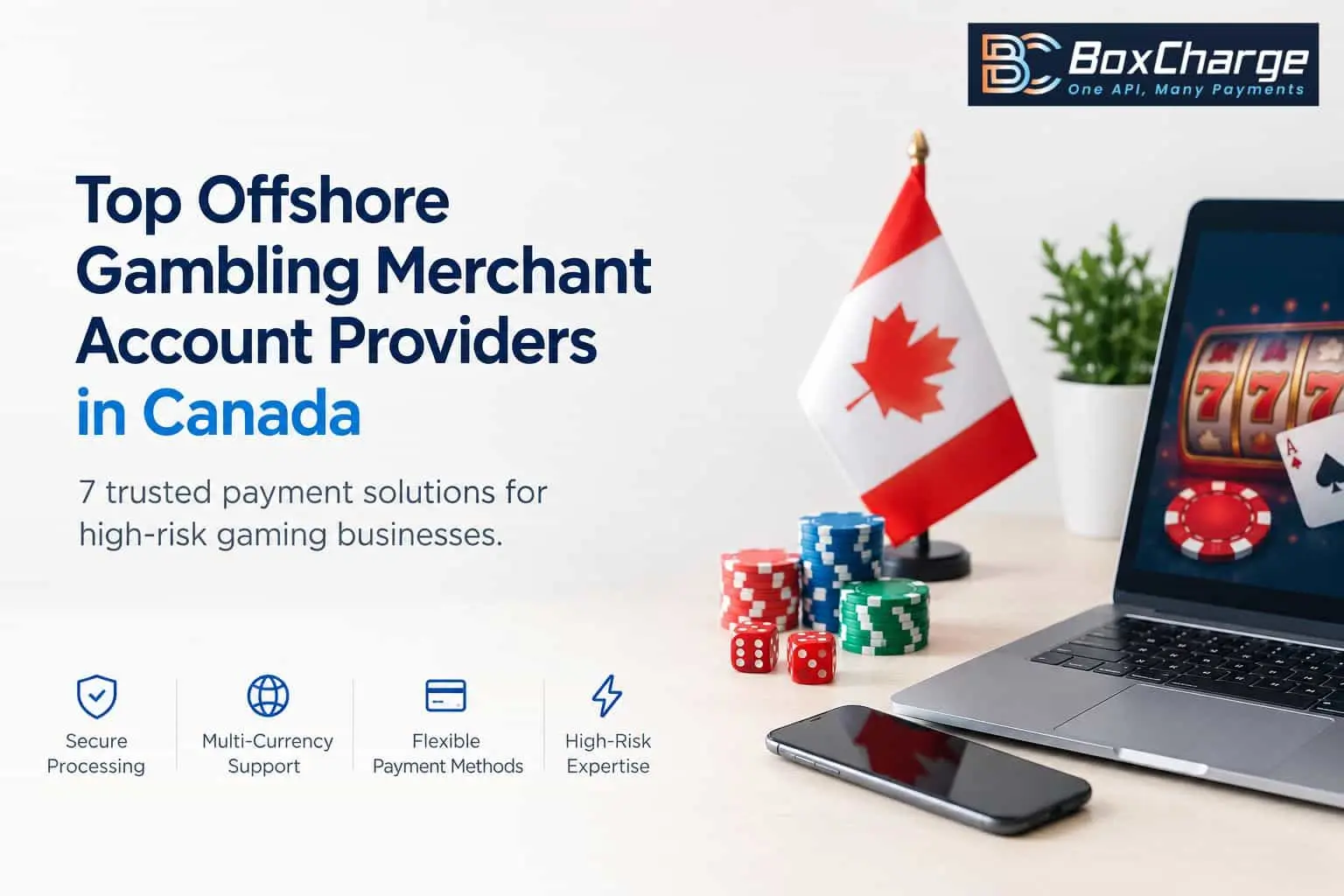
Top offshore gambling merchant account providers in Canada are becoming increasingly relevant for casino operators, sportsbooks, betting platforms, lottery businesses, and other gaming merchants dealing with payment declines, chargebacks, cross-border transactions, and strict underwriting.
For a gambling business, getting customers onto the platform is only part of the equation. The real commercial challenge starts when those customers try to deposit, withdraw, or make repeat payments.
A declined card can mean a lost player. A sudden merchant account termination can interrupt cash flow. A rolling reserve can tie up working capital. And an unsuitable payment gateway can make an otherwise successful gambling operation difficult to scale.
That is why Canadian and international gambling operators often investigate offshore merchant accounts, high-risk payment processing, multi-currency acquiring, gambling payment gateways, and alternative payment methods.
However, offshore does not mean “outside the rules.” A sustainable payment setup still needs proper licensing, KYC/KYB, AML controls, transaction monitoring, responsible gambling processes, and acquiring relationships that match the merchant's markets.
Below are seven names worth researching when evaluating the market.
Why Gambling Businesses Struggle With Payment Processing
Gambling is treated differently from ordinary e-commerce because the payment risk profile is fundamentally different.
An online casino or sportsbook can process large numbers of transactions while dealing with deposits, withdrawals, refunds, bonus abuse, account takeovers, friendly fraud, and cross-border payments at the same time.
For high-risk merchants, the biggest problems are usually:
Merchant account applications being rejected
Payment gateways terminating accounts after onboarding
High chargeback ratios
Rolling reserves and delayed settlements
Limited processing currencies
Poor approval rates
Difficulty obtaining stable acquiring relationships
Payment declines during peak traffic
Complicated compliance requirements
Dependence on a single payment processor
The problem becomes even more serious when an operator expands internationally. A payment method that performs well in one market may not provide the same approval rates or acquiring support in another.
This is where a properly structured offshore gambling merchant account can become commercially useful.
1. BoxCharge
BoxCharge is a strong option for operators researching high-risk gambling payment processing and offshore merchant account solutions.
Its gambling payment infrastructure is positioned around the specific problems that gaming businesses encounter: high transaction volumes, international payments, chargebacks, fraud exposure, and regulatory complexity. BoxCharge highlights tools such as fraud screening, 3D Secure, chargeback protection, multi-currency support, PCI-DSS security, and tokenization for online gambling businesses.
For a Canadian-facing operator, the important question is not simply whether a provider can process cards. The better question is whether the provider can help create a payment structure that remains workable as transaction volume grows.
This makes BoxCharge particularly relevant for operators looking for:
High-risk merchant accounts
Online casino payment processing
Sports betting payment solutions
International card processing
Multi-currency transactions
Fraud and chargeback management
Offshore payment infrastructure
For merchants already experiencing payment instability, this type of specialized approach can be more practical than repeatedly applying for conventional low-risk merchant accounts.
2. Inquid
Inquid focuses heavily on high-risk payment infrastructure, including iGaming, casino, sportsbook, lottery, and other gaming businesses.
Its iGaming offering describes dedicated gaming merchant accounts, multi-currency acquiring, local acquiring, AI-based fraud protection, 3D Secure, chargeback management, and offshore and onshore MID structures.
That combination matters for gambling operators because payment processing is rarely just about authorization.
A serious operator needs to think about the complete transaction lifecycle: deposit authorization, fraud screening, settlement, withdrawals, disputes, and liquidity.
Inquid also emphasizes payment stability, multiple currencies, chargeback alerts, representment, and payment routing. Those are relevant considerations for merchants attempting to reduce their dependence on a single acquiring relationship.
For a growing gambling platform, the attraction is therefore less about finding “the cheapest processor” and more about building scalable gambling payment infrastructure.
3. PayCly
PayCly is another name frequently associated with high-risk and gambling merchant accounts.
Its gambling merchant account offering is aimed at businesses operating in online gambling and related high-risk categories. PayCly explains that gambling businesses face higher risks from chargebacks, fraud, refunds, demand fluctuations, and regulatory considerations.
Its casino payment offering also promotes international currencies and multiple payment methods, positioning the merchant account and gateway as part of a broader international payment setup.
For a Canadian gambling merchant, this can be particularly relevant when the business is serving players across several jurisdictions rather than operating around one domestic payment method.
The key areas to evaluate include:
Supported jurisdictions
Available currencies
Card acceptance
Chargeback controls
Settlement schedules
Reserve requirements
Underwriting criteria
The right account structure can make payment acceptance more predictable as an operator grows.
4. Amald
Amald has a long-standing focus on high-risk payment services and specifically lists gambling, casino, betting, and iGaming among the industries it serves.
Its casino and iGaming solutions highlight features such as payment gateways, 3D Secure, alternative payment methods, chargeback and fraud management, multi-currency processing, and offshore solutions.
That makes Amald relevant to merchants looking beyond a standard payment gateway.
For a high-risk operator, the gateway is only one component. The underlying merchant account, acquiring bank, underwriting relationship, fraud controls, and settlement structure can determine whether payment processing remains stable.
Amald's emphasis on high-risk industries therefore makes it a provider worth comparing when researching offshore casino merchant accounts in Canada.
5. WebPays
WebPays positions itself as a high-risk payment provider with solutions covering gambling, casino, gaming, forex, IPTV, and other higher-risk business models.
Its public company information describes payment gateway services, global casino processing, gaming and betting payment solutions, merchant accounts, and high-risk payment gateways.
For gambling operators, the attraction of a high-risk-focused provider is straightforward: the underwriting process is designed around industries that conventional processors may not readily accept.
However, merchants should still conduct proper due diligence before onboarding.
Look beyond an advertised approval rate and ask about:
Who the acquiring bank is
Which countries are supported
Whether the MID is dedicated or shared
Settlement frequency
Rolling reserves
Chargeback thresholds
Contract termination terms
Compliance requirements
Currency availability
This is especially important for offshore gambling businesses because processing terms can vary substantially according to licensing, geography, volume, and transaction history.
6. PayPal
PayPal is a major name in the global payments ecosystem, but gambling operators should approach it differently from a specialist high-risk merchant account provider.
PayPal's Canadian Acceptable Use Policy places gambling, gaming, prize draws, contests, casino games, sports betting, horse racing, fantasy sports, lotteries, and related activities within its restricted framework, with eligibility dependent on applicable requirements and jurisdictions.
That distinction is important.
A well-known payment brand is not automatically a suitable gambling payment processor. Merchants need written confirmation that their exact business model, licensing structure, customer geography, and transaction flow are supported.
For some businesses, a mainstream payment brand may have a role within the wider payments ecosystem. For others, a dedicated high-risk acquiring relationship may be more appropriate.
7. Authorize
Authorize is another established payment gateway that merchants may encounter when researching online payment infrastructure.
However, gambling operators should not assume that a mainstream gateway automatically supports their business model. Eligibility depends on the provider's current terms, acquiring relationships, merchant location, and the specific gambling activity.
That is an important lesson when comparing offshore gambling merchant account providers: a payment gateway and a gambling merchant account are not necessarily the same thing.
A gateway can provide the technology for transmitting payment information, but the merchant account and acquiring relationship determine whether the underlying transactions can actually be accepted.
Therefore, gambling operators should verify current underwriting requirements before treating Authorize.Net as a viable option for their particular operation.
What Should Canadian Gambling Merchants Look For?
Choosing an offshore gambling merchant account should not be based on approval speed alone.
A provider may approve an account quickly but offer unsuitable settlement terms. Another may provide attractive processing rates but impose a large reserve. A third may support cards but have weak alternative payment coverage.
Before signing an agreement, evaluate the complete commercial structure.
1. Gambling licensing
Your gambling licence and operating jurisdictions matter. A payment provider will want to understand where the business is licensed, where players are located, and what products or betting services are offered.
2. Processing volume
Be realistic about expected monthly and annual transaction volume. Underestimating volume can create problems when the account suddenly experiences a major increase in processing.
3. Chargeback management
Chargebacks can quickly damage a gambling merchant's processing relationship. Look for 3D Secure, transaction monitoring, fraud screening, pre-chargeback alerts, and representment support where available.
4. Settlement and reserves
A low MDR does not necessarily mean lower payment-processing costs.
A high rolling reserve or lengthy settlement period can create more pressure on working capital than a slightly higher processing rate.
5. Multi-currency processing
If your players are located across Canada and international markets, local currencies and payment methods can have a direct impact on conversion.
6. Payment redundancy
Relying on one processor is risky for high-risk businesses. A multi-acquirer or multi-processor strategy can provide additional resilience if one route experiences downtime, declines, or underwriting changes.
Offshore Does Not Mean “No Compliance”
This is perhaps the most important point for gambling merchants.
An offshore merchant account should not be viewed as a method of avoiding licensing, AML requirements, KYC, sanctions screening, or card-network rules.
The better approach is to use offshore acquiring strategically where it is legally and commercially appropriate.
Operators should be prepared to provide corporate documents, beneficial ownership information, gambling licences, processing history, bank statements, website information, projected volumes, chargeback data, and other underwriting documents.
The stronger the application, the easier it is for an acquiring partner to understand the actual risk.
Final Thoughts
Finding the top offshore gambling merchant account providers in Canada is not simply about choosing the company promising the fastest approval.
For high-risk gambling merchants, payment processing is part of the business infrastructure.
The right provider should fit the operator's licensing model, player geography, transaction volume, currencies, risk profile, settlement requirements, and growth plans.
BoxCharge, WebPays, PayCly, Amald, Inquid, PayPal, and Authorize represent different points within the wider payments landscape. Some are more directly focused on high-risk gambling and iGaming, while mainstream payment platforms may have significant eligibility restrictions that merchants need to verify before applying.
For operators facing repeated declines, frozen funds, excessive reserves, or unstable processing, the smarter move is to assess the entire payment structure rather than simply switching processors.
A reliable high-risk merchant account, gambling payment gateway, offshore payment processor, and multi-acquirer strategy can give a growing operator considerably more control over payment continuity and international expansion.
If your current payment setup is holding back growth, reviewing your acquiring structure before your next application could be one of the most valuable payment decisions you make.
Looking for a Reliable Gambling Merchant Account?
Don’t let payment declines, rolling reserves, chargebacks, or unstable processing slow down your gambling business. BoxCharge helps high-risk merchants explore secure payment processing, international acquiring, multi-currency acceptance, and scalable merchant account solutions.
Ready to improve your payment setup? Contact BoxCharge today and discuss a solution built around your business model, target markets, and processing requirements.