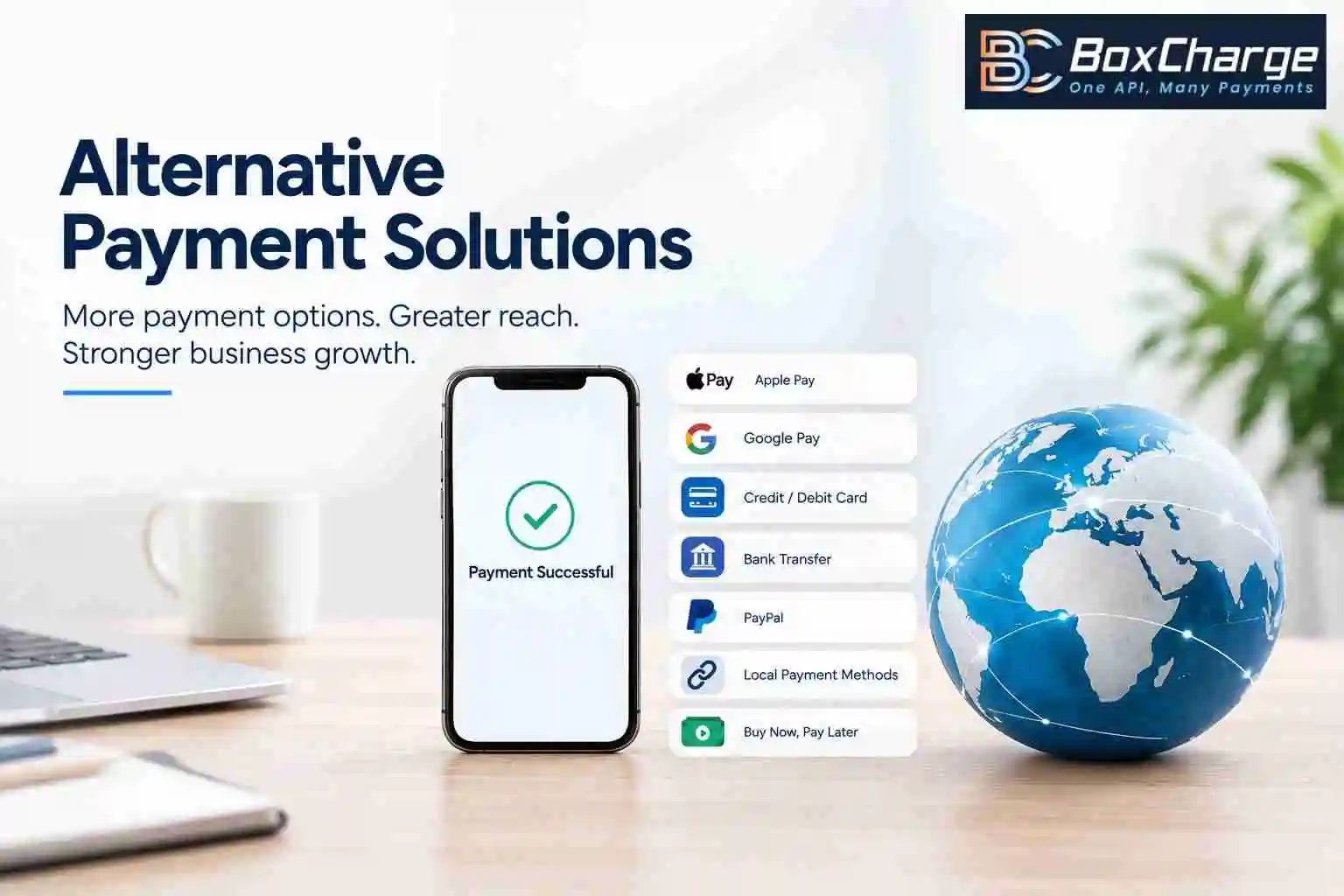
For online businesses, offering only credit and debit cards is no longer enough. Customers increasingly expect alternative payment solutions such as digital wallets, bank transfers, account-to-account payments, local payment methods, and other alternative payment methods that fit the way they already manage money.
That shift matters even more for businesses operating internationally or in higher-risk sectors. A merchant can have strong demand but still lose sales because a customer’s preferred payment method is missing, an international card is declined, or the payment flow creates too much friction.
Alternative payment methods (APMs) now cover a broad range of options beyond traditional cards and cash, including digital wallets, bank transfers, account-to-account payments, BNPL and regional payment methods. Recent industry research shows that digital wallets, payment apps, account-to-account networks and flexible payment methods are becoming an increasingly important part of the global payment mix.
For merchants, the question is no longer simply “Can I accept online payments?” It is “Can my customers pay using the method they trust, in the market where they live?”
What Are Alternative Payment Solutions?
Alternative payment solutions are payment methods and supporting infrastructure that allow businesses to accept payments outside traditional card-based transactions.
Depending on the market and provider, this can include:
Digital wallets such as Apple Pay, Google Pay and PayPal
Bank transfers and account-to-account payments
Local payment methods such as iDEAL, PIX, UPI and Bancontact
Buy now, pay later services
QR-based payment methods
Regional wallets and banking apps
Certain digital-asset payment options where legally and commercially appropriate
Stripe's 2026 overview similarly defines alternative payment methods as options beyond cash, debit and credit cards, with digital wallets, bank transfers, cryptocurrency, BNPL and account-to-account payments among the main categories.
The important distinction is that an APM is not always a replacement for a merchant account or payment gateway. In many cases, businesses need an acquiring relationship, gateway connectivity, and payment infrastructure that can connect several methods through one checkout.
Why Are Alternative Payment Methods Becoming More Important?
Customer payment preferences vary dramatically by country.
A buyer in the UK may be comfortable with cards, digital wallets, or bank-based payments. A customer in Europe may expect a familiar local bank payment method. A buyer in Brazil may prefer PIX, while customers in India are highly accustomed to UPI.
Offering only cards can therefore create unnecessary payment friction.
Global Payments' 2026 research found that payment apps, including digital wallets, account-to-account services, BNPL and banking apps, represented 37% of global point-of-sale transaction value in 2025 and are forecast to reach 46% by 2030.
For international merchants, this has a direct commercial implication: payment localization is becoming part of conversion strategy.
A customer should not have to change how they pay simply because they are buying from an overseas business.
Which Alternative Payment Methods Should an Online Business Consider?
There is no universal list that works for every merchant. The right combination depends on customer geography, average transaction value, business model, recurring-payment requirements, risk profile, and settlement needs.
Digital wallets
Digital wallets simplify checkout by allowing customers to use stored payment credentials or balances rather than manually entering card details.
They are particularly useful for mobile-first businesses and international ecommerce because customers are already familiar with the wallet interface.
For merchants, wallet acceptance can also provide another payment path when a customer does not want to enter card details directly.
Bank transfers and A2A payments
Account-to-account payments, often described as Pay by Bank, allow customers to pay directly from their bank account.
These methods can be commercially attractive for certain markets and transaction types because they do not depend on traditional card rails. They can also be useful for higher-value transactions where customers prefer bank-based payments. A2A payments are increasingly being used for both one-off transactions and some recurring-payment use cases.
Local payment methods
Local payment methods are especially important for cross-border businesses.
Examples can include:
Market or Region | Examples of Payment Methods |
Europe | iDEAL, Bancontact, SEPA, P24 |
Latin America | PIX, Boleto, OXXO |
India | UPI |
Australia | PayID |
Selected global markets | Digital wallets, local bank-based methods |
Availability, settlement and eligibility vary by acquiring partner, merchant profile and jurisdiction. BoxCharge currently advertises connectivity to regional APMs across multiple international corridors, including SEPA, iDEAL, PIX, UPI, Bancontact, Boleto, OXXO, P24 and PayID.
Buy Now, Pay Later
BNPL can be useful for eligible ecommerce merchants selling products or services where splitting payments may improve affordability.
However, merchants should assess the commercial structure carefully, including fees, customer eligibility, settlement terms, refunds and dispute responsibilities.
Other payment methods
Some businesses may also evaluate QR payments, payment apps or digital-asset payment solutions. These require additional consideration around regulations, transaction monitoring, settlement, customer demand, and provider acceptance.
The right strategy is not to add every possible payment method. It is to add the methods that customers actually use.
Why High-Risk Merchants Need Alternative Payment Solutions
The need can be even more pressing for high-risk merchants.
Businesses in sectors such as gaming, gambling, forex, subscriptions, digital services, travel, and other specialist industries can face stricter underwriting, higher chargeback exposure, rolling reserves, processing restrictions, and settlement delays.
For a high-risk merchant, payment instability can quickly become a business problem.
Imagine an online merchant that has spent heavily on customer acquisition. Sales are growing, but card declines begin increasing. A processor then introduces additional controls or a reserve requirement. International customers encounter more friction, while the merchant has limited alternatives.
Revenue may still exist, but the payment infrastructure becomes the bottleneck.
This is why many high-risk businesses look beyond a single card-processing route.
Alternative payment solutions can provide additional payment paths, but they should not be treated as a guaranteed workaround for underwriting or account restrictions. The merchant still needs appropriate onboarding, transaction monitoring, compliance controls, and payment partners willing to support the business model.
What Problems Are High-Risk Account Holders Actually Facing?
One of the biggest misconceptions about high-risk payment processing is that getting approved solves everything.
In practice, high-risk account holders can still face:
1. Application rejections: A merchant may struggle to obtain an account because of industry classification, geography, business model, or processing history.
2. Rolling reserves: A percentage of processed funds may be held, reducing immediately available working capital. The percentage, release period, and conditions can materially affect cash flow.
3. Settlement delays: A transaction can be successfully authorized while the merchant still experiences delays before funds reach the business bank account.
4. Chargeback pressure: A rise in disputes may trigger closer monitoring, higher reserves or changes to processing arrangements.
5. Recurring-payment instability: Subscription businesses can be particularly exposed when payment credentials expire, transactions fail, or a provider does not support the required recurring-payment structure.
6. Sudden account reviews: Approval is not necessarily permanent. Changes in transaction volume, customer geography, chargebacks, or other risk indicators can result in additional reviews.
For these merchants, diversification is often less about “finding a cheaper payment method” and more about building a payment setup that can continue operating as the business grows.
Do Alternative Payment Solutions Reduce Payment Risk?
Not automatically.
This is an important distinction.
Adding an APM does not eliminate fraud, chargebacks, compliance requirements or merchant-account risk. Different payment methods have different transaction flows, dispute models, fraud characteristics, and settlement arrangements.
The objective should be to build a balanced payment strategy.
For example, an international business might combine:
Cards + digital wallets + local payment methods + bank-based payments
and then connect those methods through a payment gateway or orchestration layer.
That structure gives the merchant more flexibility without forcing customers into one payment route.
Alternative Payment Solutions vs. Traditional Card Processing
Factor | Traditional Card Processing | Alternative Payment Solutions |
Customer choice | Usually card-focused | Broader payment choice |
International localization | Limited without additional setup | Can support local methods |
Digital wallet support | May require separate integration | Can be integrated into checkout |
Bank-based payments | Usually separate | Can be part of APM strategy |
Mobile checkout | Strong | Often highly relevant |
Market expansion | May need additional acquiring | Local methods can support expansion |
High-risk suitability | Depends on provider | Depends on method and underwriting |
Integration | May use one gateway | Can require multi-method infrastructure |
The important point is that alternative payments and card payments are not necessarily competing strategies.
For many global businesses, they work best together.
How Should Businesses Choose Alternative Payment Solutions?
Before integrating an APM, ask five practical questions.
Q: Where are my customers located?
Payment preferences are highly regional. Start with actual customer geography rather than adding methods based on popularity alone.
Q: Which payment methods do those customers already trust?
Look at transaction data, abandoned checkouts, and customer feedback.
Q: Does the method support my business model?
Subscription businesses need to consider recurring billing. Marketplaces need to consider split payments and settlement. High-risk businesses need to confirm that the provider actually supports their category.
Q: How will funds be settled?
Review currencies, settlement timeframes, conversion costs, and reserve requirements.
Q: Can the infrastructure scale?
A payment setup that works at £50,000 per month may not be sufficient at £500,000 or across several markets.
This is where payment orchestration, multi-acquirer processing and smart routing can become commercially relevant. BoxCharge currently positions its infrastructure around multiple acquiring connections, payment orchestration, local APM connectivity and international settlement capabilities.
What Should an International Merchant Look for in an APM Provider?
For international and high-risk businesses, the provider should be evaluated beyond its advertised transaction fee.
Look at the full payment infrastructure:
APM coverage: Does it support the countries where customers actually live?
Multi-currency processing: Can the business accept and settle payments in commercially relevant currencies?
Payment gateway connectivity: Can cards, wallets and local methods operate through a coordinated checkout?
Fraud prevention: Are transaction monitoring, authentication and risk controls available?
Chargeback management: What processes exist when disputes increase?
Recurring billing: Can subscriptions be tokenized and managed correctly?
Acquiring coverage: Does the provider have relevant acquiring relationships for the merchant's target markets?
Settlement flexibility: Are settlement currencies, timelines and reserve requirements clear?
Scalability: Can the setup support higher volumes without forcing a complete infrastructure change?
These questions become especially important for merchants that have already experienced processor shutdowns, payment declines or restricted access to mainstream acquiring.
Frequently Asked Questions
Q: What are alternative payment solutions?
Alternative payment solutions are payment methods and infrastructure beyond conventional card and cash payments. Examples include digital wallets, bank transfers, account-to-account payments, local payment methods, and BNPL.
Q: Are alternative payment methods useful for international businesses?
Yes. Local payment methods can make checkout more familiar to customers in different markets and can form part of a broader cross-border payment strategy. However, availability depends on the merchant, country, provider, and acquiring setup.
Q: Are alternative payment solutions suitable for high-risk merchants?
They can be, but eligibility is not automatic. High-risk merchants still need appropriate underwriting, compliance, risk monitoring, and acquiring support.
Q: Can alternative payment methods replace a merchant account?
Not necessarily. Many alternative payment methods still require payment gateway, acquiring, settlement, and merchant-account infrastructure behind the checkout.
Q: Do alternative payment methods reduce chargebacks?
They may change the merchant's payment and dispute profile, but they do not eliminate fraud or disputes. Merchants should evaluate each payment method's specific risk and dispute process.
Q: What is the best alternative payment method for an online business?
There is no single best method for every business. The appropriate choice depends on customer location, transaction value, business model, currencies, recurring-payment requirements, and payment-provider support.
Build a Payment Strategy Around Your Customers
Alternative payment solutions are becoming a core part of modern payment processing because global customers no longer expect one universal way to pay.
For a growing business, the objective should not be to collect as many payment methods as possible. It should be to create a payment mix that matches customer behaviour, market requirements, and business risk.
For high-risk merchants, that means going one step further. Payment acceptance needs to be supported by appropriate underwriting, fraud prevention, chargeback management, reliable settlement, and infrastructure that can handle international growth.
A merchant account may get the business started. A well-designed payment ecosystem helps keep it moving.
For businesses evaluating alternative payment methods, local payment methods, digital wallets, cross-border payment processing, or high-risk payment infrastructure, BoxCharge provides a global payment setup combining merchant services, gateway connectivity, payment orchestration, and regional APM access, subject to merchant profile, jurisdiction, and partner availability.
Ready to review your payment setup? Contact the BoxCharge team to discuss a payment structure aligned with your markets, customers, and processing requirements.