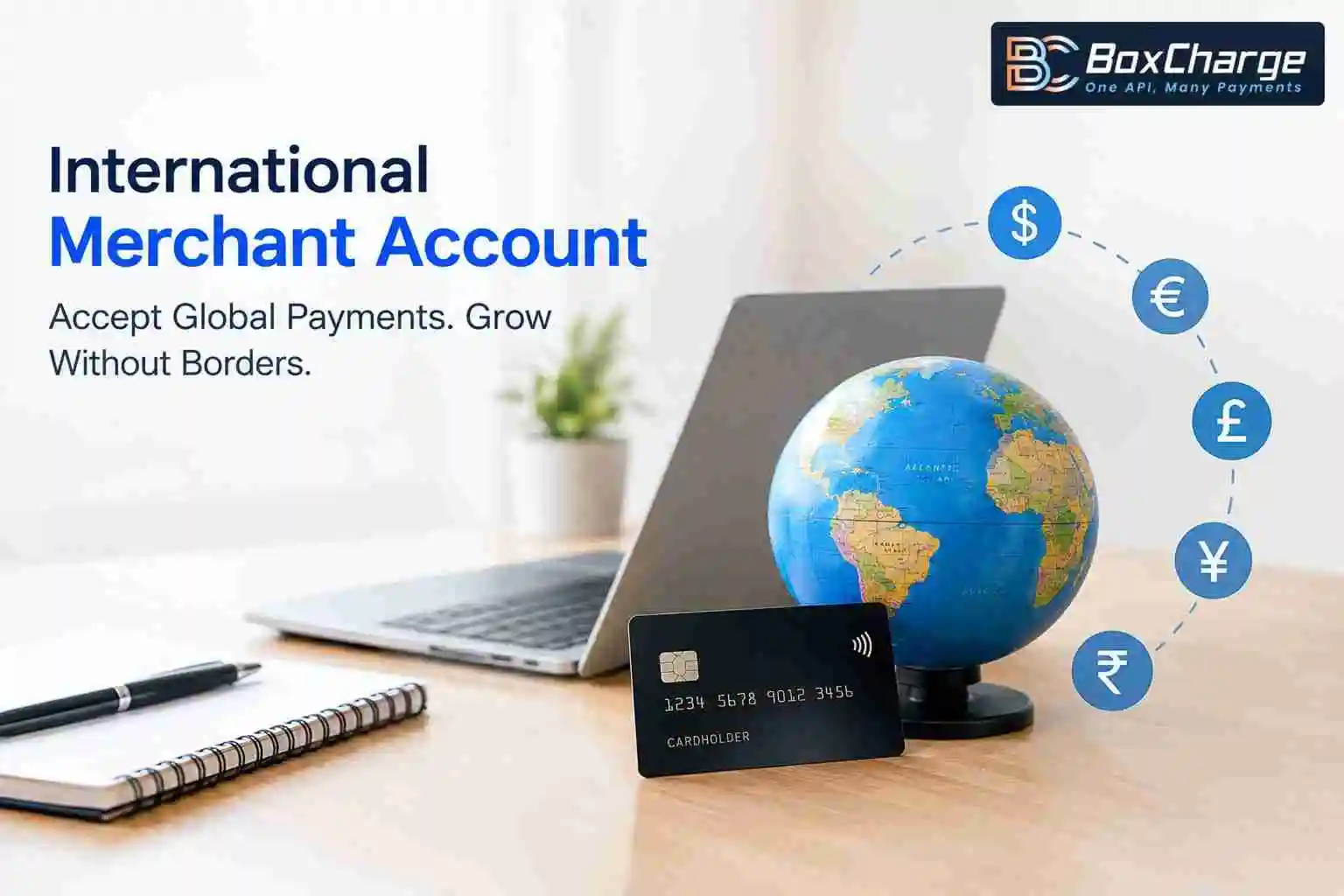
An International Merchant Account helps businesses accept payments from customers across different countries and currencies while supporting international card transactions and cross-border payment processing. For companies expanding globally, choosing the right merchant account can directly affect payment acceptance, cash flow, customer experience, and revenue growth.
For high-risk businesses, the decision matters even more. Forex platforms, gaming businesses, subscription companies, digital services, travel businesses, and other high-risk merchants can face stricter underwriting, higher processing costs, rolling reserves, settlement delays, transaction limits, and account restrictions.
A business may have strong sales and legitimate customers but still struggle to find a payment provider willing to support its model internationally.
That is why choosing the right international merchant account provider is not simply about accepting foreign cards. It is about building payment infrastructure that supports international customers, multiple currencies, higher transaction volumes, and your business's specific risk profile.
In this guide, we explain what an International Merchant Account is, how it works, what high-risk merchants should consider before applying, and how the right international payment processing setup can support sustainable global growth.
What Is an International Merchant Account?
An international merchant account is a specialized payment processing account that enables a business to accept payments from customers in different countries and markets.
It sits within the payment infrastructure that connects the customer, payment gateway, acquiring bank, card network, merchant account, and the merchant's business bank account.
A simplified payment flow looks like this:
Customer → Payment Gateway → Acquirer/Processor → Merchant Account → Business Bank Account
The exact structure can vary depending on the acquiring bank, payment provider, country, currency, and business model.
Unlike a domestic merchant account designed primarily for one market, an international setup is built around cross-border payment processing, international customers, multiple currencies, and global payment acceptance.
For businesses selling internationally, this can make a significant difference to payment reliability and customer experience.
How Does an International Merchant Account Work?
The process is similar to standard card processing, but international transactions can involve additional layers.
A typical transaction works like this:
A customer purchases a product or service online.
The customer selects a supported payment method.
The payment gateway securely transmits the transaction information.
The acquiring bank or processor sends the transaction through the relevant card network.
The customer's issuing bank approves or declines the payment.
Approved funds are processed through the merchant account.
The funds are eventually settled into the merchant's nominated business account.
For international transactions, the payment may also involve currency conversion, cross-border acquiring, foreign exchange costs, local payment methods, and additional risk or compliance checks.
That is why simply finding a payment gateway that accepts international cards is not always enough. The underlying acquiring and settlement structure matters too.
Why Do Businesses Need an International Merchant Account?
Global commerce has changed the expectations customers have around payments.
A customer may be willing to buy from an overseas company, but they still expect the checkout to feel familiar, secure, and convenient.
An effective international payment setup can help businesses:
Accept payments from international customers
Process transactions in multiple currencies
Support international credit and debit cards
Improve payment acceptance across different markets
Reduce unnecessary checkout friction
Support cross-border expansion
Manage international settlement requirements
Add alternative payment methods where appropriate
Build a more scalable payment infrastructure
For businesses planning international growth, payments should be considered before entering a new market—not after payment failures start affecting sales.
International Merchant Accounts Are Especially Important for High-Risk Businesses
This is where the situation becomes more complicated.
A conventional ecommerce business may have several merchant account options available. A high-risk merchant often does not have the same flexibility.
Businesses operating in industries such as forex, gaming, subscriptions, digital services, nutraceuticals, travel, adult businesses, or other elevated-risk categories can face more detailed underwriting and ongoing monitoring. BoxCharge's existing high-risk payment guidance similarly identifies industry, transaction profile, chargeback exposure, international activity, and regulatory considerations as factors that can influence risk classification.
The problem is not necessarily that the business is illegitimate.
The problem is that the payment provider may see greater potential exposure from chargebacks, fraud, regulatory requirements, recurring billing, international transactions, or the business model itself.
What High-Risk Merchants Are Really Struggling With
For high-risk account holders, payment problems can appear at almost every stage of growth.
High-risk merchant account application rejection is often the first obstacle. A business can have a legitimate product, real customers, and strong revenue potential but still struggle to find an acquiring partner willing to underwrite its business model.
Then comes the next problem: payment stability.
A merchant may finally get approved, start processing transactions, and begin scaling—only to face additional reviews, rolling reserves, settlement delays, transaction limits, or account restrictions.
That can be particularly damaging for businesses that depend on consistent cash flow.
Imagine spending heavily on marketing, generating more customers, and increasing monthly sales, only to discover that your payment infrastructure cannot comfortably handle the additional volume.
Growth becomes a payment risk instead of a commercial opportunity.
Common Pain Points of High-Risk Merchant Account Holders
1. Difficulty Getting Approved
Traditional payment providers often use standardized risk models. Businesses that fall outside those models can face rejection or lengthy underwriting.
For a high-risk business, finding a provider with experience in the relevant industry can therefore be more valuable than simply choosing the provider advertising the fastest approval.
2. Sudden Account Reviews or Holds
A sudden increase in processing volume can trigger additional scrutiny.
For example, a business processing $100,000 per month may suddenly reach $300,000 after a successful marketing campaign. From the merchant's perspective, that is good news.
From a risk perspective, the processor may want to understand why transaction volume changed so quickly.
Without suitable preparation and documentation, this can create unnecessary operational friction.
3. Delayed Settlements
Cash flow is critical for any business, but it is particularly important for merchants paying suppliers, advertising platforms, employees, affiliates, or service providers.
Delayed settlement can make a growing business feel cash-poor even when sales are increasing.
A Best international merchant account provider should clearly explain settlement schedules, supported currencies, reserves, and applicable conditions before processing begins.
4. Higher Processing Costs
High-risk payment processing can cost more than standard processing because the acquiring partner is taking on additional potential exposure.
Merchants should therefore avoid comparing providers based solely on the advertised transaction rate.
The real cost may also include:
Chargeback fees
Gateway charges
Currency conversion costs
Rolling reserves
Monthly fees
Refund costs
Cross-border transaction charges
Alternative payment method fees
A slightly higher processing rate can sometimes be commercially preferable if the overall infrastructure provides greater stability and better payment acceptance.
5. Declined International Transactions
A customer reaching checkout does not automatically mean the sale will happen.
International transactions can be affected by issuer decisions, fraud controls, currency issues, geographic restrictions, transaction limits, and payment routing.
For a global merchant, repeated declines can mean lost revenue and frustrated customers.
This is why international payment processing should be evaluated based on actual transaction performance rather than simply whether a provider technically supports international cards.
International Merchant Account vs. Standard Merchant Account
The fundamental purpose is similar: both facilitate electronic payment processing.
The difference is generally the markets, currencies, risk profile, and payment infrastructure involved.
Standard Merchant Account | International Merchant Account |
Primarily domestic processing | Designed for international transactions |
Often focused on one market | Supports multiple markets |
Limited currency requirements | Multi-currency capabilities may be available |
Standard risk profile | Can accommodate more complex risk profiles |
Domestic settlement focus | International settlement considerations |
Fewer cross-border requirements | Cross-border processing and compliance considerations |
These are general distinctions. Actual terms depend on the acquiring bank, merchant industry, countries served, transaction history, and underwriting decision.
What Should You Look for in an International Merchant Account Provider?
Choosing an international merchant account provider is a commercial decision. The cheapest option is not automatically the best option.
Before applying, look at the following.
Industry Experience
If you operate a high-risk business, ask whether the provider actually supports your business category.
Experience with your industry can make the underwriting process more relevant and reduce the risk of selecting a provider that was never designed for your transaction profile.
International Processing
Check which countries, currencies, card networks, and payment methods are supported.
If your customers are concentrated in specific markets, make sure those markets are commercially supported rather than relying on a generic claim of "global acceptance."
Multi-Currency Payment Processing
If customers pay in EUR, GBP, USD, CAD, AUD, SGD, or other currencies, determine how transactions are processed and settled.
Multi-currency payment processing can help international businesses reduce unnecessary currency friction and create a more localized checkout experience.
Settlement Terms
Ask important questions before signing up:
How frequently are funds settled?
Which settlement currencies are available?
Is a reserve required?
What can trigger a reserve review?
Are there transaction or volume limits?
How are refunds handled?
These details can have a direct impact on working capital.
Fraud and Chargeback Management
A reliable high-risk payment processing setup should include appropriate tools for monitoring suspicious transactions and managing disputes.
The goal is not to block every potentially risky customer. Excessive fraud controls can create false declines and damage conversion rates.
The objective is balanced risk management.
Technical Integration
Your payment infrastructure should work with your website, ecommerce platform, billing system, CRM, or trading platform where applicable.
API capabilities, recurring billing, tokenization, reporting, payment routing, and transaction monitoring can become increasingly important as transaction volumes grow.
Can High-Risk Businesses Get an International Merchant Account?
Yes, but approval is not guaranteed.
High-risk businesses can obtain international payment processing when an acquiring partner is prepared to support their business model and the merchant satisfies the provider's underwriting and compliance requirements.
A strong application should clearly explain:
What the business sells
Where customers are located
Expected transaction volume
Average transaction value
Refund and cancellation policies
Chargeback history
Processing history
Business ownership
Website and terms
Compliance procedures
Expected international transaction activity
The more clearly the provider can understand the business, the easier it is to assess the actual risk.
Why the Right International Payment Setup Matters for Growth
Payment processing is easy to ignore when everything works.
It becomes impossible to ignore when it fails.
For a growing international business, an unreliable payment system can lead to:
Lost sales → frustrated customers → cash-flow pressure → operational disruption → slower growth
A stronger payment infrastructure works in the opposite direction.
More payment options → better customer experience → stronger payment acceptance → more stable settlements → scalable growth
That is why international merchant accounts are more than a way to accept foreign cards. They can become part of the commercial infrastructure supporting international expansion.
For high-risk merchants, this is particularly important.
Your business may already be dealing with higher scrutiny, more complicated underwriting, chargeback exposure, and stricter processing conditions. Adding an unsuitable payment provider can make those problems worse.
Is an International Merchant Account Right for Your Business?
An international merchant account may be worth considering if your business:
Accepts customers from multiple countries
Processes international card payments
Requires multi-currency payment acceptance
Operates in a high-risk industry
Has experienced merchant account rejection
Has experienced payment holds or settlement delays
Wants to expand into new international markets
Needs a payment gateway for international customers
Requires a more flexible acquiring structure
The important point is to choose infrastructure around your actual business model—not force your business into a payment structure designed for a completely different merchant.
Final Thoughts
An international merchant account can give global businesses access to the payment infrastructure they need to accept international customers, manage different currencies, and support cross-border growth.
But for high-risk merchants, choosing the right setup requires more than finding a provider that says "we accept international businesses."
You need to consider underwriting, processing stability, payment acceptance, chargebacks, settlement terms, currencies, compliance, technical integration, and scalability.
The right payment partner should understand where your business is today and where you are trying to take it.
If your current payment provider is rejecting your application, delaying settlements, limiting international transactions, or creating uncertainty around your cash flow, it may be time to review your payment infrastructure.
Talk to BoxCharge for global merchant services and international acquiring connectivity for businesses operating across multiple markets, with structured onboarding, risk-aware setup, multi-currency processing, and partner-led payment activation.
For businesses looking for an international merchant account, a high-risk merchant account, or a global payment processing solution, the first step is finding a payment structure that fits the business—not simply finding the fastest approval.