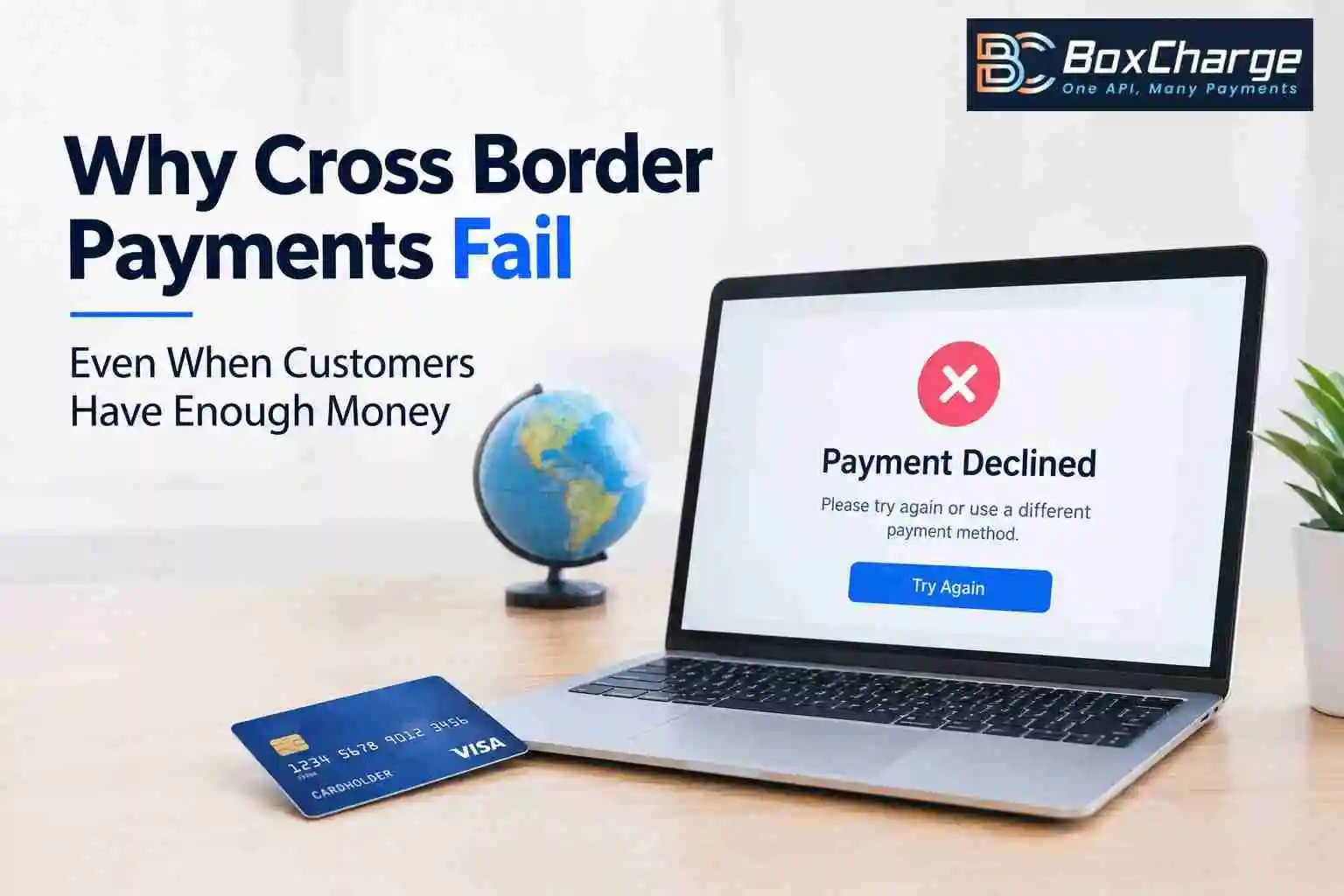
Cross-border payments can fail even when a customer has enough money, a valid card, and every intention of completing the purchase. For businesses selling internationally, this is one of the most frustrating payment problems because the customer often sees only a simple “Payment Declined” message while the actual failure may have happened several steps earlier in the transaction.
A cross-border transaction can involve the merchant, international payment gateway, payment processor, acquiring bank, card network, issuing bank, authentication systems, fraud tools, and currency conversion. A problem at any stage can prevent authorization.
For high-risk merchants, the situation can be even more difficult. Forex businesses, gaming platforms, online gambling operators, subscription businesses, digital services, and other higher-risk merchants may face additional underwriting, fraud monitoring, chargeback controls, reserves, and transaction restrictions.
Understanding why international transactions fail is therefore essential for businesses that want to accept global payments online without unnecessarily losing legitimate customers.
Having Enough Money Does Not Guarantee a Successful Payment
Customers naturally assume that a payment should succeed if their account has sufficient funds. Payment infrastructure looks at much more than the available balance.
The issuing bank may assess the transaction amount, merchant location, cardholder location, spending history, transaction pattern, authentication result, currency, and fraud indicators before approving the payment.
This becomes more complicated when a transaction crosses borders.
For example, a customer in the United Kingdom may purchase from a U.S.-based merchant while using a GBP card. The merchant could have an acquiring relationship in another jurisdiction, and the transaction may be processed in USD. Each additional variable can introduce another risk or authorization signal.
That is why global payment processing requires more than simply connecting a card form to a payment gateway.
1. The Customer's Bank May Decline the Transaction
The issuing bank has significant influence over whether a card transaction is authorized.
A bank may decline a transaction because it appears unusual, originates from an unfamiliar merchant location, involves an unexpected transaction amount, or does not match the customer's normal spending behavior.
Consider a customer who normally makes purchases in the U.K. but suddenly attempts a large international transaction while traveling in the U.S. The customer's account may have sufficient funds, but the issuer's fraud systems may still consider the transaction suspicious.
From the merchant's perspective, this can look like an unexplained decline.
The important point is that merchants cannot eliminate every issuer decline. Instead, they need payment infrastructure capable of reducing avoidable failures and providing useful transaction information.
2. International Fraud Screening Can Block Legitimate Customers
International transactions naturally create additional fraud signals.
The card-issuing country, billing address, IP address, device location, customer location, and merchant location may not match. This does not necessarily indicate fraud.
A genuine customer could be:
Traveling internationally
Using a corporate card
Purchasing from another country
Using a VPN
Paying for a digital service
Using a card issued in a different country
However, an aggressive fraud engine may interpret several of these signals together as suspicious.
This is particularly important for merchants using international payment processing services. Fraud controls should protect the merchant without making legitimate international customers fight through unnecessary payment declines.
For high-risk businesses, finding this balance is even more important.
3. AVS and CVV Checks Can Create Unnecessary Declines
AVS and CVV verification are widely used to identify potentially fraudulent transactions.
The problem is that international address formats are not always consistent.
A customer's billing address may be entered differently from the format stored by the issuing bank. Postal codes, apartment numbers, address structures, and verification capabilities can vary between markets.
If the merchant's fraud rules automatically reject every mismatch, legitimate transactions can be lost.
This is one reason an international ecommerce payment gateway should provide flexible risk controls rather than relying on one simple pass-or-fail rule.
4. 3D Secure Authentication Can Fail
3D Secure can provide an additional layer of authentication for eligible card transactions, but authentication itself can become a source of payment failure.
A customer might be asked to verify a transaction through their banking application, a one-time password, or another authentication method.
The payment may fail if the customer:
Does not complete the authentication
Closes the verification window
Enters incorrect information
Cannot access their banking application
Experiences a technical issue
Abandons the checkout process
For merchants operating internationally, a reliable international online payment solution should make authentication as seamless as possible while maintaining appropriate security controls.
5. The Acquiring Relationship May Not Suit the Transaction
This is one of the payment problems customers rarely understand.
The acquiring side of the payment ecosystem plays an important role in authorization performance. A merchant serving customers across several countries may experience different results depending on its acquiring coverage, transaction routing, currencies, and business category.
A merchant might have strong demand from the U.S., U.K., Canada, and Europe but still use a payment structure designed primarily for one domestic market.
This can lead to:
Higher decline rates
Limited currency support
Restricted payment methods
Poor regional authorization performance
Higher payment friction
This is where worldwide payment gateway solutions and appropriate acquiring relationships become commercially valuable.
The goal is not simply to process transactions from different countries. The goal is to create a payment structure that works effectively across the markets the business actually serves.
6. High-Risk Merchants Face Additional Payment Pressure
High-risk merchants often experience these challenges at a completely different level.
A conventional e-commerce business may already have to manage fraud and chargebacks. A high-risk merchant may also face stricter underwriting, enhanced monitoring, rolling reserves, transaction limits, geographic restrictions, and additional compliance reviews.
This can affect legitimate transactions.
Imagine a gaming or subscription business that suddenly doubles its monthly processing volume after a successful marketing campaign. The increase may be commercially positive, but a sudden change in transaction activity can trigger additional monitoring.
The merchant may then experience:
More transaction reviews
Increased reserve requirements
Delayed settlements
Higher scrutiny
Transaction limits
Payment declines
Requests for additional documentation
For businesses using offshore high-risk merchant accounts, the payment structure becomes even more important. The merchant's company jurisdiction, operating location, customer geography, acquiring relationship, industry, and transaction profile all need to make sense to the payment provider.
Getting approved is only the beginning. The real objective is maintaining stable processing as the business grows.
7. Currency Differences Can Add Payment Friction
Currency is another important consideration in cross-border commerce.
A customer may have a EUR card while purchasing from a merchant that charges in USD. The issuer then needs to process a foreign-currency transaction, and the customer may also be subject to currency conversion rules or fees.
Currency conversion itself does not automatically cause a decline, but it can add complexity to the payment journey.
Businesses serving several markets should therefore consider global merchant payment services that support relevant currencies and settlement requirements.
Multi-currency processing can also make the checkout experience more familiar. Customers are generally more comfortable when they understand exactly what they are being charged.
8. The Payment Gateway Can Become the Weakest Link
Not every failed transaction is caused by the customer's bank.
Sometimes the issue sits within the merchant's payment technology.
A payment gateway has to transmit transaction information securely, communicate with payment infrastructure, handle authentication, apply fraud controls, and return an authorization response.
Technical problems can occur because of:
API errors
Gateway timeouts
Incorrect integrations
Unsupported payment methods
Authentication failures
Routing problems
Configuration errors
Payment processor connectivity issues
For merchants processing international transactions at scale, an international payment gateway should provide more than basic card acceptance.
Important capabilities can include 3D Secure, tokenization, fraud screening, multi-currency processing, transaction monitoring, alternative payment methods, reporting, and intelligent transaction routing.
Why Failed Cross-Border Payments Hurt High-Risk Merchants More
For high-risk businesses, payment failures can directly affect customer acquisition economics.
A merchant may spend thousands of dollars on advertising to bring a customer to its website. The customer selects a product or service, reaches checkout, has enough money, and then receives a decline.
The merchant has paid for the acquisition but lost the transaction.
The problem becomes worse when customers repeatedly attempt payment. Multiple failed attempts can create additional fraud signals, while frustrated customers may abandon the business completely.
At the same time, high-risk merchants may already be dealing with higher processing costs, reserves, chargebacks, and stricter account monitoring.
This is why choosing among international merchant account providers should involve more than comparing advertised processing rates.
Authorization performance, settlement stability, fraud controls, acquiring coverage, transaction limits, and scalability can have a much larger commercial impact.
How Merchants Can Reduce International Payment Failures
No payment provider can guarantee that every transaction will be approved. Issuing banks ultimately make many authorization decisions.
However, merchants can reduce avoidable failures by improving the payment infrastructure underlying transactions.
Choose Acquiring Coverage Carefully
The merchant's acquiring relationship should match its target markets, business model, currencies, and transaction profile.
Use Appropriate Fraud Controls
Fraud prevention should identify suspicious behavior without automatically rejecting every transaction containing a regional mismatch.
Optimize 3D Secure
Authentication should add security without unnecessarily disrupting legitimate customers.
Offer Multiple Payment Methods
Cards are important, but international customers may prefer wallets, bank transfers, or regional payment methods.
Monitor Decline Patterns
Merchants should analyze declines by country, issuer, currency, transaction amount, authentication result, and decline reason.
Patterns can reveal whether the issue is primarily issuer-related, gateway-related, fraud-related, or connected to the acquiring setup.
Prepare for Processing Growth
A payment setup that works at $20,000 per month may not perform the same way at $200,000.
Businesses should discuss expected growth with their provider before transaction volume increases significantly.
What Businesses Should Look for in a Global Payment Provider
Businesses operating internationally should evaluate the complete payment infrastructure rather than choosing a provider based only on price.
A suitable provider may need to support international merchant accounts, multi-currency transactions, fraud prevention, 3D Secure, alternative payment methods, recurring payments, chargeback management, and reliable settlement.
Businesses should also ask:
Does the provider support my exact business model?
Which countries can I process in?
Which currencies are supported?
Which acquiring relationships are available?
Are high-risk industries supported?
What reserve requirements apply?
How are chargebacks managed?
What transaction limits apply?
How does the provider handle increased processing volume?
Can the infrastructure support future international expansion?
These questions become particularly important for businesses comparing cross-border payment gateway solutions.
The best solution is not necessarily the one with the lowest headline rate. It is the one that can support the merchant's actual transaction environment while maintaining appropriate risk and compliance controls.
Why Businesses Need More Than Basic International Card Processing
As international commerce grows, businesses increasingly need international payment solutions that cover the entire payment lifecycle.
That means connecting customers to suitable payment methods, routing transactions through appropriate infrastructure, managing authentication and fraud controls, supporting different currencies, handling settlements, and monitoring transaction performance.
For an international business, payment processing should be treated as part of the commercial strategy.
A merchant that can reliably accept global payments online has a much better opportunity to convert international demand into revenue.
A merchant that constantly loses legitimate customers to unexplained declines may have a marketing problem that is actually a payment infrastructure problem.
Final Thoughts
The best cross-border payments gateway provider for high-risk businesses can fail even when customers have sufficient funds because payment authorization depends on far more than account balance. Issuer controls, fraud screening, AVS and CVV checks, 3D Secure, currency, acquiring coverage, gateway reliability, transaction routing, and merchant risk controls can all influence the outcome.
For high-risk merchants, the challenge is greater. Additional underwriting, reserves, transaction monitoring, chargeback exposure, geographic restrictions, and compliance requirements can create payment friction that directly affects revenue and cash flow.
The answer is not to remove fraud controls or chase an unrealistic zero-decline rate. The smarter approach is to build a payment infrastructure that gives legitimate transactions the best reasonable chance of success while maintaining appropriate security and compliance.
A strong international payment gateway combined with suitable acquiring relationships, global payment processing, multi-currency capabilities, and effective risk management can help businesses build a more reliable international checkout experience.
For merchants expanding internationally, the right international payment processing services can turn payment acceptance from a recurring operational problem into a competitive advantage.
BoxCharge helps businesses explore global merchant payment infrastructure designed around international transactions, payment acceptance, acquiring connectivity, and scalable processing requirements. If international payment declines are costing your business customers and revenue, it may be time to look beyond the customer's available balance and examine the payment infrastructure behind the transaction.
Explore BoxCharge's international payment solutions and build a payment setup designed for global growth.