
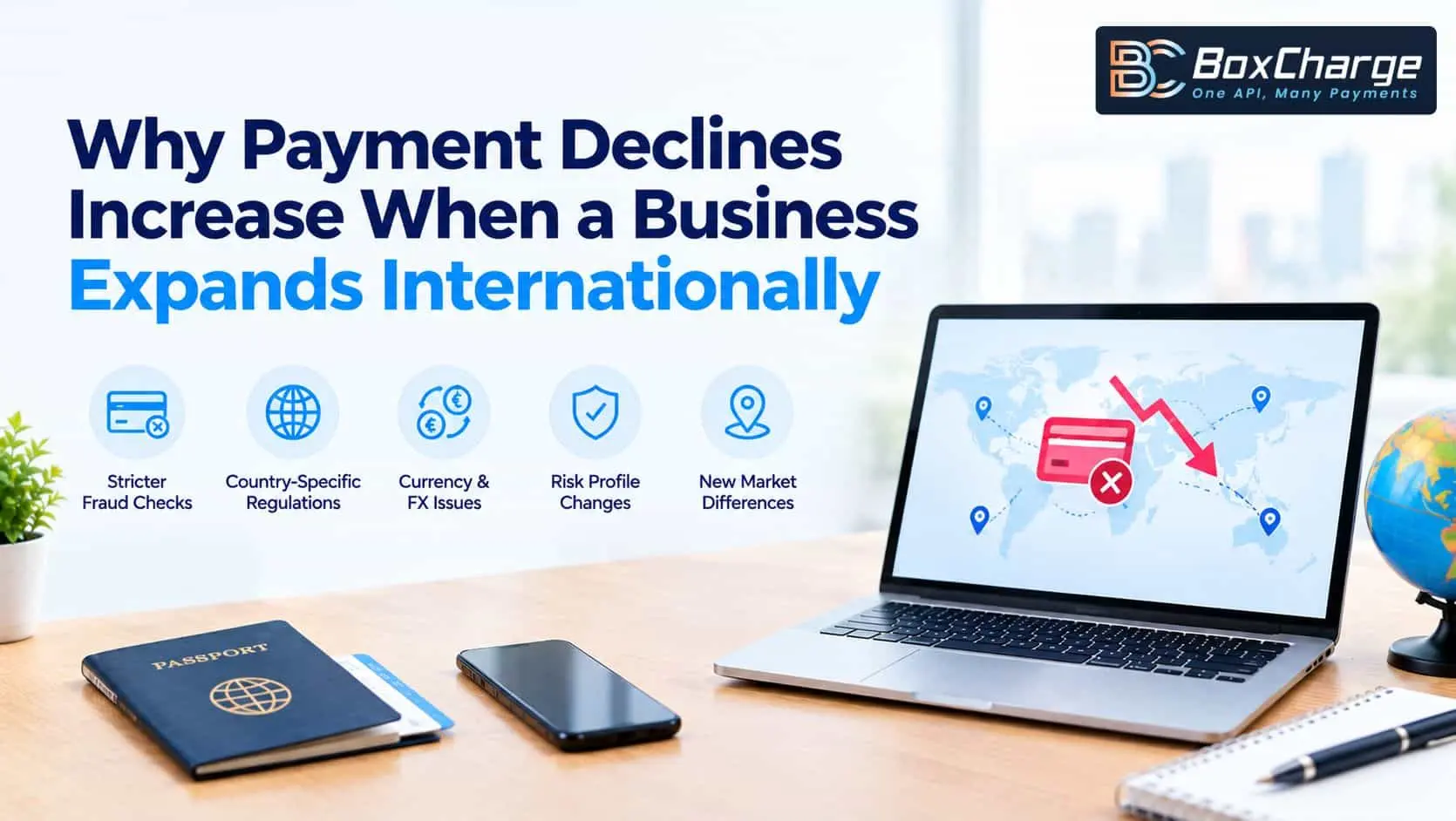
International payment declines often increase when a business expands internationally because every new market introduces different banks, customer behaviour, currencies, fraud patterns, authentication requirements, and payment rules. A payment process that performs well in one country can therefore start losing legitimate transactions as soon as a merchant begins accepting customers from multiple regions.
For high-risk merchants, the problem can be even more serious.
A growing merchant may see more international orders but a lower payment approval rate at the same time. Customers may have sufficient funds and valid cards, yet their transactions are declined because the issuing bank does not have enough confidence in the payment, the transaction appears unusual, authentication fails, or the merchant's acquiring and risk setup is not suited to the new market.
That creates a frustrating situation: sales are increasing, but approved revenue is not keeping pace.
Stripe explains that online authorization can be more difficult than card-present transactions because issuing banks use more conservative decision-making in environments with greater fraud exposure. Its current guidance also points out that legitimate payments can be lost through network and issuer declines.
For an international business, the real challenge is not simply accepting foreign cards. It is building a payment infrastructure that gives issuers, acquirers, and customers enough confidence to complete legitimate transactions.
International expansion changes the risk profile of a transaction
A domestic transaction usually has a relatively familiar pattern.
The merchant operates in one country. The customer is in the same or a nearby market. The card was issued locally. The transaction is presented in the local currency, and the merchant's previous payment behaviour may already be familiar to the issuing bank.
International commerce changes that pattern.
Consider a customer in France buying from a UK business using a card issued in France while travelling in Spain. The customer's IP address, device location, card-issuing country, billing address, and merchant location may all tell a different story.
The transaction can still be completely legitimate.
However, the issuing bank sees a more complicated risk picture.
This is one reason cross-border payment processing requires more than simply enabling international card acceptance. A merchant needs to consider the entire authorization journey, from checkout data and authentication to acquiring and issuer decisioning.
The European Banking Authority and European Central Bank's latest joint report on payment fraud also highlights the geographical dimension of fraud. In 2024, 30% of fraudulent card payments by value were related to cross-border transactions outside the EEA.
That does not mean international transactions are automatically fraudulent. It does mean that geography is an important part of the risk environment surrounding digital payments.
More countries mean more payment rules
International expansion often exposes merchants to payment environments that behave differently from their home market.
A business may enter the UK, Europe, Canada, Australia, and Asia-Pacific and discover that the same fraud rules, authentication settings, and checkout design do not perform equally well everywhere.
Strong Customer Authentication is a good example.
In markets where additional authentication is required, a transaction may need to pass a 3D Secure flow before authorization. Mastercard's transaction rules explicitly provide for situations where an issuer can return a soft decline when required authentication is missing.
EMVCo explains that EMV 3-D Secure allows issuers to assess transaction information and authenticate a cardholder either through a frictionless flow or, where necessary, a challenge flow.
The commercial lesson is important.
3D Secure is not simply something to turn on or off.
Poorly configured authentication can create checkout friction, but intelligently implemented authentication can give the issuer more information and improve confidence in legitimate transactions.
Recent Stripe analysis of 3DS trends also shows that the effect varies significantly by market and that authentication implementation quality matters more than simply increasing or reducing the amount of authentication used.
Payment data matters more than many merchants realise
One of the most overlooked reasons for payment declines is the quality of information being sent with the transaction.
International businesses frequently collect billing information, shipping information, device information and other checkout data, but the payment infrastructure does not always pass useful signals through the authorization chain in the most effective way.
That can leave the issuer with less context for deciding whether the payment is genuine.
EMVCo recommends providing accurate and complete cardholder and transaction information because incomplete or incorrect data can lead to more authentication challenges and, in some cases, declined authentication.
Visa has also been developing enhanced data-sharing approaches intended to give issuers more information when evaluating card-not-present transactions. Its current Digital Commerce Authentication Program, for example, uses data such as device ID, IP address, email address, and full billing address to support more informed authorization decisions.
For merchants, this creates a simple but important principle:
Better transaction data can support better authorization decisions.
High-risk merchants face a much narrower margin for error
International payment declines are frustrating for any business, but high-risk merchants have additional problems to manage.
A high-risk merchant may already deal with stricter underwriting, enhanced due diligence, higher processing costs, rolling reserves, transaction limits, or more detailed compliance reviews.
When international sales grow quickly, the business can suddenly look very different from the profile originally approved by its payment provider.
Transaction volume changes.
Average ticket size changes.
Customer countries change.
Chargeback patterns may change.
The percentage of cross-border transactions rises.
The processor may then reassess the account.
For the merchant, this can create a chain reaction:
more international customers → more payment attempts → more risk signals → more declines → lower conversion → higher customer frustration → greater pressure on cash flow.
This is especially painful for industries where customers are valuable and acquisition costs are already high.
A declined transaction is not only a lost payment. It can also mean a lost customer, a failed subscription renewal, an abandoned high-value order, or a customer who moves to a competitor.
Visa's current merchant guidance emphasizes the commercial importance of authorization performance and reducing false declines, while identifying insufficient funds, suspected fraud, and approval-limit issues among leading decline drivers.
Currency and local payment behaviour can affect conversion
Expanding internationally also changes what customers expect at checkout.
A customer in one country may be completely comfortable entering a card number. Another may expect a local wallet, bank-based payment method or a familiar domestic payment experience.
Currency matters too.
Displaying prices in a customer's local currency can make an international checkout easier to understand, but supporting multiple currencies also means the merchant must ensure that the payment provider, merchant account, and acquiring setup can handle those transactions correctly.
This becomes particularly important for high-risk merchants because not every processor supports every business model, currency, or market under the same commercial terms.
A merchant should therefore evaluate international payment processing based on market coverage and payment reliability, not only the headline processing rate.
One gateway may not be enough as the business grows
A payment gateway is only one part of the payment stack.
As international transaction volumes increase, merchants may need to think about:
Acquiring: Where and through which acquiring relationships are transactions being processed?
Routing: Are transactions always taking the same path, even when another route may be better suited to a particular market?
Authentication: Is 3D Secure being applied intelligently?
Fraud controls: Are legitimate customers being blocked unnecessarily?
Payment methods: Does the checkout support what customers actually use in each market?
Currency: Can the merchant accept and settle the currencies it needs?
Risk management: Can the payment provider support the merchant as volume and geographic exposure increase?
For some businesses, a multi-acquirer payment strategy can provide greater flexibility and resilience than relying on one processing route.
That does not mean every merchant needs multiple providers. It means international expansion should trigger a review of whether the existing payment architecture is capable of supporting the next stage of growth.
How merchants can reduce international payment declines
The first step is to stop looking at declines as one single metric.
An overall approval rate can hide a major problem.
A merchant should examine authorization performance by country, issuing region, currency, payment method, card type, acquirer, transaction value, and decline reason.
That may reveal, for example, that domestic transactions are performing normally while transactions from one international market are being declined at a much higher rate.
Once the problem is visible, the merchant can investigate the actual cause instead of simply lowering fraud controls and hoping approval rates improve.
A strong international payment setup usually includes several complementary measures.
Improve transaction data
Accurate billing information, device signals, cardholder information, and authentication data can help provide better context to payment decisioning systems. EMVCo specifically highlights the importance of accurate merchant-provided data in 3DS authentication.
Review 3D Secure performance market by market
Do not assume that the same authentication strategy should be used everywhere.
Some markets have stronger regulatory requirements. Some issuers may respond differently to authentication requests. Some customers are more likely to abandon a challenge.
The goal should be secure transactions with as little unnecessary friction as possible.
Reduce false positives
Fraud prevention is essential for international ecommerce, but blocking too many legitimate customers can damage revenue.
Visa's current authorization and fraud material specifically focuses on improving approval decisions while reducing false declines.
High-risk merchants should pay particular attention to this balance because aggressive rules can compound an already challenging approval environment.
Choose an acquiring setup that fits the business
The right international merchant account should match the merchant's industry, geographic footprint, expected processing volume, and risk profile.
For a high-risk merchant, this assessment should happen before international expansion—not after payment declines begin increasing.
The bigger problem is usually payment infrastructure, not customer demand
When international sales grow and payment declines rise, merchants sometimes assume the problem is a fraud attack or customers having insufficient funds.
Those are certainly possible causes, but they are not the complete explanation.
Payment authorization is a chain.
The customer enters payment information. The gateway and processor transmit the transaction. The acquirer processes the request. Card networks route it. The issuing bank evaluates it. Fraud and authentication signals can influence the decision at different stages.
A weakness anywhere in that chain can reduce the number of legitimate payments that successfully settle.
That is why international businesses should treat payment performance as a commercial KPI rather than a technical afterthought.
For high-risk merchants in particular, payment infrastructure can directly influence revenue, customer retention and cash-flow stability.
Frequently Asked Questions
Q: Why do payment declines increase when a business goes international?
International transactions can introduce additional geographic, fraud, authentication, currency, and payment-behaviour signals. Issuers may therefore evaluate some transactions more cautiously than comparable domestic payments.
Q: Are high-risk merchants more affected by international payment declines?
They can be. High-risk businesses may already face stricter risk controls, underwriting requirements and chargeback considerations. When international volume and transaction patterns change, the merchant may face additional scrutiny or payment friction.
Q: Can 3D Secure reduce payment declines?
It can help by giving issuers additional authentication information and reducing fraud-related risk, but the implementation needs to suit the market. EMVCo describes both frictionless and challenge flows designed to balance authentication, security, and customer experience.
Q: Should an international merchant use multiple payment providers?
Not every business needs multiple providers. However, growing merchants may evaluate multiple acquiring or routing options when geographic expansion, processing volume or business risk makes a single payment route less suitable.
Q: What should merchants monitor when international approval rates fall?
The most useful starting point is a market-level analysis covering country, issuer region, currency, payment method, acquirer, transaction value and decline reason. This helps separate genuine issuer declines from problems caused by payment configuration, authentication or risk controls.
International Growth Needs International Payment Infrastructure
International expansion can expose weaknesses that were invisible when a business operated in one market.
A payment setup may appear stable at first, yet struggle once transaction volume increases, customers arrive from new countries and the merchant begins processing different currencies and payment methods.
For high-risk businesses, the stakes are even higher. A few percentage points of lost authorization can represent significant revenue, particularly when the merchant is paying heavily for customer acquisition and competing in markets where customers have plenty of alternatives.
The objective should not be to eliminate every decline. Some transactions should be declined.
The objective is to reduce unnecessary declines while maintaining strong fraud, authentication, and compliance controls.
That requires the right combination of payment acquiring, merchant-account structure, transaction data, authentication, fraud management, local payment methods and ongoing authorization monitoring.
For businesses expanding internationally, choosing the right international payment processing solution before problems appear can make a significant difference. For high-risk merchants, working with a payment provider that understands the realities of cross-border processing, risk management, and merchant-account stability can be just as important as the payment gateway itself.
BoxCharge works with businesses that need payment infrastructure designed around international and higher-risk processing requirements. For merchants experiencing rising declines, account pressure, or difficulty supporting new markets, the right next step is to review the existing acquiring and payment setup before international growth turns into lost revenue.
Ready to Reduce International Payment Declines?
International growth should not mean losing legitimate customers at checkout. If rising declines, cross-border transactions, payment routing issues, or high-risk processing challenges are affecting your revenue, it may be time to review your payment infrastructure.
BoxCharge helps businesses explore reliable payment processing solutions built for international and high-risk markets.
Talk to BoxCharge today and find a payment setup designed around your business, target markets, transaction volume, and risk profile.