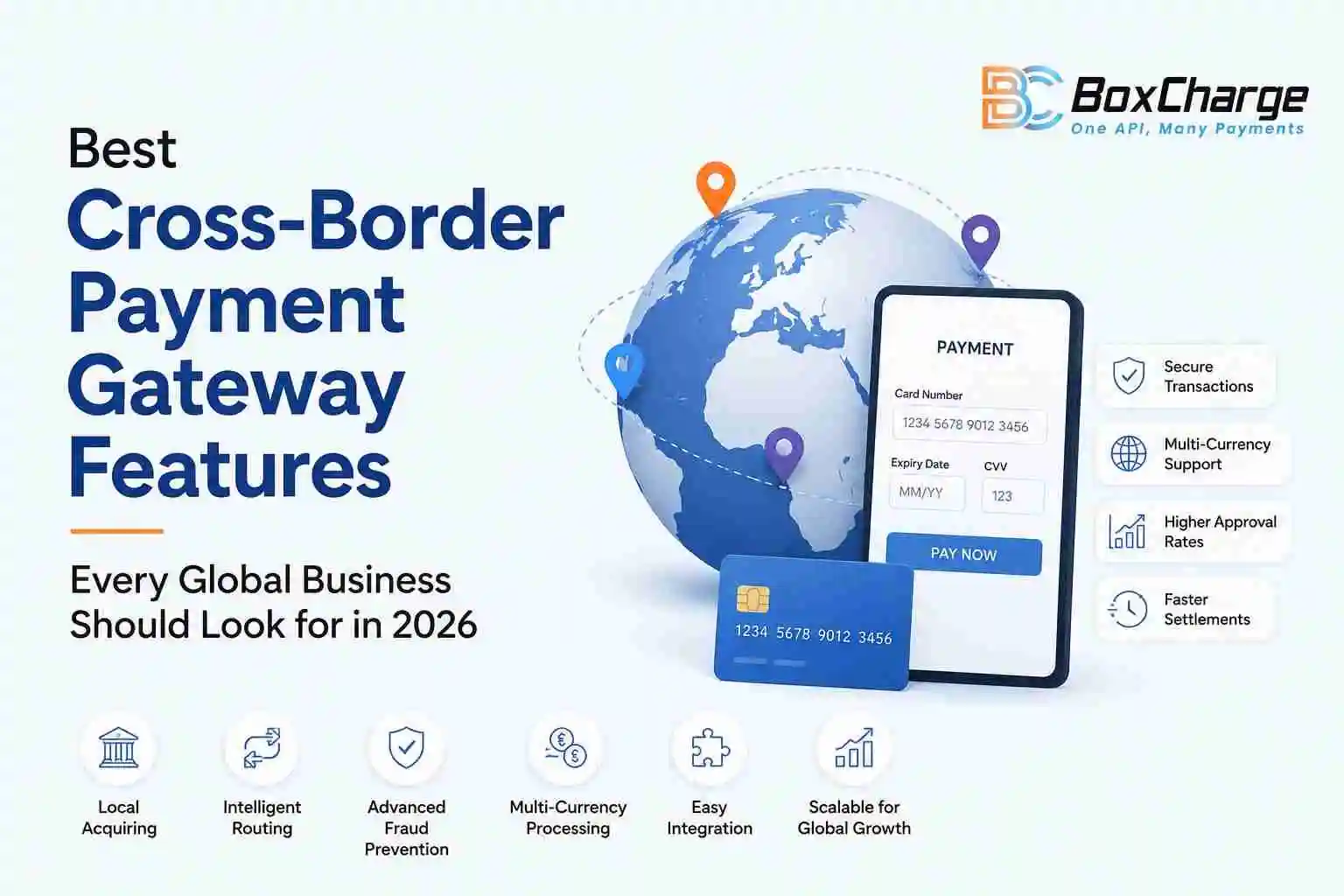
Choosing the Cross-Border Payment Gateway that's right for your business has become more important than ever. As businesses expand into international markets, customers expect fast, secure, and hassle-free payments regardless of where they live. Whether you're running an eCommerce store, SaaS platform, travel company, forex brokerage, subscription business, or another high-risk venture, your payment infrastructure directly influences customer trust, authorization rates, and long-term revenue.
Many businesses assume international payments are simply domestic transactions with different currencies. The reality is far more complex. Every cross-border transaction passes through multiple financial institutions, card networks, acquiring banks, fraud screening systems, and foreign exchange processes before it's approved. A single weak link can result in a declined payment, delayed settlement, or abandoned purchase.
For high-risk merchants, the stakes are even higher. It's not uncommon to face rejected applications, rolling reserves, higher processing fees, delayed payouts, or even sudden account closures despite maintaining a legitimate business. These challenges make choosing the right Cross-Border Payment Gateway more than a technical decision—it's a strategic investment in business continuity and global growth.
The best payment providers don't simply move money from one country to another. They optimize approvals, reduce payment friction, support local payment preferences, and provide the flexibility businesses need to scale internationally without constantly changing payment partners.
Why Cross-Border Payments Are More Challenging Than They Look
A domestic card payment is relatively straightforward. The customer and merchant usually operate under the same banking system, regulatory framework, and currency. Cross-border transactions introduce several additional variables that increase both complexity and risk.
Imagine a customer in Germany purchasing from a UK-based merchant using a credit card issued by a bank in Canada. Before the payment is approved, it may travel through the payment gateway, the card network, one or more acquiring banks, the issuing bank, fraud monitoring systems, currency conversion services, and compliance checks. Every participant evaluates the transaction independently before deciding whether to approve or decline it.
This is why legitimate international payments are sometimes rejected even when the customer has sufficient funds. Issuing banks consider factors such as transaction location, merchant category, historical spending patterns, fraud signals, and the strength of the acquiring relationship before authorizing a payment.
For merchants, these unnecessary declines translate directly into lost revenue. Customers rarely attempt the same payment multiple times. Most simply leave the checkout and buy from a competitor.
An experienced international payment gateway is designed to reduce these issues. Through intelligent routing, regional acquiring relationships, advanced fraud management, and optimized authorization strategies, it increases the likelihood that genuine transactions are approved on the first attempt while keeping fraud under control.
1. Local Acquiring That Improves Payment Approval Rates
One of the most overlooked features of a modern Cross-Border Payment Gateway is local acquiring. While many businesses compare providers based on pricing or supported currencies, the location of the acquiring bank often has a greater impact on payment success than transaction fees.
When a payment is processed through an acquiring bank in the same region as the customer, issuing banks generally view the transaction as lower risk. This increases the likelihood of authorization and reduces unnecessary declines caused by cross-border risk checks.
For example, if a customer in France makes a purchase and the transaction is routed through a European acquiring bank instead of one located overseas, approval rates are often higher because the payment appears more familiar within the regional banking ecosystem.
For businesses processing thousands of international transactions every month, even a small improvement in authorization rates can generate substantial additional revenue without increasing advertising spend or customer acquisition costs.
When evaluating a payment gateway for international business, don't just ask how many countries it supports. Ask whether it has strong local acquiring partnerships in the regions where your customers are located.
2. Intelligent Payment Routing That Recovers Lost Revenue
Every acquiring bank has different strengths. Some perform exceptionally well in Europe, while others deliver stronger approval rates in North America, Asia-Pacific, or Latin America. The same acquiring partner that works well for an eCommerce retailer may struggle with a forex broker or subscription-based business because each industry carries a different risk profile.
This is where intelligent payment routing becomes invaluable.
Rather than sending every transaction through a single acquiring bank, advanced payment gateways analyze historical performance, issuer behavior, regional acceptance trends, and merchant category codes (MCCs) to determine the most effective route for each payment. The result is a higher likelihood of authorization and a smoother checkout experience for customers.
Some providers also support transaction cascading. If a payment receives a soft decline—for example, due to temporary issuer restrictions or authentication issues—the gateway can automatically retry the transaction through another acquiring relationship when appropriate. To the customer, the process feels seamless, but behind the scenes, the technology is working to recover revenue that might otherwise be lost.
For businesses operating in high-risk sectors, where issuer scrutiny is naturally greater, intelligent routing can significantly improve payment performance and reduce avoidable declines.
3. Multi-Currency Processing That Builds Customer Confidence
International customers are far more likely to complete a purchase when prices are displayed in a currency they recognize. Unexpected exchange rates or unfamiliar pricing often create hesitation at checkout, leading to abandoned carts and lost sales.
A robust multi-currency payment gateway allows merchants to present prices in local currencies while settling funds in one or more preferred settlement currencies. This creates a familiar buying experience for customers while simplifying treasury and reconciliation for the business.
However, supporting multiple currencies isn't enough. Businesses should also consider how the provider manages foreign exchange rates, settlement flexibility, and currency conversion costs. Hidden FX markups can quietly reduce profit margins, particularly for merchants processing a high volume of international transactions.
The best global payment processing providers combine multi-currency acceptance with transparent settlement options, helping businesses expand into new markets without introducing unnecessary financial complexity.
4. Advanced Fraud Prevention Without Hurting Conversion Rates
Fraud prevention is often the first feature businesses ask about when evaluating a Cross-Border Payment Gateway, but many don't realize that being overly aggressive can hurt sales just as much as being too lenient.
Every declined transaction isn't necessarily fraudulent. In many cases, genuine customers are blocked because a payment appears unusual due to location, device, spending behavior, or purchasing pattern. These are known as false declines, and they quietly cost merchants billions in lost revenue every year.
An experienced international payment gateway strikes the right balance between security and customer experience. Instead of applying the same fraud rules to every transaction, it uses real-time risk analysis to evaluate multiple signals before making a decision.
Look for providers that offer capabilities such as:
AI-driven fraud detection
Device fingerprinting
Behavioral analytics
Velocity checks
AVS (Address Verification Service)
CVV verification
3D Secure authentication
Configurable risk rules
For high-risk businesses, fraud management should also adapt to transaction history. A returning customer with a proven payment record shouldn't face the same friction as a first-time buyer placing an unusually large order.
The goal isn't to block more transactions—it's to approve as many legitimate payments as possible while stopping fraudulent ones.
5. Support for High-Risk Businesses That Traditional Providers Often Decline
This is where many payment providers promise flexibility but fail to deliver.
Businesses operating in industries such as forex, online gaming, travel, subscription services, digital products, nutraceuticals, CBD, or adult entertainment often discover that mainstream payment providers aren't built for their business model. Approval may seem straightforward during onboarding, but problems often appear once transaction volumes increase.
Merchants frequently encounter challenges such as:
Sudden account suspensions without prior notice.
Rolling reserves that tie up working capital for months.
Delayed settlements that disrupt cash flow.
Unexpected increases in processing fees.
Frequent compliance reviews and document requests.
Merchant account termination after a rise in chargebacks—even when they remain within acceptable industry thresholds.
These issues don't just interrupt payment processing. They can halt advertising campaigns, delay supplier payments, and damage customer confidence.
A specialist high-risk payment gateway understands that higher-risk industries require stronger monitoring—not constant restrictions. Instead of treating every increase in volume as suspicious, experienced providers evaluate the broader picture, including business performance, fraud ratios, chargeback trends, and operational history.
If your business depends on international sales, choosing a provider with proven experience in high-risk cross-border payment processing is often the difference between sustainable growth and repeatedly searching for a new payment partner.
6. Faster International Settlements Improve Cash Flow
Revenue isn't truly available until it reaches your business account.
Settlement speed has a direct impact on inventory purchases, payroll, marketing budgets, supplier payments, and day-to-day operations. Yet many merchants focus only on transaction fees without considering how long they'll wait to receive their funds.
Cross-border payments naturally involve more participants than domestic transactions. Currency conversions, acquiring banks, correspondent banking relationships, and compliance checks can all extend settlement timelines if the provider lacks an efficient payment infrastructure.
While settlement times vary depending on the region, payment method, and acquiring bank, businesses should look for providers that offer:
Predictable settlement schedules.
Transparent payout reporting.
Multiple settlement currency options.
Clear visibility into pending and completed payouts.
High-risk merchants should also understand whether reserves or payout delays form part of the provider's underwriting policy. Knowing this upfront helps avoid unpleasant surprises after onboarding.
Reliable international payment processing isn't just about approving transactions—it's about ensuring businesses receive their revenue consistently and on time.
7. Compliance and Security That Protects Your Business as You Scale
International payments require more than strong technology. They also require strict compliance with global security standards and financial regulations.
Every business collecting card payments should work with a secure payment gateway that follows PCI DSS requirements, encrypts sensitive payment data, and uses tokenization to reduce exposure to cardholder information.
Beyond payment security, international merchants should also consider how their provider manages:
Know Your Customer (KYC) requirements.
Anti-Money Laundering (AML) procedures.
Regional payment regulations.
Data privacy obligations.
Strong Customer Authentication (SCA) where applicable.
As businesses expand into new markets, regulatory requirements become increasingly complex. Working with a provider that understands these obligations reduces operational risk and helps businesses expand with confidence.
Good compliance should never become a barrier to growth. Instead, it should provide the foundation for long-term international expansion.
8. Payment Orchestration That Keeps Your Business Moving
As businesses expand into new markets, relying on a single payment processor becomes increasingly risky. A provider that performs well in one country or industry may struggle in another, leading to lower authorization rates, service interruptions, or limited payment options.
This is where payment orchestration adds real value.
Rather than connecting your checkout to just one acquiring bank or payment processor, payment orchestration allows businesses to manage multiple payment providers through a single integration. Transactions can then be routed based on factors such as geography, payment method, historical approval rates, processing costs, or risk rules.
For example, if one acquiring bank is experiencing technical issues or delivering lower approval rates in a specific region, transactions can be redirected to another provider with minimal disruption to the customer.
For international merchants, this means:
Higher payment resilience.
Better authorization rates across multiple markets.
Reduced dependency on a single processor.
Greater flexibility when entering new countries.
Improved business continuity during outages or regulatory changes.
Businesses processing high transaction volumes often view payment orchestration as a long-term investment because it creates a payment infrastructure that can evolve without requiring major changes to the checkout experience.
9. Flexible APIs and Integrations That Support Business Growth
Your payment gateway shouldn't create more work for your development team.
Whether you're launching a new eCommerce website, managing recurring subscriptions, operating a mobile application, or building a custom platform, integration should be straightforward and scalable.
A modern payment gateway for international business should provide well-documented APIs, SDKs, webhooks, and pre-built integrations that allow businesses to connect with their existing systems quickly.
Beyond accepting payments, businesses should also look for features such as:
Recurring billing support.
Tokenized card storage for returning customers.
Subscription payment management.
Automated refund processing.
Real-time reporting and analytics.
Virtual terminal capabilities.
Developer-friendly sandbox environments.
As transaction volumes increase, these capabilities reduce manual work and allow finance, operations, and development teams to focus on business growth instead of payment administration.
10. Scalability That Supports Long-Term Global Expansion
Choosing a Cross-Border Payment Gateway isn't just about solving today's payment challenges. It's about preparing your business for tomorrow's opportunities.
Many companies begin by selling in one or two international markets before expanding into dozens more. As they grow, payment requirements become more demanding. New currencies, additional payment methods, regional compliance obligations, higher transaction volumes, and evolving fraud patterns all place greater pressure on the payment infrastructure.
Replacing your payment gateway every time your business enters a new market is both expensive and disruptive. Customer data migrations, integration changes, compliance reviews, and operational downtime can slow expansion and increase costs.
A scalable global payment gateway grows alongside your business. It should support higher processing volumes, additional acquiring relationships, local payment methods, and new markets without forcing you to rebuild your entire payment ecosystem.
When evaluating providers, don't just ask what they support today. Ask how they will support your business two or three years from now.
Common Mistakes Businesses Make When Choosing a Cross-Border Payment Gateway
Many businesses compare payment providers based almost entirely on processing fees. While pricing is important, it represents only a small part of the overall cost of accepting international payments.
A provider with slightly lower transaction fees may ultimately cost far more if it delivers poor authorization rates, limited regional coverage, or slow settlements.
Some of the most common mistakes include:
Choosing a provider without strong acquisition coverage in target markets.
Ignoring authorization rates and focusing only on transaction costs.
Overlooking foreign exchange fees and settlement flexibility.
Assuming every provider supports high-risk industries equally.
Selecting a gateway that lacks intelligent payment routing or orchestration.
Failing to evaluate fraud prevention capabilities beyond basic security checks.
Not asking about reserve policies, underwriting requirements, or account stability.
For high-risk merchants, these mistakes can quickly turn into operational challenges. Frozen funds, frequent payment declines, increasing chargebacks, and sudden merchant account closures don't just affect revenue—they can damage customer trust and disrupt long-term growth.
A payment gateway should be viewed as a strategic business partner, not simply another software vendor.
Final Thoughts
Choosing the right Cross-Border Payment Gateway is about much more than accepting international card payments. It's about building a payment infrastructure that helps your business grow confidently across borders while reducing unnecessary friction for your customers.
The strongest payment gateways combine local acquiring, intelligent payment routing, multi-currency support, advanced fraud prevention, flexible integrations, scalable infrastructure, and reliable settlement processes into a single platform. Together, these capabilities improve authorization rates, protect revenue, and create a better payment experience for customers worldwide.
For high-risk businesses, the stakes are even higher. Payment instability can lead to interrupted cash flow, declining customer confidence, and lost growth opportunities. Working with a provider that understands the complexities of high-risk payment processing and international commerce gives businesses the stability they need to expand into new markets with confidence.
As global commerce continues to evolve, businesses that invest in a reliable, secure, and scalable Cross-Border Payment Gateway will be better positioned to serve international customers, adapt to changing payment trends, and compete successfully in an increasingly connected marketplace.
Whether you're entering your first overseas market or processing payments across multiple regions, choosing the right payment partner today can have a lasting impact on your business tomorrow.
Ready to Expand Your Business Globally?
If your business is losing sales because of payment declines, limited international coverage, or unreliable payment processing, it may be time to rethink your payment infrastructure.
At BoxCharge, we help businesses accept payments across international markets with payment solutions built for growth. Whether you're looking for a Cross-Border Payment Gateway, a High-Risk Merchant Account, international payment processing, or multi-currency payment solutions, our team works with businesses to deliver reliable payment acceptance, higher authorization rates, and secure transaction processing.
From startups entering their first overseas market to established enterprises managing high-volume international transactions, we provide scalable payment solutions designed to support long-term global expansion.
Talk to our payment specialists today to discover how BoxCharge can help simplify international payments, improve approval rates, and create a smoother checkout experience for your customers worldwide.
Get started with BoxCharge and build a payment infrastructure that's ready for global growth.
Why Businesses Choose BoxCharge
Choosing a payment partner is about more than finding a company that can process transactions. You need a provider that understands the challenges of international commerce and high-risk industries while helping your business scale confidently.
With boxcharge, businesses benefit from:
Cross-border payment solutions designed for global growth.
Support for high-risk industries and complex business models.
Multi-currency payment processing and international payment acceptance.
Advanced fraud prevention and payment security.
Reliable merchant account solutions backed by experienced payment specialists.
Flexible integrations that fit your existing payment infrastructure.
Whether you're expanding into new markets or replacing an underperforming provider, boxCharge helps businesses create a payment ecosystem that supports higher approval rates, better customer experiences, and sustainable international growth.