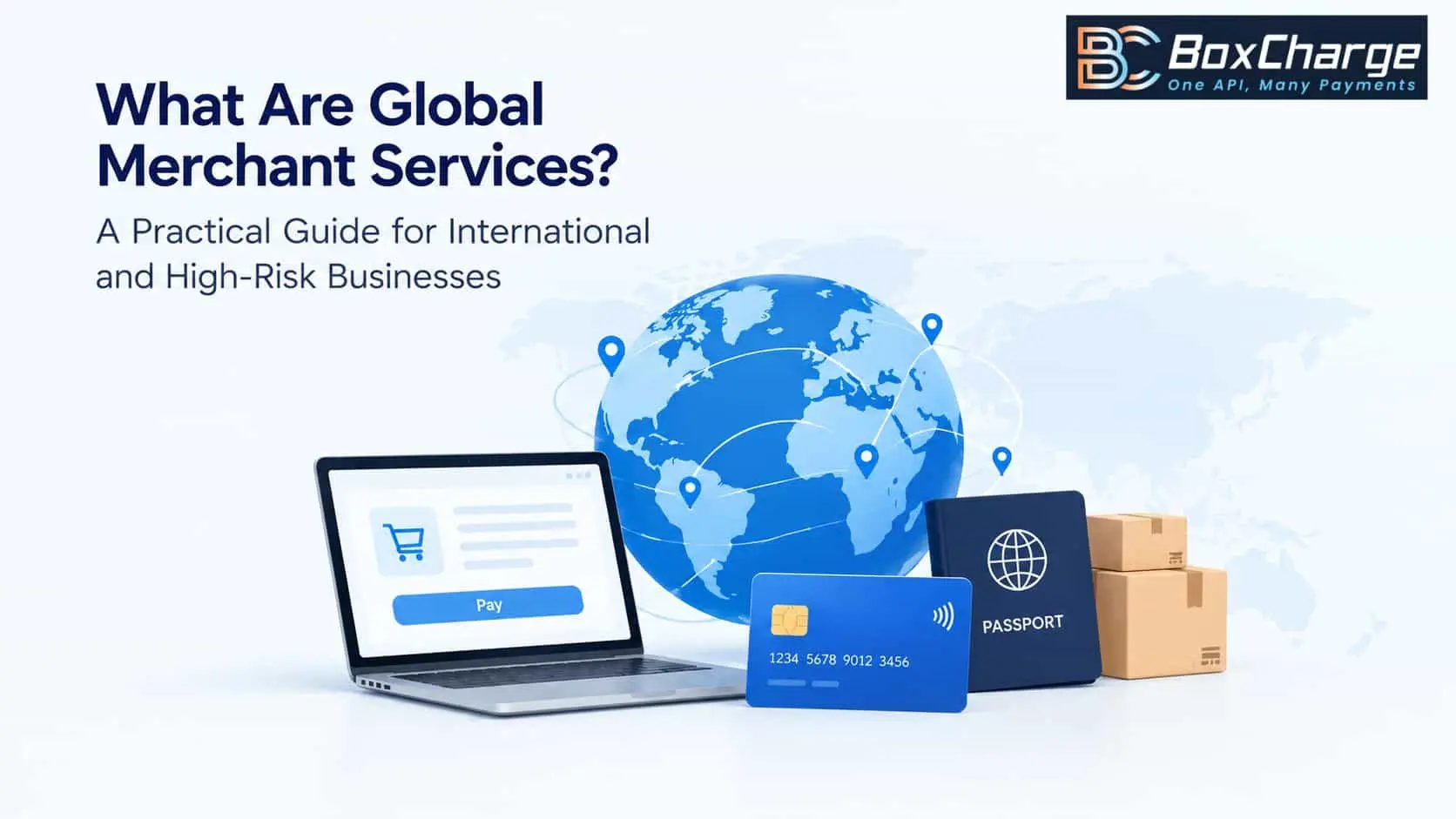
Global merchant services are payment solutions that help businesses accept, process, manage, and settle payments from customers in different countries and currencies. For an international business, this can involve merchant accounts, payment gateways, acquiring banks, local payment methods, multi-currency processing, fraud controls, chargeback management, and cross-border settlement.
As online commerce becomes increasingly international, simply having a payment gateway is often not enough. Merchants selling across borders need payment infrastructure that can support different currencies, customer preferences, regulatory requirements, acquiring relationships, and risk profiles.
This becomes particularly important for high-risk merchants, who may face additional scrutiny, higher processing costs, rolling reserves, delayed settlements, limited acquiring options, or account closures when their payment setup does not properly match their business model.
What Are Global Merchant Services?
Global merchant services refer to the collection of financial and payment-processing services that allow a business to accept payments from customers in multiple countries.
Depending on the provider and business model, global merchant services may include:
International merchant accounts
Global payment gateways
Cross-border payment processing
Multi-currency payment acceptance
Credit and debit card processing
Local payment methods
Payment routing and optimization
Fraud and transaction monitoring
Chargeback management
Currency conversion and FX support
Merchant settlement and payouts
Risk and compliance support
The underlying objective is straightforward: help a business accept international payments while keeping the payment process reliable, compliant, and operationally manageable.
Visa describes global payment acceptance as requiring businesses to manage areas such as security, compliance, and relationships with payment partners. Mastercard similarly highlights the importance of localized payment methods, currencies, authorization performance, fraud management, and operational efficiency when merchants expand internationally.
How Do Global Merchant Services Work?
A typical international card transaction involves several participants rather than one payment company handling everything.
A simplified payment flow looks like this:
Customer → Payment Gateway → Acquirer/Processor → Card Network → Issuing Bank → Authorization → Settlement → Merchant
When a customer purchases from an international merchant, the transaction needs to be securely transmitted for authorization. The relevant acquiring and payment infrastructure then processes the transaction, while funds eventually move through settlement to the merchant.
For businesses operating in several markets, the process can become considerably more complicated.
A merchant may need to deal with:
Multiple currencies
Different payment methods
Different acquiring banks
Local regulatory requirements
Cross-border transaction costs
Foreign-exchange considerations
Fraud and chargeback exposure
Different authorization rates
Reconciliation across payment channels
That is why international payment processing is increasingly treated as part of a company's broader commercial infrastructure rather than simply a checkout feature.
Who Needs Global Merchant Services?
Global merchant services can be relevant to almost any business selling internationally.
1. International E-commerce Businesses
Online retailers can use global payment processing to accept payments from customers in different markets without forcing every customer through the same domestic payment experience.
Customers may prefer different cards, wallets, bank-based payment methods, or local alternatives depending on where they live.
A localized payment experience can therefore become an important part of international conversion.
2. SaaS and Digital Businesses
Software companies, subscription platforms, online services, and digital businesses often have customers distributed across several countries.
Their payment requirements can include:
Recurring billing
Multi-currency pricing
International card acceptance
Subscription payment recovery
Automated reconciliation
Cross-border settlement
A suitable payment infrastructure can reduce the operational burden associated with managing international recurring revenue.
3. Travel and Hospitality Businesses
Hotels, travel platforms, airlines, booking businesses, and related companies routinely process transactions involving customers from different countries.
These businesses can also face payment complexities created by:
Foreign currencies
Refunds
Cancellations
Pre-authorizations
Delayed fulfillment
Cross-border disputes
Global merchant services can help structure these payment flows around the business's actual transaction model.
4. Marketplaces and Platforms
Marketplaces have another layer of complexity because they may need to collect payments from customers while supporting sellers, suppliers, contractors, or other participants.
Depending on the structure, the platform may need payment collection, split payments, payouts, KYC/KYB processes, reconciliation, and international money movement.
5. High-Risk Businesses
This is where global merchant services become especially important.
Industries such as iGaming, online gambling, forex, CFDs, adult entertainment, nutraceuticals, supplements, digital goods, travel, and certain subscription businesses may receive additional underwriting scrutiny because of their chargeback exposure, regulatory requirements, transaction patterns, or business models.
A high-risk merchant therefore cannot always approach payment processing in the same way as a conventional low-risk retailer.
Why High-Risk Merchants Often Struggle With Payment Processing
For many high-risk businesses, the problem is not simply finding a payment gateway.
The bigger challenge is finding an acquiring arrangement that understands the merchant's industry, geography, transaction profile, expected volume, customer base, and compliance requirements.
High-risk account holders commonly worry about issues such as:
Account Approval
A merchant can spend weeks preparing corporate documents, processing history, ownership information, website details, and compliance documentation, only to discover that an acquiring partner does not support its industry or geography.
This makes high-risk merchant account approval very different from simply opening a standard business payment account.
Rolling Reserves
High-risk merchants may encounter reserve requirements designed to protect the acquiring side against future chargebacks, refunds, or other liabilities.
For a growing company, this can create a significant working-capital issue.
Revenue may be increasing while part of the processed funds remains unavailable for immediate business use.
Delayed Settlement
Cash flow is another major concern.
A business may successfully authorize customer payments but still have to wait for settlement or payout.
For merchants paying advertising costs, suppliers, employees, affiliates, or inventory expenses, unpredictable settlement timelines can create unnecessary pressure.
Chargebacks
High-risk merchants often have to pay close attention to chargeback ratios and dispute management.
A sudden increase in disputes can affect the merchant's acquiring relationship, processing conditions, reserves, and long-term account stability.
This is why payment fraud prevention, transaction monitoring, clear billing descriptors, customer-service processes, and dispute management should be considered part of the payment strategy.
Limited Acquiring Options
Some conventional providers may not support particular industries, countries, transaction types, or business models.
This can leave merchants searching for high-risk payment processors, offshore merchant accounts, international acquiring solutions, or multi-acquirer payment structures.
The important point is that "offshore" should not be confused with "unregulated." A legitimate international payment setup still requires appropriate due diligence, underwriting, KYC/KYB, AML controls, and transparent disclosure of the merchant's activities.
Why Local Payment Methods Matter
Global commerce is not simply about accepting Visa or Mastercard everywhere.
Customers often expect payment methods that are familiar in their own market.
Mastercard's current cross-border payment infrastructure emphasizes localized acceptance, local currencies, preferred payment methods, payment optimization, and operational visibility as businesses expand internationally.
This matters because an international customer may abandon a purchase if the checkout:
Displays an unfamiliar currency
Does not support their preferred payment method
Looks geographically inconsistent
Creates unnecessary authentication friction
Provides unclear payment or refund information
For merchants, local payment methods and global payment processing can therefore work together rather than being separate strategies.
Global Merchant Services vs. a Standard Merchant Account
A standard merchant account may be sufficient for a business that primarily sells within one country.
A globally active merchant may need considerably more.
Requirement | Standard Merchant Account | Global Merchant Services |
Domestic card acceptance | ✓ | ✓ |
International cards | Sometimes | ✓ |
Multiple currencies | Limited | ✓ |
Local payment methods | Limited | ✓ |
Cross-border acquiring | Limited | ✓ |
International settlement | Limited | ✓ |
Multi-market support | Limited | ✓ |
Advanced risk management | Varies | Often available |
Multiple acquiring relationships | Not always | May be supported |
The exact capabilities depend on the provider, acquiring banks, merchant category, countries served, and underwriting arrangement.
What Should Businesses Look for in a Global Merchant Services Provider?
Choosing a provider should involve more than comparing headline processing rates.
Geographic Coverage
Check whether the provider can actually support the countries where the business operates and where customers are located.
Industry Experience
A payment provider experienced with your business model may understand its transaction patterns, compliance requirements, and risk profile better than a generic processor.
This becomes particularly important for high-risk merchant accounts.
Multi-Currency Processing
If customers pay in multiple currencies, understand which currencies can be accepted, settled, converted, and reported.
Settlement Terms
Look beyond the advertised processing fee.
Review:
Settlement frequency
Reserve requirements
Payout currencies
Refund procedures
Chargeback fees
Cross-border costs
FX charges
Contract terms
Risk and Compliance Infrastructure
International payment processing requires accurate merchant information and appropriate compliance controls.
Mastercard notes that inaccurate information about a merchant's identity, location, or activities can create risks within the payment ecosystem.
Merchants should therefore be transparent about their products, jurisdictions, traffic sources, expected volumes, and transaction characteristics during onboarding.
Visa also maintains a Global Registry of Service Providers and advises merchants to conduct due diligence on payment-related service providers and their security/compliance status.
Global Merchant Services Are About More Than Accepting Payments
For an international business, payments affect much more than checkout.
They influence conversion, cash flow, customer experience, risk management, reconciliation, and expansion into new markets.
For high-risk merchants, the stakes can be even higher. A poorly structured payment setup can result in rejected transactions, excessive reserves, delayed settlements, unexpected account reviews, or difficulty maintaining processing continuity.
A more appropriate strategy is to build the payment infrastructure around the actual business.
That means considering:
Business model + risk profile + customer geography + currencies + payment methods + acquiring structure + compliance + settlement requirements.
Final Thoughts
The best global merchant services providers provide the payment infrastructure businesses need to sell internationally and manage cross-border transactions more effectively. They can include international merchant accounts, global payment gateways, multi-currency processing, local payment methods, acquiring, fraud management, chargeback support, and international settlement.
For mainstream businesses, the objective is usually smoother international expansion.
For high-risk merchants, the requirement is often more specific: finding payment infrastructure that can accommodate the business model while maintaining appropriate risk controls and reliable settlement access.
As international commerce becomes more localized and interconnected, merchants need to think beyond simply asking, "Can I accept credit cards?"
The more useful question is:
Can my payment infrastructure support where my customers are, how they want to pay, the risk profile of my business, and where I plan to grow next?
For businesses that answer that question carefully, global merchant services can become a core part of a sustainable international payment strategy.
Ready to Build a More Reliable Global Payment Setup?
Expanding into international markets is easier when your payment infrastructure is built around your business model, customer locations, currencies, and risk profile. Whether you need an international merchant account, multi-currency payment processing, or high-risk payment solutions, the right acquiring setup can help you accept payments with greater consistency and better control over your payment operations.
Talk to BoxCharge about your international payment requirements and explore a merchant processing solution designed for your business.